
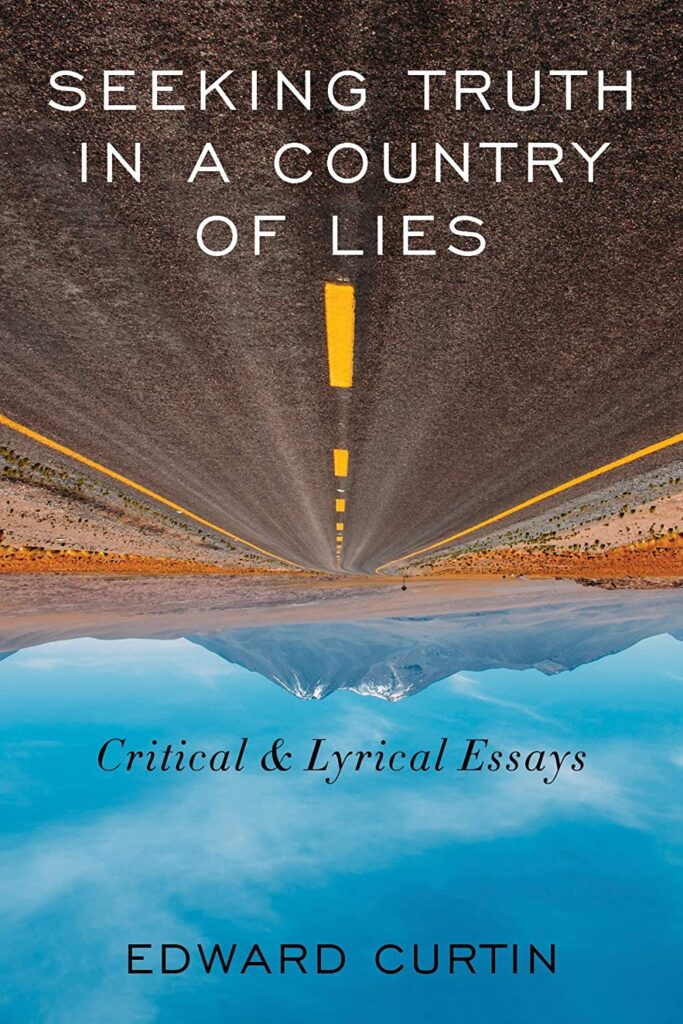
Nothing ever happened: A review of “Seeking Truth In A Country of Lies” by Edward Curtin

John Steppling

October 7, 2020

Some books demand slower reading than others. Ed Curtin’s new book is such a case. But then this assemblage of essays, many published elsewhere, is a corrective to the growing intoxication with technology, with the surveillance and the policing it is being used for, and to what Jonathan Crary wrote about in 24/7, a world where an artificial speed (or hurriedness) is layered over daily life: “Sleep is an uncompromising interruption of the theft of time from us by capitalism.” A corrective to the de-humanizing assault of capitalism.

Originally published at Off Guardian

This is a book that draws attention to what Curtin references (via James Douglass) as the *unspeakable* — the US capitalist order of crimes, from assassination to the continuing assault on the poor and marginalized. It is appropriate that the first chapter begins with a quote from Harold Pinter’s Noble Prize speech.

It never happened. Nothing ever happened. Even while it was happening it wasn’t happening. It didn’t matter. It was of no interest. The crimes of the United States have been systematic, constant, vicious, remorseless, but very few people have actually talked about them.”

This book is the unpacking of the delusion ridden world of contemporary America. And running through the pages of Curtin’s book is the metaphor of plague. Of course today is barely metaphorical at all. And so, the symbol carries even more resonance.

In that same first chapter Curtin writes…

One of the first things an authoritarian governing elite must do is to convince people that they are not free. This process has been ongoing for at least forty years. After the Church Committee’s revelations about the CIA in the mid-seventies, including its mind-control programs that left everyone appalled at the epiphany, a different tactic was added.

Now we have “experts,” social, psychological, and biological “scientists,” who repeat ad infinitum that there is no longer any mind control since we now know there is no mind; it is an illusion, and the residence of all intellect is the brain.

This is a particularly astute paragraph. And it dovetails with much of my recent writing.

The trend toward mechanistic, instrumental, and technologically modeled versions and explanations of reality is now not just the received wisdom, but it is increasingly etched in stone, and not to be questioned.

Curtin adds:

We have been interminably told that our lives revolve around our brains (our bodies) and that the answers to our problems lie in more brain research, drugs, genetic testing, etc. It is not coincidental that the US government declared the 1990s the decade of brain research, followed up with 2000-2010 as the decade of the behavior project, and our present decade being devoted to mapping the brain and artificial intelligence, organized by the Office of Science and Technology Project and more significantly, the Defense Advanced Research Projects Agency (DARPA).

The current Covid kabuki spectacle is testimony to the truth of what Curtain is describing, and to the long range implications for this sort of thinking. The human as a machine, and this delusion is reflected in Hollywood nearly every week.

In our current dystopia the appeal of being a robot in the making must have a great appeal, a promise to an end of humanness — something that currently feels as if it only brings pain and suffering with it.

In another related piece the poet Galway Kinnell is quoted from a poem titled “The Fundamental Project of Technology”:

To de-animalize human mentality, to purge it of obsolete,
evolutionary characteristics, in particular of death,
which foreknowledge terrorizes the content of skulls with,
is the fundamental project of technology;

There is a chapter devoted to the disappearance of silence in our modern world. A chapter devoted to the spiritual properties of the pencil. These are wonderful and beautiful reflections. (Most poets and playwrights I know have an almost fetishistic connection to the pencil so I was glad to see it given such a full treatment.)

In this sense, Curtin is a bit like America’s Gaston Bachelard.

Curtin catalogues the madness all around us, from the lies surrounding 9/11 to the lies sedimented in seventy years of deceit regarding the JFK assassination. He touches on current bits of grotesque charade, such as the appointment of Gina Haspel to head the CIA…

Thinking here in Rome of the Haspel vote, I am reminded of the “ratlines” organized by ex-CIA Director Allen Dulles and long-time Chief of Counterintelligence James Jesus Angleton.

These were escape routes for Nazi and fascist killers and torturers, so many of whom were brought to the United States and other countries after World War II through Italy to help the newly formed CIA torture the truth out of detainees and assassinate opponents.

Our post September 11 torture is nothing new. Is this what Haspel meant by “American values”? Many victims would attest to that.

Curtin is, in the best sense, a public intellectual. In many respects his work reminds me of everyone from Gore Vidal to Garry Wills to the writers of old Partisan Review.

Russell Jacoby wrote “we face the rise of a new intellectual class using a new scholasticism accessible only to the mandarins, who have turned their back on public life and letters.” And he added “The danger is that we have entered the era of one-stop thinking and instant commenting.”

One recognizes just how denuded the intellectual landscape really is when one is nostalgic about Edmund Wilson. Ed Curtin is a throwback in that sense, and I mean that as a compliment. But I also see Curtin as a voice not divorced from writers like James Baldwin.

Over the last, say, four decades the professionalization of opinion is in the hands of *influencers* and not really thinkers. And I see this all the time. People on social media will literally blather away in gibberish, heatedly debating topics about which they quite literally know nothing.

Curtin is also angry. And the anodyne professional academic is allergic to anger. So this is a wonderful antidote to the usual TED talk circuit.

There is a timely piece on NBA star Kevin Love and his admission to struggling with anxiety. Curtin makes this into a rather profound meditation on American masculinity.

Perhaps my favorite chapter, though, is devoted to Hillary Clinton.

Following the bidding of her oligarchic backers in the hidden government, she has always been fervently eager to lend her immoral authority to the massacre of foreign peoples and the destruction of their central governments. Iraq, Syria, Afghanistan, Ukraine, Serbia, etc. — the list is as long as her moral turpitude is deep.

But as the Queen of Heartless is crowned and feted in the City of Brotherly Love, it is crucially important that we recall her role five years ago in the destruction of the African country that had the highest living standard on the continent, excellent health care, free education, good social services, etc. — Libya.

It is, along with Diana Johnstone’s full-length study of the psychopathic former secretary of state, the best portrait of this quintessentially American ghoul, and the suffering to be laid at her feet.

She was fully aware of developments in Libya from the start; knew that the rebels were Islamic militants armed and trained by the U.S., Britain, France, Egypt, Saudi Arabia, and UAE; knew that they summarily executed anyone they considered their enemies; knew that this war of lies was aimed at preventing Gaddafi from fulfilling his goal of economic independence, not just for Libya, but for the entire continent of Africa by introducing the gold dinar into Africa as common currency; knew, in short, that Libya had to be raped, its Central Bank destroyed, for its exploitation by western globalists.

Thus her boss, Obama, in August 2011, confiscated $30 billion from Libya’s Central Bank that Gaddafi had planned to use for the establishment of the African IMF and African Central Bank.

This is what Clinton termed “smart power at its best.” Under the pretext of “humanitarian intervention,” Clinton supported the killing of tens of thousands and the destruction of an independent country to serve her masters.

Paolo Sensini characterizes the Democratic presidential nominee perfectly: ‘Mrs. Clinton’s joyous exclamation on hearing the news of Gaddafi’s death sums up the recklessness and irresponsibility of an entire political class—an unrepentant class that has wreaked havoc around the world on a truly unprecedented scale’.

Ed Curtin is also a man who cares about culture. This is increasingly rare. I don’t even agree with all of his tastes (Terrance Malick for example) but I certainly appreciate there is someone out there writing about this stuff.

I am happy to read someone WITH taste…especially when writing from a place of erudition and seriousness.

There is an excellent piece on Frank Serpico. A piece that also forensically takes apart the troubling implications of modern manhood in the West. There are essays on the cell phone and on suicide. On cyberspace and on the CIA.

And Curtin draws on sources as diverse as Norman O. Brown, Gaston Bachelard, Lewis Carroll, Albert Camus, Rollo May, Marcuse and D.H. Lawrence.

There is a splendid valentine to Bob Dylan, too. Most of all, and in nearly every piece, there is Curtin’s distillation of contemporary experience under the aegis of our new dystopia.

Speed and panic go hand-in-hand in today’s fabricated world of engineered emergencies and digital alerts. “We have no time” is today’s mantra — “We are running out of time” — and while this mood of urgency has come to grip most people’s minds, deep thinking about why this is so and who benefits is in short supply.

I believe most people sense this to be true but don’t know how to extract themselves from the addictive nature of speed long enough to grasp how deeply they have been propagandized, and why.

This is a rare and uplifting book despite the litany of catastrophes Curtin addresses. Curtin is always clear that the problem is Capitalism, in the short form.

The dissolution of the USSR created the hole in intellectual energy that has been filled with a suffocating banality and marketed coercion.

The spiritual herein is the kind only those who reject institutional religion can provide. And I believe this book is so valuable because of the love Curtin has for genuine art and radical thought.

Culture matters in these pages, and that is something increasingly rare today.

It is not possible to recommend this book highly enough.

Seeking Truth in A Country of Lies by Edward Curtin is published by Clarity Press is available through their website and most major book sellers.

Originally published at Off Guardian

About Edward Curtin 

This image has an empty alt attribute; its file name is E-Curtin.jpg

Edward Curtin is a writer whose work has appeared widely. He teaches sociology at Massachusetts College of Liberal Arts.

If you liked this review and want more of this kind on The Transnational, please let us know here. Thanks!


Related Posts

Jan Oberg May 15, 2026 Go to this Fox News page and scroll the whole way down: President Donald Trump tells the world that his meeting with President Xi Jinping yielded a lot of very concrete political and economic results – of course, only where the Chinese side, according to him, agreed with him. He does not mention the Taiwan issue, but Secretary of State, Marco Rubio, says that it did not feature prominently in their talks and that the US policy on Taiwan has not changed. Then go to China Daily – or Global Times – and you will see that for the Chinese it is framework, principles, structure of cooperation etc. that matters – all embedded in the overall idea of “constructive bilateral relationship of strategic stability.” Nowhere is any concrete agreement or deal – all that Trump refers to – mentioned. At the general level, this gives you insights into the very different social...
The MIMAC – Military-Industrial-Media-Academic Complex – drives the world’s rampant militarism and wars without end. Here is a short reflection of how it works against all interests of humanity. #5 deals with why there is no real enemy or threat images/analysis. It’s all ex-post constructions. And, btw, theTFF Peace Pulse is now on Rumble.
Jan Oberg, TFF director April 9, 2026 I was recently invited to have a good, long talk about the world – and, of course, about peace too – with Boris Malagurski on his Weight of Chains Channel on YouTube. It was a real joy and seems to have been greatly appreciated by the viewers too. Mr Malagurski and I shall of course be grateful if you share this conversation in your circles – of course, only if you like what you see and hear 😉☮️ And remember that this one – like hundreds of others with TFF Associates – can be enjoyed at our TFF Video Collection.

Recent Articles

Tony Robinson October 4, 2026 Violence is easy to recognise when someone is being beaten, shot or killed. It becomes more difficult when nobody is holding a weapon. Poverty, discrimination, exploitation and repression can restrict a human life just as effectively, although they do so in very different ways and with very different consequences. Simply adding more categories to an ever-growing list of forms of violence does not really solve the problem. The more interesting question is what all these different situations have in common and why it makes sense to describe them using the same word. Human beings do not simply react to what happens around them. They remember the past, imagine things that do not yet exist, make plans and undertake projects. Workers organise because they imagine different working conditions; people migrate because they imagine another life somewhere else; social movements emerge because people refuse to accept the...
It’s a matter of principles, courage, vision and pulling together – while the militarist world is falling apart… Peter Langille October 3, 2026 “Here, then, is the problem which we present to you, stark and dreadful and inescapable: Shall we put an end to the human race; or shall mankind renounce war?”The Bertrand Russell—Albert Einstein Manifesto, July 9, 1955 ⁕ The forecast for what’s ahead is worrisome. The sharp rise in armed conflicts over the past three years is adding to what was already the highest level in over seventy years. Genocides, which should be prevented are supported. A shared climate emergency that jeopardises survival is ignored. Diverse polls now suggest that people are war-weary, worried and interested in a more effective United Nations. And, there are viable policy options for a more secure world! Yet governments are doubling-down, betting on more war and investing heavily. If current trends persist,...
Johan Galtung 1930-2024October 2015 Published here on October 3, 2026 Let us focus on Civilization for conflict analysis and remedies. Major forms of disorder use violence; war is state organized violence. The most belligerent states are the United States of America and Israel, both with civilization roots. National Evangelism, the US Protestant Christian civilization– more national than evangelical–justifies US warfare as exceptionalism of a people chosen by God, with a manifest destiny to run the world. Orthodox Judaism justifies Israeli warfare to conquer and expand from Nile to Euphrates as a religious right and duty to the Eternal One. The third most belligerent country, the UK, no longer believes it is God-chosen but chosen by the USA; not quite the same but something. But the root cause of global disorder lies in the Occident–with Islam–seeing itself as the single, universal civilization valid for all at all times, all others being...

TFF on Substack

Discover and subscribe to more peace materials on TFF Substack

Most Popular

Tony Robinson October 4, 2026 Violence is easy to recognise when someone is being beaten, shot or killed. It becomes more difficult when nobody is holding a weapon. Poverty, discrimination, exploitation and repression can restrict a human life just as effectively, although they do so in very different ways and with very different consequences. Simply adding more categories to an ever-growing list of forms of violence does not really solve the problem. The more interesting question is what all these different situations have in common and why it makes sense to describe them using the same word. Human beings do not simply react to what happens around them. They remember the past, imagine things that do not yet exist, make plans and undertake projects. Workers organise because they imagine different working conditions; people migrate because they imagine another life somewhere else; social movements emerge because people refuse to accept the...
It’s a matter of principles, courage, vision and pulling together – while the militarist world is falling apart… Peter Langille October 3, 2026 “Here, then, is the problem which we present to you, stark and dreadful and inescapable: Shall we put an end to the human race; or shall mankind renounce war?”The Bertrand Russell—Albert Einstein Manifesto, July 9, 1955 ⁕ The forecast for what’s ahead is worrisome. The sharp rise in armed conflicts over the past three years is adding to what was already the highest level in over seventy years. Genocides, which should be prevented are supported. A shared climate emergency that jeopardises survival is ignored. Diverse polls now suggest that people are war-weary, worried and interested in a more effective United Nations. And, there are viable policy options for a more secure world! Yet governments are doubling-down, betting on more war and investing heavily. If current trends persist,...
Johan Galtung 1930-2024October 2015 Published here on October 3, 2026 Let us focus on Civilization for conflict analysis and remedies. Major forms of disorder use violence; war is state organized violence. The most belligerent states are the United States of America and Israel, both with civilization roots. National Evangelism, the US Protestant Christian civilization– more national than evangelical–justifies US warfare as exceptionalism of a people chosen by God, with a manifest destiny to run the world. Orthodox Judaism justifies Israeli warfare to conquer and expand from Nile to Euphrates as a religious right and duty to the Eternal One. The third most belligerent country, the UK, no longer believes it is God-chosen but chosen by the USA; not quite the same but something. But the root cause of global disorder lies in the Occident–with Islam–seeing itself as the single, universal civilization valid for all at all times, all others being...
Read More
Living-Peace-Sign-Budapest-copy
Tony Robinson October 4, 2026 Violence is easy to recognise when someone is being beaten, shot or killed. It becomes more difficult when nobody is holding a weapon. Poverty, discrimination, exploitation and repression can restrict a human life just as effectively, although they do so in very different ways and with very different consequences. Simply adding more categories to an ever-growing list of forms of violence does not really solve the problem. The more interesting question is what all these different situations have in common and why it makes sense to describe them using the same word. Human beings do not simply react to what happens around them. They remember the past, imagine things that do not yet exist, make plans and undertake projects. Workers organise because they imagine different working conditions; people migrate because they imagine another life somewhere else; social movements emerge because people refuse to accept the...
b54a1f10-8c65-4f0b-9dd5-4abc0a7d04cc_2659x2659
It’s a matter of principles, courage, vision and pulling together – while the militarist world is falling apart… Peter Langille October 3, 2026 “Here, then, is the problem which we present to you, stark and dreadful and inescapable: Shall we put an end to the human race; or shall mankind renounce war?”The Bertrand Russell—Albert Einstein Manifesto, July 9, 1955 ⁕ The forecast for what’s ahead is worrisome. The sharp rise in armed conflicts over the past three years is adding to what was already the highest level in over seventy years. Genocides, which should be prevented are supported. A shared climate emergency that jeopardises survival is ignored. Diverse polls now suggest that people are war-weary, worried and interested in a more effective United Nations. And, there are viable policy options for a more secure world! Yet governments are doubling-down, betting on more war and investing heavily. If current trends persist,...
010
Johan Galtung 1930-2024October 2015 Published here on October 3, 2026 Let us focus on Civilization for conflict analysis and remedies. Major forms of disorder use violence; war is state organized violence. The most belligerent states are the United States of America and Israel, both with civilization roots. National Evangelism, the US Protestant Christian civilization– more national than evangelical–justifies US warfare as exceptionalism of a people chosen by God, with a manifest destiny to run the world. Orthodox Judaism justifies Israeli warfare to conquer and expand from Nile to Euphrates as a religious right and duty to the Eternal One. The third most belligerent country, the UK, no longer believes it is God-chosen but chosen by the USA; not quite the same but something. But the root cause of global disorder lies in the Occident–with Islam–seeing itself as the single, universal civilization valid for all at all times, all others being...
Screenshot 2026-10-02 011738
Jan ObergPhD, director, The Transnational Foundation for Peace and Future Research, TFFLund, Sweden October 2, 2026 This is my full original manuscript. The Chinese Academy of Social Science, CASS, makes two publications out if it. 1. China’s Five-year plan emphasized the capabilities of basic research and original innovation. It is regarded as the goal of the future social development, which, as required, should be significantly enhanced. Can you comment on the importance of original innovation in research and academic study? I believe it is easier to define “original innovation” in the natural sciences than in social sciences. The breaking points of what constitutes something new, or innovative, are not quite as sharp in the latter. But in both fields it is about opening up something that was closed, unseen, unexplored before – making manifest what was earlier latent. Innovations come in many forms and shapes – naming something that was not...
arctic-circle-map
The agreement is catastrophic both because of what it says and what it doesn’t mention. It reduces further the major asset of security policies: Freedom of action. Jan Oberg TFF director September 25, 2026 A couple of hours before the agreement was signed on September 22, 2026, I published the following 13 hypotheses about what it would most likely contain on TFF Substack (in English). I was wrong on only the first point. Contrary to what Trump had written on his Truth Social platform, it does not appear to come into force immediately. In fact, it turned out to be worse than even I had anticipated. After these hypotheses now come a number of reflections in light of what the agreement actually contains, and does not contain, as well as the way in which it has generally been presented by major media outlets and by the public-service broadcaster DR. My...
girl-5894831_1280
Below are TFF-related media mentions, comments, videos and social media posts published elsewhere but not on this homepage. We happen to catch and list only a fraction. Regarding video comments and debates, we recommend that you go to the TFF Video Channel on Substack where many of them are reproduced. Jan Oberg is a contributor to China Daily – 52 million daily clicks – and Global Times, CGTN and CCTV (the national television), China Investment, Xinhua News Agency and several others. Articles and videos on these media very often multiply into countless Chinese (and Western media) that re-post them from these main media. Thanks to The China Academy, his analyses, interviews and comments are frequently posted on YouTube channels such as Thinkers Forum and Wave Media. These videos are often re-posted on Bilibili (China’s YouTube), the China Content Center on TikTok, and on the Chinese edition of TikTok, Douyin.com. This means reaching hundreds of millions of viewers worldwide over a year. While there are too many to catch on all these...



