Nominate someone for the Livia Prize for nonviolent conflict-resolution


The Livia Foundation was initiated by The Danish Centre for Conflict Resolution with an aim to enhance its efforts to directly address conflicts in societies through nonviolent interventions – in Denmark and beyond.

The name LIVIA refers to the olive twig, an ancient symbol of ‘approaching peacefully’. Also, at the end of the biblical flood, a dove returned to Noah’s Ark with the twig from an olive tree to signify ‘end of troubles’.

The Livia Foundation aims to create hope by promoting nonviolent conflict resolution in the world:

• making visible all the courageous, nonviolent efforts in evidence on all continents;
• supporting projects and individuals who demonstrate that severe social conflicts can be efficiently resolved through a wealth of ideas and dialogue;
• inspiring politicians, media, organizations and the general public to apply constructive, nonviolent approaches to conflict resolution
• creating conflict preparedness, locally and internationally Economy and organization

The LIVIA Foundation has raised app. DKK 700.000 or well over US$ 100.000. The bulk of these funds is spent on awards and other events, while DKK 250.000 is tied up as the foundation’s statutory capital in the Merkur Bank.

The capital comes from personal donations, from the author fees of the book ‘Conflict and Contact’, from foundations and from the Centre for Conflict Resolution.

The Livia Foundation is a civic, non-political, non-religious, non-profit initiative. We work to promote new ways to support creative, constructive nonviolent conflict resolution.

The foundation is headed by its Board assisted by a large number of active persons, who are particularly active around the prize awards. All are volunteers.

More about Livia and who has been awarded its Prize earlier here.

The worldwide examples of nonviolent action are admirable, but only rarely do they reach the front pages of the media.

This is where the Livia Foundation is working to make a difference:

We will make the life-affirming ideas and solutions known to a larger public, by drawing attention and giving a voice to people working within creative conflict resolution.

Else Hammerich, TFF Associate and former TFF Board member, has been in the forefront of both the Centre’s and the Livia Foundation’s establishment and TFF is proud to help promote knowledge about it and identifying the best possible candidates for the Livia Prize.

See at the end of this presentation how you may nominate someone for this prestigious Prize.


New activities 2015-2016

2015: A follow-up cooperative project with Mobaderoon, with CfK Ung (young members of Centre for Conflict Resolution).

March 2016: A four-day workshop for representatives of Mobaderoon, nonresident Syrian refugees, and Danes (March 2016) about active citizenship.
This was organized with ‘Globally Connected’, and CfK Ung with economic support of DKK 60,000.00 from KVINFO (The Danish Centre for Research and Information on Gender, Equality, and Diversity).

November 2016: Stories of Hope Conference at Global Platform in Copenhagen.
Participants: Former Prize awardees and nominees + active conflict workers from Denmark and abroad.
Prize-awarding ceremony and –feast on November 28th as a finale to the Stories of Hope Conference.

The Livia Foundation Board as of January 2016
Poul Erik Christoffersen (Chairman), Kirsten Ronnow Due (Deputy Chairman), Else Hammerich, Suzi Lyng Hansen, Jens Hyldahl, and Canan Atici.


The Livia Foundation urges you to help nominate a candidate

And here is how:

The Prize is awarded persons or groups who strive to handle conflicts in society with courage, creativity and nonviolence. We honour people, who will inspire and bring hope to others.

Do you know of someone who are approaching conflicts in society with creativity, wisdom, sensitivity, action and nonviolence? Then the Livia Foundation needs your advice.

The Livia Foundation is hosting an Award ceremony November 28th 2016. The ceremony takes place in Copenhagen in cooperation with the Danish Centre for Conflict Resolution. The Livia Award Recipient will be invited to Copenhagen to receive the award and participate in related events and press activities

We will nominate eight persons or groups and among these nominees two Award Recipients will be selected, one international and one from Denmark. Please find the criteria for the Livia Awards below.

If you know of any such people or groups, please let us know as soon as possible. Choose your candidate, fill the enclosed questionnaire and send it by e-mail to the sender of this mail, using the return address.

Deadline for suggesting nominees is: September 16th 2016.

By naming a nominee you contribute to demonstrating peaceful ways of dealing with conflicts in society. You help bring stories into the spotlight that bring inspiration and hope to others.

Criteria for the Livia Prize

The Prize is awarded according to criteria of constructive conflict resolution, on the basis of professional principles for handling conflicts:

• to create possibilities of genuine communication between adversaries and enemies
• to maintain contact with the adversary and insist on negotiation / dialogue
• to spot an escalation at an early stage and take steps to relaxation of destructive conflicts
• to create turnings-points in escalated conflicts and make contact and negotiation possible

• to fight for one’s truth without violence
• to support the parties after a conflict, that they can exist together, heal the wounds and come closer to a reconciliation
• to construct a workable preparedness for constructive conflicts handling in local communities

The Livia Awards are given to people, who live by these principles in societal conflicts and who – with surprising creativity and courage – when all hopes seem blocked, create ways to transform conflicts into new possibilities.


How you nominate persons or groups for the Livia Prize

We need the following information from you:

1. Name of the person or organisation you want to promote.
2. Short motivation and how it meets our criteria.
3. If possible, some documentation of the activity or project that has been carried out and merits the Prize.
4. Contact details to the nominated person(s) and organisation – email, phone, postal address, website.
5. Who you who nominate are – your name, phone number e-mail address and relation (if any) to the person or organisation you promote.

Please send this information to:

Jan Oberg, TFF director
to: tff@transnational.live

And, again, the deadline this year is September 16, 2016



PhD, Peace & future researcher + ‌Art Photographer, Professor Emeritus and media commentator

Related Posts

Jan Oberg, TFF director April 28, 2026 In this third TFF Peace Pulse, I make the important distinction between the violence and the conflict that violence is a symptom of. If you want peace, focus on the underlying conflict because that is the key to resolution, peacemaking, and a better future for the parties. The West is obsessed with violence, just look around you – and 90+ per cent of the public debate is about military issues and other violence – totally wasted for peace. These Peace Pulses will only be published here a few times. You will also not find them on YouTube and Vimeo because both platforms have blocked TFF and me; you know, peace is dangerous these days. Most TFF’s videos since 2007 are now on Rumble.
Photos © TFF 2000 Read PressInfo 90 “Lift the Sanctions and Bring More Aid to Yugoslavia” See Pictures from Belgrade © TFF 2000 Please reprint, copy, archive, quote or re-post this item, but please retain the source.
By Jan ObergTFF co-founder and director February 11, 2026 PART 3 — ECONOMICS, TRADE & FINANCIAL SOVEREIGNTY A. Trade Measures & Market Signaling Economic pressure can be applied instantly and scaled without violence. Immediate Measures (within a week) Government boycott US goods and services  A very powerful signal which over time will be felt. Targeted tariffs on selected U.S. goods Symbolic but high-visibility sectors send a clear message. Suspend trade facilitation talks A peaceful pause that signals deep concern. Freeze U.S. participation in public procurement – military procurement in particular A nonviolent way to reduce influence. Competition law review of U.S. corporations A legal tool to scrutinise market dominance. Longer-Term Measures EU–Asia–Africa trade corridors Reducing reliance on U.S. markets. European supply chains for critical minerals Strategic autonomy in resource access. European Strategic Trade Authority Monitoring coercive practices globally. Euro-denominated commodity markets Weakening the dollar’s pricing monopoly. The EU must resume contacts and negotiations with Russia, focusing on energy cooperation To...

Recent Articles

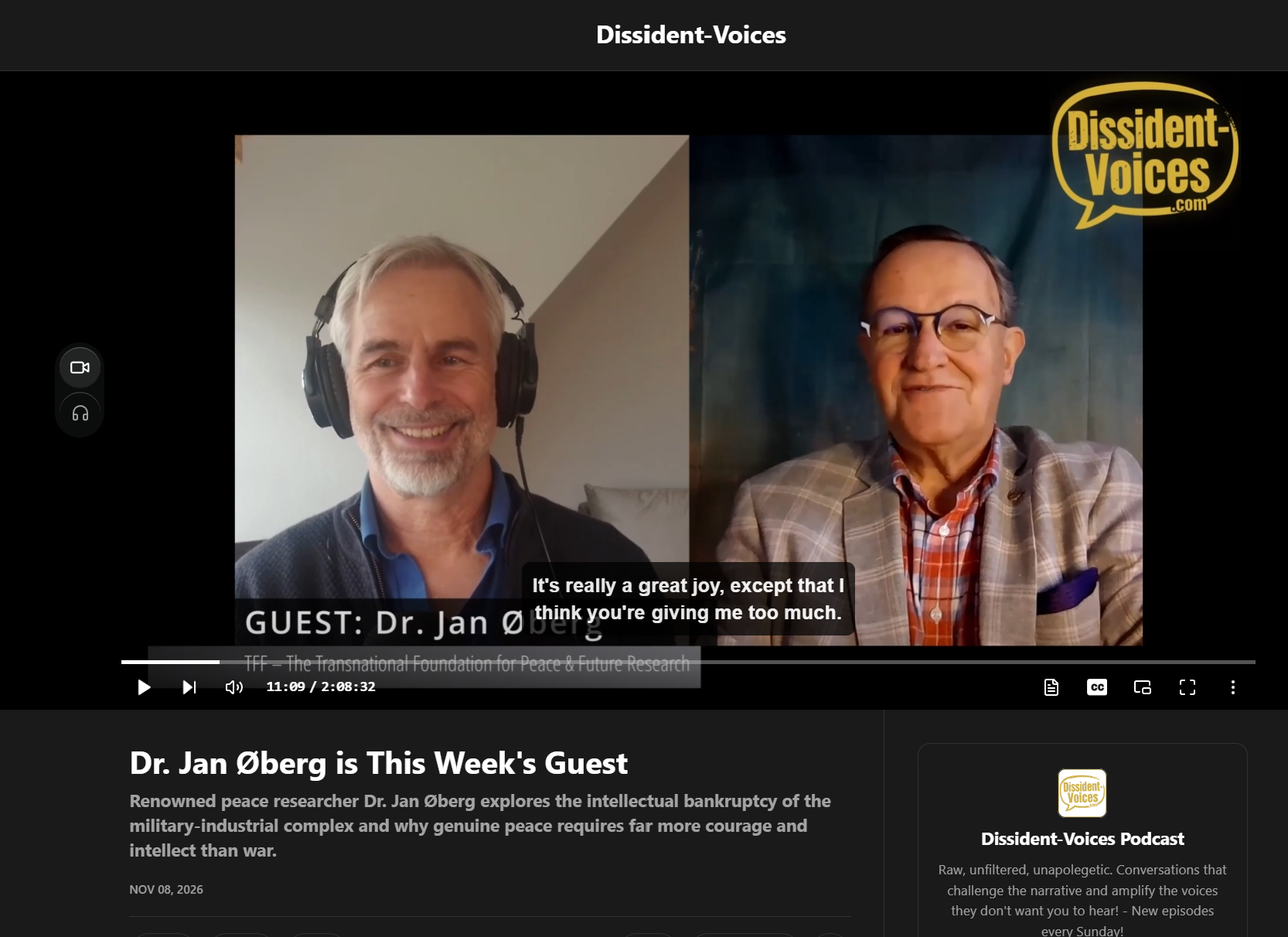
Serious but also a lot of laughs and positive energy. Because peace is also about conviviality and enchantment… Jan Oberg, TFF director November 16, 2026 This is a long (129 minutes) conversation with me. We cover very many, also personal, issues that makes a somewhat unusual media event. I am very grateful to Flemming Blicher for giving me this opportunity. I can’t remember any channel or editor who spent as much time as he did preparing it – including also asking me to answer a series of pre-interview questions, which are now posted under the conversation. If you sympathise with its content, please share it. Watch it here
A Message from Jan Oberg November 6, 2026 Over the past fifty years, I have devoted roughly 175,000 hours to research and public education for a more peaceful world: thinking, researching, writing, organising, publishing, debating, maintaining websites, corresponding, reaching out, leading a foundation, work in conflict and war zones, professorships, teaching courses and giving public lectures and doing media work. In short, ten hours a day, seven days a week, for half a century. The focus was on international political peace – analysing and trying to stop wars, address underlying conflicts and making alternative peace plans – at the desk and on the ground. Important as that has been and remains, it is only one kind of peace and it is now in a tragic militarist state compared with what it could have been.  Lately, however, I have found myself thinking about a concept from economics as well as everyday...
Photo above: Carl Fredrik Reuterswärd’s Non-Violence outside UN Headquarters in New York. Kirill Levin, CC BY-NC-SA 2. Jan Oberg November 3, 2026 I am happy to be published in Horizons which is produced by the Center for International Relations and Sustainable Development, CIRSD, in Belgrade. My contribution brings out a radical re-thinking of what concepts such as defence, security, deterrence – and peace – may mean if we want to create a more peaceful world. It also summarises a few things I have been working with the last few decades. Please read it here Og her er den på dansk, takket være Johnny Baltzersens lynhurtige oversættelse

TFF on Substack

Discover and subscribe to more peace materials on TFF Substack

Most Popular

Serious but also a lot of laughs and positive energy. Because peace is also about conviviality and enchantment… Jan Oberg, TFF director November 16, 2026 This is a long (129 minutes) conversation with me. We cover very many, also personal, issues that makes a somewhat unusual media event. I am very grateful to Flemming Blicher for giving me this opportunity. I can’t remember any channel or editor who spent as much time as he did preparing it – including also asking me to answer a series of pre-interview questions, which are now posted under the conversation. If you sympathise with its content, please share it. Watch it here
A Message from Jan Oberg November 6, 2026 Over the past fifty years, I have devoted roughly 175,000 hours to research and public education for a more peaceful world: thinking, researching, writing, organising, publishing, debating, maintaining websites, corresponding, reaching out, leading a foundation, work in conflict and war zones, professorships, teaching courses and giving public lectures and doing media work. In short, ten hours a day, seven days a week, for half a century. The focus was on international political peace – analysing and trying to stop wars, address underlying conflicts and making alternative peace plans – at the desk and on the ground. Important as that has been and remains, it is only one kind of peace and it is now in a tragic militarist state compared with what it could have been.  Lately, however, I have found myself thinking about a concept from economics as well as everyday...
Photo above: Carl Fredrik Reuterswärd’s Non-Violence outside UN Headquarters in New York. Kirill Levin, CC BY-NC-SA 2. Jan Oberg November 3, 2026 I am happy to be published in Horizons which is produced by the Center for International Relations and Sustainable Development, CIRSD, in Belgrade. My contribution brings out a radical re-thinking of what concepts such as defence, security, deterrence – and peace – may mean if we want to create a more peaceful world. It also summarises a few things I have been working with the last few decades. Please read it here Og her er den på dansk, takket være Johnny Baltzersens lynhurtige oversættelse
Read More
Screenshot 2026-11-10 174455
Serious but also a lot of laughs and positive energy. Because peace is also about conviviality and enchantment… Jan Oberg, TFF director November 16, 2026 This is a long (129 minutes) conversation with me. We cover very many, also personal, issues that makes a somewhat unusual media event. I am very grateful to Flemming Blicher for giving me this opportunity. I can’t remember any channel or editor who spent as much time as he did preparing it – including also asking me to answer a series of pre-interview questions, which are now posted under the conversation. If you sympathise with its content, please share it. Watch it here
AbstractVision_2017_#1_800 (kopia)
A Message from Jan Oberg November 6, 2026 Over the past fifty years, I have devoted roughly 175,000 hours to research and public education for a more peaceful world: thinking, researching, writing, organising, publishing, debating, maintaining websites, corresponding, reaching out, leading a foundation, work in conflict and war zones, professorships, teaching courses and giving public lectures and doing media work. In short, ten hours a day, seven days a week, for half a century. The focus was on international political peace – analysing and trying to stop wars, address underlying conflicts and making alternative peace plans – at the desk and on the ground. Important as that has been and remains, it is only one kind of peace and it is now in a tragic militarist state compared with what it could have been.  Lately, however, I have found myself thinking about a concept from economics as well as everyday...
knotted gun
Photo above: Carl Fredrik Reuterswärd’s Non-Violence outside UN Headquarters in New York. Kirill Levin, CC BY-NC-SA 2. Jan Oberg November 3, 2026 I am happy to be published in Horizons which is produced by the Center for International Relations and Sustainable Development, CIRSD, in Belgrade. My contribution brings out a radical re-thinking of what concepts such as defence, security, deterrence – and peace – may mean if we want to create a more peaceful world. It also summarises a few things I have been working with the last few decades. Please read it here Og her er den på dansk, takket være Johnny Baltzersens lynhurtige oversættelse
TFFPortfolioVign
UNITE-tillid, DREAM-velstand og andre konstruktive komponenter Normally we publish articles in English here. But this is a translation of a very important TFF document that should reach as many as possible in Denmark since this country’s government has been one of the most hardline in Europe and, up till now at least, has refused to use diplomacy and, instead, spent tremendous sums on arming Ukraine with the express goal of defeating Russia. Thus this – unique – article is in Danish. Vi er Johnny Baltzersen og hans Fælles Sikkerhed – Fælles Fremtid på Substack overmåde taknemmelige for at have oversat og publiceret TFF’s 2025-portfølje for fredsidéer med henblik på Ukraines fremtid. Vi håber den nu kan nå mange flere danskere – som også vil sprede den og skabe debat – nu den danske regerings og folketingspartiernes politik på dette område siden 2022 står nu – forudsigeligt – ved vejs ende....
JoGSS-Silent
Jan Oberg TFF director October 28, 2026 Exactly one month has now passed since I published my criticism of the introduction to the special issue on Johan Galtung published by the Journal of Global Security Studies, JoGSS, and of Tor Egil Førland’s chapter about Galtung which serves as a preview to his forthcoming biography of Galtung to be published by PRIO. See the original on The Transnational here and the same article on TFF Substack with many general and critical comments and, in particular, the people who decided to withdraw from the biography project in protest. The special issue itself was extraordinary. It was devoted to the intellectual legacy of one of the founders of peace research and contained a number of strong assessments of his personality, scholarship, intellectual trajectory, and public role. Such assessments are, of course, entirely legitimate. No scholar is beyond criticism, and neither was Johan Galtung....
Screenshot 2026-10-26 115647
An aspect of Iran’s culture and civilisation you’ve probably never heard about. Don’t be surprised if the US and Israel also try to bomb them. Jan ObergTFF director October 26, 2026 Today – under the “USraeli” threat of new “annihilating” bombings – opens the 7th International Conference on Peace and Conflict Resolution at Tehran’s University. As far as I can tell, this is the only permanent, advanced peace research institution in West Asia/the Middle East. Perhaps more countries in that region could be inspired? I mean, how many military “security” institutes and military academies do they have? Many peace research institutes and university departments have been established since the 1950s in the West. They are now all under attack; some have closed down, some have gone mainstream, yet others kept the name but do nothing to research peace and disseminate results or advice; instead, they cooperate with militarism’s platforms such...