
NATO’s Expansion Into Asia Is the Mother of Bad Ideas

Branko Marcetic

September 15, 2023

A little over a century ago, rising inter-imperial tensions coupled with a complicated, evidence board–like set of alliances pulled Europe into the most disastrous, pointless war the world had ever seen up to then, World War I. Today, a ’roided-up version of that scenario is looming, as US-China relations deteriorate and the NATO alliance begins to dip several toes in Asia, nearly six thousand miles away from its headquarters in Brussels.

Originally published at Jacobin on July 29, 2023

This isn’t an exaggeration. Asked recently at a joint appearance on Meet the Press whether NATO’s expansion into Asia was “inevitable,” Senators Tammy Duckworth (an Illinois Democrat) and Dan Sullivan (an Alaska Republican) answered yes.

“Oh, I think it is,” said Sullivan.

“I agree with my friend,” said Duckworth.

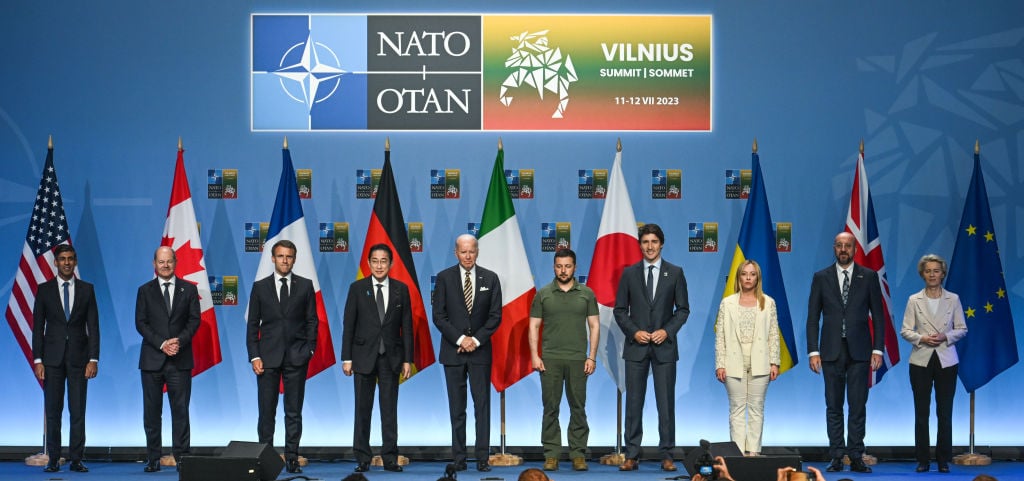
They had good reason to say so. The official communiqué from this year’s NATO summit in Vilnius mentioned China more than a dozen times — a step up from its Madrid Summit declaration last year, which mentioned China only once.

Its Brussels Summit communiqué the year before, considered quite hawkish at the time, warned that Beijing’s policies “can present challenges” but called for constructive dialogue and engagement. While the alliance’s 2010 Strategic Concept discussed only Russia, its 2022 iteration mentioned China nine times. A variety of establishment players, from influential lunatic John Bolton and the Brookings Institution to long-serving former US foreign policy officials, are among those who have written favorably about the idea.

But it’s not just words. Three years after the alliance for the first time invited its “Indo-Pacific partners” — Australia, New Zealand, Japan, and South Korea, alongside now–newly minted NATO members Finland and Sweden — to take part in a foreign ministerial meeting to discuss China’s rise, the four countries attended a NATO summit this year for the second time in a row.

All four had previously signed their own distinct Individual Partnership and Cooperation Programme agreements with NATO, and these invites are meant to further integrate into the alliance even as they remain outside it. Meanwhile, for months member states talked about opening a NATO liaison office in Tokyo, blocked for now thanks to French objections, though certain to land on the agenda again later.

“What happens in the Euro-Atlantic region matters for the Indo-Pacific, and what happens in the Indo-Pacific matters to the Euro-Atlantic,” NATO secretary general Jens Stoltenberg said at Vilnius, an echo of similar comments he’s made before. Stoltenberg has said that “security is no longer regional, security is global,” and finds that “this idea that we can say that China doesn’t matter for NATO is wrong.”

To that end, NATO “seek[s] new relationships with countries across Latin America, Africa and Asia,” he explained, for “as autocratic regimes draw closer to one another, those of us who believe in freedom and democracy must stand together.”

NATO, it seems, will have to have not just a footprint in Asia, but eventually other continents far, far away from the European territory that all of its member states sit on. First conceived as Western Europe’s line of defense should the Soviet military sweep its way across the continent, the alliance’s mission appears to have evolved to fighting for democracy all over the world against the menace of autocracy. (Well, some autocracies, anyway.)

An Age-Old Dilemma

The danger of NATO’s creep into Asia is not that it’s actually going to add any of these countries as members. The NATO charter is explicit that new members can only come from Europe, and that only attacks in Europe and North America (as well as some of its members’ overseas colonies) qualify under its collective defense clause.

But the tragic events in Ukraine show how, even without becoming an official member, a state’s growing closeness — and, more importantly, military interoperability — with the alliance can sour relations and provoke rival, nationalistic governments to do rash and terrible things in a time of rising tensions, as part of a classic security dilemma.

According to Senator Duckworth herself, the nominally non-NATO quasi-alliances in the Asia-Pacific like the Quad that the United States has been building up are part and parcel of the alliance’s move into the region. Explaining why she thought that NATO’s expansion into Asia was “inevitable,” she told NBC’s Chuck Todd that “it already has started to do that with our successful AUKUS agreement between the UK, Australia, and the United States.”

Regardless of how those pushing for the move see their own actions, the rival powers in the region — namely China, North Korea, and Russia — have made clear their unhappiness with the idea, with Beijing threatening a “resolute response” should NATO move into the neighborhood. All three are increasing their own military and political cooperation partly as a response to Washington shoring up its own alliances.

What’s needed is a little bit of strategic empathy: the ability to put ourselves in the shoes of other countries and try and understand how our actions look from their eyes. There are rational reasons why China might look at the growing US military presence near its shores and see a threat.

The US government is the most aggressive state in the world, responsible for more than five hundred foreign military interventions since its founding, with more than a third of these taking place after 1999 — long after the Cold War was over, in other words — with just six of its post-9/11 wars alone accounting for 4.5 million deaths. NATO itself has multiple times served as the tip of the spear for US-led wars and regime-change operations, as in Afghanistan and Libya.

It’s also not just US adversaries that are alarmed by this possible NATO expansion. Though the press frames the existence of the alliance’s four Indo-Pacific partners as evidence that the region is “embracing” NATO, polling shows a great deal of ambivalence in Asian countries toward US-led alliances in the region if they’re meant as anti-China instruments.

In fact, among both leaders and ordinary people in Asia, the biggest concern is being caught in the middle of a US-China conflict, one that locals understand US actions play a role in stoking.

An Old Idea for a New Conflict

For many years, the idea of NATO merely expanding further and further into eastern Europe was a subject of controversy. All of a sudden, the alliance is pushing to leap into an entirely different continent, and there’s hardly even a debate. How did we get here?

NATO’s expansion into Asia isn’t a new idea. It was all the way back in June 1990, months after the fall of the Berlin Wall, that Japan, with eager US assent, for the first time sat down with alliance officials to explore how to expand their security cooperation. Echoing its later opposition to a Tokyo office for NATO, France boycotted the meeting, complaining that it violated the alliance’s charter.

In 2007, retired colonel Joseph Núñez, then serving in civilian capacity in Iraq, called not so much for NATO’s expansion as its multiplication, specifically “a minimum of six” NATO clones for Africa, the Asia-Pacific, South Asia, the Middle East, and North and South America each.

“While states may have legitimate concerns about things like sovereignty, the alternative to constructive cooperation is the wildfire of anarchy,” he wrote.

The alliance’s end-of-history aimlessness drove this thinking, all the way up to Stoltenberg’s conception of NATO today as a worldwide arsenal of democracy. Without a compelling reason to exist after the end of the Cold War and the dissolution of the Soviet Union, the alliance looked for a new one, starting closer to home with its intervention in Kosovo, before moving into the Middle East and North Africa as part of George W. Bush’s “war on terror.”

So did the lucrative arms trade. The role of weapons manufacturers in fueling NATO’s original eastward expansion was key, but the alliance’s potential movement into a new continent today stands to be just as profitable for the sector, with Asia and Oceania now the largest region for arms imports, the latter largely due to Australia’s military buildup, and the United States as the region’s largest supplier.

Celebrating that US arms sales had shot up by nearly 50 percent in 2022 to $52 billion, a Pentagon official noted that “allies are looking at China and the situations with China in Asia, and thinking they need to increase their capabilities.”

It’s an open question whether NATO’s movement into Asia is even sustainable. Despite the shot in the arm the Russian invasion of Ukraine has given the alliance, member states are still lagging behind meeting their military spending commitments just for the sake of Europe’s defense.

That same war, meanwhile, has sparked countless complaints about weapons shortages among allies a year in, with even US officials fearing that battling Russia has so drained its arms stockpiles, it might jeopardize any future attempt to help Taiwan against a Chinese invasion.

This should cast serious doubt on the alliance’s ability to somehow operate in two separate continents against two powerful militaries, at least without a massively wasteful and pollutive arms buildup.

There are other costs. A war with China, even by proxy, would be incredibly destructive economically the world over — including for working Americans who, for all the official invective, rely on China as a major and growing trade partner. Militarily, a US-China war would be devastating for both countries, with even a recent war game that tips the United States to win forecasting massive losses on the US side, and warning of a “pyrrhic victory” where it would end up “suffering more in the long run than the ‘defeated’ Chinese.”

The best course of action is acting now to avoid this scenario before it happens — something that involves not just dialogue, but a willingness from Washington and allies to accept some limits to their military footprint.

Unfortunately, the Donald Trump–era debate around NATO and US foreign policy, coupled with a McCarthyite turn in political discourse that’s gone into overdrive since the Ukraine invasion, has made criticism of NATO virtually taboo in the United States and Europe.

And so, having failed to understand the role of US military expansion in helping lead to one disastrous war, we seem ready to repeat the same blunder all over again elsewhere.

About the author

Branko Marcetic is a Jacobin staff writer and the author of Yesterday’s Man: The Case Against Joe Biden.

Originally published at Jacobin on July 29, 2023

Please support TFF if you thought this article was useful!

Click here now. Thanks!

One Response

  1. The ONLY reason why all of this NATO garbage is happening is because the USA is determined to contain China. China’s rise threatens US global hegemony. It doesn’t matter that China’s rise is utterly peaceful (China has fought no wars since 1979). It doesn’t matter that China has threatened no country anywhere. China respects all nations and their sovereignty. China has legitimate maritime disputes in the South China Sea, just like Brunei, Indonesia, Malaysia, Philippines, and Vietnam. China has the legitimate right to protect its territorial integrity with respect to Taiwan. There is no conceivable reason for NATO to enter Asia.

Related Posts

The agreement is catastrophic both because of what it says and what it doesn’t mention. It reduces further the major asset of security policies: Freedom of action. Jan Oberg TFF director September 25, 2026 A couple of hours before the agreement was signed on September 22, 2026, I published the following 13 hypotheses about what it would most likely contain on TFF Substack (in English). I was wrong on only the first point. Contrary to what Trump had written on his Truth Social platform, it does not appear to come into force immediately. In fact, it turned out to be worse than even I had anticipated. After these hypotheses now come a number of reflections in light of what the agreement actually contains, and does not contain, as well as the way in which it has generally been presented by major media outlets and by the public-service broadcaster DR. My...
Jan Oberg May 15, 2026 Go to this Fox News page and scroll the whole way down: President Donald Trump tells the world that his meeting with President Xi Jinping yielded a lot of very concrete political and economic results – of course, only where the Chinese side, according to him, agreed with him. He does not mention the Taiwan issue, but Secretary of State, Marco Rubio, says that it did not feature prominently in their talks and that the US policy on Taiwan has not changed. Then go to China Daily – or Global Times – and you will see that for the Chinese it is framework, principles, structure of cooperation etc. that matters – all embedded in the overall idea of “constructive bilateral relationship of strategic stability.” Nowhere is any concrete agreement or deal – all that Trump refers to – mentioned. At the general level, this gives you insights into the very different social...
Jan Oberg, TFF director April 9, 2026 I was recently invited to have a good, long talk about the world – and, of course, about peace too – with Boris Malagurski on his Weight of Chains Channel on YouTube. It was a real joy and seems to have been greatly appreciated by the viewers too. Mr Malagurski and I shall of course be grateful if you share this conversation in your circles – of course, only if you like what you see and hear 😉☮️ And remember that this one – like hundreds of others with TFF Associates – can be enjoyed at our TFF Video Collection.

Recent Articles

Tony Robinson October 4, 2026 Violence is easy to recognise when someone is being beaten, shot or killed. It becomes more difficult when nobody is holding a weapon. Poverty, discrimination, exploitation and repression can restrict a human life just as effectively, although they do so in very different ways and with very different consequences. Simply adding more categories to an ever-growing list of forms of violence does not really solve the problem. The more interesting question is what all these different situations have in common and why it makes sense to describe them using the same word. Human beings do not simply react to what happens around them. They remember the past, imagine things that do not yet exist, make plans and undertake projects. Workers organise because they imagine different working conditions; people migrate because they imagine another life somewhere else; social movements emerge because people refuse to accept the...
It’s a matter of principles, courage, vision and pulling together – while the militarist world is falling apart… Peter Langille October 3, 2026 “Here, then, is the problem which we present to you, stark and dreadful and inescapable: Shall we put an end to the human race; or shall mankind renounce war?”The Bertrand Russell—Albert Einstein Manifesto, July 9, 1955 ⁕ The forecast for what’s ahead is worrisome. The sharp rise in armed conflicts over the past three years is adding to what was already the highest level in over seventy years. Genocides, which should be prevented are supported. A shared climate emergency that jeopardises survival is ignored. Diverse polls now suggest that people are war-weary, worried and interested in a more effective United Nations. And, there are viable policy options for a more secure world! Yet governments are doubling-down, betting on more war and investing heavily. If current trends persist,...
Johan Galtung 1930-2024October 2015 Published here on October 3, 2026 Let us focus on Civilization for conflict analysis and remedies. Major forms of disorder use violence; war is state organized violence. The most belligerent states are the United States of America and Israel, both with civilization roots. National Evangelism, the US Protestant Christian civilization– more national than evangelical–justifies US warfare as exceptionalism of a people chosen by God, with a manifest destiny to run the world. Orthodox Judaism justifies Israeli warfare to conquer and expand from Nile to Euphrates as a religious right and duty to the Eternal One. The third most belligerent country, the UK, no longer believes it is God-chosen but chosen by the USA; not quite the same but something. But the root cause of global disorder lies in the Occident–with Islam–seeing itself as the single, universal civilization valid for all at all times, all others being...

TFF on Substack

Discover and subscribe to more peace materials on TFF Substack

Most Popular

Tony Robinson October 4, 2026 Violence is easy to recognise when someone is being beaten, shot or killed. It becomes more difficult when nobody is holding a weapon. Poverty, discrimination, exploitation and repression can restrict a human life just as effectively, although they do so in very different ways and with very different consequences. Simply adding more categories to an ever-growing list of forms of violence does not really solve the problem. The more interesting question is what all these different situations have in common and why it makes sense to describe them using the same word. Human beings do not simply react to what happens around them. They remember the past, imagine things that do not yet exist, make plans and undertake projects. Workers organise because they imagine different working conditions; people migrate because they imagine another life somewhere else; social movements emerge because people refuse to accept the...
It’s a matter of principles, courage, vision and pulling together – while the militarist world is falling apart… Peter Langille October 3, 2026 “Here, then, is the problem which we present to you, stark and dreadful and inescapable: Shall we put an end to the human race; or shall mankind renounce war?”The Bertrand Russell—Albert Einstein Manifesto, July 9, 1955 ⁕ The forecast for what’s ahead is worrisome. The sharp rise in armed conflicts over the past three years is adding to what was already the highest level in over seventy years. Genocides, which should be prevented are supported. A shared climate emergency that jeopardises survival is ignored. Diverse polls now suggest that people are war-weary, worried and interested in a more effective United Nations. And, there are viable policy options for a more secure world! Yet governments are doubling-down, betting on more war and investing heavily. If current trends persist,...
Johan Galtung 1930-2024October 2015 Published here on October 3, 2026 Let us focus on Civilization for conflict analysis and remedies. Major forms of disorder use violence; war is state organized violence. The most belligerent states are the United States of America and Israel, both with civilization roots. National Evangelism, the US Protestant Christian civilization– more national than evangelical–justifies US warfare as exceptionalism of a people chosen by God, with a manifest destiny to run the world. Orthodox Judaism justifies Israeli warfare to conquer and expand from Nile to Euphrates as a religious right and duty to the Eternal One. The third most belligerent country, the UK, no longer believes it is God-chosen but chosen by the USA; not quite the same but something. But the root cause of global disorder lies in the Occident–with Islam–seeing itself as the single, universal civilization valid for all at all times, all others being...
Read More
Living-Peace-Sign-Budapest-copy
Tony Robinson October 4, 2026 Violence is easy to recognise when someone is being beaten, shot or killed. It becomes more difficult when nobody is holding a weapon. Poverty, discrimination, exploitation and repression can restrict a human life just as effectively, although they do so in very different ways and with very different consequences. Simply adding more categories to an ever-growing list of forms of violence does not really solve the problem. The more interesting question is what all these different situations have in common and why it makes sense to describe them using the same word. Human beings do not simply react to what happens around them. They remember the past, imagine things that do not yet exist, make plans and undertake projects. Workers organise because they imagine different working conditions; people migrate because they imagine another life somewhere else; social movements emerge because people refuse to accept the...
b54a1f10-8c65-4f0b-9dd5-4abc0a7d04cc_2659x2659
It’s a matter of principles, courage, vision and pulling together – while the militarist world is falling apart… Peter Langille October 3, 2026 “Here, then, is the problem which we present to you, stark and dreadful and inescapable: Shall we put an end to the human race; or shall mankind renounce war?”The Bertrand Russell—Albert Einstein Manifesto, July 9, 1955 ⁕ The forecast for what’s ahead is worrisome. The sharp rise in armed conflicts over the past three years is adding to what was already the highest level in over seventy years. Genocides, which should be prevented are supported. A shared climate emergency that jeopardises survival is ignored. Diverse polls now suggest that people are war-weary, worried and interested in a more effective United Nations. And, there are viable policy options for a more secure world! Yet governments are doubling-down, betting on more war and investing heavily. If current trends persist,...
010
Johan Galtung 1930-2024October 2015 Published here on October 3, 2026 Let us focus on Civilization for conflict analysis and remedies. Major forms of disorder use violence; war is state organized violence. The most belligerent states are the United States of America and Israel, both with civilization roots. National Evangelism, the US Protestant Christian civilization– more national than evangelical–justifies US warfare as exceptionalism of a people chosen by God, with a manifest destiny to run the world. Orthodox Judaism justifies Israeli warfare to conquer and expand from Nile to Euphrates as a religious right and duty to the Eternal One. The third most belligerent country, the UK, no longer believes it is God-chosen but chosen by the USA; not quite the same but something. But the root cause of global disorder lies in the Occident–with Islam–seeing itself as the single, universal civilization valid for all at all times, all others being...
Screenshot 2026-10-02 011738
Jan ObergPhD, director, The Transnational Foundation for Peace and Future Research, TFFLund, Sweden October 2, 2026 This is my full original manuscript. The Chinese Academy of Social Science, CASS, makes two publications out if it. 1. China’s Five-year plan emphasized the capabilities of basic research and original innovation. It is regarded as the goal of the future social development, which, as required, should be significantly enhanced. Can you comment on the importance of original innovation in research and academic study? I believe it is easier to define “original innovation” in the natural sciences than in social sciences. The breaking points of what constitutes something new, or innovative, are not quite as sharp in the latter. But in both fields it is about opening up something that was closed, unseen, unexplored before – making manifest what was earlier latent. Innovations come in many forms and shapes – naming something that was not...
arctic-circle-map
The agreement is catastrophic both because of what it says and what it doesn’t mention. It reduces further the major asset of security policies: Freedom of action. Jan Oberg TFF director September 25, 2026 A couple of hours before the agreement was signed on September 22, 2026, I published the following 13 hypotheses about what it would most likely contain on TFF Substack (in English). I was wrong on only the first point. Contrary to what Trump had written on his Truth Social platform, it does not appear to come into force immediately. In fact, it turned out to be worse than even I had anticipated. After these hypotheses now come a number of reflections in light of what the agreement actually contains, and does not contain, as well as the way in which it has generally been presented by major media outlets and by the public-service broadcaster DR. My...
girl-5894831_1280
Below are TFF-related media mentions, comments, videos and social media posts published elsewhere but not on this homepage. We happen to catch and list only a fraction. Regarding video comments and debates, we recommend that you go to the TFF Video Channel on Substack where many of them are reproduced. Jan Oberg is a contributor to China Daily – 52 million daily clicks – and Global Times, CGTN and CCTV (the national television), China Investment, Xinhua News Agency and several others. Articles and videos on these media very often multiply into countless Chinese (and Western media) that re-post them from these main media. Thanks to The China Academy, his analyses, interviews and comments are frequently posted on YouTube channels such as Thinkers Forum and Wave Media. These videos are often re-posted on Bilibili (China’s YouTube), the China Content Center on TikTok, and on the Chinese edition of TikTok, Douyin.com. This means reaching hundreds of millions of viewers worldwide over a year. While there are too many to catch on all these...




