
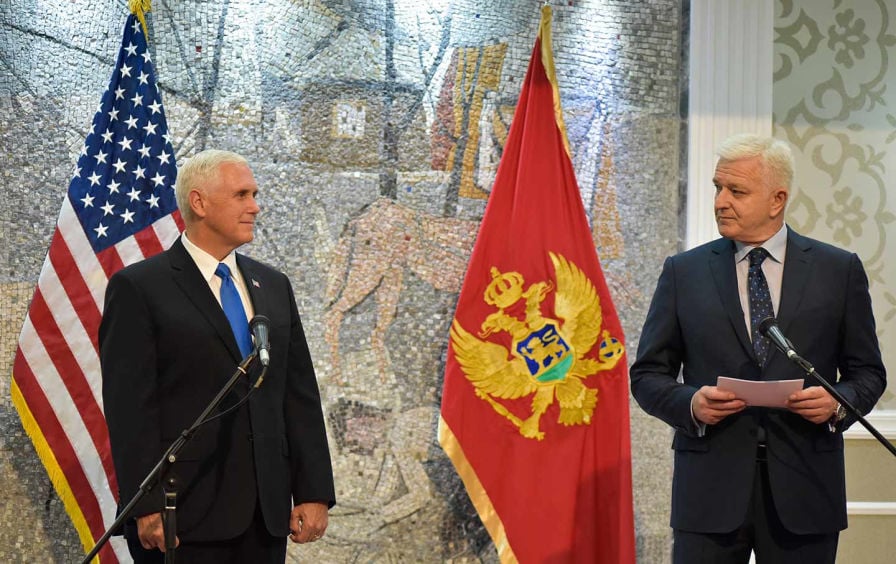
U.S Vice President Mike Pence, left, joined by Montenegro’s Prime Minister Dusko Markovic during a joint press conference in Villa Gorica in Podgorica, Montenegro on August 2, 2017. (AP Photo / Risto Bozovic)
Did Montenegro’s NATO accession increase the collective defense of the West or merely protect a corrupt regime?
When Fox News host Tucker Carlson recently asked President Donald Trump why the United States should defend Montenegro, Trump responded by saying that if Montenegrins decided to “get aggressive.… Congratulations, you’re in World War III.”
The subsequent outcry was predictable; a New York Times editorial quickly attacked Trump’s comments as revealing “another facet of his ignorance of and disdain for America’s historic place in the world and its alliances.”
Yet Trump’s comments—inarticulately expressed as they were—were in fact in line with the thinking of past American presidents leery of getting the country involved in foreign problems with no bearing on US national interests. Presidents George Washington and Thomas Jefferson, respectively, warned of “permanent” and “entangling” alliances, and John Quincy Adams advised against going abroad in search of monsters to slay.
The article was originally published by The Nation on August 10, 2018 here
In 1951, NATO’s first military commander (and later US president) Dwight Eisenhower expressed similar views when he claimed that, “If in 10 years, all American troops stationed in Europe for national-defense purposes have not been returned to the United States, then this whole project [NATO] will have failed.”
And, contra the Times’ claim that the debate about NATO expansion has been “answered in the affirmative,” the preeminent American diplomat George Kennan warned us that this would be “the most fateful error of American policy in the entire post-cold-war era.”
It is hard to see how allowing Montenegro to join NATO increased the alliance’s defensive capabilities. NATO could only hope that Russian warships would hole up in the Bay of Kotor. In a time when serious military strategists worry about nuclear weapons, cyber warfare, and the militarization of space, arguments about denying the Russians a particular warm-water port seem quaintly 19th century. The Russians probably realize this themselves, which probably accounts for why, according to Montenegrin officials, Moscow has never pressed the matter.
Just as importantly, this controversy highlights how uninformed and disingenuous much of the debate about American foreign policy has become. Montenegro’s NATO accession in 2017, for instance, has frequently been justified by the claim that “the Russians” attacked that country’s “fledgling democracy” in October 2016.
But what if Montenegro is not really a democracy and Russia didn’t really attack it? After all, it’s certainly an odd democracy in which the ruling party has held uninterrupted power for 73 years and the ruling strongman, President Milo Djukanovic, has been at the helm for nearly three decades.
Add to this the fact that in 2015 the Organized Crime and Corruption Reporting Project named Djukanovic international “Man of the Year in Organized Crime” or that Montenegro’s rating in Reporters Sans Frontieres’ Press Freedom Index has precipitously declined (dropping from 58th place in 2007 to 103rd in 2018).
If this state of affairs represents what Senator John McCain has called “the greatest European democracy project since the end of the Cold War,” then Washington’s democracy-promotion strategies need a serious rethink.
Also worth a serious rethink is the entire story about an alleged “Russia-backed coup plot.”
Tellingly, this is not the first such incident that has happened in Montenegro on the eve of elections. Similar election surprises also occurred there in 1997 and 2006.
In the former instance, a group of Serbian citizens were arrested for planning to disrupt the elections; all were released after the elections and subsequently cleared of all charges. In 2006 police detained a group of Albanians for allegedly planning “terrorist actions” on election day. Several of those arrested sued the Montenegrin government for torture and mistreatment before the European Court for Human Rights in Strasbourg, where the court ruled in their favor.
This time around, the cast of characters was more worthy of the Keystone Cops than of the KGB.
Perceptive journalists noted that the alleged conspirators were “more suited to opera buffa than to espionage,” that many of the arrested were “elderly and in ill health,” and that the entire story was so fantastical that “the only element missing is the poison-tipped toe caps of agent Rosa Klebb,” a villain from James Bond with a retractable fugu-laced dagger in her shoe.
The protagonist in the alleged coup was a fringe Serbian nationalist named Sasa Sindjelic, whose primary achievement in life appears to have been the theft of a tractor and the murder of its owner. In testimony marked by countless inanities and inconsistencies, he both claimed that Chechen President Ramzan Kadyrov was involved and that Montenegro’s so-called “pro-Russian opposition” was in fact working for Western intelligence services.
Indeed, a former CIA operative was apparently active in Montenegro around the time of the alleged coup plot.
Having played his part in the proceedings, Sindjelic has now disappeared.
Other elements of the story are equally bizarre. Another accused conspirator, Miroslav Velimirovic, allegedly bought weapons for the plot, which have never been produced, from an Albanian black marketer, who has never been identified. Although according to his testimony, he was proficient enough in handling weapons to dismantle and dispose of 50 automatic rifles within 30 minutes, he did not know what kind of weapons they were. At one point he renounced his testimony altogether.
Despite such absurdities, this third-rate cabaret has been eagerly embraced and promoted by policy-makers bent on NATO expansion. Since NATO is the primary instrument for exercising US influence in Europe, such eagerness is understandable. But it is also important to ask whether adding Montenegro to NATO has increased the West’s collective defense or whether NATO has merely provided a security guarantee to a corrupt regime.
However one answers these questions, two things should be abundantly clear. First, skepticism about holding American lives or treasure hostage to the machinations of foreign charlatans is well-placed.
Second, if Washington and Moscow remain determined to turn the Balkans into another front in the new Cold War, the real loser is going to be democracy in southeastern Europe.
Comment by Jan Oberg
An alliance that a) operates against many of provisions of its own treaty, b) has a deeper-than-ever Transatlantic crisis, c) is step-by-step losing it’s second-largest member – Tyrkey – and d) boasts about having a country like Montenegro as a new member is not an alliance in good shape. It’s an alliance in pre-dissolution crisis.





