
Keeping the Empire Running: Britain’s Global Military Footprint

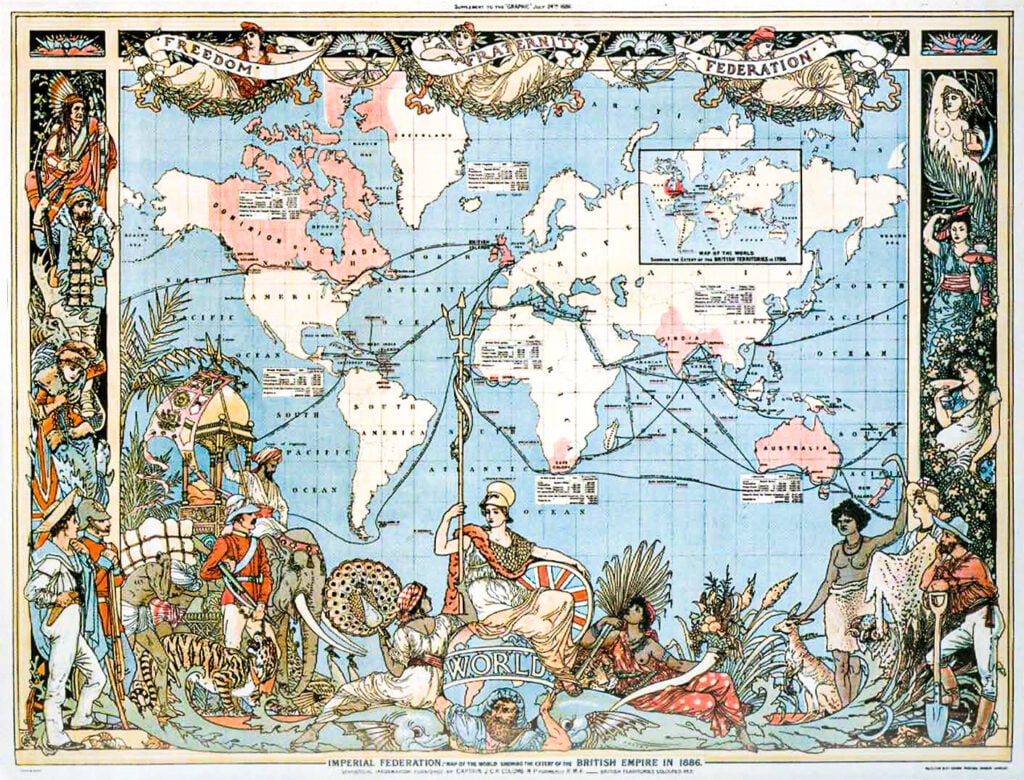
The British Empire in 1886

Britain leaves the EU on December 31, 2020. We mark this historical event by looking at its global, imperial military footprint and the mind-boggling waste of scarce resources its prime minister is proud of standing behind in times that are already extremely hard for the citizens.

A few nostalgic types still believe that the Union Jack continues to flutter to sighs and reverence over outposts of the world, from the tropics to the desert. They would be right, if only to a point. Britain, it turns out, has a rather expansive global reach when it comes to bases, military installations and testing sites. While not having the obese heft and lumbering brawn of the United States, it makes a good go of it. Globally, the UK military has a presence in 145 sites in 42 countries.

Originally posted by Off Guardian on November 29, 2020

Such figures tally with Ian Cobain’s prickly observation in The History Thieves: that the British were the only people “perpetually at war.”

Phil Miller’s rich overview of Britain’s military footprint for Declassified UK shows it to be heavy.

The size of the global military presence is far larger than previously thought and is likely to mean that the UK has the second largest military network in the world, after the United States.”

The UK military, for instance, has a presence in five countries in the Asia-Pacific: naval facilities in Singapore; garrisons in Brunei, drone testing facilities in Australia; three facilities in Nepal; a quick reaction force in Afghanistan. Cyprus remains a favourite with 17 military installations. In Africa, British personnel can be found in Kenya, Somalia, Djibouti, Malawi, Sierra Leone, Nigeria and Mali. Then come the ever dubious ties to Arab monarchies.

The nature of having such bases is to be kind to your host, despite him being theocratic, barking mad, or an old fashioned despot with fetishes. Despite the often silly pronouncements by British policymakers that they take issue with authoritarians, exceptions numerous in number abound.

The UK has never had a problem with authoritarians it can work with or despots it can coddle. A closer look at such relations usually reveal the same ingredients: capital, commerce, perceptions of military necessity. The approach to Oman, a state marked by absolute rule, is a case in point.

Click and subscribe so you
do not miss anything from us

Since 1798, Britain has had a hand in ensuring the success, and the survivability, of the House of Al Said. On September 12, UK Defence Secretary Ben Wallace announced that a further £23.8 million would go to enhancing the British Joint Logistics Support Base at Duqm port, thereby tripling “the size of the existing UK base and help facilitate Royal Navy deployments to the Indian Ocean”. The Ministry of Defence also went so far as to describe a “renewal” of a “hugely valuable relationship,” despite the signing of a new Joint Defence Agreement in February 2019.

The agreement had been one of the swan song acts of the ailing Sultan Qaboos bin Said, whose passing this year was genuinely mourned in British political circles. Prime Minister Boris Johnson called him “an exceptionally wise and respected leader who will be missed enormously.” Papers of record wrote in praise of a reformer and a developer. “The longest serving Arab ruler,” observed a sycophantic column in The Guardian, “Qaboos was an absolute monarch, albeit a relatively benevolent and popular one.”

The same Sultan, it should be said, had little fondness for freedom of expression, assembly and association, encouraged the arrests and harassment of government critics and condoned sex discrimination. But he was of the “one of us” labels: trained at the Royal Military Academy Sandhurst, an unwavering Anglophile, installed on the throne by Britain in the 1970 palace coup during the all but forgotten Dhofar Rebellion.

“Strategically,” Cobain reminds us, “the Dhofar war was one of the most important conflicts of the 20th century, as the victors could expect to control the Strait of Hormuz and the flow of oil.” The British made sure their man won.

Public mention of greater British military involvement in foreign theatres can be found, though they rarely make front page acts. The business of projecting such power, especially in the Britannic model, should be careful, considered, even gnomic. Britain, for instance, is rallying to the US-led call to contain the Yellow Peril in the Asia Pacific, a nice reminder to Beijing that old imperial misdeeds should never be a bar to repetition.

The head of the British Army, General Sir Mark Carleton-Smith, spoke in September about there being “a market for a more persistent presence from the British Army (in Asia). It’s an area that saw a much more consistent Army presence in the Eighties, but with 9/11 we naturally receded from it.” The time had come “to redress that imbalance”.

The UK Chief of Defence Staff, General Sir Nick Carter, prefers to be more enigmatic about the “future of Global Britain.” To deal with an “ever more complex and dynamic strategic context,” he suggests the “Integrated Operating Concept”. Britain had to:

… “compete below the threshold of war in order to deter war, and to prevent one’s adversaries from achieving their objectives in fait accompli strategies.”

Gone are the old thuggeries of imperial snatch and grab; evident are matters of flexibility in terms of competition. “Competing involves a campaign posture that includes continuous operating on our terms and in places of our choosing.”

This entails a thought process involving “several dimensions to escalate and deescalate up and down multiple ladders – as if it were a spider’s web.” The general attempts to illustrate this gibberish with the following example:

One might actively constrain in the cyber domain to protect critical national infrastructure in the maritime Domain.”

In 2017, there were already more than just murmurings from Johnson, then Foreign Secretary, and Defence Secretary Michael Fallon, that a greater British presence in the Asia-Pacific was warranted. Fallon was keen to stress the reasons for deeper involvement, listing them to a group of Australian journalists.

The tensions have been rising in the region, not just from the tests by North Korea but also escalating tension in the South China Sea with the building program that’s gone there on the islands and the need to keep those routes open.”

With such chatter about the China threat you could be forgiven for believing that British presence in the Asia-Pacific was minimal. But that would ignore, for instance, the naval logistics base at Singapore’s Sembawang Wharf, permanently staffed by eight British military personnel with an eye on the busy Malacca Strait. A more substantial presence can also be found in the Sultanate of Brunei, comprising an infantry battalion of Gurkhas and an Army Air Corps Flight of Bell 212 helicopters.

The MOD is particularly keen on the surroundings, as they offer “tropical climate and terrain … well suited to jungle training”.

Over the next four years, the UK military can expect to get an extra £16.5 billion – a 10% increase in funding and a fond salute to militarists. “I have decided that the era of cutting our defence budget must end, and ends now,” declared Johnson. “Our plans will safeguard hundreds of thousands of jobs in the defence industry, protecting livelihoods across the UK and keeping the British people safe.”

The prime minister was hoping to make that announcement accompanied by the “Integrated Defence and Security Review” long championed by his now-departed chief special adviser, Dominic Cummings. Cummings might have been ejected from the gladiatorial arena of Downing Street politics, but the ideas in the Review are unlikely to buck old imperial trends. At the very least, there will be a promise of more military bases to reflect a posture General Carter describes rather obscurely as “engaged and forward deployed”.
Related Posts

TFF’s comprehensive proposal for dialogue about true peace in Ukraine is due in a day or two Jan Oberg November 20, 2025 What is being whispered through diplomatic corridors today is not peace, but quackery. The alleged 28‑point plan drafted in Washington and Moscow is mentioned as a solution to the Ukraine war. It is being negotiated by US businessman, real estate developer and Trump ally, Steve Witkoff, and by Kirill Dmitriev, who is CEO of the Russian Direct Investment Fund and a close ally of Putin, according to India’s Economic Times. For presumably good reasons, their education, qualifications and experience in international conflict analysis and peace-making remain untold. They look like surgeons who have never opened a medical textbook. It is nothing more than a mirage: a framework of concessions imposed on Ukraine’s citizens, negotiated without Kyiv, and excluding Europe. Like Gaza, it promises “peace” while institutionalising injustice. If half of what is available about...
OK, Trump did not get it. But he got a full endorsement of a possible future US regime change in Venezuela. And that is what Ms Machado has advocated. Jan Oberg October 10, 2025 On October 10, 2025, the Norwegian Nobel Committee awarded its Peace Prize to Venezuelan opposition figure María Corina Machado. The citation praised her “tireless work promoting democratic rights.” But Ms Machado has openly called for U.S. military intervention in Venezuela, stating on CBS: “The only way to stop the suppression is by force—U.S. force.” She or her party has received funding from the National Endowment for Democracy (NED), a U.S. government-backed body known as a CIA front organisation and for supporting regime-change operations worldwide. And in 2018, she sent a letter to Israeli Prime Minister Benjamin Netanyahu, asking him to use “force and influence” to help dismantle Venezuela’s government—citing alleged ties to terrorism, Iran and narcotrafficking....
Officially, the drones were not identified. By simply thinking critically – which journalists and selected experts no longer do – there may be a good reason for that. And this article will never be mentioned in Denmark… Jan Oberg October 3, 2025 Drones over Denmark. No damage. No trace. No answers. Yet the headlines scream “Russian threat,” and Prime Minister Mette Frederiksen speaks with a certainty that defies logic: “We don’t know they were Russian—but we know Russia is the biggest threat to Europe.” It could be nobody else – unless you make an interest analysis which I did two days ago. This is not security policy. It’s theatre. And the audience is being played. Let’s rewind. These drones—unphotographed, untracked, unclaimed—appear and vanish like ghosts. Airports shut down. Panic spreads. Military budgets swell. And the narrative hardens: Russia is behind it. But what if that’s not just wrong but deliberately...

Recent Articles

Below are TFF-related media mentions, comments, videos and social media posts published elsewhere but not on this homepage. We happen to catch and list only a fraction. Regarding video comments and debates, we recommend that you go to the TFF Video Channel on Substack where many of them are reproduced. Jan Oberg is a contributor to China Daily – 52 million daily clicks – and Global Times, CGTN and CCTV (the national television), China Investment, Xinhua News Agency and several others. Articles and videos on these media very often multiply into countless Chinese (and Western media) that re-post them from these main media. Thanks to The China Academy, his analyses, interviews and comments are frequently posted on YouTube channels such as Thinkers Forum and Wave Media. These videos are often re-posted on Bilibili (China’s YouTube), the China Content Center on TikTok, and on the Chinese edition of TikTok, Douyin.com. This means reaching hundreds of millions of viewers worldwide over a year. While there are too many to catch on all these...
Jan Oberg TFF director October 13, 2026 According to Alfred Nobel’s will, the Nobel Peace Prize shall be awarded: ”to the person who has done the most or best to advance fellowship among nations, the abolition or reduction of standing armies, and the establishment and promotion of peace congresses.” Further down, he also expresses how the prize for the “champions of peace” shall be decided: “that for champions of peace by a committee of five persons to be selected by the Norwegian Storting. Alfred Nobel’s will is remarkably short and clear. But few seem to have read it. Nobel did not say that the committee itself should consist of members of parliament. He entrusted the Storting with appointing five persons. In principle, it could have selected diplomats, mediators, peace researchers, conflict-resolution specialists, or other individuals with recognised expertise in matters of peace from around the world. Instead, the Storting gradually...
The Quest for Humane Survival Richard Falk Professor emeritus, Princeton UniversityTFF Associate since 1986October 12, 2026 After decades of teaching and writing about international law in academic frameworks that were not institutionally situated within law school environments—at Princeton and the University of California, Santa Barbara—I found myself most receptive to the TWAIL outlook. It has been especially illuminating in clarifying the extent to which international law evolved as a dialogical critique of Europe’s efforts to legitimize its colonial undertakings. In particular, TWAIL has exposed how international law has functioned to legalize the subjugation of Third World peoples, securing conditions for exploitative investment and trade relations, the coercive enforcement of public debts, and an ideology of cultural superiority. TWAIL’s exposure of these economic legacies of colonialism has influenced my understanding of the history and development of international law, broadly conceived, as an ideological project of the Western sub-system of the world...

TFF on Substack

Discover and subscribe to more peace materials on TFF Substack

Most Popular

Below are TFF-related media mentions, comments, videos and social media posts published elsewhere but not on this homepage. We happen to catch and list only a fraction. Regarding video comments and debates, we recommend that you go to the TFF Video Channel on Substack where many of them are reproduced. Jan Oberg is a contributor to China Daily – 52 million daily clicks – and Global Times, CGTN and CCTV (the national television), China Investment, Xinhua News Agency and several others. Articles and videos on these media very often multiply into countless Chinese (and Western media) that re-post them from these main media. Thanks to The China Academy, his analyses, interviews and comments are frequently posted on YouTube channels such as Thinkers Forum and Wave Media. These videos are often re-posted on Bilibili (China’s YouTube), the China Content Center on TikTok, and on the Chinese edition of TikTok, Douyin.com. This means reaching hundreds of millions of viewers worldwide over a year. While there are too many to catch on all these...
Jan Oberg TFF director October 13, 2026 According to Alfred Nobel’s will, the Nobel Peace Prize shall be awarded: ”to the person who has done the most or best to advance fellowship among nations, the abolition or reduction of standing armies, and the establishment and promotion of peace congresses.” Further down, he also expresses how the prize for the “champions of peace” shall be decided: “that for champions of peace by a committee of five persons to be selected by the Norwegian Storting. Alfred Nobel’s will is remarkably short and clear. But few seem to have read it. Nobel did not say that the committee itself should consist of members of parliament. He entrusted the Storting with appointing five persons. In principle, it could have selected diplomats, mediators, peace researchers, conflict-resolution specialists, or other individuals with recognised expertise in matters of peace from around the world. Instead, the Storting gradually...
The Quest for Humane Survival Richard Falk Professor emeritus, Princeton UniversityTFF Associate since 1986October 12, 2026 After decades of teaching and writing about international law in academic frameworks that were not institutionally situated within law school environments—at Princeton and the University of California, Santa Barbara—I found myself most receptive to the TWAIL outlook. It has been especially illuminating in clarifying the extent to which international law evolved as a dialogical critique of Europe’s efforts to legitimize its colonial undertakings. In particular, TWAIL has exposed how international law has functioned to legalize the subjugation of Third World peoples, securing conditions for exploitative investment and trade relations, the coercive enforcement of public debts, and an ideology of cultural superiority. TWAIL’s exposure of these economic legacies of colonialism has influenced my understanding of the history and development of international law, broadly conceived, as an ideological project of the Western sub-system of the world...
Read More
girl-5894831_1280
Below are TFF-related media mentions, comments, videos and social media posts published elsewhere but not on this homepage. We happen to catch and list only a fraction. Regarding video comments and debates, we recommend that you go to the TFF Video Channel on Substack where many of them are reproduced. Jan Oberg is a contributor to China Daily – 52 million daily clicks – and Global Times, CGTN and CCTV (the national television), China Investment, Xinhua News Agency and several others. Articles and videos on these media very often multiply into countless Chinese (and Western media) that re-post them from these main media. Thanks to The China Academy, his analyses, interviews and comments are frequently posted on YouTube channels such as Thinkers Forum and Wave Media. These videos are often re-posted on Bilibili (China’s YouTube), the China Content Center on TikTok, and on the Chinese edition of TikTok, Douyin.com. This means reaching hundreds of millions of viewers worldwide over a year. While there are too many to catch on all these...
Nobel-Prize-Plaque
Jan Oberg TFF director October 13, 2026 According to Alfred Nobel’s will, the Nobel Peace Prize shall be awarded: ”to the person who has done the most or best to advance fellowship among nations, the abolition or reduction of standing armies, and the establishment and promotion of peace congresses.” Further down, he also expresses how the prize for the “champions of peace” shall be decided: “that for champions of peace by a committee of five persons to be selected by the Norwegian Storting. Alfred Nobel’s will is remarkably short and clear. But few seem to have read it. Nobel did not say that the committee itself should consist of members of parliament. He entrusted the Storting with appointing five persons. In principle, it could have selected diplomats, mediators, peace researchers, conflict-resolution specialists, or other individuals with recognised expertise in matters of peace from around the world. Instead, the Storting gradually...
law-419057_1280
The Quest for Humane Survival Richard Falk Professor emeritus, Princeton UniversityTFF Associate since 1986October 12, 2026 After decades of teaching and writing about international law in academic frameworks that were not institutionally situated within law school environments—at Princeton and the University of California, Santa Barbara—I found myself most receptive to the TWAIL outlook. It has been especially illuminating in clarifying the extent to which international law evolved as a dialogical critique of Europe’s efforts to legitimize its colonial undertakings. In particular, TWAIL has exposed how international law has functioned to legalize the subjugation of Third World peoples, securing conditions for exploitative investment and trade relations, the coercive enforcement of public debts, and an ideology of cultural superiority. TWAIL’s exposure of these economic legacies of colonialism has influenced my understanding of the history and development of international law, broadly conceived, as an ideological project of the Western sub-system of the world...
images-2
Advocates of nuclear disarmament are regularly dismissed by the champions of nuclear deterrence as naïve and unrealistic, utopian or even irresponsible. Yet this ‘doctrine’ of deterrence, regarded by France as the ‘cornerstone’ of its national security, is based on quasi-religious beliefs, a theory that cannot be proven, risky gambles and fragile assumptions. So much so that one might legitimately ask which side the ‘Care Bears’ are on. Marc FinaudVice-President of Initiatives for Nuclear Disarmament (IDN) October 9, 2026 This article was originally published on Pressenza When it comes to these things being treated as religious concepts, look here. Idealists and realists It was Hubert Védrine, François Mitterrand’s former Foreign Minister, who repeatedly coined the phrase: ‘Europeans are a sort of Care Bears who don’t realise they’re living in Jurassic Park’. He applies this reference to the cartoon for well-behaved children not only to what he regards as weakness or idealism...
8824b09f-33a5-43f9-9fd0-550f28cda24d_1536x1024
What the West Borrowed from Asia and What It Left Behind Jan Krikke October 8, 2026 The article was originally published here In the late 1960s, the musical Hair announced that the Age of Aquarius was dawning. Its opening anthem promised a transformation of human consciousness: an era of peace, harmony and understanding. Half a century later, a familiar echo of that promise is a meditation app offered by your employer. You can find it in the same list of benefits as the pension plan and the gym discount. How did a spiritual revolution become an employee benefit? The answer lies in the history of the movement known as New Age: where it came from, what it borrowed from Asia, and why the meaning of what it borrowed changed in the process. Two definitions will help. New Age is a loose label for a wide range of spiritual practices and...
Screenshot 2026-10-04 210142
Small and different + among the 10% most active + 9,000 texts + 150 Associates + 60 000 a day — and a stubborn belief that peace is smarter and must be secured by peaceful means. In 2026, the Transnational Foundation for Peace and Future Research (TFF) turns 40. On Monday, October 5, 2026, a new TFF homepage will go live — a new gateway to more than 9,000 articles, analyses, research papers and other contributions produced over four decades of independent peace research. But this is not simply a new website. For four decades, TFF has worked from a simple conviction: peace is smarter than militarism and can be brought about by peaceful means. This is not merely an aspiration. It is the principle expressed in the UN Charter and the Gandhian tradition that has guided our work from the beginning. TFF is a research-based, independent and people-financed foundation....





