
July 14, 2022
As the Pentagon authorizes an additional $400 million for Ukraine’s defense on Friday, bringing estimated total U.S. security spending on Ukraine under President Biden to a staggering $8 billion, we speak to Joe Lauria, editor-in-chief of Consortium News, about the pressure on news media to follow a single approved narrative on the Ukraine war. The independent media outlet recently had their PayPal account shut down and received notice from NewsGuard, a fact-checking group, that they are under review for publishing fake news. “American and European audiences have been fed the idea that Russia has been failing in this war and that Ukraine still has a chance to win, but I think we’re starting to see reality seep into the reporting,” says Lauria.
•
Transcript
This is a rush transcript. Copy may not be in its final form.
AMY GOODMAN: I’m Amy Goodman, with Juan González. This is Democracy Now!, democracynow.org, The War and Peace Report.
As U.S. President Joe Biden is set to visit with leaders in Israel and Saudi Arabia this week, the Kremlin says Russian President Vladimir Putin will travel to Tehran next week to meet with the presidents of Iran and Turkey for peace talks on Syria and also to hold separate talks with the Turkish president, Erdogan, who has offered to mediate between Russia and Ukraine. This comes as White House national security adviser Jake Sullivan claimed Monday Iran plans to supply Russia with potentially hundreds of drones for its war in Ukraine.
JAKE SULLIVAN: Our information indicates that the Iranian government is preparing to provide Russia with up to several hundred UAVs, including weapons-capable UAVs, on an expedited timeline. Our information further indicates that Iran is preparing to train Russian forces to use these UAVs, with initial training sessions slated to begin as soon as early July. It’s unclear whether Iran has delivered any of these UAVs to Russia already.
AMY GOODMAN: Sullivan vowed the United States will continue to sustain its defense of Ukraine. His comments come after the Pentagon on Friday authorized another $400 million for the fight in Ukraine. This brings the total U.S. security assistance to Ukraine in the last three weeks alone to $2.2 billion. Under President Biden, the U.S. has committed at least $8 billion overall to Ukraine.
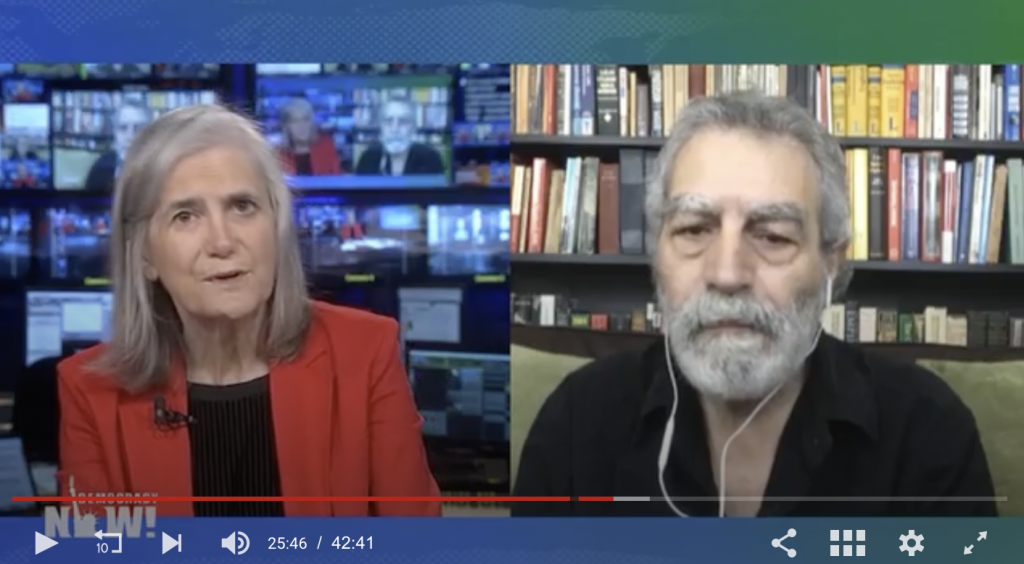
For more, we’re joined by Joe Lauria, editor-in-chief of the independent news outlet Consortium News, also a former U.N. correspondent and investigative reporter for The Wall Street Journal, Boston Globe, Sunday Times of London.
Welcome back to Democracy Now!, Joe. If you can start off by talking about the latest situation in Ukraine and what you think is missing from the mainstream news coverage?
JOE LAURIA: Well, there’s plenty missing. First of all, thanks for having me on to talk about this, Amy.
Plenty missing from the mainstream media coverage of this from the initial part of this invasion until today. Mostly we have seen reporting in the corporate media based solely on U.S. officials or Ukrainian officials. So we’re getting only one side of the story. And obviously, that’s pretty much journalism 101 that there’s more than one side of the story. So, American and European audiences have been fed the idea that Russia has been failing in this war and that Ukraine still has a chance to win, but I think we’re starting to see the reality seep into the reporting. When you’ve got somebody like Henry Kissinger saying that Ukraine is going to have to make territorial concessions, when the pope says that NATO was barking at Russia’s door, we start to see that, in fact, it wasn’t the simple story that we’re being told every day.
And the reporting on the ground is very difficult. We shy away from it, because both sides lie in wars. When both sides admit an event happened, then you can pretty much be assured that it happened. And now there’s pretty much a consensus emerging that Russia is close to taking all of Donbas, which was their initial aim in this war. So we’re starting somewhat to see that kind of reporting. But still we cannot trust what the Western media is reporting. We cannot trust whatever the Russian Defense Ministry says necessarily, either. So I think that the — we have to hope that the mainstream media will begin to take a more balanced view, but I don’t — I’m not holding my breath about that.
JUAN GONZÁLEZ: Well, Joe, I wanted to ask you, in terms of the roots of the conflict — I’ve been really impressed by a lot of the coverage that Consortium News has been producing, from people who used to be covered a lot by folks on the left, like Scott Ritter and John Kiriakou and Caitlin Johnstone and Jeffrey Sachs, but are now sort of ignored because they’re not going along with the main narrative. But there was an interesting piece that came out in The New York Times in July, five months into the war, which says — the headline is “Commando Network Coordinates Flow [of] Weapons in Ukraine.” And deep in that story, there’s this amazing fact thrown in, and I want to quote it:
“From 2015 to early this year, American Special Forces and National Guard instructors trained more than 27,000 Ukrainian soldiers at the Yavoriv Combat Training Center in western Ukraine, near the city of Lviv, Pentagon officials said.”
This is the first time I hear of this enormous training operation that was going on inside Ukraine by U.S. soldiers for the last seven years. If you could talk about this whole issue of Ukraine not being in NATO, but effectively being a U.S. ally now for years?
JOE LAURIA: Yeah, it’s a de facto member of NATO. That’s very clear. This wasn’t just the United States; there are other NATO nations that were training Ukrainian troops and arming Ukraine even before this massive inflow of weapons that we’ve seen since February. So, I mean, this is not lost, obviously, on Russia. Since the coup in 2014, Russia has seen a buildup of what they see as anti-Russian government backed by the United States with this NATO training and weaponizing of the country. And I think that this is just the latest development.
Now, the CIA has been involved in Ukraine since the late 1940s, when they worked with Mykola Lebed, who was the right-hand man of Stepan Bandera, the World War II-era Ukrainian fascist leader, to undermine the Soviet Union. And that never stopped, really. The U.S. has been deeply involved in Ukraine. And this comes as no surprise with The New York Times report. And I think we already knew pretty much that this was going on, that in fact NATO — while Ukraine is not a member of NATO, it has been and is a de facto member of NATO today.
JUAN GONZÁLEZ: And you mentioned the coup in 2014. The founder of Consortium News, the legendary investigative reporter Bob Parry, did a lot of coverage on that. Could you talk about how that has informed the way Consortium News looks at the current crisis?
JOE LAURIA: Oh, very much so. Bob was way ahead of the game on Ukraine. He even wrote a piece back in 2015 in which he warned about a nuclear war over Ukraine. I thought it was a bit over the top at the time, but now we see, with the situation, we’re probably closer to a possible nuclear exchange than we’ve been certainly since the Cuban Missile Crisis. So, Bob understood, and he got a lot of flak for this. It started back then. It’s much worse now against Consortium News.
But he pointed out that the U.S. was working with extreme-right groups, neo-Nazi groups in Ukraine to help overthrow a democratically elected, albeit corrupt — but I don’t think there’s hardly a politician in Ukraine who cannot be called that — to overthrow Viktor Yanukovych, who the OSCE, by the way, certified his election in 2010. And the United States helped install leaders that were absolutely anti-Russian and accommodated these extreme-right groups and then launched a war against the Donbas, because the Russian ethnic speakers there on the Russian border objected to this coup. Their president that they voted for was overthrown, and they declared independence of Ukraine, and the response, backed by the U.S., was to begin a civil war, in which thousands of people have been killed over the last eight years. That’s something that’s completely excised from the reporting today.
It was that war that Russia entered, really, in February of this year to try to put down that rebellion — and to do a lot more, no question about that. Russia’s aims, we’re still not clear exactly what they are, but they’re certainly beyond Donbas, though that is what they’ve concentrated on in the last few months.
So, Bob Parry was way ahead of the reporting on Ukraine, and he kind of paved the way and informed me. I started working for Consortium News in 2011, but my understanding of Ukraine was certainly influenced very much by Bob’s factual reporting about what was going on, despite the attacks he came under and that, as I said, have only increased dramatically since February of this year.
AMY GOODMAN: Joe Lauria, in May, PayPal canceled the account and froze the funds of your independent news outlet, of Consortium. What happened? And what effect has it had on Consortium News?
JOE LAURIA: Well, we thank PayPal for doing that, because the effect has been an enormous influx of money. We had our best spring fund drive in our history, and people have shown enormous support, for what PayPal did. And we don’t really know exactly why, because they refuse to tell us the reason why. But they did release their funds after Matt Taibbi wrote a piece about it in his Substack, and the New York Post even picked up on that. So, we got our money back, but the issue is we are completely banned from PayPal, and we don’t know why. The only reasons we can assume is because we trade in information, not in banned drug paraphernalia or arms, which you cannot sell over PayPal. And in their user agreement, restricted activities include purveying misinformation to third parties. So, clearly, I think this has to do with our coverage of the Ukraine war.
And what has been our coverage of the Ukraine war but to talk about the causes of the war and the historical context, which is completely missing from the mainstream reporting. You know, historians will talk about the causes of World War II and the rise of Nazism. They often will point to the Versailles Treaty and the onerous conditions it imposed on Germany. And nobody accuses those historians of being Hitler apologists. But when we talk in real time now about the causes of this unfortunate conflict, and avoidable conflict, we are smeared as Kremlin agents and as Putin puppets and all of this complete nonsense. We saw in The Grayzone leaked emails that a government official, someone from the Foreign Office, was looking into us, that Nina Jankowicz, who was the head of the short-lived governance — Disinformation Governance Board, a chilling, Orwellian board that the Biden administration set up, she said we were “useful idiots.” We weren’t funded, presumably, by a hostile power. You know, we’re seeing, Amy, if you recall, during the Vietnam War, Americans who justly protested the murderous policies of their government were smeared as puppets of Hanoi or Beijing or Moscow. It’s the oldest trick in the book for governments to smear legitimate critics of their policies as foreign stooges. And we’re insulted by that because it takes our agency away from us, as if we can’t think on our own.
So, they’re trying to — they’re trying to crush the smallest spark of dissent, because Consortium News, we have about 10,000 readers a day. It briefly went up to 40,000 at the beginning of the war. Why? Because we were providing the historical context, the causes of the war — NATO expansion, the rejection of the Russian treaties back in December, to NATO and the U.S. to create a new security architecture in Europe, the failure to implement the Donetsk Minsk accords — sorry, in Donbas. And, of course, when you remove all of those causes, it looks like Russia is just a madman and only an imperialist. Now, while it’s true Putin has talked over the years about Novorossiya, founded by Catherine the Great in the 18th century, that it was basically an integral part of Russia, if you remove all these other causes, he just looks like some imperial madman. And the invasion of Ukraine pales in comparison, of course, with the invasion of Iraq and Panama and Grenada by the United States, all of which — none of which have had Security Council authorization, including Russia, so it is technically an illegal invasion.
So, we are in a situation now where because we report these causes, we’re being smeared and attacked and deplatformed, and PayPal won’t let us raise money through them. But as I said, we are doing quite well without them, thank you very much.
JUAN GONZÁLEZ: And could you talk about this organization NewsGuard and how they are targeting you? Who exactly is NewsGuard?
JOE LAURIA: Yeah. NewsGuard started in — two or three years ago. It’s a private company based in New York. On its board is Michael Hayden, who was the former CIA and NSA director; a former NATO Secretary-General, Rasmussen; Tom Ridge, the first homeland security director. They have partnerships with the Pentagon and with the State Department. They have taken it upon themselves — Steven Brill was one of the founders of it, who back in the ’90s had the magazine _Brill’s Content_. They take it upon themselves to review news organizations, large and small, from The New York Times to Consortium News.
And they have announced that they — or, wrote to us that they were reviewing us. But in the very first email, we were accused of publishing false content on Ukraine. Well, we turned the tables on them.
I wrote a 9,000-word article responding to their charges against us, in which I show that in fact NewsGuard’s reporting on Ukraine is false, and they need to make the corrections that they’re demanding of us.
It’s chilling, because they will give a red label to websites that they consider to be untrustworthy. This pops up on libraries across Europe and the United States. And every person who buys a Microsoft — a computer with Microsoft software in it has this extension built in that they can turn on. And then, whenever our website shows up on social media, whether that’s Twitter or Google, there will be this red mark against us, and there’s a warning to proceed with caution.
This is outrageous, obviously. We have a right even to be wrong. We have a right to say what we want to. This is supposed to be the freedom of press that the U.S. and European governments protest that they support. And in fact, they’re trying to protect their own interests and to cover up any criticism of — legitimate criticism of the failures of their policies. And this is no different than any kind of totalitarian system, I’m sorry, because they want total control — and the word “total” is in “totalitarian.”
And I’ve got to bring up Julian Assange here, because he is the symbol of this. It started very much with him back in — when they arrested him now and indicted him, even though Biden, when he was vice president, said they could not indict unless there was proof that he actually stole the documents. There is no proof he stole the documents. The main witness has now recanted, saying that Assange had hacked. So, there’s no evidence against him. And they’re going after him because — as any tinpot dictator would do, throwing a journalist in the dungeon because he revealed war crimes, corruption.
We’re at a very critical and crisis of journalism in the United States when the United States government can get away with doing what they’re doing, with British connivance, against Assange, and now all these moves against independent media like us. It’s not just us. MintPress News also had their PayPal shut down. They only want one one narrative on this. This is in line with firing conductors, Russian music conductors and opera singers. And tennis players cannot play at Wimbledon. This is part of an extraordinary clampdown on information.
And by the way, the U.S., in my view, needed Russia to intervene in Ukraine in order to unleash their economic war, in order to unleash their information war and the proxy war, which they want to go on for a long time. Lloyd Austin said the aim here is to weaken Russia. Joe Biden actually said it, that the aim here is to overthrow Putin. He said on February 24th in his press conference on the day of the invasion that the purpose of the sanctions was never to stop the invasion, it was to bring down Putin. It was to get the Russian people to rise up. So they needed this invasion.
And part of it is the information war. And we’re a small part of the attacks and being targeted on that. They could never have shut down RT America. Europe has banned RT and Sputnik. Whether you agree with them or not, it was the Russian point of view of the news. And they could not have done — and mostly the economic war, the sanctions against the central bank, which are backfiring in the West, and against all the products of Russia that are no longer available, including food and minerals and fuel. This was not possible without this invasion. And I believe U.S. set a trap that Russia walked into, and that was to stir up an offensive in Donbas, and Russia had to decide whether to intervene to try to protect the ethnic Russians there or to let them be slaughtered.
And this is the situation right now, though, unfortunately, there’s a long history in the U.S. This is nothing new. This is a trend going back to John Adams with his Sedition Act, throwing people in jail for what they wrote. And Woodrow Wilson failed by one vote in the Senate from getting official censorship in the Espionage Act, and then he came with his own Sedition Act a year later and threw Eugene Debs and hundreds of people in jail for speeches and articles they wrote. And then, of course, there’s McCarthyism. So, this is a recurring theme in U.S. history, and we’re seeing a very strong example of it right now.
AMY GOODMAN: Well, Joe Lauria, we want to thank you so much for being with us, editor-in-chief of the independent news outlet Consortium News, founded in 1995. He’s a former U.N. correspondent for The Wall Street Journal, Boston Globe and others, investigative reporter for The Sunday Times of London, now with Consortium News. Thanks so much for being with us.





