
Jan Oberg: The Doomsday Clock – Deceptive and rather an indicator of US foreign policies

Jan Oberg

January 26, 2023

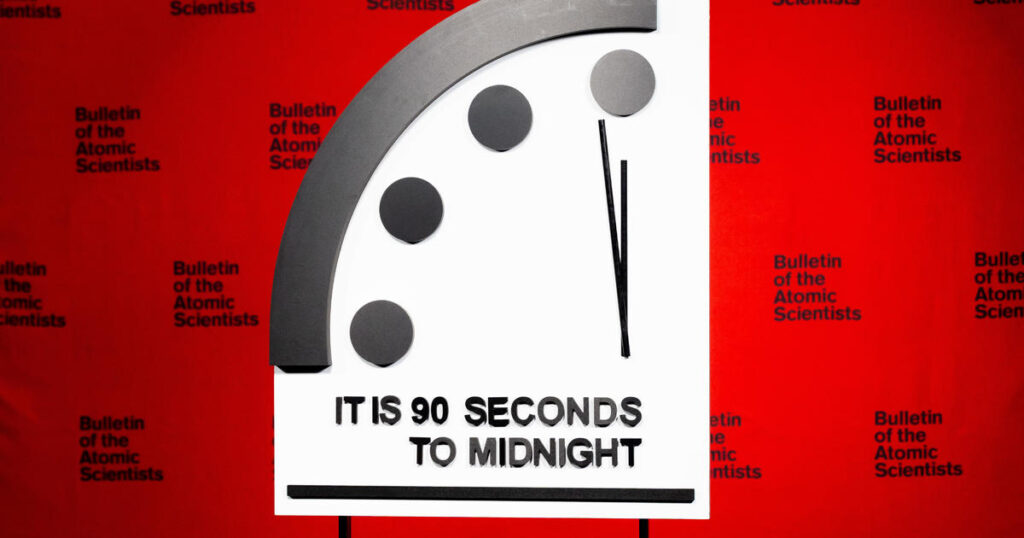
Like the Nobel Prizes, the Doomsday Clock of the Bulletin of the Atom Scientists attracts enormous media attention. It simplifies a very complex issue into a time measure: How close is the world to global catastrophe?

This year it is at 90 seconds to midnight. Between 2020 and 2022, it was at 100 seconds. 75 years ago, it was ticking at 7 minutes, and in 1991, at the end of the First Cold War, it stood at 17 minutes to midnight. Philosophically, this is highly enigmatic: Out of 24 hours, the world has always been a few minutes or seconds from global catastrophe. Over 75 years!

The whole thing is arbitrary or symbolic, if not bizarre. But it does alert the media and does have the positive effect of turning people’s attention at the global rather than regional or local issues. At least for a few moments.

Anyone who has studied risks and threats a bit seriously knows that it is not an easy piece of cake. It involves some theory, lots of different expertise, scenario-creativity and very solid natural and social science expertise. The Bulletin of the Atomic Scientists doesn’t have it.

But the media love it – and never, again like with the Nobel Peace Prize, do they do any research on how it is actually constructed and who is behind it.

They ought to.

Because this is not a genuinely global assessment with estimates and analyses from around the world. It is a US thing which – when you read this year’s statement – very clearly serves US foreign policies and NATO in the NATO-Russia conflict that so tragically plays out in Ukraine.

By and large, it’s a diatribe against Russia – something that has also popped up in articles in the Bulletin more frequently (and, as I have experienced, something the Bulletin does not respond to critical letters of).

And it comes in the wake of the Bulletin’s extremely one-sided condemnation of Russia’s invasion from March 2022. Be sure that such a thing as NATO expansion against all promises and NATO activities inside Ukraine over the last 30 years is part of the Bulletin’s analytical capacity and probably not something this US Bulletin can allow itself even to mention.

It lacks every conflict analysis and macro perspective in time and space – and runs like any other outlet of the omission-prone, self-righteous Western media narrative.

One would expect more from a group of high-level scientists. But perhaps not; because being a natural scientist does not mean being any more competent in political analysis and understanding of the world than the average citizen, but that is what is pretended – and swallowed by the media.

It is as indefensible – and laughable – as if the present author, educated in sociology and peace research, would play it as an expert in physics.

Siegfried Hecker, from left, Daniel Holz, Sharon Squassoni, Mary Robinson and Elbegdorj Tsakhia with the Bulletin of the Atomic Scientists, remove a cloth covering the Doomsday Clock before a virtual news conference at the National Press Club in Washington, Tuesday, Jan. 24, 2023. The Bulletin of the Atomic Scientists announced that it has moved the minute hand of the Doomsday Clock to 90 seconds to midnight. (AP Photo/Patrick Semansky)

You’ll see in this article by the Bulletin’s editor, journalist John Mecklin, which is supposed to explain this year’s Doomsday Clock that virtually everybody else but the US is responsible for the world’s close-to-catastrophe situation; it’s Russia, China, Iran (that does not have any nukes), North Korea and India. He also maintains that Russia, more than the other UN Security Council Nuclear-Haves should “make a renewed commitment to confront nuclear dangers through arms control efforts and strategic stability agreement…”

Would he even think of saying something similar about the United States and other NATO-nuclear countries?

The US nuclear activity is mentioned only cursorily “The United States, Russia, and China are now pursuing full-fledged nuclear weapons modernization programs, setting the table for a dangerous new “third nuclear age” of competition. Long-standing concerns about arms racing in South Asia and missile arms races in Northeast Asia complete a dismal picture that needs to be addressed.”

The neutrality of that sentence is remarkable – they are all equally responsible for what goes on over there? That the US is roaming around with nuclear submarines close to China doesn’t seem to be a concern to Mr Mecklin. Exercises, the US’ Taiwan armament provocation and that sort of thing?

The huge British nuclear weapons programs is not mentioned. Same thing with Israel’s nuclear weapons – while non-nuclear Iran, as mentioned, is pointed out as part of a global risk assessment. Yes, perhaps Iran is sick and tired of being harassed year after year and, in particular, since then US President Trump ruined the 2015 JCPOA, the most important diplomatic agreement in decades, by withdrawing from it and by the fact that the Biden administration follows his policy – a pretext, one may assume, for a later military action against Iran?

The manifest US Cold War policy against China, well-financed and also orchestrated through the Western mainstream media – goes unmentioned too.

As does the ongoing US nuclear escalation in Europe – the equivalent of 83 Hiroshima bombs, according to ICAN, the Geneva-based coalition of 652 non-governmental partner organisations in 107 countries, promoting adherence to and implementation of the UN Treaty on the Prohibition of Nuclear Weapons, received the 2017 Nobel Peace Prize.

That Treaty on the prohibition of nuclear weapons is also not mentioned – that is, the positive fact that the huge majority of humanity does not want nuclear weapons.

And, finally, while the Russians are blamed 100% for what now goes on in Ukraine – which is peak anti-intellectualism – the Bulletin of the Atomic Scientists and its editor do not have one word to say about the risk of catastrophe associated with – as of now – NATO countries having dispatched weapons for about US$ 150 billion, totally ignored every possibility of a negotiated solution and told President Zelensky to stop talking about negotiations – to the effect that he has signed a law that prohibits negotiation with Russia as long as its president is Vladimir Putin.

All this is not a concern to those who decide about the – alarming – Doomsday Clock.

You should wonder why.

Here is my primary explanation: It is, for all practical purposes, a US public relation thing. The Doomsday Clock can also be seen as an indicator of where the world is today as a consequence of the policies of the largest and most killing and nuclear global actor of all – the US – and its allies and partners in NATO, all in all 72 countries. That such an entity needs to blame others and see threats and catastrophes in everything those others do – what I would call psycho-political projection of its own dark sides onto others – is anything but unlikely.

To back this up, look at what the Bulletin says and what it really is.

“The Science and Security Board (SASB) is comprised of a select group of globally recognized leaders with a specific focus on nuclear risk, climate change, and disruptive technologies. The SASB provides the Bulletin with objective external perspectives on trends and issues in these related fields and connects the organization to outside experts. The SASB’s responsibilities include: (1) setting the hands of the Doomsday Clock…”

“Globally recognised leaders…objective…” This falsely conveys the impression that this is a globally-composed expert group. Also, the criteria for their being globally recognised are not stated (I, for one, have heard about only 1or 2 of them, sorry for my ignorance. It is marketing/PR language).

This Board consists of 22 members, at least 19 of whom are Americans. (I have not been able to identify the nationality of 3, but they are US-educated, and one is a professor at Oxford). Not exactly an international or global group assessing global threats to humanity. Many of them are Standford University people and members of the US Academy of Sciences. Surely high-level, but perhaps with a bit of a US-biased worldview – and, naturally, a politically correct anti-Russian sentiment?

Furthermore, 7 of them have had or have relations with US government and military institutions such as State Department, Pentagon, the White House, National Defence College, Homeland Security and the US Airforce.

Could it be that they might not that easily see the log that is in their own US eyes but see very well the speck that is in their brothers’ eyes?

Finally, the Doomsday Clock is Western-biased in the extreme. If it is Russia and it happens in Europe, it’s very dangerous to the whole world. Secondly, the Bulletin gives no explanation as to how the regional conflict of NATO and Russia in Ukraine necessarily would translate into a global threat or humanity’s annihilation. Or under what circumstances the conventional war and escalation there would escalate to the level of the use of tactical nukes in the regional theatre and then to a global all-out Holocaust.

Of course, that scenario cannot be excluded, but to make it a world media issue without any analytical explanation is alarmist. But that is, one must assume, OK in these US politico-academic circles when it comes to Russia – as if NATO did not have a nuclear doctrine, too, that includes the right to use nukes even against a conventional attack.

I suppose the Bulletin and the experts behind its Doomsday Clock find that nuclear posture purely defensive and morally right. Remember, NATO is officially a defensive alliance. And that the Ukraine conflict is quite an extraordinary, unique conflict in that it has only one party.

We have enough doom and gloom.

Time is indeed ticking for this outdated, deceptive clock.
Peace & future researcher + ‌Art Photographer

Related Posts

In contrast to most, we’ll bring alternatives, solutions, hope and strategies for a better future. Times are dangerous, yes, but that only intensifies the need for constructive thinking and action! Jan Oberg, TFF director April 13, 2026 The new TFF Peace Pulse uses video messages in a new way: Max 3-5-minute-long comments, ideas or perhaps mini-lectures, all about peace – positive peace. We launch them today on April 13, 2026 with a carefully crafted visual aesthetic fitting the content. We hope to publish them regularly from now on. We launch Peace Pulse (PP) – for a number of reasons. The world is in chaos, and there are countless reasons to feel concerned, frustrated, even angry. The atmosphere is saturated with doom and gloom, with negative energy and rear‑mirror thinking, while vision, imagination, alternatives, strategies and genuine future‑mindedness remain in short supply. And without them, we simply can’t save the world. Looking at problems from a hundred angles will...
This is not another geopolitical commentary on the Arctic. It is a visionary peace proposal that can save the region from militarised rivalry and ecological ruin. A blueprint for shared security, sustainable development, and human dignity — benefitting Greenland, the Arctic, and the rest of us. Jan Oberg TFF director Lund, Sweden, February 17, 2026 I. Four Principles for a New Arctic Vision The Arctic is often framed as a cold arena of rivalry — a place where great powers test each other’s resolve. But this worldview is outdated, unimaginative, and ultimately self‑defeating. The Arctic is not a vacuum waiting to be militarised; it is a living region, a climate stabiliser, and a cultural homeland whose future will shape the future of humanity. If we begin from that understanding, a far more rational Arctic order becomes possible — one that is peaceful, cooperative, and centred on the people who actually live there. This vision rests...
PART 2 — Diplomacy, Law and Nonviolent Power By Jan ObergTFF co-founder and director January 26, 2026 This is the second of four TFF-created idea portfolios designed to curb the global reach of the United States and, in both the short and long term, help catalyse a worldwide nonviolent resistance to what many observers describe as the Trump administration’s uniquely confrontational, destructive and world-threatening policies. These portfolios outline what governments and citizens across the world can do through dynamic diplomacy, creative initiatives, and strictly nonviolent means. They are typical TFF works in that we do not only tell what the problem is and how bad it will go – as 90+% of all commentators, experts and scholars do – we tell what we think can be done, inviting you to think of what you think you can do. It seems painfully clear to me that the current political dynamics in Washington increasingly resemble the most dangerous...

Recent Articles

Tony Robinson October 4, 2026 Violence is easy to recognise when someone is being beaten, shot or killed. It becomes more difficult when nobody is holding a weapon. Poverty, discrimination, exploitation and repression can restrict a human life just as effectively, although they do so in very different ways and with very different consequences. Simply adding more categories to an ever-growing list of forms of violence does not really solve the problem. The more interesting question is what all these different situations have in common and why it makes sense to describe them using the same word. Human beings do not simply react to what happens around them. They remember the past, imagine things that do not yet exist, make plans and undertake projects. Workers organise because they imagine different working conditions; people migrate because they imagine another life somewhere else; social movements emerge because people refuse to accept the...
It’s a matter of principles, courage, vision and pulling together – while the militarist world is falling apart… Peter Langille October 3, 2026 “Here, then, is the problem which we present to you, stark and dreadful and inescapable: Shall we put an end to the human race; or shall mankind renounce war?”The Bertrand Russell—Albert Einstein Manifesto, July 9, 1955 ⁕ The forecast for what’s ahead is worrisome. The sharp rise in armed conflicts over the past three years is adding to what was already the highest level in over seventy years. Genocides, which should be prevented are supported. A shared climate emergency that jeopardises survival is ignored. Diverse polls now suggest that people are war-weary, worried and interested in a more effective United Nations. And, there are viable policy options for a more secure world! Yet governments are doubling-down, betting on more war and investing heavily. If current trends persist,...
Johan Galtung 1930-2024October 2015 Published here on October 3, 2026 Let us focus on Civilization for conflict analysis and remedies. Major forms of disorder use violence; war is state organized violence. The most belligerent states are the United States of America and Israel, both with civilization roots. National Evangelism, the US Protestant Christian civilization– more national than evangelical–justifies US warfare as exceptionalism of a people chosen by God, with a manifest destiny to run the world. Orthodox Judaism justifies Israeli warfare to conquer and expand from Nile to Euphrates as a religious right and duty to the Eternal One. The third most belligerent country, the UK, no longer believes it is God-chosen but chosen by the USA; not quite the same but something. But the root cause of global disorder lies in the Occident–with Islam–seeing itself as the single, universal civilization valid for all at all times, all others being...

TFF on Substack

Discover and subscribe to more peace materials on TFF Substack

Most Popular

Tony Robinson October 4, 2026 Violence is easy to recognise when someone is being beaten, shot or killed. It becomes more difficult when nobody is holding a weapon. Poverty, discrimination, exploitation and repression can restrict a human life just as effectively, although they do so in very different ways and with very different consequences. Simply adding more categories to an ever-growing list of forms of violence does not really solve the problem. The more interesting question is what all these different situations have in common and why it makes sense to describe them using the same word. Human beings do not simply react to what happens around them. They remember the past, imagine things that do not yet exist, make plans and undertake projects. Workers organise because they imagine different working conditions; people migrate because they imagine another life somewhere else; social movements emerge because people refuse to accept the...
It’s a matter of principles, courage, vision and pulling together – while the militarist world is falling apart… Peter Langille October 3, 2026 “Here, then, is the problem which we present to you, stark and dreadful and inescapable: Shall we put an end to the human race; or shall mankind renounce war?”The Bertrand Russell—Albert Einstein Manifesto, July 9, 1955 ⁕ The forecast for what’s ahead is worrisome. The sharp rise in armed conflicts over the past three years is adding to what was already the highest level in over seventy years. Genocides, which should be prevented are supported. A shared climate emergency that jeopardises survival is ignored. Diverse polls now suggest that people are war-weary, worried and interested in a more effective United Nations. And, there are viable policy options for a more secure world! Yet governments are doubling-down, betting on more war and investing heavily. If current trends persist,...
Johan Galtung 1930-2024October 2015 Published here on October 3, 2026 Let us focus on Civilization for conflict analysis and remedies. Major forms of disorder use violence; war is state organized violence. The most belligerent states are the United States of America and Israel, both with civilization roots. National Evangelism, the US Protestant Christian civilization– more national than evangelical–justifies US warfare as exceptionalism of a people chosen by God, with a manifest destiny to run the world. Orthodox Judaism justifies Israeli warfare to conquer and expand from Nile to Euphrates as a religious right and duty to the Eternal One. The third most belligerent country, the UK, no longer believes it is God-chosen but chosen by the USA; not quite the same but something. But the root cause of global disorder lies in the Occident–with Islam–seeing itself as the single, universal civilization valid for all at all times, all others being...
Read More
Living-Peace-Sign-Budapest-copy
Tony Robinson October 4, 2026 Violence is easy to recognise when someone is being beaten, shot or killed. It becomes more difficult when nobody is holding a weapon. Poverty, discrimination, exploitation and repression can restrict a human life just as effectively, although they do so in very different ways and with very different consequences. Simply adding more categories to an ever-growing list of forms of violence does not really solve the problem. The more interesting question is what all these different situations have in common and why it makes sense to describe them using the same word. Human beings do not simply react to what happens around them. They remember the past, imagine things that do not yet exist, make plans and undertake projects. Workers organise because they imagine different working conditions; people migrate because they imagine another life somewhere else; social movements emerge because people refuse to accept the...
b54a1f10-8c65-4f0b-9dd5-4abc0a7d04cc_2659x2659
It’s a matter of principles, courage, vision and pulling together – while the militarist world is falling apart… Peter Langille October 3, 2026 “Here, then, is the problem which we present to you, stark and dreadful and inescapable: Shall we put an end to the human race; or shall mankind renounce war?”The Bertrand Russell—Albert Einstein Manifesto, July 9, 1955 ⁕ The forecast for what’s ahead is worrisome. The sharp rise in armed conflicts over the past three years is adding to what was already the highest level in over seventy years. Genocides, which should be prevented are supported. A shared climate emergency that jeopardises survival is ignored. Diverse polls now suggest that people are war-weary, worried and interested in a more effective United Nations. And, there are viable policy options for a more secure world! Yet governments are doubling-down, betting on more war and investing heavily. If current trends persist,...
010
Johan Galtung 1930-2024October 2015 Published here on October 3, 2026 Let us focus on Civilization for conflict analysis and remedies. Major forms of disorder use violence; war is state organized violence. The most belligerent states are the United States of America and Israel, both with civilization roots. National Evangelism, the US Protestant Christian civilization– more national than evangelical–justifies US warfare as exceptionalism of a people chosen by God, with a manifest destiny to run the world. Orthodox Judaism justifies Israeli warfare to conquer and expand from Nile to Euphrates as a religious right and duty to the Eternal One. The third most belligerent country, the UK, no longer believes it is God-chosen but chosen by the USA; not quite the same but something. But the root cause of global disorder lies in the Occident–with Islam–seeing itself as the single, universal civilization valid for all at all times, all others being...
Screenshot 2026-10-02 011738
Jan ObergPhD, director, The Transnational Foundation for Peace and Future Research, TFFLund, Sweden October 2, 2026 This is my full original manuscript. The Chinese Academy of Social Science, CASS, makes two publications out if it. 1. China’s Five-year plan emphasized the capabilities of basic research and original innovation. It is regarded as the goal of the future social development, which, as required, should be significantly enhanced. Can you comment on the importance of original innovation in research and academic study? I believe it is easier to define “original innovation” in the natural sciences than in social sciences. The breaking points of what constitutes something new, or innovative, are not quite as sharp in the latter. But in both fields it is about opening up something that was closed, unseen, unexplored before – making manifest what was earlier latent. Innovations come in many forms and shapes – naming something that was not...
arctic-circle-map
The agreement is catastrophic both because of what it says and what it doesn’t mention. It reduces further the major asset of security policies: Freedom of action. Jan Oberg TFF director September 25, 2026 A couple of hours before the agreement was signed on September 22, 2026, I published the following 13 hypotheses about what it would most likely contain on TFF Substack (in English). I was wrong on only the first point. Contrary to what Trump had written on his Truth Social platform, it does not appear to come into force immediately. In fact, it turned out to be worse than even I had anticipated. After these hypotheses now come a number of reflections in light of what the agreement actually contains, and does not contain, as well as the way in which it has generally been presented by major media outlets and by the public-service broadcaster DR. My...
girl-5894831_1280
Below are TFF-related media mentions, comments, videos and social media posts published elsewhere but not on this homepage. We happen to catch and list only a fraction. Regarding video comments and debates, we recommend that you go to the TFF Video Channel on Substack where many of them are reproduced. Jan Oberg is a contributor to China Daily – 52 million daily clicks – and Global Times, CGTN and CCTV (the national television), China Investment, Xinhua News Agency and several others. Articles and videos on these media very often multiply into countless Chinese (and Western media) that re-post them from these main media. Thanks to The China Academy, his analyses, interviews and comments are frequently posted on YouTube channels such as Thinkers Forum and Wave Media. These videos are often re-posted on Bilibili (China’s YouTube), the China Content Center on TikTok, and on the Chinese edition of TikTok, Douyin.com. This means reaching hundreds of millions of viewers worldwide over a year. While there are too many to catch on all these...





