
ISS Today: Do global actors have what it takes to help Burundi?

Burundi’s ongoing political instability highlights the stark divide between global conflict prevention rhetoric and practice.


By Priyal Singh for ISS TODAY.

 First published by ISS Today

• Since Burundian President Pierre Nkurunziza announced that he would run for a third term in early 2015, political instability across the country has tested the limits of global conflict prevention responses. This instability has included a failed coup d’état, violent clashes between government and opposition forces, increasing suppressionof the media and civil society, as well as targeted assassinations.

The violence has resulted in more than 400,000 Burundians fleeing to neighbouring states and over 55,000 internally displaced, amid allegations of serious human rights violations in the country.

Burundi’s instability, however, appears not to feature the central elements or drivers generally associated with the conflicts of other countries. The presence of transnational organised criminal syndicates has not featured prominently, nor have the influence or proliferation of radical non-state actors. And while the Nkurunziza government has accused regional actors of meddling to fuel conflict in the country, these allegations have remained largely false.

Why then, after more than two years since the violence began, have international, continental and regional conflict prevention responses been so ineffective? It seems intractability, in Burundi’s case, has found its greatest expression not in the nature of the conflict itself – the interests, agendas and material capabilities of the belligerents – but rather in the limits of normative and institutional global conflict prevention frameworks and mechanisms.

To be fair, international and regional peace and security stakeholders have kept abreast of developments in Burundi and have generally articulated positions highlighting the fragility of the country’s peace and security environment. These include the United Nations (UN) and the African Union (AU), and sub-regional actors such as the East African Community (EAC) and the International Conference on the Great Lakes Region (ICGLR).

These actors have all either shown concern regarding Burundi’s crisis, or attempted to act on this concern. Working within the institutional bounds of its peace and security architecture, both the AU and the EAC have tried to find meaningful solutions to allay crisis in the country, and avoid a relapse into the scale of conflict the country has seen.

But these efforts have largely failed in the face of the Nkurunziza government’s increasingly rigid and unco-operative position. The government rejected the recommendations of a 2014 joint EAC-Common Market for Eastern and Southern Africa (Comesa) Panel of the Wise,which sought to defuse tensions leading up to the country’s 2015 elections.

Nkurunziza further rejected exit plans that were initially offered by Ugandan President Yoweri Museveni through the early 2015 intervention of an EAC-led negotiation process.

The government has also sidelined (or completely boycotted) EAC summits since 2015. It has further rejected the deployment of the AU’s African Prevention and Protection Mission in Burundi (MAPROBU) peacekeeping force which had been authorised by the Peace and Security Council in December 2015 (along with the full deployment of 100 human rights and military observers authorised earlier that year).

The Nkurunziza government, growing wary of international scrutiny, has also consistently refused to cooperate with the UN’s commission of inquiry on human rights in the country. The commission’s mandate, as of September 2017, has been extended by a year.

Most recently, the International Criminal Court authorised an investigation into alleged crimes against humanity in the country (between April 2015 and October 2017) which came into effect just two days before the country’s formal withdrawal from the court.

Rejection, impunity and inflexibility have characterised the Nkurunziza government since early 2015. This has resulted in the incumbent political elite’s continued rule through the suppression of the opposition, beyond the scrutiny of external actors and processes geared towards conflict prevention.

The situation directly calls into question the capability and coordination of regional and international conflict prevention actors.

First published by ISS Today

One such question refers to the readiness and fit-for-purpose capability of sub-regional organisations in leading conflict-prevention strategies. While the principle of subsidiarity is important, developments concerning Burundi clearly highlight critical shortcomings associated with divergent sub-regional political agendas and interests – and the impartiality needed to establish and sustain conflict prevention processes.

Further questions concerning the institutional coherence of the AU system, particularly regarding the structures comprising its African Peace and Security Architecture, must be critically appraised.

Gustavo de Carvalho, peace building expert at the Institute for Security Studies (ISS), argues that “in light of the UN’s recent prioritisation of conflict prevention, the lack of any clear strategies, implementable plans, concise guidelines and inter-organisational coordination mechanisms to serve this agenda, is becoming an increasingly significant concern”.

Opportunities and entry points for greater co-ordination between the organs of the UN’s peace building architecture, for example, with the AU, EAC and ICGLR should be more coherently pursued. Hopefully this would result in more uniform and effective conflict prevention strategies, over longer-term frameworks.

Global actors should consider using their existing conflict-prevention approaches to effectively urge the Burundi government to commit to an inclusive peace process – in accordance with its international obligations. Failing to do so would raise serious questions on whether conflict prevention can be effectively implemented in practice.

Without the necessary innovation and co-ordination to make this change, the international community may well have found the limits of its conflict- prevention agenda. DM

This ISS Today is a version of an article first published on the Conflict Prevention Innovation website, a partnership between the ISS and the Igarapé Institute

Priyal Singh is a researcher, Peace Operations and Peace Building, ISS Pretoria

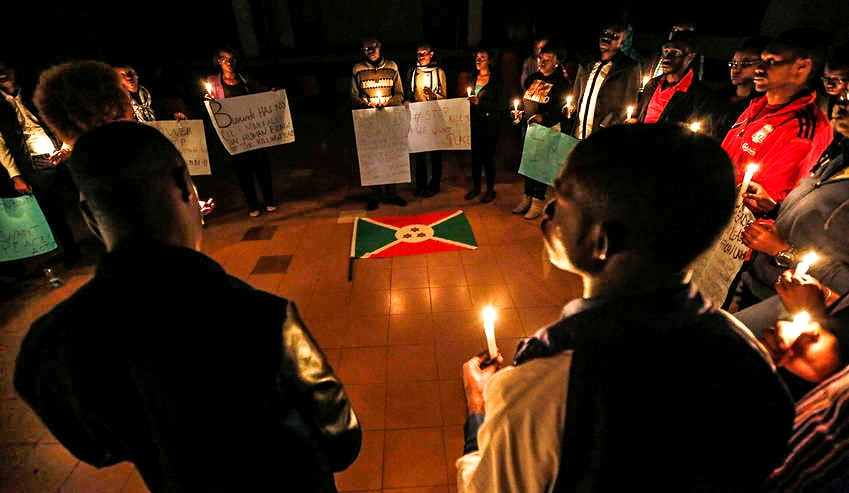
Photo: Students stand around a Burundian flag during a candlelight vigil for the country, in Nairobi, Kenya, 16 December 2015. Students gathered at the Catholic University of Eastern Africa in Nairobi to remember Burundi that has been gripped by violence between police and opposition groups since April, when President Pierre Nkurunziza announced he would seek a third term in office. EPA/DAI KUROKAWA


Related Posts

It’s a matter of principles, courage, vision and pulling together – while the militarist world is falling apart… Peter Langille October 3, 2026 “Here, then, is the problem which we present to you, stark and dreadful and inescapable: Shall we put an end to the human race; or shall mankind renounce war?”The Bertrand Russell—Albert Einstein Manifesto, July 9, 1955 ⁕ The forecast for what’s ahead is worrisome. The sharp rise in armed conflicts over the past three years is adding to what was already the highest level in over seventy years. Genocides, which should be prevented are supported. A shared climate emergency that jeopardises survival is ignored. Diverse polls now suggest that people are war-weary, worried and interested in a more effective United Nations. And, there are viable policy options for a more secure world! Yet governments are doubling-down, betting on more war and investing heavily. If current trends persist,...
Lena Petrova of “World Affairs In Context” with more than half a million subscribers on YouTube wanted to explore what a peace researcher like me has to say about, among other things, the First and the Second Cold War and why eethics has disappeared from politics. I am particularly happy about this conversation that also yielded an amazing number of very appreciative comments on YouTube. No doubt, people are longing for alternatives, including peace perspectives.
In contrast to most, we’ll bring alternatives, solutions, hope and strategies for a better future. Times are dangerous, yes, but that only intensifies the need for constructive thinking and action! Jan Oberg, TFF director April 13, 2026 The new TFF Peace Pulse uses video messages in a new way: Max 3-5-minute-long comments, ideas or perhaps mini-lectures, all about peace – positive peace. We launch them today on April 13, 2026 with a carefully crafted visual aesthetic fitting the content. We hope to publish them regularly from now on. We launch Peace Pulse (PP) – for a number of reasons. The world is in chaos, and there are countless reasons to feel concerned, frustrated, even angry. The atmosphere is saturated with doom and gloom, with negative energy and rear‑mirror thinking, while vision, imagination, alternatives, strategies and genuine future‑mindedness remain in short supply. And without them, we simply can’t save the world. Looking at problems from a hundred angles will...

Recent Articles

Photo above: Carl Fredrik Reuterswärd’s Non-Violence outside UN Headquarters in New York. Kirill Levin, CC BY-NC-SA 2. Jan Oberg November 3, 2026 I am happy to be published in Horizons which is produced by the Center for International Relations and Sustainable Development, CIRSD, in Belgrade. My contribution brings out a radical re-thinking of what concepts such as defence, security, deterrence – and peace – may mean if we want to create a more peaceful world. It also summarises a few things I have been working with the last few decades. Please read it here Og her er den på dansk, takket være Johnny Baltzersens lynhurtige oversættelse
UNITE-tillid, DREAM-velstand og andre konstruktive komponenter Normally we publish articles in English here. But this is a translation of a very important TFF document that should reach as many as possible in Denmark since this country’s government has been one of the most hardline in Europe and, up till now at least, has refused to use diplomacy and, instead, spent tremendous sums on arming Ukraine with the express goal of defeating Russia. Thus this – unique – article is in Danish. Vi er Johnny Baltzersen og hans Fælles Sikkerhed – Fælles Fremtid på Substack overmåde taknemmelige for at have oversat og publiceret TFF’s 2025-portfølje for fredsidéer med henblik på Ukraines fremtid. Vi håber den nu kan nå mange flere danskere – som også vil sprede den og skabe debat – nu den danske regerings og folketingspartiernes politik på dette område siden 2022 står nu – forudsigeligt – ved vejs ende....
Jan Oberg TFF director October 28, 2026 Exactly one month has now passed since I published my criticism of the introduction to the special issue on Johan Galtung published by the Journal of Global Security Studies, JoGSS, and of Tor Egil Førland’s chapter about Galtung which serves as a preview to his forthcoming biography of Galtung to be published by PRIO. See the original on The Transnational here and the same article on TFF Substack with many general and critical comments and, in particular, the people who decided to withdraw from the biography project in protest. The special issue itself was extraordinary. It was devoted to the intellectual legacy of one of the founders of peace research and contained a number of strong assessments of his personality, scholarship, intellectual trajectory, and public role. Such assessments are, of course, entirely legitimate. No scholar is beyond criticism, and neither was Johan Galtung....

TFF on Substack

Discover and subscribe to more peace materials on TFF Substack

Most Popular

Photo above: Carl Fredrik Reuterswärd’s Non-Violence outside UN Headquarters in New York. Kirill Levin, CC BY-NC-SA 2. Jan Oberg November 3, 2026 I am happy to be published in Horizons which is produced by the Center for International Relations and Sustainable Development, CIRSD, in Belgrade. My contribution brings out a radical re-thinking of what concepts such as defence, security, deterrence – and peace – may mean if we want to create a more peaceful world. It also summarises a few things I have been working with the last few decades. Please read it here Og her er den på dansk, takket være Johnny Baltzersens lynhurtige oversættelse
UNITE-tillid, DREAM-velstand og andre konstruktive komponenter Normally we publish articles in English here. But this is a translation of a very important TFF document that should reach as many as possible in Denmark since this country’s government has been one of the most hardline in Europe and, up till now at least, has refused to use diplomacy and, instead, spent tremendous sums on arming Ukraine with the express goal of defeating Russia. Thus this – unique – article is in Danish. Vi er Johnny Baltzersen og hans Fælles Sikkerhed – Fælles Fremtid på Substack overmåde taknemmelige for at have oversat og publiceret TFF’s 2025-portfølje for fredsidéer med henblik på Ukraines fremtid. Vi håber den nu kan nå mange flere danskere – som også vil sprede den og skabe debat – nu den danske regerings og folketingspartiernes politik på dette område siden 2022 står nu – forudsigeligt – ved vejs ende....
Jan Oberg TFF director October 28, 2026 Exactly one month has now passed since I published my criticism of the introduction to the special issue on Johan Galtung published by the Journal of Global Security Studies, JoGSS, and of Tor Egil Førland’s chapter about Galtung which serves as a preview to his forthcoming biography of Galtung to be published by PRIO. See the original on The Transnational here and the same article on TFF Substack with many general and critical comments and, in particular, the people who decided to withdraw from the biography project in protest. The special issue itself was extraordinary. It was devoted to the intellectual legacy of one of the founders of peace research and contained a number of strong assessments of his personality, scholarship, intellectual trajectory, and public role. Such assessments are, of course, entirely legitimate. No scholar is beyond criticism, and neither was Johan Galtung....
Read More
knotted gun
Photo above: Carl Fredrik Reuterswärd’s Non-Violence outside UN Headquarters in New York. Kirill Levin, CC BY-NC-SA 2. Jan Oberg November 3, 2026 I am happy to be published in Horizons which is produced by the Center for International Relations and Sustainable Development, CIRSD, in Belgrade. My contribution brings out a radical re-thinking of what concepts such as defence, security, deterrence – and peace – may mean if we want to create a more peaceful world. It also summarises a few things I have been working with the last few decades. Please read it here Og her er den på dansk, takket være Johnny Baltzersens lynhurtige oversættelse
TFFPortfolioVign
UNITE-tillid, DREAM-velstand og andre konstruktive komponenter Normally we publish articles in English here. But this is a translation of a very important TFF document that should reach as many as possible in Denmark since this country’s government has been one of the most hardline in Europe and, up till now at least, has refused to use diplomacy and, instead, spent tremendous sums on arming Ukraine with the express goal of defeating Russia. Thus this – unique – article is in Danish. Vi er Johnny Baltzersen og hans Fælles Sikkerhed – Fælles Fremtid på Substack overmåde taknemmelige for at have oversat og publiceret TFF’s 2025-portfølje for fredsidéer med henblik på Ukraines fremtid. Vi håber den nu kan nå mange flere danskere – som også vil sprede den og skabe debat – nu den danske regerings og folketingspartiernes politik på dette område siden 2022 står nu – forudsigeligt – ved vejs ende....
JoGSS-Silent
Jan Oberg TFF director October 28, 2026 Exactly one month has now passed since I published my criticism of the introduction to the special issue on Johan Galtung published by the Journal of Global Security Studies, JoGSS, and of Tor Egil Førland’s chapter about Galtung which serves as a preview to his forthcoming biography of Galtung to be published by PRIO. See the original on The Transnational here and the same article on TFF Substack with many general and critical comments and, in particular, the people who decided to withdraw from the biography project in protest. The special issue itself was extraordinary. It was devoted to the intellectual legacy of one of the founders of peace research and contained a number of strong assessments of his personality, scholarship, intellectual trajectory, and public role. Such assessments are, of course, entirely legitimate. No scholar is beyond criticism, and neither was Johan Galtung....
Screenshot 2026-10-26 115647
An aspect of Iran’s culture and civilisation you’ve probably never heard about. Don’t be surprised if the US and Israel also try to bomb them. Jan ObergTFF director October 26, 2026 Today – under the “USraeli” threat of new “annihilating” bombings – opens the 7th International Conference on Peace and Conflict Resolution at Tehran’s University. As far as I can tell, this is the only permanent, advanced peace research institution in West Asia/the Middle East. Perhaps more countries in that region could be inspired? I mean, how many military “security” institutes and military academies do they have? Many peace research institutes and university departments have been established since the 1950s in the West. They are now all under attack; some have closed down, some have gone mainstream, yet others kept the name but do nothing to research peace and disseminate results or advice; instead, they cooperate with militarism’s platforms such...
Screenshot 2026-10-15 141837
Let’s discuss using AI to create peace – in contrast to boring geopolitics devoid of creative healing and visions. Jan Oberg TFF director October 15, 2026 I asked VEED to create a short video exemplifying how peace is preferable to war, then chose the lady as a template. Simple as that. In less than a minute, it produced this video, which any peace-loving person would appreciate. The only problem is that human intelligence (HI), at least the one that exists among Western decision-makers, isn’t half as moral or smart as AI. I have used AI to dialogue about peace and peace plans, creative conflict resolution and visions of a better future for humankind. It so happens that I am having more stimulating, intelligent, creative and moral discussions with AI than I could possibly have with any EU or NATO leader today. Yes, AI has very problematic and dangerous aspects; used...
girl-5894831_1280
Below are TFF-related media mentions, comments, videos and social media posts published elsewhere but not on this homepage. We happen to catch and list only a fraction. Regarding video comments and debates, we recommend that you go to the TFF Video Channel on Substack where many of them are reproduced. Jan Oberg is a contributor to China Daily – 52 million daily clicks – and Global Times, CGTN and CCTV (the national television), China Investment, Xinhua News Agency and several others. Articles and videos on these media very often multiply into countless Chinese (and Western media) that re-post them from these main media. Thanks to The China Academy, his analyses, interviews and comments are frequently posted on YouTube channels such as Thinkers Forum and Wave Media. These videos are often re-posted on Bilibili (China’s YouTube), the China Content Center on TikTok, and on the Chinese edition of TikTok, Douyin.com. This means reaching hundreds of millions of viewers worldwide over a year. While there are too many to catch on all these...



