
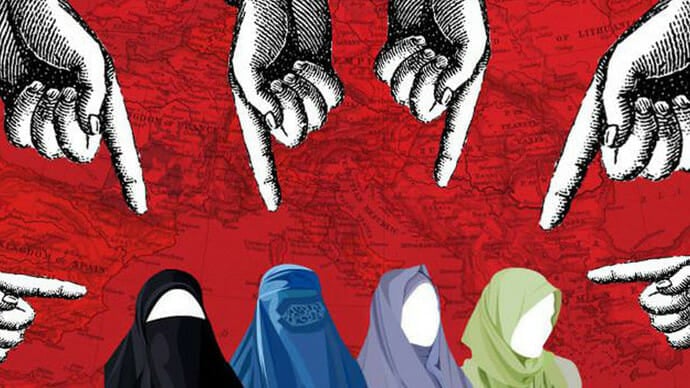
Islamophobia can be said to refer to the way Islam is being alienated in society by other cultures through fear and distrust against people belonging to the Islamic faith. Muslims are often portrayed in an increasingly negative context as witnessed in media, legislation and public debates.

By Idriss Jazairy

June 1, 2019

Islam is often presented as an ‘isolated culture’ with its own distinct features, which are allegedly incompatible with certain values upheld in Western societies.

It is the rise of such a polarizing context that results in growing fear against Muslims, prejudice of other cultures and the ‘us versus them’ paradigm.

Originally published human-wrongs-watch.net

Although Arabs are a Semitic people like the Jews themselves, the media know that anti-Semitism is banned for the latter but tolerated for the former in the name of freedom of expression.

Following the 9/11 terrorist attacks in the US by individuals – who were alien to the West and pretended to be guided by the teachings of Islam – some media unleashed smear campaigns against Muslims. They were depicted as terrorists and extremists supporting a violent and politically motivated Islam.

When this assertion entered the public domain, it led to people in advanced societies ostracizing Muslims in the political, social and cultural spheres of their societies. Some Western media claim that Muslims do not respond or adapt to change easily as they supposedly tend to adhere and to preserve their own culture and religious values and dogmas. It is this trait of being backward-looking that accredited Islamophobia as the new and fashionable nemesis. Thus did the concept of Islamophobia dawn with the present Millennium.

The wrongful depiction of Islam is used as fuel by xenophobic and extreme right groups as well as lay and populist parties to equate Islam with terrorism. Public statements warn people in different countries to stay away from people who might appear as ‘typical Muslims’.

Furthermore, individuals with ‘most wanted’ tags in the West bear Islamic or Arabic names. Muslims are thus often scapegoated as the first suspects to have carried out terrorist and violent attacks targeting Western societies. Some news anchors and politicians also instill fear of “the Other”.

It is through the development of fear factors in Western communities that Islamophobia develops and thrives.

Furthermore, policies or legislation that indirectly affect Muslims, and restrict their freedom of religion, such as bans on wearing visible religious and cultural symbols and laws against headscarves likewise contribute to the rise of Islamophobia.

This legislation creates fear and division among different layers of society. Owing to ignorance and disinformation, people are taught that the Islamic culture has its own distinct style of dressing – such as the use of the hijab – which allegedly puts women in a subjugated and subdued role vis-à-vis their male counterparts.

Muslim feminists denounce these allegations as endeavours to take their bodies hostage to political wrangling. Labelling Muslim women who wear the headscarf as submissive, and enacting laws seeking to ban it from public space, is merely a sign of ignorance and of discrimination.

How can one address the rise of Islamophobia?

It is empathy and not ethnicity that creates a community and lays the foundation for durable peaceful and inclusive societies. In the aftermath of the 15 March 2019 terrorist attacks in Christchurch, New Zealand, the remarkable handing of the aftermath of the attacks by Prime Minister Jacinda Ardern stood out as a shining example of a country expressing empathy welcoming diversity in unity.

It offered a template for the world illustrating that the celebration of cultural diversity remains the greatest strength of human fraternity. In times of crisis, it is through enlightened leadership as expressed by New Zealand’s Prime Minister that the darkness of ignorance and hatred can be dispelled.

Responsibility therefore lies with politicians. Global decision-makers must find appropriate ways to promote an open and inclusive dialogue between peoples and nations united in their moral obligations to stand up to injustice.

State policies must aim at creating societies where diversity is respected and where the source of respect stems from values based on basic human rights as reaffirmed in UN General Assembly Resolution 16/18 entitled Combatting intolerance, negative stereotyping and stigmatization of, and discrimination, incitement to violence and violence against, persons based on religion or belief.

The promotion of the value of inter-culturalism in societies could be achieved by reconciling diversity with unity. It is important to initiate a global dialogue on how to engage with the rising trend of vilification of one religion and of its followers – yesterday the Jews, today the Muslims – to deter racist and xenophobic acts.

In this regard, emphasis must be put on education and the creation of institutions that teach future generations the culture of peace and dialogue. Educators have the power to introduce instant attitudinal change in the upcoming generations: I therefore call upon all educators to provide the correct message on Islam and defuse the wick of Islamophobia.

Through education, dialogue between and within societies, civilizations and cultures can be increasingly understood, enabling societies to break down the walls of ignorance and prejudice. Only then will it be possible to achieve durably the objective of ensuring equal citizenship rights for all.

As advocated during the 25 June 2018 Geneva Centre initiated World Conference on religions and equal citizenship rights, the promotion of equal citizenship rights could become the silver-bullet to eliminate the fear of the Other and to prevent or foil the manipulation of potential ethnic and religious diversity to stoke conflict within multicultural societies and across diverse nations.

Inclusive national citizenship extended to global citizenship enables diversity to become a force for social progress and world peace. The essence of this approach echoes the vision of the renowned French physicist and chemist Marie Curie who once said:

Nothing in life is to be feared, it is only to be understood.

Read more about and of the author here on his homepage.

Originally published human-wrongs-watch.net

Photo Credit Wall Street International

One Response

  1. empathy instead of ethnicity right! But emlathy is mutual or not. Mohammedan hadith sharia rules are hostile to any non-muslim or worse to ex-muslim. Being European free from religious dictates I feel flabbergasted by increasing mohammedan rule in my continent. Yes I agree judeo-semitic rules for example about the cruel for inadaequate throat cut as slaughtering method for animals with dorsal artery are equally obnoxious to europeo-humanitarian standards. I dont agree in that islam is only inacceptable as being identified – and acc to Koran texts rightly so- with terrorism. Yes western atttacks on the Dar el Islam are sufficiënt justification for this weapon in an assymetrical war. But dont skip over the civisational clah which has estranged Europe from Ottoman as well as Salafist suni rule over centuries. Islam is also not compatible with the Chinese and Hindu civilisations, which it was unable to subdue. I am not so sure whether madochistic christian liberal demoCRAZIES can withstand it. The USSR could, orthodoxy tries but the EU singing the Timmermans’ s song if diversity preaches the Untergang des Abendlandes. And social democrat Oberg is totally blind for historical example of disastrous socialist-islamic cooperation: , the socialists in Indonesia and Iran were the first to be decapitated by their muslim allies. Nasser, Houssain Baath, Kaddafi and many more trying to embed mohamnedans in socialist ideas but failed, islam being easily manipulated by the USA. This time to subdue Europe even more into a ethnic religious racist civil war ? Please leave Lund and go and live in Nanterre;Brixton, Neuköln or dare stay in Malmö for some weeks. I feel intensily offended by this headsharp and burkas as if I as a man be a wild animal ready to furnicate. Many Europeans cannot handle this and nany more hostile mohannedan asocial behavior towards them and you to blame them lack of empathy! Can Oberg handle this criticim or is he going to block me as he already has announced for my ‘obsession with islam’ ?

Related Posts

Jan Oberg PhD, director, The Transnational Foundation for Peace and Future Research, TFFLund, Sweden October 2, 2026 This is my full original manuscript. The Chinese Academy of Social Science, CASS, makes two publications out if it. 1. China’s Five-year plan emphasized the capabilities of basic research and original innovation. It is regarded as the goal of the future social development, which, as required, should be significantly enhanced. Can you comment on the importance of original innovation in research and academic study? I believe it is easier to define “original innovation” in the natural sciences than in social sciences. The breaking points of what constitutes something new, or innovative, are not quite as sharp in the latter. But in both fields it is about opening up something that was closed, unseen, unexplored before – making manifest what was earlier latent. Innovations come in many forms and shapes – naming something that was...
The agreement is catastrophic both because of what it says and what it doesn’t mention. It reduces further the major asset of security policies: Freedom of action. Jan Oberg TFF director September 25, 2026 A couple of hours before the agreement was signed on September 22, 2026, I published the following 13 hypotheses about what it would most likely contain on TFF Substack (in English). I was wrong on only the first point. Contrary to what Trump had written on his Truth Social platform, it does not appear to come into force immediately. In fact, it turned out to be worse than even I had anticipated. After these hypotheses now come a number of reflections in light of what the agreement actually contains, and does not contain, as well as the way in which it has generally been presented by major media outlets and by the public-service broadcaster DR. My...
Jan Oberg May 15, 2026 Go to this Fox News page and scroll the whole way down: President Donald Trump tells the world that his meeting with President Xi Jinping yielded a lot of very concrete political and economic results – of course, only where the Chinese side, according to him, agreed with him. He does not mention the Taiwan issue, but Secretary of State, Marco Rubio, says that it did not feature prominently in their talks and that the US policy on Taiwan has not changed. Then go to China Daily – or Global Times – and you will see that for the Chinese it is framework, principles, structure of cooperation etc. that matters – all embedded in the overall idea of “constructive bilateral relationship of strategic stability.” Nowhere is any concrete agreement or deal – all that Trump refers to – mentioned. At the general level, this gives you insights into the very different social...

Recent Articles

Below are TFF-related media mentions, comments, videos and social media posts published elsewhere but not on this homepage. We happen to catch and list only a fraction. Regarding video comments and debates, we recommend that you go to the TFF Video Channel on Substack where many of them are reproduced. Jan Oberg is a contributor to China Daily – 52 million daily clicks – and Global Times, CGTN and CCTV (the national television), China Investment, Xinhua News Agency and several others. Articles and videos on these media very often multiply into countless Chinese (and Western media) that re-post them from these main media. Thanks to The China Academy, his analyses, interviews and comments are frequently posted on YouTube channels such as Thinkers Forum and Wave Media. These videos are often re-posted on Bilibili (China’s YouTube), the China Content Center on TikTok, and on the Chinese edition of TikTok, Douyin.com. This means reaching hundreds of millions of viewers worldwide over a year. While there are too many to catch on all these...
Jan Oberg TFF director October 13, 2026 According to Alfred Nobel’s will, the Nobel Peace Prize shall be awarded: ”to the person who has done the most or best to advance fellowship among nations, the abolition or reduction of standing armies, and the establishment and promotion of peace congresses.” Further down, he also expresses how the prize for the “champions of peace” shall be decided: “that for champions of peace by a committee of five persons to be selected by the Norwegian Storting. Alfred Nobel’s will is remarkably short and clear. But few seem to have read it. Nobel did not say that the committee itself should consist of members of parliament. He entrusted the Storting with appointing five persons. In principle, it could have selected diplomats, mediators, peace researchers, conflict-resolution specialists, or other individuals with recognised expertise in matters of peace from around the world. Instead, the Storting gradually...
The Quest for Humane Survival Richard Falk Professor emeritus, Princeton UniversityTFF Associate since 1986October 12, 2026 After decades of teaching and writing about international law in academic frameworks that were not institutionally situated within law school environments—at Princeton and the University of California, Santa Barbara—I found myself most receptive to the TWAIL outlook. It has been especially illuminating in clarifying the extent to which international law evolved as a dialogical critique of Europe’s efforts to legitimize its colonial undertakings. In particular, TWAIL has exposed how international law has functioned to legalize the subjugation of Third World peoples, securing conditions for exploitative investment and trade relations, the coercive enforcement of public debts, and an ideology of cultural superiority. TWAIL’s exposure of these economic legacies of colonialism has influenced my understanding of the history and development of international law, broadly conceived, as an ideological project of the Western sub-system of the world...

TFF on Substack

Discover and subscribe to more peace materials on TFF Substack

Most Popular

Below are TFF-related media mentions, comments, videos and social media posts published elsewhere but not on this homepage. We happen to catch and list only a fraction. Regarding video comments and debates, we recommend that you go to the TFF Video Channel on Substack where many of them are reproduced. Jan Oberg is a contributor to China Daily – 52 million daily clicks – and Global Times, CGTN and CCTV (the national television), China Investment, Xinhua News Agency and several others. Articles and videos on these media very often multiply into countless Chinese (and Western media) that re-post them from these main media. Thanks to The China Academy, his analyses, interviews and comments are frequently posted on YouTube channels such as Thinkers Forum and Wave Media. These videos are often re-posted on Bilibili (China’s YouTube), the China Content Center on TikTok, and on the Chinese edition of TikTok, Douyin.com. This means reaching hundreds of millions of viewers worldwide over a year. While there are too many to catch on all these...
Jan Oberg TFF director October 13, 2026 According to Alfred Nobel’s will, the Nobel Peace Prize shall be awarded: ”to the person who has done the most or best to advance fellowship among nations, the abolition or reduction of standing armies, and the establishment and promotion of peace congresses.” Further down, he also expresses how the prize for the “champions of peace” shall be decided: “that for champions of peace by a committee of five persons to be selected by the Norwegian Storting. Alfred Nobel’s will is remarkably short and clear. But few seem to have read it. Nobel did not say that the committee itself should consist of members of parliament. He entrusted the Storting with appointing five persons. In principle, it could have selected diplomats, mediators, peace researchers, conflict-resolution specialists, or other individuals with recognised expertise in matters of peace from around the world. Instead, the Storting gradually...
The Quest for Humane Survival Richard Falk Professor emeritus, Princeton UniversityTFF Associate since 1986October 12, 2026 After decades of teaching and writing about international law in academic frameworks that were not institutionally situated within law school environments—at Princeton and the University of California, Santa Barbara—I found myself most receptive to the TWAIL outlook. It has been especially illuminating in clarifying the extent to which international law evolved as a dialogical critique of Europe’s efforts to legitimize its colonial undertakings. In particular, TWAIL has exposed how international law has functioned to legalize the subjugation of Third World peoples, securing conditions for exploitative investment and trade relations, the coercive enforcement of public debts, and an ideology of cultural superiority. TWAIL’s exposure of these economic legacies of colonialism has influenced my understanding of the history and development of international law, broadly conceived, as an ideological project of the Western sub-system of the world...
Read More
girl-5894831_1280
Below are TFF-related media mentions, comments, videos and social media posts published elsewhere but not on this homepage. We happen to catch and list only a fraction. Regarding video comments and debates, we recommend that you go to the TFF Video Channel on Substack where many of them are reproduced. Jan Oberg is a contributor to China Daily – 52 million daily clicks – and Global Times, CGTN and CCTV (the national television), China Investment, Xinhua News Agency and several others. Articles and videos on these media very often multiply into countless Chinese (and Western media) that re-post them from these main media. Thanks to The China Academy, his analyses, interviews and comments are frequently posted on YouTube channels such as Thinkers Forum and Wave Media. These videos are often re-posted on Bilibili (China’s YouTube), the China Content Center on TikTok, and on the Chinese edition of TikTok, Douyin.com. This means reaching hundreds of millions of viewers worldwide over a year. While there are too many to catch on all these...
Nobel-Prize-Plaque
Jan Oberg TFF director October 13, 2026 According to Alfred Nobel’s will, the Nobel Peace Prize shall be awarded: ”to the person who has done the most or best to advance fellowship among nations, the abolition or reduction of standing armies, and the establishment and promotion of peace congresses.” Further down, he also expresses how the prize for the “champions of peace” shall be decided: “that for champions of peace by a committee of five persons to be selected by the Norwegian Storting. Alfred Nobel’s will is remarkably short and clear. But few seem to have read it. Nobel did not say that the committee itself should consist of members of parliament. He entrusted the Storting with appointing five persons. In principle, it could have selected diplomats, mediators, peace researchers, conflict-resolution specialists, or other individuals with recognised expertise in matters of peace from around the world. Instead, the Storting gradually...
law-419057_1280
The Quest for Humane Survival Richard Falk Professor emeritus, Princeton UniversityTFF Associate since 1986October 12, 2026 After decades of teaching and writing about international law in academic frameworks that were not institutionally situated within law school environments—at Princeton and the University of California, Santa Barbara—I found myself most receptive to the TWAIL outlook. It has been especially illuminating in clarifying the extent to which international law evolved as a dialogical critique of Europe’s efforts to legitimize its colonial undertakings. In particular, TWAIL has exposed how international law has functioned to legalize the subjugation of Third World peoples, securing conditions for exploitative investment and trade relations, the coercive enforcement of public debts, and an ideology of cultural superiority. TWAIL’s exposure of these economic legacies of colonialism has influenced my understanding of the history and development of international law, broadly conceived, as an ideological project of the Western sub-system of the world...
images-2
Advocates of nuclear disarmament are regularly dismissed by the champions of nuclear deterrence as naïve and unrealistic, utopian or even irresponsible. Yet this ‘doctrine’ of deterrence, regarded by France as the ‘cornerstone’ of its national security, is based on quasi-religious beliefs, a theory that cannot be proven, risky gambles and fragile assumptions. So much so that one might legitimately ask which side the ‘Care Bears’ are on. Marc FinaudVice-President of Initiatives for Nuclear Disarmament (IDN) October 9, 2026 This article was originally published on Pressenza When it comes to these things being treated as religious concepts, look here. Idealists and realists It was Hubert Védrine, François Mitterrand’s former Foreign Minister, who repeatedly coined the phrase: ‘Europeans are a sort of Care Bears who don’t realise they’re living in Jurassic Park’. He applies this reference to the cartoon for well-behaved children not only to what he regards as weakness or idealism...
8824b09f-33a5-43f9-9fd0-550f28cda24d_1536x1024
What the West Borrowed from Asia and What It Left Behind Jan Krikke October 8, 2026 The article was originally published here In the late 1960s, the musical Hair announced that the Age of Aquarius was dawning. Its opening anthem promised a transformation of human consciousness: an era of peace, harmony and understanding. Half a century later, a familiar echo of that promise is a meditation app offered by your employer. You can find it in the same list of benefits as the pension plan and the gym discount. How did a spiritual revolution become an employee benefit? The answer lies in the history of the movement known as New Age: where it came from, what it borrowed from Asia, and why the meaning of what it borrowed changed in the process. Two definitions will help. New Age is a loose label for a wide range of spiritual practices and...
Screenshot 2026-10-04 210142
Small and different + among the 10% most active + 9,000 texts + 150 Associates + 60 000 a day — and a stubborn belief that peace is smarter and must be secured by peaceful means. In 2026, the Transnational Foundation for Peace and Future Research (TFF) turns 40. On Monday, October 5, 2026, a new TFF homepage will go live — a new gateway to more than 9,000 articles, analyses, research papers and other contributions produced over four decades of independent peace research. But this is not simply a new website. For four decades, TFF has worked from a simple conviction: peace is smarter than militarism and can be brought about by peaceful means. This is not merely an aspiration. It is the principle expressed in the UN Charter and the Gandhian tradition that has guided our work from the beginning. TFF is a research-based, independent and people-financed foundation....




