
I Gandhis fotspår 1 – Egentligen är Indien en omöjlighet

Att resa är att leva, sa H. C. Andersen. Att resa i Indien är att leva ett annorlunda liv. Man kan faktisk bara lyckas med Indien genom att lämna sitt svenska liv bakom sig. Indien är oändligt, gåtfullt, underbart och vidrigt. Det är fattigt och rikt, det är sublimt, meditativt och infernaliskt bullrigt, det har skönhet men håller på att dö av förorening. Det är vänligt och samtidigt känner jag ingen plats under solen där folk kan vara så jobbiga, tjatiga, närgångna, ja rentav oförskämda – enligt svensk norm, alltså.

Om Indien går det inte att göra en enda generalisering – utom att varje generalisering är omöjlig. Att resa i Indien innebär att leva i ständig växling mellan hat och kärlek. Och i livsbejakande förvåning över existensen. En utmaning, to say the least!

Indien är en och många civilisationer i egen regi, en världsdel som förmodligen skulle överleva alldeles förträffligt även om resten av världen försvann, kanske rentav få en renässans. Vare sig Orient eller Occident, fast båda och, men först och främst, Indien. Som inte heter Indien, det namnet är ett västligt påhitt, utan Bharat. Hinduismen har inte en utan minst 330,000 manifestationer av gudar, inklusive skådespelare ifrån Bombays filmindustri Bollywood. Ändå finns det en hinduisk fundamentalism. Och “hindu”, ja det ordet fanns (liksom curry) inte i något indiskt språk, det betyder egentligen folket bortom floden Sindu eller Indus. Indus har givit upphov till namnet Indien men ligger i dagens Pakistan!

Hur ska man som skribent egentligen hantera ett land – eller snarare begrepp – som har världens längsta grundlag (400 sidor), 17 officiella språk, 35 språk som talas av över en miljon människor och 22.000 dialekter? Ett samhälle där Hindi kan förstås (men ej talas) av lite under hälften vilket gör det och alla andra språk till minoritetsspråk. Hur förstå påståendet att Indien är “världens största demokrati” när hälften fortfarande inte kan läsa och majoriteten, de 700.000 byarna, inte tycks vara med i någon utveckling?

Detta Indien är en myt, en dröm, en vision som aldrig tycks bli verklighet. Och ändå är det en mycket påtaglig verklighet som ingen, ingen i denna värld, kan undvika att bli påverkad av, vare sig man reser dit eller inte. Indien är moder till två världsreligioner, hinduism och buddhism, till jainismen och sikhismen. Det är också det största muslimska landet. Samtidigt som Indien är efterblivet är det ett av världens mest avancerade länder i termer av forskning och ny teknologi. Det är en kärnvapenstat. Du kan bo för 12 kronor per dygn med full pension men Du kan också hitta de mest lyxiga hotell med rum till 4000 kronor. Indien är envist sig självt och samtidig en sorglig produkt av kolonialism och dagens globalisering.

I en serie artiklar under vinjetten “I Gandhis fotspår” ska jag skriva om detta gåtfulla Bharat. Det vill säga, det ska jag inte för under nio veckors irrande omkring kom jag aldrig söder om Bombay eller öster om Sevagram, en liten by i mitten av landet där Gandhi på sin tid satt i en lerhytt och via en telefon installerad av engelsmännen styrde det mesta. Jag har alltså bekantat mig ytligt med sådär en tredjedel av detta makrokosmos. Så egentligen vet jag bara lite om Indien. Syftet var inte heller att studera Indien utan att låta det vara den miljö i vilken jag hade fyra andra målsättningar.
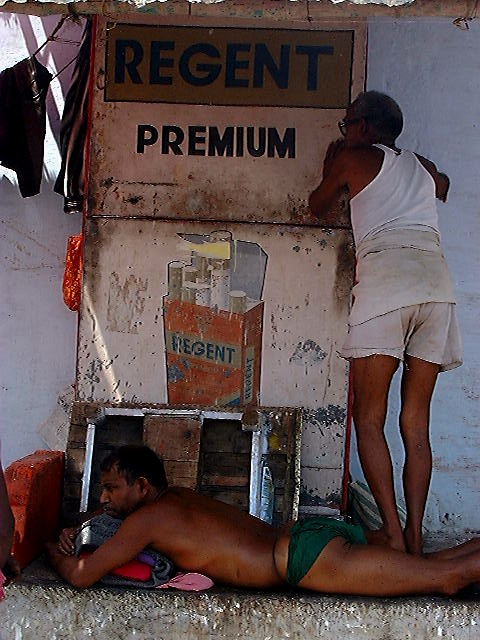
Massage i Varanasi – © Photo Jan Öberg TFF 2001

För det första ville jag leva ett annat liv: se mitt eget liv, Sverige och väst utifrån och på avstånd, bli av med all materiell överflod, leva enkelt och fundera över vad jag själv håller på med, varva ned, vara öppen för intryck, flyta med i en lååångsam tidsrytm. Särskild mycket själafrid blev det, av skäl jag ska beskriva senare, egentligen inte; Skånes skogar och strand är nog bättre för det, men sedan har Indien ett och annat som Skåne saknar!

För det andra skulle jag hålla en kurs för unga tibetaner i norra Indien, i Dharamsala vid Himalayas fot. Under vägledning av det danska Center for Konfliktløsning ska de etablera en kursorganisation som ska hjälpa exiltibetanerna att bättre hantera sina egna konflikter och de konflikter de naturligt nog har med det indiska samhälle de lever i. Det gav mig tillfälle att förstå Tibet-frågan på ett nyttigt sätt – och inse hur stor, djup och olycklig den är och hur okunnig jag varit. Alltför länge åtminstone med tanke på mitt yrke som fredsforskare.

För det tredje har jag alltid velat besöka de platser som var av central betydelse för Mohandas K. Gandhi, som jag inte kallar Mahatma eller “Stor Själ”, därför att han hatade alla sådana beteckningar om sig själv. Samtidigt ville jag uppsöka forskare och folkrörelser, som arbetar i gandhiansk anda.

Det blev Delhi, Amritsar, Bombay, Puna, Sevagram, Ahmedabad (efter jordbävningen, dock), Surat, Dandi och Dharasana. Gandhi spelar i dag i allmänhet bara en symbolisk roll. Ändå betyder han fortfarande något för många på landsbygden. Rikspolitiker skulle säkert stoppat honom i fängelse om han levt i dag. Indien för i dag en politik som är en systematisk negation av allt Gandhi stod för. Och det, tror jag, är en huvudorsak till den tragedi jag vill hävda att dagens Indien också är.

För det fjärde kan man knappast göra en resa till Indien utan att dras till religionen, om än bara turistiskt. Varanasi är hinduismens centrum. Bodghaya och Rajgir är två av de viktigaste platserna för buddhismen. Här var det Shakyamuni vandrade runt, ägnade sig åt total askes men kom på bättre tankar för att sedan uppnå vishet under pipal- eller Bodhi-trädet i Bodghaya. I Sarnath utanför Varanasi började han sprida sin nyvunna livsfilosofi till lärjungarna.

Självfallet ville jag också besöka Det Gyllene Templet i Amritsar i Punjab, för att förstå litet av sikhismen som kan sägas vara en blandning av hinduism och islam. Och slutligen uppsökte jag alla de små jain-tempel jag kunde. Jainismen är den mest asketiska och ickevåldsliga av alla religioner; det finns jainister som sopar framför sig för att undvika att trampa på något levande! Men jaintemplen är underbart oasketiska med fantastiska figurer, färger, klockor och mystik.

Slutligen för det femte: Indien, min kuliss för de fyra andra resorna. Resten av världen kommer inte undan. Du kan inte lämna det därhän. Vad Indiens miljardbefolkning väljer att göra i dag och i morgon kommer – som i Kinas fall – att påverka resten av världen. Jag valde att vara en egensinnig turist. De flesta turister kommer i grupp, bussas runt med guider, tar flyget över väldiga avstånd mellan storstäderna. Andra tar sig runt mest på egen hand men hyr bilar med guide eller köper lokala paketresor.

Jag valde att försöka leva och resa mer “indiskt;” genom att fixa min resa själv, färdas med tåg och landsvägsbussar, hitta biljetter och övernattning med hjälp av Lonely Planet-bibeln och lokala (miss)informatörer. På det sättet träffade jag folk av alla de slag och tvingades leva i ett slags lokal rytm; genomsnittshastigheten med landvägsbuss är 20-30 kilometer i timman, med expresståg 50-60. Det är totalt frustrerande i början, sedan upptäcker man att man mår bra av det.

Att resa ut ur sitt normala liv och in i en annan värld är egentligen ett fascinerande dubbelliv. Uppmärksamheten skärps, livet får spänst. Att skriva om en sådan resa är faktiskt ett sätt att förlänga livet på. Följ med men gör framför allt en resa själv!

Peace & future researcher + ‌Art Photographer

Related Posts

LONDON – So far so good, at least on the wider level. While internally Iraq seems on the edge of chaos, the much heralded clash of civilizations between the Muslim and Judaeo-Christian worlds has yet to become apparent. We have anger and despair aplenty in the Arab and Muslim worlds. But very little rushing to the standard and there was no great pilgrimage of warriors to join the fight, as happened when the Soviet Union invaded Afghanistan twenty years ago, and then, having driven the Red Army out, were left to ferment in that mountainous redoubt. With the armaments supplied by the CIA the mujahidin were transformed into Al Qaeda that became, for a relatively brief moment as these things go, ‘the greatest threat to the homeland that America has ever known.’ Nevertheless a ‘Cold War’ between much of the Muslim world and the West is certainly in full swing. Winston...
The Challenge of Nuclear Weaponsin the Twenty-first CenturyA Path Forward The peoples and governments of the world face an urgent challenge relating to weaponry of mass destruction and particularly to nuclear weaponry.  At the crossroads of technology, terrorism, geopolitical ambition, and policies of preemption are new and potent dangers for humanity. Despite ending the nuclear standoff of the Cold War era, nuclear weaponry is again menacing the peoples of the world with catastrophic possibilities.  We recognize the need for any government to pursue its security interests in accordance with international law; and further, we recognize that distinctive threats to these interests now exist as a result of an active international terrorist network having declared war on the United States and its allies. Nonetheless, we reject the assessment of the current US administration that upgrading a reliance on nuclear weapons is in any sense justified as a response. We find it...
By Karin Wegestal MP, the Social Democratic Partyon behalf of the Swedish Committee for Solidarity with the Yugoslav People During the last decade, the Federal Republic of Yugoslavia has received more than 500,000 refugees from Croatia and Bosnia, and another 300,000 internally displaced persons, mainly from the province Kosovo and Metohia. For a country with about ten million inhabitants, such an influx of homeless people is obviously a very heavy burden – even under peaceful conditions. But in addition to that, the Federal Republic of Yugoslavia has been the subject to sanctions from the western powers for close to ten years and its infrastructure was badly hurt through Nato’s intense bombardment during 78 days in 1999. The result of all this is that Yugoslavia, once the most developed industrial country in Eastern Europe, is today the poorest country in Europe. In Serbia excluding Kosovo, with about ten million inhabitants and...

Recent Articles

Tony Robinson October 4, 2026 Violence is easy to recognise when someone is being beaten, shot or killed. It becomes more difficult when nobody is holding a weapon. Poverty, discrimination, exploitation and repression can restrict a human life just as effectively, although they do so in very different ways and with very different consequences. Simply adding more categories to an ever-growing list of forms of violence does not really solve the problem. The more interesting question is what all these different situations have in common and why it makes sense to describe them using the same word. Human beings do not simply react to what happens around them. They remember the past, imagine things that do not yet exist, make plans and undertake projects. Workers organise because they imagine different working conditions; people migrate because they imagine another life somewhere else; social movements emerge because people refuse to accept the...
It’s a matter of principles, courage, vision and pulling together – while the militarist world is falling apart… Peter Langille October 3, 2026 “Here, then, is the problem which we present to you, stark and dreadful and inescapable: Shall we put an end to the human race; or shall mankind renounce war?”The Bertrand Russell—Albert Einstein Manifesto, July 9, 1955 ⁕ The forecast for what’s ahead is worrisome. The sharp rise in armed conflicts over the past three years is adding to what was already the highest level in over seventy years. Genocides, which should be prevented are supported. A shared climate emergency that jeopardises survival is ignored. Diverse polls now suggest that people are war-weary, worried and interested in a more effective United Nations. And, there are viable policy options for a more secure world! Yet governments are doubling-down, betting on more war and investing heavily. If current trends persist,...
Johan Galtung 1930-2024October 2015 Published here on October 3, 2026 Let us focus on Civilization for conflict analysis and remedies. Major forms of disorder use violence; war is state organized violence. The most belligerent states are the United States of America and Israel, both with civilization roots. National Evangelism, the US Protestant Christian civilization– more national than evangelical–justifies US warfare as exceptionalism of a people chosen by God, with a manifest destiny to run the world. Orthodox Judaism justifies Israeli warfare to conquer and expand from Nile to Euphrates as a religious right and duty to the Eternal One. The third most belligerent country, the UK, no longer believes it is God-chosen but chosen by the USA; not quite the same but something. But the root cause of global disorder lies in the Occident–with Islam–seeing itself as the single, universal civilization valid for all at all times, all others being...

TFF on Substack

Discover and subscribe to more peace materials on TFF Substack

Most Popular

Tony Robinson October 4, 2026 Violence is easy to recognise when someone is being beaten, shot or killed. It becomes more difficult when nobody is holding a weapon. Poverty, discrimination, exploitation and repression can restrict a human life just as effectively, although they do so in very different ways and with very different consequences. Simply adding more categories to an ever-growing list of forms of violence does not really solve the problem. The more interesting question is what all these different situations have in common and why it makes sense to describe them using the same word. Human beings do not simply react to what happens around them. They remember the past, imagine things that do not yet exist, make plans and undertake projects. Workers organise because they imagine different working conditions; people migrate because they imagine another life somewhere else; social movements emerge because people refuse to accept the...
It’s a matter of principles, courage, vision and pulling together – while the militarist world is falling apart… Peter Langille October 3, 2026 “Here, then, is the problem which we present to you, stark and dreadful and inescapable: Shall we put an end to the human race; or shall mankind renounce war?”The Bertrand Russell—Albert Einstein Manifesto, July 9, 1955 ⁕ The forecast for what’s ahead is worrisome. The sharp rise in armed conflicts over the past three years is adding to what was already the highest level in over seventy years. Genocides, which should be prevented are supported. A shared climate emergency that jeopardises survival is ignored. Diverse polls now suggest that people are war-weary, worried and interested in a more effective United Nations. And, there are viable policy options for a more secure world! Yet governments are doubling-down, betting on more war and investing heavily. If current trends persist,...
Johan Galtung 1930-2024October 2015 Published here on October 3, 2026 Let us focus on Civilization for conflict analysis and remedies. Major forms of disorder use violence; war is state organized violence. The most belligerent states are the United States of America and Israel, both with civilization roots. National Evangelism, the US Protestant Christian civilization– more national than evangelical–justifies US warfare as exceptionalism of a people chosen by God, with a manifest destiny to run the world. Orthodox Judaism justifies Israeli warfare to conquer and expand from Nile to Euphrates as a religious right and duty to the Eternal One. The third most belligerent country, the UK, no longer believes it is God-chosen but chosen by the USA; not quite the same but something. But the root cause of global disorder lies in the Occident–with Islam–seeing itself as the single, universal civilization valid for all at all times, all others being...
Read More
Living-Peace-Sign-Budapest-copy
Tony Robinson October 4, 2026 Violence is easy to recognise when someone is being beaten, shot or killed. It becomes more difficult when nobody is holding a weapon. Poverty, discrimination, exploitation and repression can restrict a human life just as effectively, although they do so in very different ways and with very different consequences. Simply adding more categories to an ever-growing list of forms of violence does not really solve the problem. The more interesting question is what all these different situations have in common and why it makes sense to describe them using the same word. Human beings do not simply react to what happens around them. They remember the past, imagine things that do not yet exist, make plans and undertake projects. Workers organise because they imagine different working conditions; people migrate because they imagine another life somewhere else; social movements emerge because people refuse to accept the...
b54a1f10-8c65-4f0b-9dd5-4abc0a7d04cc_2659x2659
It’s a matter of principles, courage, vision and pulling together – while the militarist world is falling apart… Peter Langille October 3, 2026 “Here, then, is the problem which we present to you, stark and dreadful and inescapable: Shall we put an end to the human race; or shall mankind renounce war?”The Bertrand Russell—Albert Einstein Manifesto, July 9, 1955 ⁕ The forecast for what’s ahead is worrisome. The sharp rise in armed conflicts over the past three years is adding to what was already the highest level in over seventy years. Genocides, which should be prevented are supported. A shared climate emergency that jeopardises survival is ignored. Diverse polls now suggest that people are war-weary, worried and interested in a more effective United Nations. And, there are viable policy options for a more secure world! Yet governments are doubling-down, betting on more war and investing heavily. If current trends persist,...
010
Johan Galtung 1930-2024October 2015 Published here on October 3, 2026 Let us focus on Civilization for conflict analysis and remedies. Major forms of disorder use violence; war is state organized violence. The most belligerent states are the United States of America and Israel, both with civilization roots. National Evangelism, the US Protestant Christian civilization– more national than evangelical–justifies US warfare as exceptionalism of a people chosen by God, with a manifest destiny to run the world. Orthodox Judaism justifies Israeli warfare to conquer and expand from Nile to Euphrates as a religious right and duty to the Eternal One. The third most belligerent country, the UK, no longer believes it is God-chosen but chosen by the USA; not quite the same but something. But the root cause of global disorder lies in the Occident–with Islam–seeing itself as the single, universal civilization valid for all at all times, all others being...
Screenshot 2026-10-02 011738
Jan ObergPhD, director, The Transnational Foundation for Peace and Future Research, TFFLund, Sweden October 2, 2026 This is my full original manuscript. The Chinese Academy of Social Science, CASS, makes two publications out if it. 1. China’s Five-year plan emphasized the capabilities of basic research and original innovation. It is regarded as the goal of the future social development, which, as required, should be significantly enhanced. Can you comment on the importance of original innovation in research and academic study? I believe it is easier to define “original innovation” in the natural sciences than in social sciences. The breaking points of what constitutes something new, or innovative, are not quite as sharp in the latter. But in both fields it is about opening up something that was closed, unseen, unexplored before – making manifest what was earlier latent. Innovations come in many forms and shapes – naming something that was not...
arctic-circle-map
The agreement is catastrophic both because of what it says and what it doesn’t mention. It reduces further the major asset of security policies: Freedom of action. Jan Oberg TFF director September 25, 2026 A couple of hours before the agreement was signed on September 22, 2026, I published the following 13 hypotheses about what it would most likely contain on TFF Substack (in English). I was wrong on only the first point. Contrary to what Trump had written on his Truth Social platform, it does not appear to come into force immediately. In fact, it turned out to be worse than even I had anticipated. After these hypotheses now come a number of reflections in light of what the agreement actually contains, and does not contain, as well as the way in which it has generally been presented by major media outlets and by the public-service broadcaster DR. My...
girl-5894831_1280
Below are TFF-related media mentions, comments, videos and social media posts published elsewhere but not on this homepage. We happen to catch and list only a fraction. Regarding video comments and debates, we recommend that you go to the TFF Video Channel on Substack where many of them are reproduced. Jan Oberg is a contributor to China Daily – 52 million daily clicks – and Global Times, CGTN and CCTV (the national television), China Investment, Xinhua News Agency and several others. Articles and videos on these media very often multiply into countless Chinese (and Western media) that re-post them from these main media. Thanks to The China Academy, his analyses, interviews and comments are frequently posted on YouTube channels such as Thinkers Forum and Wave Media. These videos are often re-posted on Bilibili (China’s YouTube), the China Content Center on TikTok, and on the Chinese edition of TikTok, Douyin.com. This means reaching hundreds of millions of viewers worldwide over a year. While there are too many to catch on all these...




