
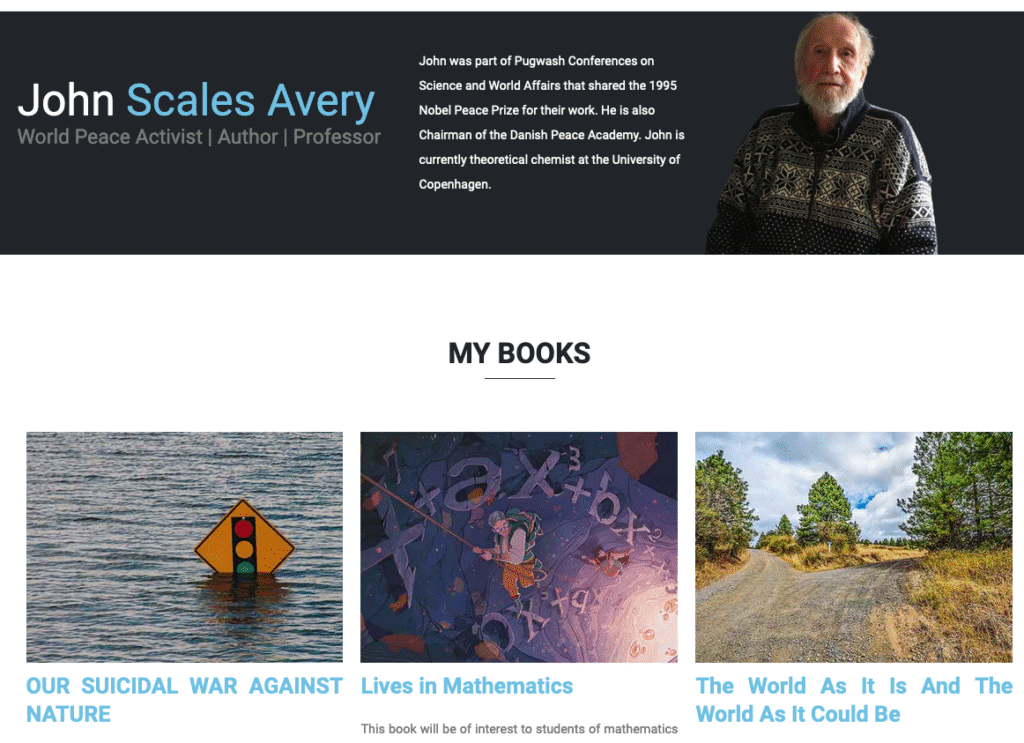
A new report, published on 14 March, 2021, in the Royal Swedish Academy of Sciences’ journal Ambio, points out that humanity is hurtling towards destruction unless we have the collective wisdom to change course quickly.

The Ambio article was written as part of the preparation of a meeting of Nobel Prize winners to discuss the state of the planet. The virtual meeting will be held on April 26-28, 2021.

We Must Achieve a Steady-State Economic System

A steady-state economic system is necessary because neither population growth nor economic growth can continue indefinitely on a finite earth. No one can maintain that exponential industrial growth is sustainable in the long run except by refusing to look more than a short  distance into the future.

Of course, it is necessary to distinguish between industrial growth, and growth of culture and knowledge, which can and should continue to grow.

Qualitative improvements in human society are possible and desirable, but resource-using and pollution-producing industrial growth is reaching its limits, both because of ecological constraints and because of the exhaustion of petroleum, natural gas and other non-renewable resources, such as metals. The threat of catastrophic climate change makes it imperative for us to stop using fossil fuels within very few years.

Entropy is a measure of disorder. Our present  economic system is unidirectional and entropic: Low-entropy resources are converted into high-entropy waste, a unidirectional process. By contrast, to be sustainable in the long run, a process must be cyclic, like the growth and regeneration of a forest.

We Must Decrease Economic Inequality

In his Apostolic Exhortation, “Evangelii Gaudium” Pope Francis said:

“In our time humanity is experiencing a turning-point in its history, as we can see from the advances being made in so many fields. We can only praise the steps being taken to improve people’s welfare in areas such as health care, education and communications. At the same time we have to remember that the majority of our contemporaries are barely living from day to day, with dire consequences. A number of diseases are spreading. The hearts of many people are gripped by fear and desperation, even in the so-called rich countries. The joy of living frequently fades, lack of respect for others and violence are on the rise, and inequality is increasingly evident. It is a struggle to live and, often, to live with precious little dignity.

“Just as the commandment `Thou shalt not kill’ sets a clear limit in order to safeguard the value of human life, today we also have to say `thou shalt not’ to an economy of exclusion and inequality. Such an economy kills. How can it be that it is not a news item when an elderly homeless person dies of exposure, but it is news when the stock market loses two points? This is a case of exclusion.

“Can we continue to stand by when food is thrown away while people are starving? This is a case of inequality. Today everything comes under the laws of competition and the survival of the fittest, where the powerful feed upon the powerless. As a consequence, masses of people find themselves excluded and marginalized: without work, without possibilities, without any means of escape.”

The social epidemiologist Prof. Richard Wilkinson, has documented the ways in which societies with less economic inequality do better than more unequal societies in a number of areas, including increased rates of life expectancy, mathematical performance, literacy, trust, social mobility, together with decreased rates of infant mortality, homicides, imprisonment, teenage births, obesity and mental illness, as well as drug and alcohol addiction.

We must also remember that according to the economist John A. Hobson, the basic problem that led to imperialism was an excessively unequal distribution of incomes in the industrialized countries.

The result of this unequal distribution was that neither the rich nor the poor could buy back the total output of their society. The incomes of the poor were insufficient, and rich were too few in number. Thus governments were forced to look for markets in the less developed parts of the world.

We Must Break the Power of Corporate Greed

When the United Nations was established in 1945, the purpose of the organization was to abolish the institution of war. This goal was built into many of the articles of the UN Charter. Accordingly, throughout the world, many War Departments were renamed and became Departments of Defense.

But the very name is a lie. In an age of nuclear threats and counter-threats, populations are by no means protected. Ordinary citizens are just hostages in a game for power and money. It is all about greed.

Why is war continually threatened? Why is Russia threatened? Why is war with Iran threatened? Why fan the flames of conflict with China? Is it to “protect” civilians? Absolutely not! In a thermonuclear war, hundreds of millions of civilians would die horribly everywhere in the world, also in neutral countries.

What is really being protected are the profits of arms manufacturers. As long as there are tensions; as long as there is a threat of war, military budgets are safe; and the profits of arms makers are safe. The people in several “democracies”, for example the United States, do not rule at the moment. Greed rules.

As Professor Noam Chomsky has pointed out, greed and lack of ethics are built into the structure of corporations. By law, the Chief Executive Officer of a corporation must be entirely motivated by the collective greed of the stockholders.

He must maximize profits. If the CEO abandons this single-minded chase after corporate profits for ethical reasons, or for the sake of humanity or the biosphere or the future, he (or she) must, by law, be fired and replaced.

We Must Leave Fossil Fuels in the Ground

The threat of catastrophic climate change requires prompt and dedicated action by the global community. Unless we very quickly make the transition from fossil fuels to 100% renewable energy, we will reach a tipping point after which uncontrollable feedback loops could take over, leading to a human-caused 6th geological extinction event.

This might even be comparable to the Permian-Triassic event, during which 96% of all marine species and 70% of terrestrial vertebrates became extinct.

Arctic sea-ice is melting at an increasingly rapid rate, because of several feedback loops. One of these feedback loops, called the albedo effect, is due to the fact that white snow-covered sea-ice in the Arctic reflects sunlight, while dark water absorbs it, raising the temperature and leading to more melting.

Another feedback loop is due to the fact that rising temperatures mean that more water is evaporated. The water vapor in the atmosphere acts like a greenhouse gas, and raises the temperature still further.

If we consider long-term effects, by far the most dangerous of the feedback loops is the melting of methane hydrate crystals and the release of methane into the atmosphere, where its effects as a greenhouse gas are roughly twenty times greater than those of CO2.

When organic matter is carried into the oceans by rivers, it decays to form methane. The methane then combines with water to form hydrate crystals, which are stable at the temperatures which currently exist on ocean floors. However, if the temperature rises, the crystals become unstable, and methane gas bubbles up to the surface.

The worrying thing about methane hydrate deposits on ocean floors is the enormous amount of carbon involved: roughly 10,000 gigatons. To put this huge amount into perspective, we can remember that the total amount in world CO2 emissions since 1751 has been only 337 gigatons.

Hope for the future comes from the exponential growth of renewable energy. Governments and banks must aid this growth, and they must end the support that they give to fossil fuel corporations.

Ecological Economics

In the future, ecology must be incorporated into economic theory. The human economy is a part of the global environment, rather than the reverse. Human society cannot prosper while the environment suffers. Economists must acknowledge this fact. We need a new economic system, one that has both a social conscience and an ecological conscience

Related Posts

Photo above: Carl Fredrik Reuterswärd’s Non-Violence outside UN Headquarters in New York. Kirill Levin, CC BY-NC-SA 2. Jan Oberg November 3, 2026 I am happy to be published in Horizons which is produced by the Center for International Relations and Sustainable Development, CIRSD, in Belgrade. My contribution brings out a radical re-thinking of what concepts such as defence, security, deterrence – and peace – may mean if we want to create a more peaceful world. It also summarises a few things I have been working with the last few decades. Please read it here Og her er den på dansk, takket være Johnny Baltzersens lynhurtige oversættelse
UNITE-tillid, DREAM-velstand og andre konstruktive komponenter Normally we publish articles in English here. But this is a translation of a very important TFF document that should reach as many as possible in Denmark since this country’s government has been one of the most hardline in Europe and, up till now at least, has refused to use diplomacy and, instead, spent tremendous sums on arming Ukraine with the express goal of defeating Russia. Thus this – unique – article is in Danish. Vi er Johnny Baltzersen og hans Fælles Sikkerhed – Fælles Fremtid på Substack overmåde taknemmelige for at have oversat og publiceret TFF’s 2025-portfølje for fredsidéer med henblik på Ukraines fremtid. Vi håber den nu kan nå mange flere danskere – som også vil sprede den og skabe debat – nu den danske regerings og folketingspartiernes politik på dette område siden 2022 står nu – forudsigeligt – ved vejs ende....
Jan Oberg TFF director October 28, 2026 Exactly one month has now passed since I published my criticism of the introduction to the special issue on Johan Galtung published by the Journal of Global Security Studies, JoGSS, and of Tor Egil Førland’s chapter about Galtung which serves as a preview to his forthcoming biography of Galtung to be published by PRIO. See the original on The Transnational here and the same article on TFF Substack with many general and critical comments and, in particular, the people who decided to withdraw from the biography project in protest. The special issue itself was extraordinary. It was devoted to the intellectual legacy of one of the founders of peace research and contained a number of strong assessments of his personality, scholarship, intellectual trajectory, and public role. Such assessments are, of course, entirely legitimate. No scholar is beyond criticism, and neither was Johan Galtung....

Recent Articles

Photo above: Carl Fredrik Reuterswärd’s Non-Violence outside UN Headquarters in New York. Kirill Levin, CC BY-NC-SA 2. Jan Oberg November 3, 2026 I am happy to be published in Horizons which is produced by the Center for International Relations and Sustainable Development, CIRSD, in Belgrade. My contribution brings out a radical re-thinking of what concepts such as defence, security, deterrence – and peace – may mean if we want to create a more peaceful world. It also summarises a few things I have been working with the last few decades. Please read it here Og her er den på dansk, takket være Johnny Baltzersens lynhurtige oversættelse
UNITE-tillid, DREAM-velstand og andre konstruktive komponenter Normally we publish articles in English here. But this is a translation of a very important TFF document that should reach as many as possible in Denmark since this country’s government has been one of the most hardline in Europe and, up till now at least, has refused to use diplomacy and, instead, spent tremendous sums on arming Ukraine with the express goal of defeating Russia. Thus this – unique – article is in Danish. Vi er Johnny Baltzersen og hans Fælles Sikkerhed – Fælles Fremtid på Substack overmåde taknemmelige for at have oversat og publiceret TFF’s 2025-portfølje for fredsidéer med henblik på Ukraines fremtid. Vi håber den nu kan nå mange flere danskere – som også vil sprede den og skabe debat – nu den danske regerings og folketingspartiernes politik på dette område siden 2022 står nu – forudsigeligt – ved vejs ende....
Jan Oberg TFF director October 28, 2026 Exactly one month has now passed since I published my criticism of the introduction to the special issue on Johan Galtung published by the Journal of Global Security Studies, JoGSS, and of Tor Egil Førland’s chapter about Galtung which serves as a preview to his forthcoming biography of Galtung to be published by PRIO. See the original on The Transnational here and the same article on TFF Substack with many general and critical comments and, in particular, the people who decided to withdraw from the biography project in protest. The special issue itself was extraordinary. It was devoted to the intellectual legacy of one of the founders of peace research and contained a number of strong assessments of his personality, scholarship, intellectual trajectory, and public role. Such assessments are, of course, entirely legitimate. No scholar is beyond criticism, and neither was Johan Galtung....

TFF on Substack

Discover and subscribe to more peace materials on TFF Substack

Most Popular

Photo above: Carl Fredrik Reuterswärd’s Non-Violence outside UN Headquarters in New York. Kirill Levin, CC BY-NC-SA 2. Jan Oberg November 3, 2026 I am happy to be published in Horizons which is produced by the Center for International Relations and Sustainable Development, CIRSD, in Belgrade. My contribution brings out a radical re-thinking of what concepts such as defence, security, deterrence – and peace – may mean if we want to create a more peaceful world. It also summarises a few things I have been working with the last few decades. Please read it here Og her er den på dansk, takket være Johnny Baltzersens lynhurtige oversættelse
UNITE-tillid, DREAM-velstand og andre konstruktive komponenter Normally we publish articles in English here. But this is a translation of a very important TFF document that should reach as many as possible in Denmark since this country’s government has been one of the most hardline in Europe and, up till now at least, has refused to use diplomacy and, instead, spent tremendous sums on arming Ukraine with the express goal of defeating Russia. Thus this – unique – article is in Danish. Vi er Johnny Baltzersen og hans Fælles Sikkerhed – Fælles Fremtid på Substack overmåde taknemmelige for at have oversat og publiceret TFF’s 2025-portfølje for fredsidéer med henblik på Ukraines fremtid. Vi håber den nu kan nå mange flere danskere – som også vil sprede den og skabe debat – nu den danske regerings og folketingspartiernes politik på dette område siden 2022 står nu – forudsigeligt – ved vejs ende....
Jan Oberg TFF director October 28, 2026 Exactly one month has now passed since I published my criticism of the introduction to the special issue on Johan Galtung published by the Journal of Global Security Studies, JoGSS, and of Tor Egil Førland’s chapter about Galtung which serves as a preview to his forthcoming biography of Galtung to be published by PRIO. See the original on The Transnational here and the same article on TFF Substack with many general and critical comments and, in particular, the people who decided to withdraw from the biography project in protest. The special issue itself was extraordinary. It was devoted to the intellectual legacy of one of the founders of peace research and contained a number of strong assessments of his personality, scholarship, intellectual trajectory, and public role. Such assessments are, of course, entirely legitimate. No scholar is beyond criticism, and neither was Johan Galtung....
Read More
knotted gun
Photo above: Carl Fredrik Reuterswärd’s Non-Violence outside UN Headquarters in New York. Kirill Levin, CC BY-NC-SA 2. Jan Oberg November 3, 2026 I am happy to be published in Horizons which is produced by the Center for International Relations and Sustainable Development, CIRSD, in Belgrade. My contribution brings out a radical re-thinking of what concepts such as defence, security, deterrence – and peace – may mean if we want to create a more peaceful world. It also summarises a few things I have been working with the last few decades. Please read it here Og her er den på dansk, takket være Johnny Baltzersens lynhurtige oversættelse
TFFPortfolioVign
UNITE-tillid, DREAM-velstand og andre konstruktive komponenter Normally we publish articles in English here. But this is a translation of a very important TFF document that should reach as many as possible in Denmark since this country’s government has been one of the most hardline in Europe and, up till now at least, has refused to use diplomacy and, instead, spent tremendous sums on arming Ukraine with the express goal of defeating Russia. Thus this – unique – article is in Danish. Vi er Johnny Baltzersen og hans Fælles Sikkerhed – Fælles Fremtid på Substack overmåde taknemmelige for at have oversat og publiceret TFF’s 2025-portfølje for fredsidéer med henblik på Ukraines fremtid. Vi håber den nu kan nå mange flere danskere – som også vil sprede den og skabe debat – nu den danske regerings og folketingspartiernes politik på dette område siden 2022 står nu – forudsigeligt – ved vejs ende....
JoGSS-Silent
Jan Oberg TFF director October 28, 2026 Exactly one month has now passed since I published my criticism of the introduction to the special issue on Johan Galtung published by the Journal of Global Security Studies, JoGSS, and of Tor Egil Førland’s chapter about Galtung which serves as a preview to his forthcoming biography of Galtung to be published by PRIO. See the original on The Transnational here and the same article on TFF Substack with many general and critical comments and, in particular, the people who decided to withdraw from the biography project in protest. The special issue itself was extraordinary. It was devoted to the intellectual legacy of one of the founders of peace research and contained a number of strong assessments of his personality, scholarship, intellectual trajectory, and public role. Such assessments are, of course, entirely legitimate. No scholar is beyond criticism, and neither was Johan Galtung....
Screenshot 2026-10-26 115647
An aspect of Iran’s culture and civilisation you’ve probably never heard about. Don’t be surprised if the US and Israel also try to bomb them. Jan ObergTFF director October 26, 2026 Today – under the “USraeli” threat of new “annihilating” bombings – opens the 7th International Conference on Peace and Conflict Resolution at Tehran’s University. As far as I can tell, this is the only permanent, advanced peace research institution in West Asia/the Middle East. Perhaps more countries in that region could be inspired? I mean, how many military “security” institutes and military academies do they have? Many peace research institutes and university departments have been established since the 1950s in the West. They are now all under attack; some have closed down, some have gone mainstream, yet others kept the name but do nothing to research peace and disseminate results or advice; instead, they cooperate with militarism’s platforms such...
Screenshot 2026-10-15 141837
Let’s discuss using AI to create peace – in contrast to boring geopolitics devoid of creative healing and visions. Jan Oberg TFF director October 15, 2026 I asked VEED to create a short video exemplifying how peace is preferable to war, then chose the lady as a template. Simple as that. In less than a minute, it produced this video, which any peace-loving person would appreciate. The only problem is that human intelligence (HI), at least the one that exists among Western decision-makers, isn’t half as moral or smart as AI. I have used AI to dialogue about peace and peace plans, creative conflict resolution and visions of a better future for humankind. It so happens that I am having more stimulating, intelligent, creative and moral discussions with AI than I could possibly have with any EU or NATO leader today. Yes, AI has very problematic and dangerous aspects; used...
girl-5894831_1280
Below are TFF-related media mentions, comments, videos and social media posts published elsewhere but not on this homepage. We happen to catch and list only a fraction. Regarding video comments and debates, we recommend that you go to the TFF Video Channel on Substack where many of them are reproduced. Jan Oberg is a contributor to China Daily – 52 million daily clicks – and Global Times, CGTN and CCTV (the national television), China Investment, Xinhua News Agency and several others. Articles and videos on these media very often multiply into countless Chinese (and Western media) that re-post them from these main media. Thanks to The China Academy, his analyses, interviews and comments are frequently posted on YouTube channels such as Thinkers Forum and Wave Media. These videos are often re-posted on Bilibili (China’s YouTube), the China Content Center on TikTok, and on the Chinese edition of TikTok, Douyin.com. This means reaching hundreds of millions of viewers worldwide over a year. While there are too many to catch on all these...




