
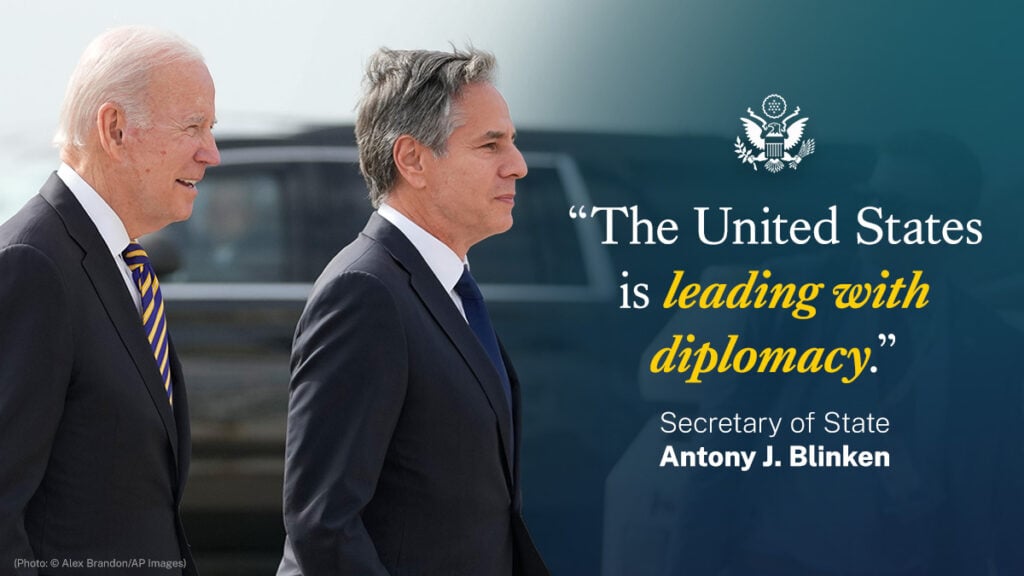
How Blinken turned the diplomatic corps into a wing of the military

Ted Snider

October 9, 2024

It is said that Henry Kissinger asserted that little can be won at the negotiating table that isn’t earned on the battlefield.

In several wars in recent weeks, U.S. officials have echoed that approach. State Department spokesperson Matthew Miller recently said that the U.S. “supports[s] a ceasefire” in Lebanon while simultaneously recognizing that “military pressure can at times enable diplomacy.” Meanwhile, Secretary of State Antony Blinken has expressed the doctrine as doing “all that we can to strengthen Ukraine’s position on the battlefield so it has the strongest possible position at the negotiating table.”

This article was published first by Responsible Statecraft on October 8, 2024 here

But during the Biden administration, the iteration of Kissinger’s doctrine has gone well beyond the generals supporting the diplomats. The diplomats are now outpacing and pushing the generals. In the Biden administration, despite the promise to open “a new era of relentless diplomacy,” the State Department has metamorphosized into the hawkish arm of the Pentagon.

In the debate within the Biden administration over whether permission should be granted for Ukraine to fire Western-supplied long-range missiles deeper into Russian territory, it is the diplomats who have pushed for escalation, and the Pentagon and intelligence community who have argued for caution.

Blinken has promised that “from day one… as what Russia is doing has changed, as the battlefield has changed, we’ve adapted… And I can tell you that as we go forward, we will do exactly what we have already done, which is we will adjust, we’ll adapt as necessary, including with regard to the means that are at Ukraine’s disposal to effectively defend against the Russian aggression.”

It is the Pentagon that has counseled restraint. They have argued that the uncertain benefits of longer range strikes do not outweigh the risk of escalation. Secretary of Defense Lloyd Austin has maintained that “long-range strikes into Russia would not turn the tide of the war in Ukraine’s favor,” and agrees with the intelligence community that Russia is capable of quickly moving most of its assets out of range.

This is not the first time the debate on escalation has featured unexpected sides. While, soon after Russia’s invasion of Ukraine, the State Department argued that “real diplomacy” does not take place at times of aggression, it was General Mark Milley, the Chairman of the Joint Chiefs of Staff, who advocated for diplomacy and said that the goal of a sovereign Ukraine with its territory intact would require “a long, very difficult, high casualty-producing war.”

Milley further argued that “You can achieve those objectives through military means…. but you can also achieve those objectives maybe possibly, through some sort of diplomatic means.” Once again, it was the top general who advocated for diplomacy while the top diplomat argued for more war.

It is also not the first debate on long-range missiles. On May 15, before the U.S. had approved even limited longer-range strikes into Russia, it was the State Department that first floated giving the green light. Asked about the U.S. ban on Ukraine’s use of American equipment to strike into Russian territory, Blinken replied that, “We have not encouraged or enabled strikes outside of Ukraine,” before adding, “but ultimately Ukraine has to make decisions for itself about how it’s going to conduct this war…. these are decisions that Ukraine has to make, Ukraine will make for itself.”

The State Department has from the start abdicated diplomacy. We know that on December 17, 2021, Putin proposed security guarantees to the United States with a key demand of no NATO expansion to Ukraine. But rather than negotiate, Derek Chollet, counselor to Secretary Blinken, later revealed that the U.S. at the time did not consider NATO expansion to be on the bargaining table.

At the end of a full term in office, the Blinken State Department does not have a single diplomatic victory to boast about. At the start of his term, Biden promised to “offer Tehran a credible path back to diplomacy.” He promised he would “promptly reverse the failed Trump policies that have inflicted harm on the Cuban people and done nothing to advance democracy and human rights.” He promised a different foreign policy than Trump’s “abject failure” in Venezuela. And he promised a new approach to North Korea that “is open to and will explore diplomacy.”

The Blinken State Department has delivered on none of these promises and has failed to attain a ceasefire in Gaza or in Ukraine. Instead, it has availed itself of a one tool tool box of coercion, be it sanctions or military force. It has fallen to the Pentagon to suggest diplomacy and to question unrestricted use of force.

Meanwhile, it was General Charles Q. Brown Jr., the chairman of the Joint Chiefs of Staff, and other senior Pentagon officials who recently raised the question at the White House of whether over-reliance on military force has emboldened America’s partners to be increasingly aggressive and cross American red lines.

Diplomacy has often in the past partnered with military force. But in the Biden administration, the State Department has abdicated diplomacy and reduced itself to the hawkish arm of the Pentagon which has, paradoxically, been the louder voice for diplomacy.
Ted Snider

Ted Snider is a regular columnist on U.S. foreign policy and history at Antiwar.com and The Libertarian Institute. He is also a frequent contributor to Responsible Statecraft and other outlets.

Please support TFF, which continues to bring you truthful, pro-peace public education based on decades of research by some of the world’s most experienced professionals.
Press this read peace button.
Thanks!


Related Posts

A friendly quarrel while we agree that the US sanctions are a weapon of mass destruction and kill more people than wars do. And that we must talk much more about sanctions than we have so far. Jan Oberg, TFF director March 16, 2026 John Mearsheimer recently stated that U.S. sanctions murdered around 38 million people between 1971 and 2021 – see the video below. It is a dramatic figure, and it has spread quickly because it captures, in one sentence, the enormous human cost of modern sanctions. I share his concern about the destructive effects of economic coercion. But the specific number he cites — and the way he attributes it — deserves a friendly academic clarification. The figure comes from a 2023 Lancet Global Health article estimating the mortality effects of unilateral U.S. and EU sanctions over the past half‑century. This is the first point where Mearsheimer’s shorthand diverges from the text: the study...
The MSC’s closed groupthink militarism offers only one prescription — more weapons — even as record military expenditures, squeezed from taxpayers in economic crisis, destroy diplomacy and drive escalation to the highest war risks in decades. Jan Oberg TFF director February 13, 2026 From Dialogue Forum to Militarised Ritual For decades, the Munich Security Conference (MSC) – which opened today and runs till Sunday – was one of the few places where adversaries could meet without theatrics. Founded in 1963 as the Wehrkundetagung, it served as a discreet Cold War dialogue forum between NATO and the Warsaw Pact. Even at moments of high tension, Soviet and later Russian representatives were present, and Munich allowed uncomfortable messages to be delivered directly rather than through press releases or military manoeuvres. That era has vanished. The MSC has become something entirely different: a €13–20 million annual gathering of a closed Western security elite, a polished meeting...
By Jan ObergTFF co-founder and director February 11, 2026 PART 3 — ECONOMICS, TRADE & FINANCIAL SOVEREIGNTY A. Trade Measures & Market Signaling Economic pressure can be applied instantly and scaled without violence. Immediate Measures (within a week) Government boycott US goods and services  A very powerful signal which over time will be felt. Targeted tariffs on selected U.S. goods Symbolic but high-visibility sectors send a clear message. Suspend trade facilitation talks A peaceful pause that signals deep concern. Freeze U.S. participation in public procurement – military procurement in particular A nonviolent way to reduce influence. Competition law review of U.S. corporations A legal tool to scrutinise market dominance. Longer-Term Measures EU–Asia–Africa trade corridors Reducing reliance on U.S. markets. European supply chains for critical minerals Strategic autonomy in resource access. European Strategic Trade Authority Monitoring coercive practices globally. Euro-denominated commodity markets Weakening the dollar’s pricing monopoly. The EU must resume contacts and negotiations with Russia, focusing on energy cooperation To...

Recent Articles

Tony Robinson October 4, 2026 Violence is easy to recognise when someone is being beaten, shot or killed. It becomes more difficult when nobody is holding a weapon. Poverty, discrimination, exploitation and repression can restrict a human life just as effectively, although they do so in very different ways and with very different consequences. Simply adding more categories to an ever-growing list of forms of violence does not really solve the problem. The more interesting question is what all these different situations have in common and why it makes sense to describe them using the same word. Human beings do not simply react to what happens around them. They remember the past, imagine things that do not yet exist, make plans and undertake projects. Workers organise because they imagine different working conditions; people migrate because they imagine another life somewhere else; social movements emerge because people refuse to accept the...
It’s a matter of principles, courage, vision and pulling together – while the militarist world is falling apart… Peter Langille October 3, 2026 “Here, then, is the problem which we present to you, stark and dreadful and inescapable: Shall we put an end to the human race; or shall mankind renounce war?”The Bertrand Russell—Albert Einstein Manifesto, July 9, 1955 ⁕ The forecast for what’s ahead is worrisome. The sharp rise in armed conflicts over the past three years is adding to what was already the highest level in over seventy years. Genocides, which should be prevented are supported. A shared climate emergency that jeopardises survival is ignored. Diverse polls now suggest that people are war-weary, worried and interested in a more effective United Nations. And, there are viable policy options for a more secure world! Yet governments are doubling-down, betting on more war and investing heavily. If current trends persist,...
Johan Galtung 1930-2024October 2015 Published here on October 3, 2026 Let us focus on Civilization for conflict analysis and remedies. Major forms of disorder use violence; war is state organized violence. The most belligerent states are the United States of America and Israel, both with civilization roots. National Evangelism, the US Protestant Christian civilization– more national than evangelical–justifies US warfare as exceptionalism of a people chosen by God, with a manifest destiny to run the world. Orthodox Judaism justifies Israeli warfare to conquer and expand from Nile to Euphrates as a religious right and duty to the Eternal One. The third most belligerent country, the UK, no longer believes it is God-chosen but chosen by the USA; not quite the same but something. But the root cause of global disorder lies in the Occident–with Islam–seeing itself as the single, universal civilization valid for all at all times, all others being...

TFF on Substack

Discover and subscribe to more peace materials on TFF Substack

Most Popular

Tony Robinson October 4, 2026 Violence is easy to recognise when someone is being beaten, shot or killed. It becomes more difficult when nobody is holding a weapon. Poverty, discrimination, exploitation and repression can restrict a human life just as effectively, although they do so in very different ways and with very different consequences. Simply adding more categories to an ever-growing list of forms of violence does not really solve the problem. The more interesting question is what all these different situations have in common and why it makes sense to describe them using the same word. Human beings do not simply react to what happens around them. They remember the past, imagine things that do not yet exist, make plans and undertake projects. Workers organise because they imagine different working conditions; people migrate because they imagine another life somewhere else; social movements emerge because people refuse to accept the...
It’s a matter of principles, courage, vision and pulling together – while the militarist world is falling apart… Peter Langille October 3, 2026 “Here, then, is the problem which we present to you, stark and dreadful and inescapable: Shall we put an end to the human race; or shall mankind renounce war?”The Bertrand Russell—Albert Einstein Manifesto, July 9, 1955 ⁕ The forecast for what’s ahead is worrisome. The sharp rise in armed conflicts over the past three years is adding to what was already the highest level in over seventy years. Genocides, which should be prevented are supported. A shared climate emergency that jeopardises survival is ignored. Diverse polls now suggest that people are war-weary, worried and interested in a more effective United Nations. And, there are viable policy options for a more secure world! Yet governments are doubling-down, betting on more war and investing heavily. If current trends persist,...
Johan Galtung 1930-2024October 2015 Published here on October 3, 2026 Let us focus on Civilization for conflict analysis and remedies. Major forms of disorder use violence; war is state organized violence. The most belligerent states are the United States of America and Israel, both with civilization roots. National Evangelism, the US Protestant Christian civilization– more national than evangelical–justifies US warfare as exceptionalism of a people chosen by God, with a manifest destiny to run the world. Orthodox Judaism justifies Israeli warfare to conquer and expand from Nile to Euphrates as a religious right and duty to the Eternal One. The third most belligerent country, the UK, no longer believes it is God-chosen but chosen by the USA; not quite the same but something. But the root cause of global disorder lies in the Occident–with Islam–seeing itself as the single, universal civilization valid for all at all times, all others being...
Read More
Living-Peace-Sign-Budapest-copy
Tony Robinson October 4, 2026 Violence is easy to recognise when someone is being beaten, shot or killed. It becomes more difficult when nobody is holding a weapon. Poverty, discrimination, exploitation and repression can restrict a human life just as effectively, although they do so in very different ways and with very different consequences. Simply adding more categories to an ever-growing list of forms of violence does not really solve the problem. The more interesting question is what all these different situations have in common and why it makes sense to describe them using the same word. Human beings do not simply react to what happens around them. They remember the past, imagine things that do not yet exist, make plans and undertake projects. Workers organise because they imagine different working conditions; people migrate because they imagine another life somewhere else; social movements emerge because people refuse to accept the...
b54a1f10-8c65-4f0b-9dd5-4abc0a7d04cc_2659x2659
It’s a matter of principles, courage, vision and pulling together – while the militarist world is falling apart… Peter Langille October 3, 2026 “Here, then, is the problem which we present to you, stark and dreadful and inescapable: Shall we put an end to the human race; or shall mankind renounce war?”The Bertrand Russell—Albert Einstein Manifesto, July 9, 1955 ⁕ The forecast for what’s ahead is worrisome. The sharp rise in armed conflicts over the past three years is adding to what was already the highest level in over seventy years. Genocides, which should be prevented are supported. A shared climate emergency that jeopardises survival is ignored. Diverse polls now suggest that people are war-weary, worried and interested in a more effective United Nations. And, there are viable policy options for a more secure world! Yet governments are doubling-down, betting on more war and investing heavily. If current trends persist,...
010
Johan Galtung 1930-2024October 2015 Published here on October 3, 2026 Let us focus on Civilization for conflict analysis and remedies. Major forms of disorder use violence; war is state organized violence. The most belligerent states are the United States of America and Israel, both with civilization roots. National Evangelism, the US Protestant Christian civilization– more national than evangelical–justifies US warfare as exceptionalism of a people chosen by God, with a manifest destiny to run the world. Orthodox Judaism justifies Israeli warfare to conquer and expand from Nile to Euphrates as a religious right and duty to the Eternal One. The third most belligerent country, the UK, no longer believes it is God-chosen but chosen by the USA; not quite the same but something. But the root cause of global disorder lies in the Occident–with Islam–seeing itself as the single, universal civilization valid for all at all times, all others being...
Screenshot 2026-10-02 011738
Jan ObergPhD, director, The Transnational Foundation for Peace and Future Research, TFFLund, Sweden October 2, 2026 This is my full original manuscript. The Chinese Academy of Social Science, CASS, makes two publications out if it. 1. China’s Five-year plan emphasized the capabilities of basic research and original innovation. It is regarded as the goal of the future social development, which, as required, should be significantly enhanced. Can you comment on the importance of original innovation in research and academic study? I believe it is easier to define “original innovation” in the natural sciences than in social sciences. The breaking points of what constitutes something new, or innovative, are not quite as sharp in the latter. But in both fields it is about opening up something that was closed, unseen, unexplored before – making manifest what was earlier latent. Innovations come in many forms and shapes – naming something that was not...
arctic-circle-map
The agreement is catastrophic both because of what it says and what it doesn’t mention. It reduces further the major asset of security policies: Freedom of action. Jan Oberg TFF director September 25, 2026 A couple of hours before the agreement was signed on September 22, 2026, I published the following 13 hypotheses about what it would most likely contain on TFF Substack (in English). I was wrong on only the first point. Contrary to what Trump had written on his Truth Social platform, it does not appear to come into force immediately. In fact, it turned out to be worse than even I had anticipated. After these hypotheses now come a number of reflections in light of what the agreement actually contains, and does not contain, as well as the way in which it has generally been presented by major media outlets and by the public-service broadcaster DR. My...
girl-5894831_1280
Below are TFF-related media mentions, comments, videos and social media posts published elsewhere but not on this homepage. We happen to catch and list only a fraction. Regarding video comments and debates, we recommend that you go to the TFF Video Channel on Substack where many of them are reproduced. Jan Oberg is a contributor to China Daily – 52 million daily clicks – and Global Times, CGTN and CCTV (the national television), China Investment, Xinhua News Agency and several others. Articles and videos on these media very often multiply into countless Chinese (and Western media) that re-post them from these main media. Thanks to The China Academy, his analyses, interviews and comments are frequently posted on YouTube channels such as Thinkers Forum and Wave Media. These videos are often re-posted on Bilibili (China’s YouTube), the China Content Center on TikTok, and on the Chinese edition of TikTok, Douyin.com. This means reaching hundreds of millions of viewers worldwide over a year. While there are too many to catch on all these...




