
Preliminary Notes
This post devoted to health and human rights in Gaza. It is based on a video presentation some weeks ago to a conference on this theme held in Gaza. It makes no effort to update by reference to the latest cycle of violence sparked by the targeted assassination of Baha Abu-Ata, an Islamic Jihad military commander, on November 12. I feel strongly about the issues raised by this post not only because I have witnessed living conditions in Gaza and have friends in Gaza who have endured hardship and injustice for so long without losing their warmth or even their hope. My contacts with Gaza and Gazans over the course of many years has been at once inspirational and deeply dispiriting, a deep insight into the deficiencies of the human condition coupled with an uplifting glimpse at the spiritual courage of those so severely victimized.
Reflecting on the terrifying destiny bestowed upon the people of Gaza, I became ashamed of stultifying silences, especially of those governments and their leaders in the region and those countries with a historical responsibility (the UK) and with geopolitical leverage (the US).
I also take alarmed note of the refusal of the mainstream media to accord attention to the misery so long endured by the people of Gaza. If ever the norm of ‘the responsibility to protect’ was applied according to humanitarian need, Gaza would be at the top of the list, but of course there is no list, and if ever there were one, given the present international atmosphere, Gaza would remain among the unlisted!
This neglect of the people of Gaza is so acute as to extend the web of criminal complicity far beyond the borders of Israel.
Health and Human Rights in Gaza: Shame on the World
I want to begin by offering my greetings to all those here today. I dearly wish that conditions in Gaza were different, enabling me to share the experience of the conference directly with you by taking part directly and actively. The theme of the conference touches the policies and practice of Israeli abuse that have been victimizing the people of Gaza for such a long time. The population of Gaza already faced a lamentable situation ever since the occupation began in 1967, but it has grown far worse since the Gaza elections of 2006, as reinforced by the changes in political administration that occurred in the following year.
Israel’s policies have been systematically cruel and abusive, disregarding the legal standards and moral values applicable to the behavior of an Occupying Power. These standards and values are embodied in International Humanitarian Law (IHL) and International Human Rights Law (IHRL).
Upholding the right to health is among the most fundamental of human rights, first articulated in the 1946 Constitution of the World Health Organization: “The right of everyone to the enjoyment of the highest attainable standard of physical and mental health.”
This right is further articulated in the Universal Declaration of Human Rights, especially in Article 25, and then put in a treaty form by the International Covenant on Economic, Social and Cultural Rights in 1966. The deliberate interference with the right to health is among the worst imaginable collective abuses of a people subject to belligerent occupation.
Israel, which relies on an apartheid regime to maintain control over the Palestinian people in the face of their internationally protected right of resistance, has been particularly guilty of behavior that has flagrantly, consistently, and intentionally encroached upon and violated the right to health of the entire civilian population of Gaza in a variety of ways.
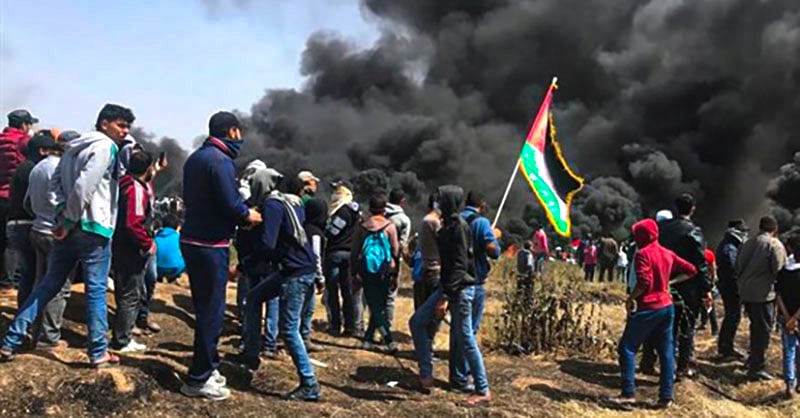
The Great March of Return epitomizes the brutalities of Israeli occupation policy, which include a shocking disregard of the physical and mental health of the Palestinian civilian population taking part in the demonstrations. It also offers us a metaphor for the abuses of the right to health and other rights of the Gaza population regarded as a collective entity. This pattern of abuse occurs in the context of persistent and courageous Palestinian acts of resistance in support of their right of return to their homeland, a right affirmed at the UN and clearly established in international law, which Israel has refused to uphold for seven decades, that is, ever since the Nakba.
In the face of such a failure of international procedures to uphold Palestinian rights, a recourse to a politics of self-reliance seems reasonable, and in fact the only path presently capable of yielding positive results. The people of Gaza have waited long enough, indeed too long, without having their most basic international rights protected by the organized world community.
A preliminary matter is whether, as Israel alleges, it is relieved of all international legal obligations to the people of Gaza as a result of its supposed ‘disengagement’ from Gaza in 2005. From an international law perspective, the physical removal of IDF occupying troops from the territory of Gaza and the dismantlement of unlawful Israeli settlements did not affect the legal status of Gaza as ‘occupied Palestinian territory.’
Israel has maintained tight control over Gaza, which has included massive military attacks in 2008-09, 2012, and 2014, as well as frequent uses of excessive force, unlawful weapons and tactics, and disregard of the constraints of law.
Despite ‘disengagement’ Israel maintains effective and comprehensive control over Gaza’s borders, air space, and offshore maritime waters. In fact, as a result of the blockade in existence since 2007, the occupation is more intense and abusive than was the oppressive form of occupation that existed in Gaza prior to disengagement.
Originally published on Richard Falk’s blog “Citizen Pilgrimage”
From the perspective of IHL and IHRL, Israel is fully obligated under international law in exercising its role as an occupying power, and its claims to the contrary are legally irrelevant. Unfortunately, due to geopolitical realities and the weakness of the UN, these Israeli claims continue to have a political relevance as Israel’s obligations are unenforced and mostly ignored, creating an unacceptable situation in which Israel enjoys de facto impunity and escapes from all procedures of accountability provided by recourse to international law and international judicial institutions.
It is also important, in our view, to understand the significance of the findings of the 2017 ESCWA report prepared by Virginia Tilley and myself. We concluded after examining the evidence that Israel maintains an apartheid structure of control over the Palestinian people as a whole, which of course includes the population of Gaza. Our main point is that Israel uses a variety of means to subjugate and victimize the Palestinians so as to establish and sustain an exclusivist Jewish state in which, according to Israel’s Basic Law of 2018 gives only Jews authority to claim a right of self-determination.
To circumscribe the right of self-determination by exclusionary racial criteria is a virtual acknowledgement of an apartheid ideology.
Apartheid – and the case of South Africa
It needs to be more widely appreciated that apartheid is a Crime Against Humanity, according to Article 7(j) of the Rome Statute that governs the operations of the International Criminal Court.
The criminal character of apartheid had been previously confirmed by the 1973 UN Convention on the Suppression and Punishment of the Crime of Apartheid. If apartheid is indeed present then all governments have themselves legal and moral obligations to join the effort to suppress and punish.
As with IHL and IHRL, the criminalization of apartheid is not acted upon by formal inter-governmental mechanisms due to roadblocks erected by geopolitics and the related weakness of the UN, but this does not mean that the designation is politically and morally insignificant. Since governments refuse to act, the responsibility and opportunity for law enforcement falls on the peoples of the world to do what the formal framework of world order is incapable of doing.
Such an anti-apartheid grassroots surge occurred with respect to the South African regime of apartheid, producing an entirely unexpected reversal of approach by the Afrikaner leadership of the country resulting in the release of Nelson Mandela from prison after 27 years of captivity followed by the largely peaceful transition to a multiracial constitutional democracy with human rights promised to all regardless of race.
Such an outcome was considered impossible across the entire political spectrum in South Africa until 1994 when it actually happened.
We cannot guarantee, of course, that history will repeat itself and liberate the Palestinian people from their century-long ordeal, but neither can we foreclose the possibility that the combination of Palestinian resistance and global solidarity will have an empowering, liberating effect.
In part, the Palestinian national movement is the last great unfinished struggle against European settler colonialism.
Looked at in this way, the Zionist Project through the establishment of Israel temporarily reversed the flow of history in Palestine for a series of complicated reasons, but the final fate of Palestine remains in doubt so long as Palestinian resistance is sustained and solidarity robust.
The Great March of Return – and the health situation
In this regard, the Great March of Return is a powerful sign that Palestinian resistance here in Gaza continues to offer inspirational energy to those of us throughout the world who believe that this particular struggle for individual and collective justice by an oppressed people is what human rights are most fundamentally about.
The Great March is a perfect metaphor for both the theme of this conference and of the struggle that motivated the defenseless residents of Gaza to demand this most basic right to return to their homeland from which they have been wrongfully and forcibly displaced. This demand was impressively reasserted every Friday for more than a year in the face of Israel’s vindictive reliance on excessive force since its inception in March 2018.
Israel from the very beginning of the protests adopted an approach of excessive force based on terrorizing the demonstrators by resorting to lethal violence in a harsh effort to punish and destroy this formidable creative challenge to Israeli apartheid/colonial control. Israel’s aim seems to be a vain and unlawful effort to undermine the Palestinian will to resist that has survived decades of confinement, discouragement, and unspeakable abuse.
At the same time, such a criminal response by Israel to this anguished claim of right by the people of Gaza was also the culminating expression of Israel’s assault on the physical and mental health of the civilian population of Gaza.
It is hardly surprising that the burdens created by 20,000 injured Gazans have overwhelmed Gaza’s already stressed medical capabilities. Many of those injured received life and limb threatening gunshot wounds, causing serious infections and frequently requiring amputation. This crisis situation in health care was aggravated by shortages of needed antibiotic medicines, and by the dismal experiences of those injured Gazans requiring specialized attention that could be obtained only outside of Gaza.
Those so desperately in need of medical treatment external to Gaza faced almost impossible difficulties obtaining required exit and entry permits that Israel often even withheld under normal circumstances. In relation to those wounded at Great March events the situation was far worse. Israel was more unwilling to grant exit permits to those wounded in the Great March, discriminating against any Palestinian who dared to protest peacefully against the denial of the rights to which every human being on earth is entitled.
Such an abuse is criminally escalated in relation to Gazans who are supposed to be especially protected by virtue of the Fourth Geneva Conventions, and IHL more generally. Instead of protection, the Israeli approach has been one of imposing prolonged collective punishment not only on Palestinian resistors but on the entire population of Gaza in direct violation of Article 33 of the Fourth Geneva Convention, and not for a short interval associated with special circumstances, but over the course of decades.
Beyond these exceptional conditions associated with the medical fallout from the Great March, Israel by failing to protect the civilian population of Gaza under conditions of rightless prolonged occupation is guilty of several additional forms of collective punishment each of which has an adverse impact of Gazan health.
These adverse effects consequences result from its maintenance of a vindictive blockade, the periodic application of excessive force well beyond any reasonable security justifications, and the application of policies and practices reflective of the apartheid/colonial character of its approach to the Palestinian people, which has long assumed a sinister form in Gaza.
The health results are disastrous as confirmed by reliable statistical measures of the physical and mental condition of the population, as exhibited by the unavailability of safe drinking water, the existence of untreated open sewage, the frequency of long power outages that interfere with the operation of hospitals and medical equipment, and by studies documenting the high incidence of severe trauma experienced by many residents of Gaza, including young and particularly vulnerable children.
For those of us who have visited Gaza even under what could be described as ‘normal’ conditions, we came away wondering how anyone could endure such stress without experiencing a traumatic reaction.
This severe infringement on the right to health of the people of Gaza should be the occasion of outrage in the international community, and receive appropriate media attention, but Israel’s deliberate and massive violations of IHL and IHRL are shielded by geopolitics from censure and sanctions on the part of governments and at the UN, a reality further obscured by a compliant mainstream Western media that is misled and manipulated by a carefully orchestrated Israeli propaganda campaign that presents its criminally unlawful conduct as reasonable behavior undertaken to uphold the national security of a sovereign state, an aspect of its legal right to defend itself against what it labels as a terrorist enemy.
Such Israeli propaganda falsifies the realities of the situation in multiple ways, but creates enough confusion outside of Gaza to divert attention from the suffering imposed upon the Palestinian people as a whole, and the civilian population of Gaza in particular.
Against this background, it becomes clear that grassroots solidarity efforts to expose these truths and exert nonviolent pressures on Israel by means of the BDS Campaign and other initiatives are essential contributions to the ongoing resistance struggles of the Palestinian people.
And unlike the South African response, Israel with its sophisticated global outreach has tried by every means to discredit such global solidarity work, even going to the extent of using its leverage overseas to criminalize participation in BDS activity by encouraging the passage of punitive laws and the adoption of restrictive administrative policies in Europe and North America.
In spite of all…
Let me end these remarks by saying that despite the seeming imbalance of forces on the ground, history remains strongly on the side of the Palestinian struggle against this Israeli apartheid regime.
Much of the world realizes that the brave people of Gaza have long been in the eye of a dreadful and seemingly endless storm. It is my honor to support as best I can your struggle for the realization of the right of self-determination.
Despite present appearances to the contrary, I am confident that justice will prevail, that Palestinians will achieve their rights, and surprise the world as did the opponents of South African apartheid a generation ago.
It is my hope that I will live long enough to visit Gaza in the future at a time of liberation and celebration. In the meantime, I wish you a successful conference.







One Response
GAZA – Palestine fate of is one of the sadest ”things” in our time… and shameful… Israel is whipping out the anti-semitism card every time they see support for Palestine – and the world bow their head and keep quiet… WHY? cynically as it may be… ”follow the money” is the answer… The dance around the Golden Calf has been going on for too long…