
By Michael T. Klare
February 26, 2019
In his highly acclaimed 2017 book, Destined for War, Harvard professor Graham Allison assessed the likelihood that the United States and China would one day find themselves at war. Comparing the U.S.-Chinese relationship to great-power rivalries all the way back to the Peloponnesian War of the fifth century BC, he concluded that the future risk of a conflagration was substantial.
Like much current analysis of U.S.-Chinese relations, however, he missed a crucial point: for all intents and purposes, the United States and China are already at war with one another.
Originally published at juancole.com
Even if their present slow-burn conflict may not produce the immediate devastation of a conventional hot war, its long-term consequences could prove no less dire.
To suggest this means reassessing our understanding of what constitutes war. From Allison’s perspective (and that of so many others in Washington and elsewhere), “peace” and “war” stand as polar opposites.
One day, our soldiers are in their garrisons being trained and cleaning their weapons; the next, they are called into action and sent onto a battlefield. War, in this model, begins when the first shots are fired.
Well, think again in thisnew era of growing great-power struggle and competition. Today, war means so much more than military combat and can take place even as the leaders of the warring powers meet to negotiate and share dry-aged steak and whipped potatoes (as Donald Trump and Xi Jinping did at Mar-a-Lago in 2017).
That is exactly where we are when it comes to Sino-American relations. Consider it war by another name, or perhaps, to bring back a long-retired term, a burning new version of a cold war.
Even before Donald Trump entered the Oval Office, the U.S. military and other branches of government were already gearing up for a long-term quasi-war, involving both growing economic and diplomatic pressure on China and a buildup of military forces along that country’s periphery.
Since his arrival, such initiatives have escalated into Cold War-style combat by another name, with his administration committed to defeating China in a struggle for global economic, technological, and military supremacy.
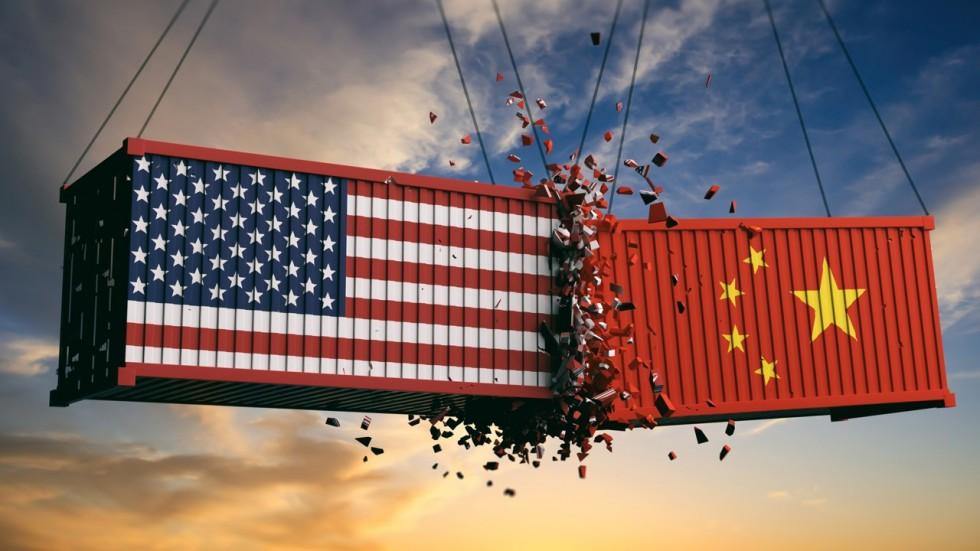
This includes the president’s much-publicized “trade war” with China, aimed at hobbling that country’s future growth; a techno-war designed to prevent it from overtaking the U.S. in key breakthrough areas of technology; a diplomatic war intended to isolate Beijing and frustrate its grandiose plans for global outreach; a cyber war (largely hidden from public scrutiny); and a range of military measures as well.
This may not be war in the traditional sense of the term, but for leaders on both sides, it has the feel of one. Why China?
Why China
The media and many politicians continue to focus on U.S.-Russian relations, in large part because of revelations of Moscow’s meddling in the 2016 American presidential election and the ongoing Mueller investigation. Behind the scenes, however, most senior military and foreign policy officials in Washington view China, not Russia, as the country’s principal adversary.
In eastern Ukraine, the Balkans, Syria, cyberspace, and in the area of nuclear weaponry, Russia does indeed pose a variety of threats to Washington’s goals and desires.
Still, as an economically hobbled petro-state, it lacks the kind of might that would allow it to truly challenge this country’s status as the world’s dominant power. China is another story altogether.
With its vast economy, growing technological prowess, intercontinental “Belt and Road” infrastructure project, and rapidly modernizing

Washington’s fears of a rising China were on full display in January with the release of the 2019 Worldwide Threat Assessment of the U.S. Intelligence Community, a synthesis of the views of the Central Intelligence Agency and other members of that “community.”
Its conclusion: “We assess that China’s leaders will try to extend the country’s global economic, political, and military reach while using China’s military capabilities and overseas infrastructure and energy investments under the Belt and Road Initiative to diminish U.S. influence.”
To counter such efforts, every branch of government is now expected to mobilize its capabilities to bolster American — and diminish Chinese — power. In Pentagon documents, this stance is summed up by the term “overmatch,” which translates asthe eternal preservation of American global superiority vis-à-vis China (and all other potential rivals).
“The United States must retain overmatch,” the administration’s National Security Strategy insists, and preserve a “combination of capabilities in sufficient scale to prevent enemy success,” while continuing to “shape the international environment to protect our interests.”
In other words, there can never be parity between the two countries. The only acceptable status for China is as a distinctly lesser power.
To ensure such an outcome, administration officials insist, the U.S. must take action on a daily basis to contain or impede its rise.
In previous epochs, as Allison makes clear in his book, this equation — a prevailing power seeking to retain its dominant status and a rising power seeking to overcome its subordinate one — has almost always resulted in conventional conflict.
In today’s world, however, where great-power armed combat could possibly end in a nuclear exchange and mutual annihilation, direct military conflict is a distinctly unappealing option for all parties.
Instead, governing elites have developed other means of warfare — economic, technological, and covert — to achieve such strategic objectives. Viewed this way, the United States is already in close to full combat mode with respect to China.
Trade War
When it comes to the economy, the language betrays the reality all too clearly. The Trump administration’s economic struggle with China is regularly described, openly and without qualification, as a “war.” And there’s no doubt that senior White House officials, beginning with the president and his chief trade representative, Robert Lighthizer, see it just that way: as a means of pulverizing the Chinese economy and so curtailing that country’s ability to compete with the United States in all other measures of power.
Ostensibly, the aim of President Trump’s May 2018 decision to impose $60 billion in tariffs on Chinese imports (increased in September to $200 billion) was to rectify a trade imbalance between the two countries, while protecting the American economy against what is described as China’s malign behavior.
Its trade practices “plainly constitute a grave threat to the long-term health and prosperity of the United States economy,” as the president put it when announcing the second round of tariffs.
An examination of the demands submitted to Chinese negotiators by the U.S. trade delegation last May suggests, however, that Washington’s primary intent hasn’t been to rectify that trade imbalance but to impede China’s economic growth.
Among the stipulations Beijing must acquiesce to before receiving tariff relief, according to leaked documents from U.S. negotiators that were spread on Chinese social media:
- halting all government subsidies to advanced manufacturing industries in its Made in China 2025 program, an endeavor that covers 10 key economic sectors, including aircraft manufacturing, electric cars, robotics, computer microchips, and artificial intelligence;
- accepting American restrictions on investments in sensitive technologies without retaliating;
- opening up its service and agricultural sectors — areas where Chinese firms have an inherent advantage — to full American competition.
In fact, this should be considered a straightforward declaration of economic war. Acquiescing to such demands would mean accepting a permanent subordinate status vis-à-vis the United States in hopes of continuing a profitable trade relationship with this country.
“The list reads like the terms for
Technological warfare
As suggested by America’s trade demands, Washington’s intent is not only to hobble China’s economy today and tomorrow but for decades to come. This has led to an intense, far-ranging campaign to deprive it of access to advanced technologies and to cripple its leading technology firms.
Chinese leaders have long realized that, for their country to achieve economic and military parity with the United States, they must master the cutting-edge technologies that will dominate the twenty-first-century global economy, including artificial intelligence (AI), fifth-generation (5G) telecommunications, electric vehicles, and nanotechnology.
Not surprisingly then, the government has invested in a major way in science and technology education, subsidized research in pathbreaking fields, and helped launch promising startups, among other such endeavors — all in the very fashion that the Internet and other American computer and aerospace innovations were originally financed and encouraged by the Department of Defense.
Chinese companies have also demanded technology transfers when investing in or forging industrial partnerships with foreign firms, a common practice in international development. India, to cite a recent example of this phenomenon, expects that significant technology transfers from American firms will be one outcome of its agreed-upon purchases of advanced American weaponry.
In addition, Chinese firms have been accused of stealing American technology through cybertheft, provoking widespread outrage in this country. Realistically speaking, it’s difficult for outside observers to determine to what degree China’s recent technological advances are the product of commonplace and legitimate investments in science and technology and to what degree they’re due to cyberespionage.
Given Beijing’s massive investment in science, technology, engineering, and mathematics education at the graduate and post-graduate level, however, it’s safe to assume that most of that country’s advances are the result of domestic efforts.
Certainly, given what’s publicly known about Chinese cybertheft activities, it’s reasonable for American officials to apply pressure on Beijing to curb the practice. However, the Trump administration’s drive to blunt that country’s technological progress is also aimed at perfectly legitimate activities.
For example, the White House seeks to ban Beijing’s government subsidies for progress on artificial intelligence at the same time that the Department of Defense is pouring billions of dollars into AI research at home. The administration is also acting to block the Chinese acquisition of U.S. technology firms and of exports of advanced components and know-how.
In an example of this technology war that’s made the headlines lately, Washington has been actively seeking to sabotage the efforts of Huawei, one of China’s most prominent telecom firms, to gain leadership in the global deployment of 5G wireless communications.
Such wireless systems are important in part because they will transmit colossal amounts of electronic data at far faster rates than now conceivable, facilitating the introduction of self-driving cars, widespread roboticization, and the universalapplication of AI.

In what is widely described as a “tech Cold War,” it has put enormous pressure on both its Asian and European allies to bar the company from conducting business in their countries, even as it sought the arrest in Canada of Huawei’s chief financial officer, Meng Wanzhou, and her extradition to the U.S. on charges of tricking American banks into aiding Iranian firms (in violation of Washington’s sanctions on that country).
Other attacks on Huawei are in the works, including a potential ban on the sales of its products in this country. Such moves are regularly described as focused on boosting the security of both the United States and its allies by preventing the Chinese government from using Huawei’s telecom networks to steal military secrets. The real reason — barely disguised — is simply to block China from gaining technological parity with the United States.
Cyberwarfare
There would be much to write on this subject, if only it weren’t still hidden in the shadows of the growing conflict between the two countries. Not surprisingly, however, little information is available on U.S.-Chinese cyberwarfare. All that can be said with confidence is that an intense war is now being waged between the two countries in cyberspace.
American officials accuse China of engaging in a broad-based cyber-assault on this country, involving both outright cyberespionage to obtain military as well as corporate secrets and widespread political meddling. “What the Russians are doing pales in comparison to what China is doing,” said Vice President Mike Pence last October in a speech at the Hudson Institute, though — typically on the subject — he provided not a shred of evidence for his claim.
Not disclosed is what this country is doing to combat China in cyberspace. All that can be known from available information is that this is a two-sided war in which the U.S. is conducting its own assaults.
“The United States will impose swift and costly consequences on foreign governments, criminals, and other actors who undertake significant malicious cyber activities,” the 2017 National Security Strategy affirmed.
What form these “consequences” have taken has yet to be revealed, but there’s little doubt that America’s cyber warriors have been active in this domain.
Diplomatic and military coercion
Completing the picture of America’s ongoing war with China are the fierce pressures being exerted on the diplomatic and military fronts to frustrate Beijing’s geopolitical ambitions. To advance those aspirations, China’sleadership is relying heavily on a much-touted Belt and Road Initiative, a trillion-dollar plan to help fund and encourage the construction of a vast new network of road, rail, port, and pipeline infrastructure across Eurasia and into the Middle East and Africa.
By financing — and, in many cases, actually building — such infrastructure, Beijing hopes to bind the economies of a host of far-flung nations ever closer to its own, while increasing its political influence across the Eurasian mainland and Africa.
As Beijing’s leadership sees it, at least in terms of orienting the planet’s future economics, its role would be similar to that of the Marshall Plan that cemented U.S. influence in Europe after World War II.
And given exactly that possibility, Washington has begun to actively seek to undermine the Belt and Road wherever it can — discouraging allies from participating, while stirring up unease in countries like Malaysia and Uganda over the enormous debts to China they may end up with and the heavy-handed manner in which that country’s firms often carry out such overseas construction projects. (For example, they typically bring in Chinese laborers to do most of the work, rather than hiring and training locals.)
“China uses bribes, opaque agreements, and the strategic use of debt to hold states in Africa captive to Beijing’s wishes and demands,” National Security Advisor John Bolton claimed in a December speech on U.S. policy on that continent. “Its investment ventures are riddled with corruption,” he added, “and do not meet the same environmental or ethical standards as U.S. developmental programs.”
Bolton promised that the Trump administration would provide a superior alternative for African nations seeking development funds, but — and this is something of a pattern as well — no such assistance has yet materialized.
In addition to diplomatic pushback, the administration has undertaken a series of initiatives intended to isolate China militarily and limit its strategic options. In South Asia, for example, Washington has abandoned its past position of maintaining rough parity in its relations with India and Pakistan.
In recent years, it’s swung sharply towards a strategic alliance with New Dehli, attempting to enlist it fully in America’s efforts to contain China and, presumably, in the process punishing Pakistan for its increasingly enthusiastic role in the Belt and Road Initiative.
In the Western Pacific, the U.S. has stepped up its naval patrols and forged new basing arrangements with local powers — all with the aim of confining the Chinese military to areas close to the mainland.
In response, Beijing has sought to escape the grip of American power by establishing miniature bases on Chinese-claimed islands in the South China Sea (or even constructing artificial islands to house bases there) — moves widely condemned by the hawks in Washington.
To demonstrate its ire at the effrontery of Beijing in the Pacific (once knownas an “American lake”), the White House has ordered an increased pace of so-called freedom-of-navigation operations (FRONOPs).
Navy warships regularly sail within shooting range of those very island bases, suggesting a U.S. willingness to employ military force to resist future Chinese moves in the region (and also creating situations in which a misstep could lead to a military incident that could lead… well, anywhere).
In Washington, the warnings about Chinese military encroachment in the region are already reaching a fever pitch. For instance, Admiral Philip Davidson, commander of U.S. forces in the Pacific, described the situation there in recent congressional testimony this way: “In short, China is now capable of controlling the South China Sea in all scenarios short of war with the United States.”
A long war of attrition
As Admiral Davidson suggests, one possible outcome of the ongoing cold war with China could be armed conflict of the traditional sort. Such an encounter, in turn, could escalate to the nuclear level, resulting in mutual annihilation.
A war involving only “conventional” forces would itself undoubtedly be devastating and lead to widespread suffering, not to mention the collapse of the global economy.
Even if a shooting war doesn’t erupt, however, a long-term geopolitical war of attrition between the U.S. and China will, in the end, have debilitating and possibly catastrophic consequences for both sides.
Take the trade war, for example. If that’s not resolved soon in a positive manner, continuing high U.S. tariffs on Chinese imports will severely curb Chinese economic growth and so weaken the world economy as a whole, punishing every nation on Earth, including this one.
High tariffs will also increase costs for Amer





