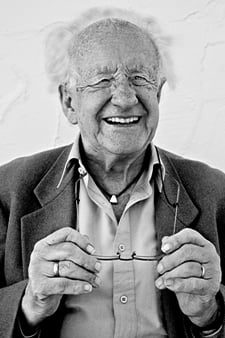
johangaltung

Kuala Lumpur: Perdana Global Peace Foundation, 25 August 2013: “Global Peace Efforts: What Went Wrong & What Next?”

The TRANSCEND NGO Mediation Network just turned 20, and our experience is clear: a good peace proposal quite often works.

To mention some out of 30 positive experiences: we have had a hand in launching peace studies and peace journalism; improving race relations in Charlottesville, VA; in ending the Cold War through bridge-building between Norway and Poland, the idea of a Conference for Security and Cooperation in Europe and nonviolence; in improving North-South relations through South-South cooperation and then relinking with North on a basis of equity–this from the early 1960s.

Later on there have been contributions to peace on the Korean peninsula (first unify the nation, then perhaps the countries), the Kurdish issue (a Kurdistan as a confederation of human rights-based autonomies in the four countries), ending the longest war in Latin America, Ecuador/Peru (a two-state condominium up in the Andes with a natural park, later a joint economic zone); in tripartite peace in the Caucasus; in solutions for bullying in schools; in judicial mediation; in the problem of settlers in Zimbabwe; conciliation Germany/Herero, Turkey/Armenians, Denmark/Islam; and so on and so forth, up till now.

Our conspicuous failures include Israel/Palestine-Arab States-Islam, Yugoslavia, Sri Lanka, Kashmir, Nepal, Colombia; not for lack of trying. As many have pointed out, mediation becomes very difficult if one party is convinced that victory is at hand, positively by being stronger (USA, Israel), negatively by expecting others to collapse (the Koreas, India/Pakistan in Kashmir). The winner can dictate the terms; they think. However, victory is not peace. Victory is glory to the winner and appetite for more; and trauma for the loser and wish for revenge, for revanche, a new deal. It may look as if the victory is acceptable and sustainable but just wait and victory backfires. Nothing solved.

True peace has to address not only the inner attitudes of hatred and the outer behavior of violence–even if more empathy and less violence will help–but the contradictions, incompatibilities between them. We are talking about peace, not glib pacification like Nepal.

In our experience a good peace proposal has some characteristics:

• it comes out of mediation dialogues with all parties, eliciting their legitimate goals (compatible with human rights), their visions of a good future; treating them all (they can be numerous!) equally;

• it is concrete, constructive, creative–not generalities, not moralizing criticism; and creative, bringing in something new;
there must be in the proposal the legitimate parts of the goals of all parties + something extra to all by creating a new reality, moving forward (like a condominium in the Andes, or a Middle East Community);

• the proposal should be self-sustaining by paying for itself (like a condominium for the islands in the China seas with mainland Southeast and Northeast Asia and island Asia Philippines, Taiwan, Japan, with a revenue distribution profile that also pays for the condominium);

• the proposal should be seen by outside parties as reasonable, even compelling–Enact Me!!–making rejection look unreasonable;
ideally the parties work out the details together in the direction indicated by the proposal; if unacceptable their objections should be taken seriously and if legitimate be worked into the proposal;

• the good proposal should be sustainable by making the incompatible compatible; the experience being that hatred and violence wither away when a good solution respecting the dignity of all has come about.

A good solution must identify the conflict (not between Korea North and South, more between North Korea and USA). A good solution depends on creativity more than “good chemistry” between the parties: they may actually understand each other too well, proposing solutions in a shared direction (like drawing a border in the Andes). A solution-orientation is needed; analyses taught at universities are not good enough, nor diplomacy as promoting the interests of one’s own state. But, Anatol Pikas pointed to five impediments to solutions:

• Conflict and violence are attractive, producing identity and thrill of life, the media feeding on the negative and bloody; love them not peace.

• People are used to conflict being solved at the top, so they will wait till the top comes out with something, by definition a solution.

• To take responsibility often means hard work; leave it to others.

• Archetypes tend to be violent, like “heroes”, defining violence and victory as normal-natural-good. But Gandhi-King-Mandela changed that?

• Proposals may carry more cognitive dissonance than people can take, like breaking with the hegemon yet cooperating when the hegemon shows signs of equity, criticizing Israel’s expansionism, but proposing a Middle East community on equal terms with the five Arab neighbors– modeled on the EC of 1958–with a two-state solution in the center and embedded in an Organization for Security and Cooperation in West Asia. One Jerusalem for each as capital, rights of return for both, Israeli cantons on the West Bank and Palestinian cantons in Northwest Israel.

Why? Because there is a Jewish legitimacy given the history of Antiquity and for the same reason an Arab legitimacy. Those who argue also on the basis of history like I do, will of course also recognize the legitimacy of Chinese rights to the sea given the sea lanes from East China to East Africa 500 AD to 1500 AD, brutally eliminated by two countries from the West, Portugal and England. What is not legal may nevertheless carry legitimacy and be negotiated.

To summarize: to reduce violence we must identify the conflicts, the clash of goals; to identify conflicts we must have dialogue with all parties; to arrive at solutions the method is a mutual search for a new reality, not winning debates and compromises; the more proposals floating in the air the better; sooner or later they will be picked up.

This article was first published here.

Related Posts

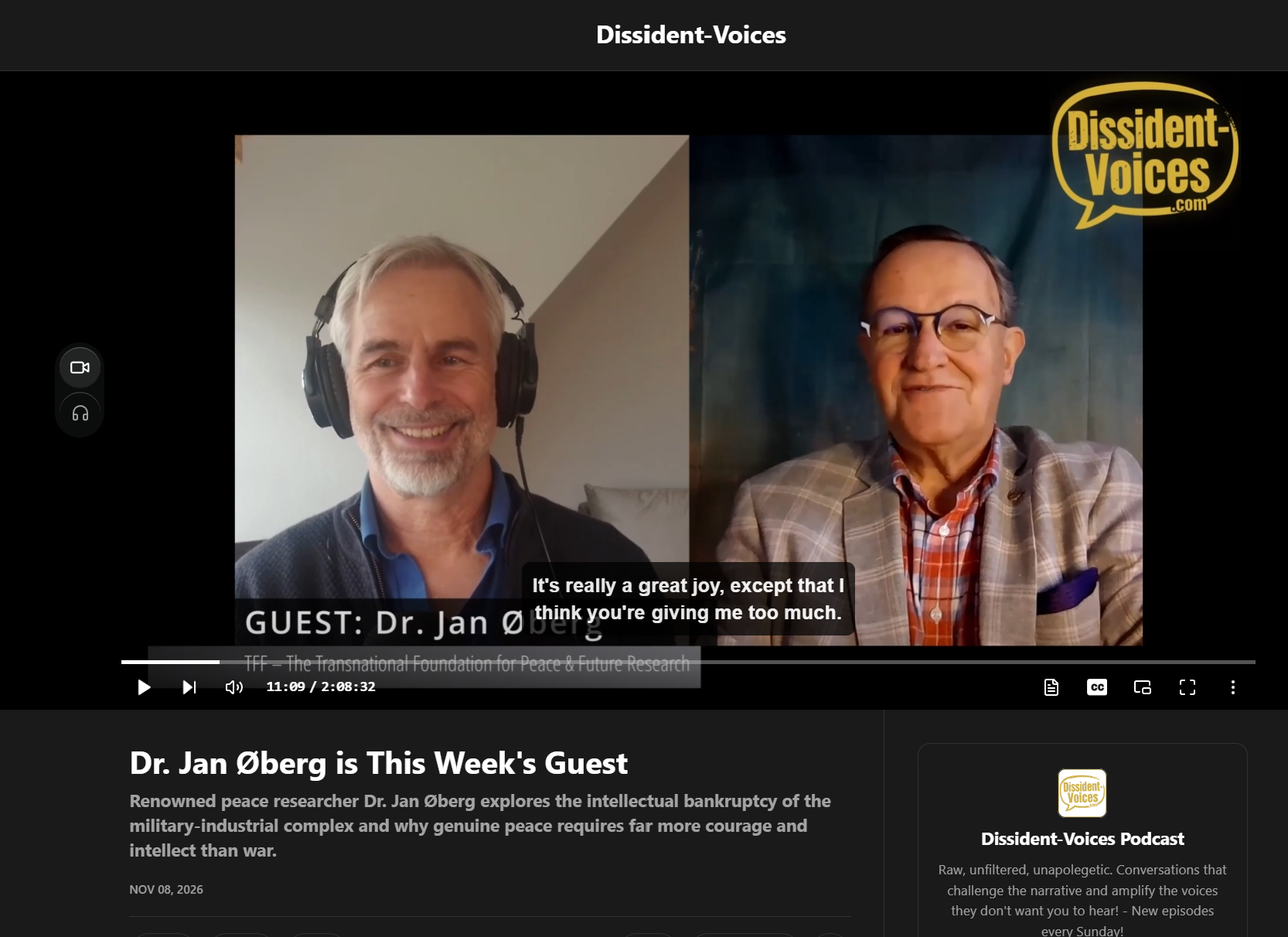
Serious but also a lot of laughs and positive energy. Because peace is also about conviviality and enchantment… Jan Oberg, TFF director November 16, 2026 This is a long (129 minutes) conversation with me. We cover very many, also personal, issues that makes a somewhat unusual media event. I am very grateful to Flemming Blicher for giving me this opportunity. I can’t remember any channel or editor who spent as much time as he did preparing it – including also asking me to answer a series of pre-interview questions, which are now posted under the conversation. If you sympathise with its content, please share it. Watch it here
A Message from Jan Oberg November 6, 2026 Over the past fifty years, I have devoted roughly 175,000 hours to research and public education for a more peaceful world: thinking, researching, writing, organising, publishing, debating, maintaining websites, corresponding, reaching out, leading a foundation, work in conflict and war zones, professorships, teaching courses and giving public lectures and doing media work. In short, ten hours a day, seven days a week, for half a century. The focus was on international political peace – analysing and trying to stop wars, address underlying conflicts and making alternative peace plans – at the desk and on the ground. Important as that has been and remains, it is only one kind of peace and it is now in a tragic militarist state compared with what it could have been.  Lately, however, I have found myself thinking about a concept from economics as well as everyday...
Photo above: Carl Fredrik Reuterswärd’s Non-Violence outside UN Headquarters in New York. Kirill Levin, CC BY-NC-SA 2. Jan Oberg November 3, 2026 I am happy to be published in Horizons which is produced by the Center for International Relations and Sustainable Development, CIRSD, in Belgrade. My contribution brings out a radical re-thinking of what concepts such as defence, security, deterrence – and peace – may mean if we want to create a more peaceful world. It also summarises a few things I have been working with the last few decades. Please read it here Og her er den på dansk, takket være Johnny Baltzersens lynhurtige oversættelse

Recent Articles

Serious but also a lot of laughs and positive energy. Because peace is also about conviviality and enchantment… Jan Oberg, TFF director November 16, 2026 This is a long (129 minutes) conversation with me. We cover very many, also personal, issues that makes a somewhat unusual media event. I am very grateful to Flemming Blicher for giving me this opportunity. I can’t remember any channel or editor who spent as much time as he did preparing it – including also asking me to answer a series of pre-interview questions, which are now posted under the conversation. If you sympathise with its content, please share it. Watch it here
A Message from Jan Oberg November 6, 2026 Over the past fifty years, I have devoted roughly 175,000 hours to research and public education for a more peaceful world: thinking, researching, writing, organising, publishing, debating, maintaining websites, corresponding, reaching out, leading a foundation, work in conflict and war zones, professorships, teaching courses and giving public lectures and doing media work. In short, ten hours a day, seven days a week, for half a century. The focus was on international political peace – analysing and trying to stop wars, address underlying conflicts and making alternative peace plans – at the desk and on the ground. Important as that has been and remains, it is only one kind of peace and it is now in a tragic militarist state compared with what it could have been.  Lately, however, I have found myself thinking about a concept from economics as well as everyday...
Photo above: Carl Fredrik Reuterswärd’s Non-Violence outside UN Headquarters in New York. Kirill Levin, CC BY-NC-SA 2. Jan Oberg November 3, 2026 I am happy to be published in Horizons which is produced by the Center for International Relations and Sustainable Development, CIRSD, in Belgrade. My contribution brings out a radical re-thinking of what concepts such as defence, security, deterrence – and peace – may mean if we want to create a more peaceful world. It also summarises a few things I have been working with the last few decades. Please read it here Og her er den på dansk, takket være Johnny Baltzersens lynhurtige oversættelse

TFF on Substack

Discover and subscribe to more peace materials on TFF Substack

Most Popular

Serious but also a lot of laughs and positive energy. Because peace is also about conviviality and enchantment… Jan Oberg, TFF director November 16, 2026 This is a long (129 minutes) conversation with me. We cover very many, also personal, issues that makes a somewhat unusual media event. I am very grateful to Flemming Blicher for giving me this opportunity. I can’t remember any channel or editor who spent as much time as he did preparing it – including also asking me to answer a series of pre-interview questions, which are now posted under the conversation. If you sympathise with its content, please share it. Watch it here
A Message from Jan Oberg November 6, 2026 Over the past fifty years, I have devoted roughly 175,000 hours to research and public education for a more peaceful world: thinking, researching, writing, organising, publishing, debating, maintaining websites, corresponding, reaching out, leading a foundation, work in conflict and war zones, professorships, teaching courses and giving public lectures and doing media work. In short, ten hours a day, seven days a week, for half a century. The focus was on international political peace – analysing and trying to stop wars, address underlying conflicts and making alternative peace plans – at the desk and on the ground. Important as that has been and remains, it is only one kind of peace and it is now in a tragic militarist state compared with what it could have been.  Lately, however, I have found myself thinking about a concept from economics as well as everyday...
Photo above: Carl Fredrik Reuterswärd’s Non-Violence outside UN Headquarters in New York. Kirill Levin, CC BY-NC-SA 2. Jan Oberg November 3, 2026 I am happy to be published in Horizons which is produced by the Center for International Relations and Sustainable Development, CIRSD, in Belgrade. My contribution brings out a radical re-thinking of what concepts such as defence, security, deterrence – and peace – may mean if we want to create a more peaceful world. It also summarises a few things I have been working with the last few decades. Please read it here Og her er den på dansk, takket være Johnny Baltzersens lynhurtige oversættelse
Read More
Screenshot 2026-11-10 174455
Serious but also a lot of laughs and positive energy. Because peace is also about conviviality and enchantment… Jan Oberg, TFF director November 16, 2026 This is a long (129 minutes) conversation with me. We cover very many, also personal, issues that makes a somewhat unusual media event. I am very grateful to Flemming Blicher for giving me this opportunity. I can’t remember any channel or editor who spent as much time as he did preparing it – including also asking me to answer a series of pre-interview questions, which are now posted under the conversation. If you sympathise with its content, please share it. Watch it here
AbstractVision_2017_#1_800 (kopia)
A Message from Jan Oberg November 6, 2026 Over the past fifty years, I have devoted roughly 175,000 hours to research and public education for a more peaceful world: thinking, researching, writing, organising, publishing, debating, maintaining websites, corresponding, reaching out, leading a foundation, work in conflict and war zones, professorships, teaching courses and giving public lectures and doing media work. In short, ten hours a day, seven days a week, for half a century. The focus was on international political peace – analysing and trying to stop wars, address underlying conflicts and making alternative peace plans – at the desk and on the ground. Important as that has been and remains, it is only one kind of peace and it is now in a tragic militarist state compared with what it could have been.  Lately, however, I have found myself thinking about a concept from economics as well as everyday...
knotted gun
Photo above: Carl Fredrik Reuterswärd’s Non-Violence outside UN Headquarters in New York. Kirill Levin, CC BY-NC-SA 2. Jan Oberg November 3, 2026 I am happy to be published in Horizons which is produced by the Center for International Relations and Sustainable Development, CIRSD, in Belgrade. My contribution brings out a radical re-thinking of what concepts such as defence, security, deterrence – and peace – may mean if we want to create a more peaceful world. It also summarises a few things I have been working with the last few decades. Please read it here Og her er den på dansk, takket være Johnny Baltzersens lynhurtige oversættelse
TFFPortfolioVign
UNITE-tillid, DREAM-velstand og andre konstruktive komponenter Normally we publish articles in English here. But this is a translation of a very important TFF document that should reach as many as possible in Denmark since this country’s government has been one of the most hardline in Europe and, up till now at least, has refused to use diplomacy and, instead, spent tremendous sums on arming Ukraine with the express goal of defeating Russia. Thus this – unique – article is in Danish. Vi er Johnny Baltzersen og hans Fælles Sikkerhed – Fælles Fremtid på Substack overmåde taknemmelige for at have oversat og publiceret TFF’s 2025-portfølje for fredsidéer med henblik på Ukraines fremtid. Vi håber den nu kan nå mange flere danskere – som også vil sprede den og skabe debat – nu den danske regerings og folketingspartiernes politik på dette område siden 2022 står nu – forudsigeligt – ved vejs ende....
JoGSS-Silent
Jan Oberg TFF director October 28, 2026 Exactly one month has now passed since I published my criticism of the introduction to the special issue on Johan Galtung published by the Journal of Global Security Studies, JoGSS, and of Tor Egil Førland’s chapter about Galtung which serves as a preview to his forthcoming biography of Galtung to be published by PRIO. See the original on The Transnational here and the same article on TFF Substack with many general and critical comments and, in particular, the people who decided to withdraw from the biography project in protest. The special issue itself was extraordinary. It was devoted to the intellectual legacy of one of the founders of peace research and contained a number of strong assessments of his personality, scholarship, intellectual trajectory, and public role. Such assessments are, of course, entirely legitimate. No scholar is beyond criticism, and neither was Johan Galtung....
Screenshot 2026-10-26 115647
An aspect of Iran’s culture and civilisation you’ve probably never heard about. Don’t be surprised if the US and Israel also try to bomb them. Jan ObergTFF director October 26, 2026 Today – under the “USraeli” threat of new “annihilating” bombings – opens the 7th International Conference on Peace and Conflict Resolution at Tehran’s University. As far as I can tell, this is the only permanent, advanced peace research institution in West Asia/the Middle East. Perhaps more countries in that region could be inspired? I mean, how many military “security” institutes and military academies do they have? Many peace research institutes and university departments have been established since the 1950s in the West. They are now all under attack; some have closed down, some have gone mainstream, yet others kept the name but do nothing to research peace and disseminate results or advice; instead, they cooperate with militarism’s platforms such...