

Gandhis fotspår 10 Väst som pop, Indien som Bach

Min Indienresa går mot sitt slut. Jag har träffat buddhistiska ungdomar från Tibet och uppsökt historiska platser och ashrams förknippade med Gandhi. Jag har besökt hinduernas heligaste stad, Varanasi eller Benares, och sett hur människor söker frälsning i Ganges kolibakteriefyllda vatten och hur gamla väntar på att dö och få sina kroppar uppeldade på stora brasor innan askan förs bort med floden.
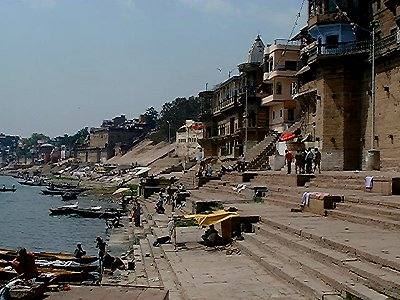
Ganges-floden, Varanasi – Photo Jan Öberg, © TFF 2001

Jag har tillika besökt platser centrala för buddhismen – Bodghaya där unga Gautama nådde upplysning under pipal-trädet och Sarnath, där han först talade till sina lärjungar.
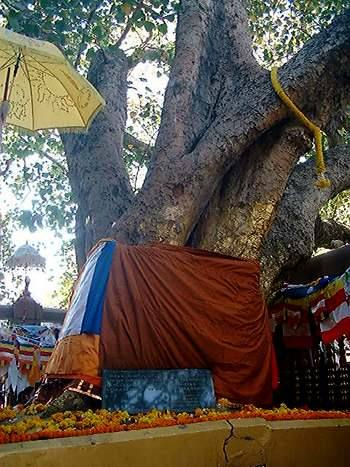
Pipalträdet, Bodghaya – här uppnådde Gautama “enlightenment” – Photo Jan Öberg, © TFF 2001

Jag for till Rajgai där Buddha levde under 12 år och såg den egendomliga klippformation, Gridhakuta, där det sägs att han höll sina viktigaste föreläsningar.
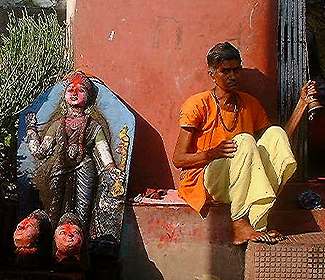
Ingången till ett tempel i badanläggningen i Rajgai – Photo Jan Öberg, © TFF 2001

Där upplevde jag också den enorma, magnifika Fredspagoden, byggd av den japanska Nichiren-buddhistiska munken Nichidatsu Sufujii Gurujin i Rajgiri Hills. I samband med honom stöter jag åter på Gandhi. Gurujin föddes 1885, kom till Indien 1931 och träffade Gandhi. De blev vänner och Gandhi inkluderade från det året buddhistiska mantra som “nam-myo-ho-renge-kyo” i sina ekumeniska andakter. Guruji byggde över 70 fredspagoder över hela världen och dog 101 år gammal.
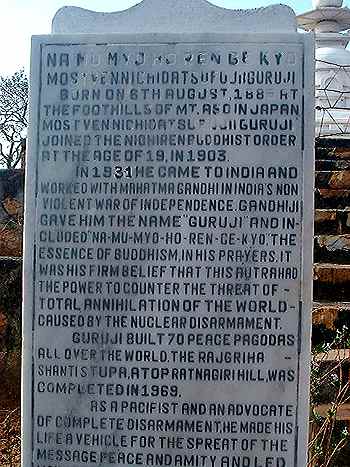
Om Guruji som byggde 70 fredspagoder och blev Gandhis vän, Rajgai – Photo Jan Öberg, © TFF 2001

Jag har alltid tyckt att det fanns stora likheter mellan Gandhis och Buddhas tänkande och handlande. Kanske jag har hittat en – av flera – nycklar just i Rajgai? Jag lägger denna till den redan långa lista över frågor som jag måste undersöka närmare när allt detta ska bli till en bok. Indien är omtumlande. Men jag känner inget behov av att veta alla detaljer eller göra akademiska analyser.

Jag kom till Indien för att uppleva, för att fundera över mitt liv, över Väst och resten av världen. Jag känner mig rikare nu.

Fredspagodan på toppen av berget utanför Rajgai – Photo Jan Öberg, © TFF 2001

I den första av mina tio artiklar i HD skrev jag att Indien egentligen är en omöjlighet. Nu måste jag erkänna att det särskilt gäller om man kommer hit med ett västligt programmerat intellekt. Indien är egentligen också obegripligt. Jag har spenderat två månader, simple living, ganska nära vardagslivet och människorna. Ändå har jag bara sett en bråkdel; inte varit söder om Bombay eller öster om Gandhis ashram in Sevagram. Men jag har lärt den viktigaste läxan: att man måste rensa sin själ och sitt tänkande från så många fördomar man kan för att vara öppen i mötet med detta lika fascinerande som frustrerande land.

Det finns ingen enkel sanning i någon fråga. Har man sagt om en sak i Indien att “så här är det” så måste man omedelbart också tillägga att “men såhär är det också” eller “i själva verket är det jag just sagt bara en del av sanningen därför att man kan egentligen också säga att det förhåller sig precis tvärtom”.

Denna gränslösa komplexitet, denna urindiska “enhet i mångfald” gjorde mig mer ödmjuk. Den får mig att under två månader se min egen Västvärld, Occidenten, som aningen banal, som pseudo- eller pop-kultur med snabba rytmer, glitter och ytliga sanningar som dunka-dunkas in i oss själva och alla andra. Väst som popschlager, Indien som Johan Sebastian Bach!

Gudafigur i Jain-templet i Bombai – Photo Jan Öberg, © TFF 2001

Jag grips av den svindlande tanke att mycket av det vi byggt upp i Väst kanske inte kommer att hålla så länge som detta märkligt svaga, krisdrabbade och ändå majestätiskt starka Indien? Kanske är Indiens styrka att landet inte utvecklas i vår mening utan mera är, existerar, andas långsamt och sparar sin civilisatoriska energi till framtiden?

Karl Marx gjorde på sin tid otroligt nedlåtande beskrivningar av Indien. Man kan ändå i dag fråga om religion fungerar som ett opium för befolkningen. Man är född in i en kast, det är ett synnerligen individuellt, atomiserat samhälle, bara en elit har stor mobilitet, bara lite under hälften av alla i Indien kan läsa och skriva. Lever du sedan i slummen eller/och är kvinna – ja, då har du ingen chans. Livet och hoppet måste ligga bortom nuet och tingen.

Känslan av fastlåsthet, av ett hårt samhälle där alla ser varandra som konkurrenter, har stannat hos mig. Taxichaufförer hamnar i knytnävskamp för att tjäna en krona på mig. Lojaliteten riktar sig mest vertikalt, till den överordnade, till de som har makten – inklusive diverse gudar – inte horisontellt till dem som är i samma situation som du själv. Det blir ingen kollektiv revolution här inte! Det finns mycket krypande, falsk hövlighet och äkta underdånighet. Det finns mycket psykologiskt våld kopplat till samhällsstrukturers våld.

Detta är det hårda Indien. Till det hör också den politiska cynism, korruptionen, de groteska klasskillnaderna, kärnvapnen, miljöförstörelsen och, inte minst, kvinnoförtrycket.
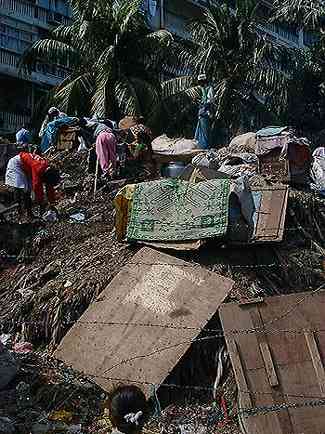
Slumområde i Mumbai, bara några hundra meter ifrån… – Photo Jan Öberg, © TFF 2001

Samtidigt är det kolossalt imponerande hur Indien stolt förblivit sig självt – inte västligt, inte östligt, men just indiskt. I det mjuka Indien finns det spirituella, medvetandet om att livet inte bara handlar om det materiella, här finns filosofien, litteraturen, Gandhianismen; här blandas världsreligionerna, här finns det Indien som gett resten av världen så mycket och som gav det brittiska imperiet en läxa en gång för alla men utan att hata. I det mjuka Indien är tidsrytmen långsam. Seklers invasioner från alla världshörn har inte kunnat kuva Indien.
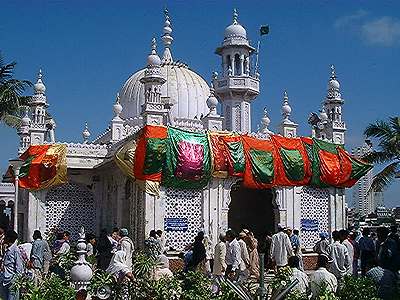
…Mumbais magnifika moské – Photo Jan Öberg, © TFF 2001

Dessa Indiens båda sidor tycks sammanfattade i figuren Gandhi. Landsfader och -moder i en och samma kropp, stark individualist på kollektivets vägnar, självmedveten utöver alla gränser och ödmjukt experimenterande med livet självt. Han var hindu, kristen, muslim och buddhist och skruvade ändå ihop sin egen eklekticistiska livsåskådning enligt vilken Sanning är Gud och Gud är Sanning.

Och när man sagt just detta måste man retirera: Gandhi var det rakt motsatta av Indien. Han skulle, tror jag, bli djupt deprimerat om han plötsligt dök upp i dagens Indien. Och han skulle vara regeringens fiende nummer ett och permanent bakom galler.

Jag blev inte förälskad i Indien så det kan inte göra mig besviken när jag reser dit igen – och det gör jag. Utmaningen bara växer för varje gång!

Jan Øberg

Peace & future researcher + ‌Art Photographer

Related Posts

LONDON – So far so good, at least on the wider level. While internally Iraq seems on the edge of chaos, the much heralded clash of civilizations between the Muslim and Judaeo-Christian worlds has yet to become apparent. We have anger and despair aplenty in the Arab and Muslim worlds. But very little rushing to the standard and there was no great pilgrimage of warriors to join the fight, as happened when the Soviet Union invaded Afghanistan twenty years ago, and then, having driven the Red Army out, were left to ferment in that mountainous redoubt. With the armaments supplied by the CIA the mujahidin were transformed into Al Qaeda that became, for a relatively brief moment as these things go, ‘the greatest threat to the homeland that America has ever known.’ Nevertheless a ‘Cold War’ between much of the Muslim world and the West is certainly in full swing. Winston...
The Challenge of Nuclear Weaponsin the Twenty-first CenturyA Path Forward The peoples and governments of the world face an urgent challenge relating to weaponry of mass destruction and particularly to nuclear weaponry.  At the crossroads of technology, terrorism, geopolitical ambition, and policies of preemption are new and potent dangers for humanity. Despite ending the nuclear standoff of the Cold War era, nuclear weaponry is again menacing the peoples of the world with catastrophic possibilities.  We recognize the need for any government to pursue its security interests in accordance with international law; and further, we recognize that distinctive threats to these interests now exist as a result of an active international terrorist network having declared war on the United States and its allies. Nonetheless, we reject the assessment of the current US administration that upgrading a reliance on nuclear weapons is in any sense justified as a response. We find it...
By Karin Wegestal MP, the Social Democratic Partyon behalf of the Swedish Committee for Solidarity with the Yugoslav People During the last decade, the Federal Republic of Yugoslavia has received more than 500,000 refugees from Croatia and Bosnia, and another 300,000 internally displaced persons, mainly from the province Kosovo and Metohia. For a country with about ten million inhabitants, such an influx of homeless people is obviously a very heavy burden – even under peaceful conditions. But in addition to that, the Federal Republic of Yugoslavia has been the subject to sanctions from the western powers for close to ten years and its infrastructure was badly hurt through Nato’s intense bombardment during 78 days in 1999. The result of all this is that Yugoslavia, once the most developed industrial country in Eastern Europe, is today the poorest country in Europe. In Serbia excluding Kosovo, with about ten million inhabitants and...

Recent Articles

Jan Oberg TFF director October 28, 2026 Exactly one month has now passed since I published my criticism of the introduction to the special issue on Johan Galtung published by the Journal of Global Security Studies, JoGSS, and of Tor Egil Førland’s chapter about Galtung which serves as a preview to his forthcoming biography of Galtung to be published by PRIO. See the original on The Transnational here and the same article on TFF Substack with many general and critical comments and, in particular, the people who decided to withdraw from the biography project in protest. The special issue itself was extraordinary. It was devoted to the intellectual legacy of one of the founders of peace research and contained a number of strong assessments of his personality, scholarship, intellectual trajectory, and public role. Such assessments are, of course, entirely legitimate. No scholar is beyond criticism, and neither was Johan Galtung....
An aspect of Iran’s culture and civilisation you’ve probably never heard about. Don’t be surprised if the US and Israel also try to bomb them. Jan ObergTFF director October 26, 2026 Today – under the “USraeli” threat of new “annihilating” bombings – opens the 7th International Conference on Peace and Conflict Resolution at Tehran’s University. As far as I can tell, this is the only permanent, advanced peace research institution in West Asia/the Middle East. Perhaps more countries in that region could be inspired? I mean, how many military “security” institutes and military academies do they have? Many peace research institutes and university departments have been established since the 1950s in the West. They are now all under attack; some have closed down, some have gone mainstream, yet others kept the name but do nothing to research peace and disseminate results or advice; instead, they cooperate with militarism’s platforms such...
Let’s discuss using AI to create peace – in contrast to boring geopolitics devoid of creative healing and visions. Jan Oberg TFF director October 15, 2026 I asked VEED to create a short video exemplifying how peace is preferable to war, then chose the lady as a template. Simple as that. In less than a minute, it produced this video, which any peace-loving person would appreciate. The only problem is that human intelligence (HI), at least the one that exists among Western decision-makers, isn’t half as moral or smart as AI. I have used AI to dialogue about peace and peace plans, creative conflict resolution and visions of a better future for humankind. It so happens that I am having more stimulating, intelligent, creative and moral discussions with AI than I could possibly have with any EU or NATO leader today. Yes, AI has very problematic and dangerous aspects; used...

TFF on Substack

Discover and subscribe to more peace materials on TFF Substack

Most Popular

Jan Oberg TFF director October 28, 2026 Exactly one month has now passed since I published my criticism of the introduction to the special issue on Johan Galtung published by the Journal of Global Security Studies, JoGSS, and of Tor Egil Førland’s chapter about Galtung which serves as a preview to his forthcoming biography of Galtung to be published by PRIO. See the original on The Transnational here and the same article on TFF Substack with many general and critical comments and, in particular, the people who decided to withdraw from the biography project in protest. The special issue itself was extraordinary. It was devoted to the intellectual legacy of one of the founders of peace research and contained a number of strong assessments of his personality, scholarship, intellectual trajectory, and public role. Such assessments are, of course, entirely legitimate. No scholar is beyond criticism, and neither was Johan Galtung....
An aspect of Iran’s culture and civilisation you’ve probably never heard about. Don’t be surprised if the US and Israel also try to bomb them. Jan ObergTFF director October 26, 2026 Today – under the “USraeli” threat of new “annihilating” bombings – opens the 7th International Conference on Peace and Conflict Resolution at Tehran’s University. As far as I can tell, this is the only permanent, advanced peace research institution in West Asia/the Middle East. Perhaps more countries in that region could be inspired? I mean, how many military “security” institutes and military academies do they have? Many peace research institutes and university departments have been established since the 1950s in the West. They are now all under attack; some have closed down, some have gone mainstream, yet others kept the name but do nothing to research peace and disseminate results or advice; instead, they cooperate with militarism’s platforms such...
Let’s discuss using AI to create peace – in contrast to boring geopolitics devoid of creative healing and visions. Jan Oberg TFF director October 15, 2026 I asked VEED to create a short video exemplifying how peace is preferable to war, then chose the lady as a template. Simple as that. In less than a minute, it produced this video, which any peace-loving person would appreciate. The only problem is that human intelligence (HI), at least the one that exists among Western decision-makers, isn’t half as moral or smart as AI. I have used AI to dialogue about peace and peace plans, creative conflict resolution and visions of a better future for humankind. It so happens that I am having more stimulating, intelligent, creative and moral discussions with AI than I could possibly have with any EU or NATO leader today. Yes, AI has very problematic and dangerous aspects; used...
Read More
JoGSS-Silent
Jan Oberg TFF director October 28, 2026 Exactly one month has now passed since I published my criticism of the introduction to the special issue on Johan Galtung published by the Journal of Global Security Studies, JoGSS, and of Tor Egil Førland’s chapter about Galtung which serves as a preview to his forthcoming biography of Galtung to be published by PRIO. See the original on The Transnational here and the same article on TFF Substack with many general and critical comments and, in particular, the people who decided to withdraw from the biography project in protest. The special issue itself was extraordinary. It was devoted to the intellectual legacy of one of the founders of peace research and contained a number of strong assessments of his personality, scholarship, intellectual trajectory, and public role. Such assessments are, of course, entirely legitimate. No scholar is beyond criticism, and neither was Johan Galtung....
Screenshot 2026-10-26 115647
An aspect of Iran’s culture and civilisation you’ve probably never heard about. Don’t be surprised if the US and Israel also try to bomb them. Jan ObergTFF director October 26, 2026 Today – under the “USraeli” threat of new “annihilating” bombings – opens the 7th International Conference on Peace and Conflict Resolution at Tehran’s University. As far as I can tell, this is the only permanent, advanced peace research institution in West Asia/the Middle East. Perhaps more countries in that region could be inspired? I mean, how many military “security” institutes and military academies do they have? Many peace research institutes and university departments have been established since the 1950s in the West. They are now all under attack; some have closed down, some have gone mainstream, yet others kept the name but do nothing to research peace and disseminate results or advice; instead, they cooperate with militarism’s platforms such...
Screenshot 2026-10-15 141837
Let’s discuss using AI to create peace – in contrast to boring geopolitics devoid of creative healing and visions. Jan Oberg TFF director October 15, 2026 I asked VEED to create a short video exemplifying how peace is preferable to war, then chose the lady as a template. Simple as that. In less than a minute, it produced this video, which any peace-loving person would appreciate. The only problem is that human intelligence (HI), at least the one that exists among Western decision-makers, isn’t half as moral or smart as AI. I have used AI to dialogue about peace and peace plans, creative conflict resolution and visions of a better future for humankind. It so happens that I am having more stimulating, intelligent, creative and moral discussions with AI than I could possibly have with any EU or NATO leader today. Yes, AI has very problematic and dangerous aspects; used...
girl-5894831_1280
Below are TFF-related media mentions, comments, videos and social media posts published elsewhere but not on this homepage. We happen to catch and list only a fraction. Regarding video comments and debates, we recommend that you go to the TFF Video Channel on Substack where many of them are reproduced. Jan Oberg is a contributor to China Daily – 52 million daily clicks – and Global Times, CGTN and CCTV (the national television), China Investment, Xinhua News Agency and several others. Articles and videos on these media very often multiply into countless Chinese (and Western media) that re-post them from these main media. Thanks to The China Academy, his analyses, interviews and comments are frequently posted on YouTube channels such as Thinkers Forum and Wave Media. These videos are often re-posted on Bilibili (China’s YouTube), the China Content Center on TikTok, and on the Chinese edition of TikTok, Douyin.com. This means reaching hundreds of millions of viewers worldwide over a year. While there are too many to catch on all these...
Nobel-Prize-Plaque
Jan Oberg TFF director October 13, 2026 According to Alfred Nobel’s will, the Nobel Peace Prize shall be awarded: ”to the person who has done the most or best to advance fellowship among nations, the abolition or reduction of standing armies, and the establishment and promotion of peace congresses.” Further down, he also expresses how the prize for the “champions of peace” shall be decided: “that for champions of peace by a committee of five persons to be selected by the Norwegian Storting. Alfred Nobel’s will is remarkably short and clear. But few seem to have read it. Nobel did not say that the committee itself should consist of members of parliament. He entrusted the Storting with appointing five persons. In principle, it could have selected diplomats, mediators, peace researchers, conflict-resolution specialists, or other individuals with recognised expertise in matters of peace from around the world. Instead, the Storting gradually...
law-419057_1280
The Quest for Humane Survival Richard Falk Professor emeritus, Princeton UniversityTFF Associate since 1986October 12, 2026 After decades of teaching and writing about international law in academic frameworks that were not institutionally situated within law school environments—at Princeton and the University of California, Santa Barbara—I found myself most receptive to the TWAIL outlook. It has been especially illuminating in clarifying the extent to which international law evolved as a dialogical critique of Europe’s efforts to legitimize its colonial undertakings. In particular, TWAIL has exposed how international law has functioned to legalize the subjugation of Third World peoples, securing conditions for exploitative investment and trade relations, the coercive enforcement of public debts, and an ideology of cultural superiority. TWAIL’s exposure of these economic legacies of colonialism has influenced my understanding of the history and development of international law, broadly conceived, as an ideological project of the Western sub-system of the world...





