
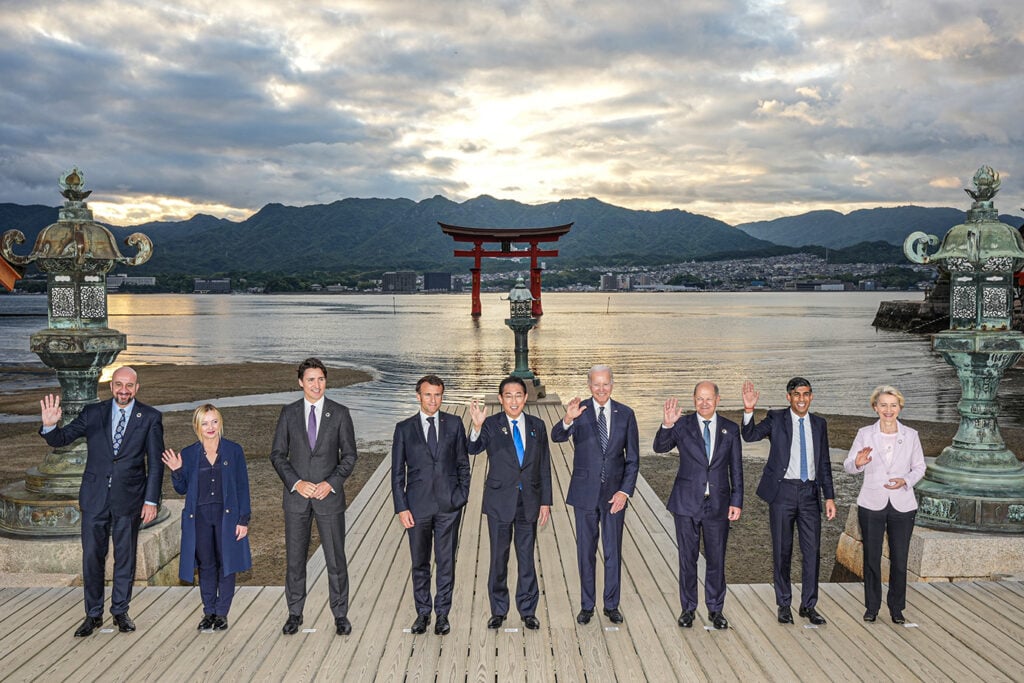
G7 in Hiroshima – Milestone of Western decline?

Waving goodbye? Not agreeing whether to wave at the world or not…

Words. Words. Words. And words missing.

Jan Oberg

June 1, 2023

The G7 countries’ share of the global GDP has fallen from about 70% in the 1960s, to 46% in 2019, to 31% in 2021 and is projected to fall to 28% in 2027. They make up less than 10% of the world’s people. According to the World Bank, between 2013 and 2021, all the G7 countries contributed 26% to world economic growth, and China 39%.

I shall argue here that the G7s are in denial and need a reality check. The Hiroshima summit will, I predict, be seen in the future as a milestone of Western decline and militarism’s self-destructive role in it.

These countries had agreed in advance on a statement of no less than 19 000 words, 40 pages. It contains all kinds of things and, thus, spreads thin with no consolidated, common strategy. It contains countless ”we reiterate,” ”once again condemn,” ”reaffirm,” ”stand united,” ”re-emphasise,” ”remain deeply concerned,” and ”continue to” – revealing the repetitive character of it all.

Since G7 meetings are informal, more political than economic, and decisions non-binding, they could, in principle, be golden opportunities for more free, creative and visionary thinking that would inspire and enthuse the rest of the world.

The statement professes that G7 will meet the global challenges. But in the midst of a deeply worrying global crisis and the emergence of a multipolar world with great new opportunities, there is not even an attempt at that.

The G7 leaders appeared to suffer from an intellectual jetlag.

Under ”concrete steps” – their priorities – they mention Ukraine, disarmament and nuclear freedom, economic security, clean energy economies, food security, and Partnership for Global Infrastructure Investment (PGII) – the latter being an old one containing many other items but infrastructure, too little too late to match the Belt and Road Initiative.

Secondary priorities are a free and open Pacific, global economic recovery, achieving Sustainable Development Goals (SDG), evolution of the Multilateral Development Banks, decarbonisation, cooperation about various other climate- and energy-related forums, global health through vaccine manufacturing capacity, and AI.

Among those is also to ”cooperate on international migration and strengthen our common effort to fight the trafficking and smuggling of human beings.” But have they not done that so far? Will they address the one main reason people seek asylum and become refugees (not migrants!), namely warfare? No!

The only discernible set of principles or concepts are: the UN Charter, respect for borders, universal human rights, gender equality and human dignity; multilateralism and rules-based trading.

And that comes from 7 countries, most of which have never adhered to the UN Charter’s Article 1 about making peace by peaceful means and have violated other provisions on a daily basis, not the least as NATO members.

Perhaps because they met in Hiroshima – giving Ukraine’s pop-up president Zelensky an opportunity to say what everybody had heard before but also compare his falling Bakhmut with Hiroshima… – the G7 statement reads: ”Strengthen disarmament and non-proliferation efforts, towards the ultimate goal of a world without nuclear weapons with undiminished security for all.”

Except for Japan, the G7 countries have never seriously done anything for that. NATO members embarked on the provocative expansion of NATO over 30 years and decided about the – intellectually absurd – measure of spending 2% of their GDP on the military as a floor, not a ceiling. And they’ve spent close to 100 US $ billion on arming Ukraine instead of investing brainpower in bringing about a ceasefire and a long-term solution. In their de facto fight to weaken Russia, they urge China to put pressure on Russia – the China they see as their main adversary whose mediation it turns down.

And this is stated in Japan, which is now investing hugely in re-militarisation – and in Hiroshima, where President Biden found no reason to say, ”I am sorry!”

The statement refers to the Non-Proliferation Treaty of 1968 as the basic guideline that they have all grossly ignored. They omit every mention of The Treaty in the Prohibition of 2021 with 92 signatories, however of course none of the nuclear powers! 55 years-old words. Nothing new – also not the cynicism vis-a-vis humanity demanding nuclear freedom.

G7 doesn’t attempt bridge-building or cooperation. They single out adversaries: First, China – with the usual elements of the Western accusation industry but stated more strongly. Then Russia, North Korea, Myanmar, Iran – the latter shall never be allowed to have nuclear weapons (no mention of their own and Israel’s) adding involuntarily funny words about the JCPOA as a ’useful reference’ – an eminent victory for diplomacy in 2015 the US withdrew from. Then Syria but no mention of the illegal US bases there or of Syria’s re-integration into the Arab League. And of course no mention of the China-mediated rapprochement between Iran and Saudi Arabia.

What words can’t be found? Conflict-resolution, defensive defence, common security, multi-polar, world order change, nonviolence, forgiveness, global dynamics, bridge-building, reconciliation and… Nord Stream. And BRICS.

The reasons they seem to still think of themselves as world order leaders must be a) a deep-rooted colonial centre-periphery worldview with themselves at the centre; b) a self-centredness preventing a respectful understanding of 90% of humanity, non-Western thinking and world order changes, c) a history of teaching with Bible or Sword, not learning, d) denial of their own declines (in more fields), and e) their hubris-like intoxication from spending out-of-all-proportions 50% of the world’s military expenditures.

To avoid more cold and warm wars and secure a peaceful future for all, the Rest must wisely abstain from every tit-for-tat, act constructively and benevolently seek – in spite of all – to help the West accommodate to the future cooperative world.

Note
This article was published by Wenzhou News on May 30, 2023
七国集团广岛峰会——西方衰落的里程碑? – yet another Chinese media that I shall write comments for on a regular basis.


Peace & future researcher + ‌Art Photographer

2 Responses

  1. Sadly, Orientalism that the late Edward Said talked about seems to be alive and well. G7, with the exception of Japan as a single non-European-American token member, is a totally Western grouping of the world’s former and current empires. They have not given up their imperial way of blaming the rest of the world for all the ills that confronts mankind and lecturing and ordering others to adhere to a rules-based international order (without mentioning who had made those rules) and what happens to international law. As the article rightly points out, that way of thinking is totally out of place in the modern world, and if they do not wake up they will see that they will be increasingly rejected and left behind by the rest of the world, as is already happening.

Related Posts

Below are TFF-related media mentions, comments, videos and social media posts published elsewhere but not on this homepage. We happen to catch and list only a fraction. Regarding video comments and debates, we recommend that you go to the TFF Video Channel on Substack where many of them are reproduced. Jan Oberg is a contributor to China Daily – 52 million daily clicks – and Global Times, CGTN and CCTV (the national television), China Investment, Xinhua News Agency and several others. Articles and videos on these media very often multiply into countless Chinese (and Western media) that re-post them from these main media. Thanks to The China Academy, his analyses, interviews and comments are frequently posted on YouTube channels such as Thinkers Forum and Wave Media. These videos are often re-posted on Bilibili (China’s YouTube), the China Content Center on TikTok, and on the Chinese edition of TikTok, Douyin.com. This means reaching hundreds of millions of viewers worldwide over a year. While there are too many to catch on all these...
Jan Oberg TFF director October 13, 2026 According to Alfred Nobel’s will, the Nobel Peace Prize shall be awarded: ”to the person who has done the most or best to advance fellowship among nations, the abolition or reduction of standing armies, and the establishment and promotion of peace congresses.” Further down, he also expresses how the prize for the “champions of peace” shall be decided: “that for champions of peace by a committee of five persons to be selected by the Norwegian Storting. Alfred Nobel’s will is remarkably short and clear. But few seem to have read it. Nobel did not say that the committee itself should consist of members of parliament. He entrusted the Storting with appointing five persons. In principle, it could have selected diplomats, mediators, peace researchers, conflict-resolution specialists, or other individuals with recognised expertise in matters of peace from around the world. Instead, the Storting gradually...
The Quest for Humane Survival Richard Falk Professor emeritus, Princeton UniversityTFF Associate since 1986October 12, 2026 After decades of teaching and writing about international law in academic frameworks that were not institutionally situated within law school environments—at Princeton and the University of California, Santa Barbara—I found myself most receptive to the TWAIL outlook. It has been especially illuminating in clarifying the extent to which international law evolved as a dialogical critique of Europe’s efforts to legitimize its colonial undertakings. In particular, TWAIL has exposed how international law has functioned to legalize the subjugation of Third World peoples, securing conditions for exploitative investment and trade relations, the coercive enforcement of public debts, and an ideology of cultural superiority. TWAIL’s exposure of these economic legacies of colonialism has influenced my understanding of the history and development of international law, broadly conceived, as an ideological project of the Western sub-system of the world...

Recent Articles

Below are TFF-related media mentions, comments, videos and social media posts published elsewhere but not on this homepage. We happen to catch and list only a fraction. Regarding video comments and debates, we recommend that you go to the TFF Video Channel on Substack where many of them are reproduced. Jan Oberg is a contributor to China Daily – 52 million daily clicks – and Global Times, CGTN and CCTV (the national television), China Investment, Xinhua News Agency and several others. Articles and videos on these media very often multiply into countless Chinese (and Western media) that re-post them from these main media. Thanks to The China Academy, his analyses, interviews and comments are frequently posted on YouTube channels such as Thinkers Forum and Wave Media. These videos are often re-posted on Bilibili (China’s YouTube), the China Content Center on TikTok, and on the Chinese edition of TikTok, Douyin.com. This means reaching hundreds of millions of viewers worldwide over a year. While there are too many to catch on all these...
Jan Oberg TFF director October 13, 2026 According to Alfred Nobel’s will, the Nobel Peace Prize shall be awarded: ”to the person who has done the most or best to advance fellowship among nations, the abolition or reduction of standing armies, and the establishment and promotion of peace congresses.” Further down, he also expresses how the prize for the “champions of peace” shall be decided: “that for champions of peace by a committee of five persons to be selected by the Norwegian Storting. Alfred Nobel’s will is remarkably short and clear. But few seem to have read it. Nobel did not say that the committee itself should consist of members of parliament. He entrusted the Storting with appointing five persons. In principle, it could have selected diplomats, mediators, peace researchers, conflict-resolution specialists, or other individuals with recognised expertise in matters of peace from around the world. Instead, the Storting gradually...
The Quest for Humane Survival Richard Falk Professor emeritus, Princeton UniversityTFF Associate since 1986October 12, 2026 After decades of teaching and writing about international law in academic frameworks that were not institutionally situated within law school environments—at Princeton and the University of California, Santa Barbara—I found myself most receptive to the TWAIL outlook. It has been especially illuminating in clarifying the extent to which international law evolved as a dialogical critique of Europe’s efforts to legitimize its colonial undertakings. In particular, TWAIL has exposed how international law has functioned to legalize the subjugation of Third World peoples, securing conditions for exploitative investment and trade relations, the coercive enforcement of public debts, and an ideology of cultural superiority. TWAIL’s exposure of these economic legacies of colonialism has influenced my understanding of the history and development of international law, broadly conceived, as an ideological project of the Western sub-system of the world...

TFF on Substack

Discover and subscribe to more peace materials on TFF Substack

Most Popular

Below are TFF-related media mentions, comments, videos and social media posts published elsewhere but not on this homepage. We happen to catch and list only a fraction. Regarding video comments and debates, we recommend that you go to the TFF Video Channel on Substack where many of them are reproduced. Jan Oberg is a contributor to China Daily – 52 million daily clicks – and Global Times, CGTN and CCTV (the national television), China Investment, Xinhua News Agency and several others. Articles and videos on these media very often multiply into countless Chinese (and Western media) that re-post them from these main media. Thanks to The China Academy, his analyses, interviews and comments are frequently posted on YouTube channels such as Thinkers Forum and Wave Media. These videos are often re-posted on Bilibili (China’s YouTube), the China Content Center on TikTok, and on the Chinese edition of TikTok, Douyin.com. This means reaching hundreds of millions of viewers worldwide over a year. While there are too many to catch on all these...
Jan Oberg TFF director October 13, 2026 According to Alfred Nobel’s will, the Nobel Peace Prize shall be awarded: ”to the person who has done the most or best to advance fellowship among nations, the abolition or reduction of standing armies, and the establishment and promotion of peace congresses.” Further down, he also expresses how the prize for the “champions of peace” shall be decided: “that for champions of peace by a committee of five persons to be selected by the Norwegian Storting. Alfred Nobel’s will is remarkably short and clear. But few seem to have read it. Nobel did not say that the committee itself should consist of members of parliament. He entrusted the Storting with appointing five persons. In principle, it could have selected diplomats, mediators, peace researchers, conflict-resolution specialists, or other individuals with recognised expertise in matters of peace from around the world. Instead, the Storting gradually...
The Quest for Humane Survival Richard Falk Professor emeritus, Princeton UniversityTFF Associate since 1986October 12, 2026 After decades of teaching and writing about international law in academic frameworks that were not institutionally situated within law school environments—at Princeton and the University of California, Santa Barbara—I found myself most receptive to the TWAIL outlook. It has been especially illuminating in clarifying the extent to which international law evolved as a dialogical critique of Europe’s efforts to legitimize its colonial undertakings. In particular, TWAIL has exposed how international law has functioned to legalize the subjugation of Third World peoples, securing conditions for exploitative investment and trade relations, the coercive enforcement of public debts, and an ideology of cultural superiority. TWAIL’s exposure of these economic legacies of colonialism has influenced my understanding of the history and development of international law, broadly conceived, as an ideological project of the Western sub-system of the world...
Read More
girl-5894831_1280
Below are TFF-related media mentions, comments, videos and social media posts published elsewhere but not on this homepage. We happen to catch and list only a fraction. Regarding video comments and debates, we recommend that you go to the TFF Video Channel on Substack where many of them are reproduced. Jan Oberg is a contributor to China Daily – 52 million daily clicks – and Global Times, CGTN and CCTV (the national television), China Investment, Xinhua News Agency and several others. Articles and videos on these media very often multiply into countless Chinese (and Western media) that re-post them from these main media. Thanks to The China Academy, his analyses, interviews and comments are frequently posted on YouTube channels such as Thinkers Forum and Wave Media. These videos are often re-posted on Bilibili (China’s YouTube), the China Content Center on TikTok, and on the Chinese edition of TikTok, Douyin.com. This means reaching hundreds of millions of viewers worldwide over a year. While there are too many to catch on all these...
Nobel-Prize-Plaque
Jan Oberg TFF director October 13, 2026 According to Alfred Nobel’s will, the Nobel Peace Prize shall be awarded: ”to the person who has done the most or best to advance fellowship among nations, the abolition or reduction of standing armies, and the establishment and promotion of peace congresses.” Further down, he also expresses how the prize for the “champions of peace” shall be decided: “that for champions of peace by a committee of five persons to be selected by the Norwegian Storting. Alfred Nobel’s will is remarkably short and clear. But few seem to have read it. Nobel did not say that the committee itself should consist of members of parliament. He entrusted the Storting with appointing five persons. In principle, it could have selected diplomats, mediators, peace researchers, conflict-resolution specialists, or other individuals with recognised expertise in matters of peace from around the world. Instead, the Storting gradually...
law-419057_1280
The Quest for Humane Survival Richard Falk Professor emeritus, Princeton UniversityTFF Associate since 1986October 12, 2026 After decades of teaching and writing about international law in academic frameworks that were not institutionally situated within law school environments—at Princeton and the University of California, Santa Barbara—I found myself most receptive to the TWAIL outlook. It has been especially illuminating in clarifying the extent to which international law evolved as a dialogical critique of Europe’s efforts to legitimize its colonial undertakings. In particular, TWAIL has exposed how international law has functioned to legalize the subjugation of Third World peoples, securing conditions for exploitative investment and trade relations, the coercive enforcement of public debts, and an ideology of cultural superiority. TWAIL’s exposure of these economic legacies of colonialism has influenced my understanding of the history and development of international law, broadly conceived, as an ideological project of the Western sub-system of the world...
images-2
Advocates of nuclear disarmament are regularly dismissed by the champions of nuclear deterrence as naïve and unrealistic, utopian or even irresponsible. Yet this ‘doctrine’ of deterrence, regarded by France as the ‘cornerstone’ of its national security, is based on quasi-religious beliefs, a theory that cannot be proven, risky gambles and fragile assumptions. So much so that one might legitimately ask which side the ‘Care Bears’ are on. Marc FinaudVice-President of Initiatives for Nuclear Disarmament (IDN) October 9, 2026 This article was originally published on Pressenza When it comes to these things being treated as religious concepts, look here. Idealists and realists It was Hubert Védrine, François Mitterrand’s former Foreign Minister, who repeatedly coined the phrase: ‘Europeans are a sort of Care Bears who don’t realise they’re living in Jurassic Park’. He applies this reference to the cartoon for well-behaved children not only to what he regards as weakness or idealism...
8824b09f-33a5-43f9-9fd0-550f28cda24d_1536x1024
What the West Borrowed from Asia and What It Left Behind Jan Krikke October 8, 2026 The article was originally published here In the late 1960s, the musical Hair announced that the Age of Aquarius was dawning. Its opening anthem promised a transformation of human consciousness: an era of peace, harmony and understanding. Half a century later, a familiar echo of that promise is a meditation app offered by your employer. You can find it in the same list of benefits as the pension plan and the gym discount. How did a spiritual revolution become an employee benefit? The answer lies in the history of the movement known as New Age: where it came from, what it borrowed from Asia, and why the meaning of what it borrowed changed in the process. Two definitions will help. New Age is a loose label for a wide range of spiritual practices and...
Screenshot 2026-10-04 210142
Small and different + among the 10% most active + 9,000 texts + 150 Associates + 60 000 a day — and a stubborn belief that peace is smarter and must be secured by peaceful means. In 2026, the Transnational Foundation for Peace and Future Research (TFF) turns 40. On Monday, October 5, 2026, a new TFF homepage will go live — a new gateway to more than 9,000 articles, analyses, research papers and other contributions produced over four decades of independent peace research. But this is not simply a new website. For four decades, TFF has worked from a simple conviction: peace is smarter than militarism and can be brought about by peaceful means. This is not merely an aspiration. It is the principle expressed in the UN Charter and the Gandhian tradition that has guided our work from the beginning. TFF is a research-based, independent and people-financed foundation....




