
Finland and Sweden receive peace prize for sending NATO membership application

It’s time to distinguish between concepts of peace – the peace of life and civilisation and the peace of armament, war and other destruction, the latter being a defilement of the first. This award represents the latter, a Rest In Peace – RIP – Prize in times when war has become peace, real peace has been cancelled – and you are being fooled by the kakistocrats of rampant militarism, who – if they are allowed to continue – will destroy our society the way cancer destroys our body.

Jan Oberg

February 15, 2023

It’s one of those countless absurd events within the field of security politics of our dark times: Finland and Sweden are proud to receive the Ewald von Kleist Prize at the Munich Security Conference, February 17-19, 2023.

The Prime Minister of Denmark, Mette Frederiksen, will give the keynote speech. More here.

The Munich Security Conference is the main European hawk forum – historically growing out of von Kleist’s Wehrkunde concerns – for everyone believing in more weapons, armament and confrontation as synonymous with peace and freedom. They’ve never thought of the UN Charter’s Article 1 – that peace shall be established by peaceful means – and it has never struck these peace-illiterate elites that if weapons (and more of them) could bring peace, the world would have seen peace decades ago.

While true peace is a cherised global normative value and ideal, peace is not at all their goal. It is, instead, a major event of the Western MIMAC – Military-Industrial-Media-Academic Complex.

•

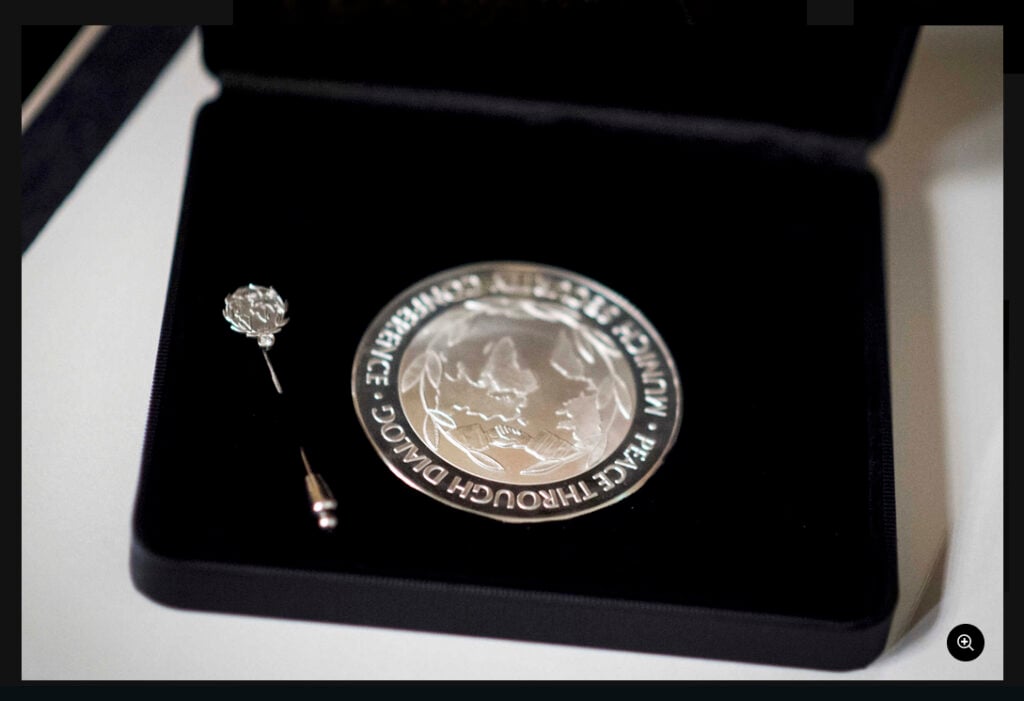
Now, as you can see on the links and the photo above, the prize is awarded to people who contribute to “Peace Through Dialog.”

It has been awarded to quite a few whose names you associate neither with peace nor dialogue – such as Henry Kissinger, John McCain and Jens Stoltenberg. But also a few who could be quite fitting such as the United Nations and the Organisation for Security and Cooperation, OSCE.

But for sending an application to NATO? Is that an example of making peace through dialogue?

Is NATO for dialogue and peace? At this moment, 30 NATO members (standing for 58% of the world’s military expenditures) do all they can to make the Ukraine war as long and hurtful to the Ukrainians as they can. Not one of them speak seriously about dialogue, negotiations or peace. Some leaders of NATO member states have recently argued that they deliberately did not put pressure on Ukraine to accept and implement the Minsk Agreements because they wanted to help Ukraine win time to arm and militarise itself further and continue the civil war on Russian-speaking people in the Donbas region.

Western leaders have told Ukrainian president Zelensky to stop talking about talks.

So, dialogue with Russia? There is none – NATO has not listened or adapted to anything Russian leaders have said since the days of Mikhail Gorbachev about 30 years ago. And they cheated him and Russia by breaking their promises about not expanding NATO “one inch” if they got unified Germany into the alliance.

And who is it Sweden and Finland are now rewarded for seeking to join?

It’s a group of countries which have repeatedly participated in wars, some of them have nuclear weapons, and they have intervened militarily worldwide, in particular in the Middle East, and continue to have a military presence around the world – bases, troops, naval exercises, aircraft carriers, you name it.

It’s a NATO that daily violates the provisions of its own Charter which is a copy of the UN Charter and argues for all disputes to be transferred to the UN. It’s an alliance that has violated international law and killed and maimed in, for instance, Yugoslavia (without a UN mandate) and Libya (by going way beyond the UN mandate).

And NATO’s supreme leader, the United States, distinguishes itself as being in a class of its own when it comes to militarism and warfare, has killed and wounded millions of innocent people and destroyed a series of countries since the Vietnam wars, lost all its wars morally and politically if not also militarily.

To quote from John Menadue’s fact-based expose here:

“The US has never had a decade without war. Since its founding in 1776, the US has been at war 93 per cent of the time. These wars have extended from its own hemisphere to the Pacific, to Europe and most recently to the Middle East. The US has launched 201 out of 248 armed conflicts since the end of World War II. In recent decades most of these wars have been unsuccessful. The US maintains 800 military bases or sites around the world, including in Australia. The US has in our region a massive deployment of hardware and troops in Japan, the Republic of Korea and Guam.

The US tried to change other countries’ governments 72 times during the Cold War…”

And countries that voluntarily join such an alliance with such a leader are awarded a prize for peace through dialogue?

Seriously?

•

Some of us – not the least professionally competent people when it comes to peace and peacemaking – strongly believe that peace is about reducing all kinds of violence – against other human beings, cultures, gender and Nature, on the one hand, and promote society’s individual and collective realisation of potentials – in short, a less violent and more constructive, convivial and tolerant world. (Like the doctor’s aim is to reduce diseases and create positive health).

As a matter of fact, those the world used to perceive as peace leaders were those who stood for that kind of peace such as, say, Gandhi, Martin Luther King, Jr., Daisaku Ikeda, scholars like Johan Galtung, Elise and Kenneth Boulding, the peace movement – again, you name them, including the forgotten heroes of peace in all warzones that never receive any attention in our media. Alfred Nobel wanted to reward those who work against the warfare system, reduce weapons and armies and negotiate peace…

But this?

•

And some of us associate peace with life, creativity, tolerance, coexistence, Ubuntu – the fundamental connectedness of humanity. With civilian, intelligent conflict-resolution (because there will always be conflicts and differences, but they can be solved in smart ways without harming and killing).

But, as we all know by now – and since the end of the First Cold War and 9/11 – peace is also associated with death and planned destruction – by those who never thought a deeper thought about the concept of peace – .

They say RIP – Rest in Peace. Peace as silence, lifelessness, death and winning on the battlefield because ‘the others’ are humiliated, harmed and killed.

The above peace prize is associated with the destructive, not constructive, peace – it’s a Rest In Peace Prize. Peace through Dialogue? – No, peace by historically unique militarism and preparation of Death.

The signal being sent – but not problematised in any media is this:

Peace is now what NATO does. Peace is armament. Peace is military strength. Peace is not to dialogue but to play it tough. Peace is to never do soul-searching and ask: Did I possibly do something wrong? Peace is arming someone else to fight our enemy, but to not pay a price in human terms ourselves. Peace is to blame everybody else and see the world in black-and-white colours only. Peace is appoint ourselves as the good, innocent and victimised side. And therefore, peace is to legitimate our own ongoing unspeakable brutality, arms addiction and contempt for others.

Furthermore:

Peace is to never mention words such as consultation, mediation, peacekeeping, reconciliation, forgiveness, empathy, mutual understanding, respect, nonviolence, and tolerance – they are all out of time and out of place.

You know this strategy, of course:

“If you tell a lie big enough and keep repeating it, people will eventually come to believe it. The lie can be maintained only for such time as the State can shield the people from the political, economic and/or military consequences of the lie. It thus becomes vitally important for the State to use all of its powers to repress dissent, for the truth is the mortal enemy of the lie, and thus by extension, the truth is the greatest enemy of the State.”

It seems not to be formulated by Goebbels, Hitler’s public relations manager or spin-doctor. A post about The Big Lie at the Jewish Virtual Library informs us that:

“This is an excellent definition of the “Big lie,” however, there seems to be no evidence that it was used by Nazi propaganda chief Joseph Goebbels, though it is often attributed to him… The original description of the big lie appeared in Mein Kampf…”

I’d not be surprised if we shall soon witness similar RIP Prizes given posthumously to, say, Hitler, Mussolini, Stalin or Goebbels… whoever works diligently for the RIP Peace.

For the peace of our times is a RIP peace.

I congratulate the Finnish and Swedish governments to the award – and thank the German prize committee for having made it so clear for the world to see just how fast and far the lemmings of militarism are running towards doom.

Note

You may get much finer insights into these things by watching Harold Pinter’s lecture upon receiving the Nobel Prize in Literature in 2005. Its headline is “Art, Truth And Politics.”


Peace & future researcher + ‌Art Photographer

2 Responses

  1. This is a brilliant article. In these dark days when right is wrong and peace is war it is very important to remind us that there could be an alternative. It is frightful to see how ignorance has been engrained in our contemporary discourse. As Goethe said: “There is nothing more frightful than ignorance in action”. As Harold Pinter said in his Nobel Prize acceptance speech: “It means the brainwashing is so thorough we are programmed to swallow a pack of lies. If we don’t recognise propaganda, we may accept it as normal and believe it. That’s the submissive void.” Thank you for your courage and your persistence to take us out of submissive void.

Related Posts

Jan Oberg TFF director October 13, 2026 According to Alfred Nobel’s will, the Nobel Peace Prize shall be awarded: ”to the person who has done the most or best to advance fellowship among nations, the abolition or reduction of standing armies, and the establishment and promotion of peace congresses.” Further down, he also expresses how the prize for the “champions of peace” shall be decided: “that for champions of peace by a committee of five persons to be selected by the Norwegian Storting. Alfred Nobel’s will is remarkably short and clear. But few seem to have read it. Nobel did not say that the committee itself should consist of members of parliament. He entrusted the Storting with appointing five persons. In principle, it could have selected diplomats, mediators, peace researchers, conflict-resolution specialists, or other individuals with recognised expertise in matters of peace from around the world. Instead, the Storting gradually...
Advocates of nuclear disarmament are regularly dismissed by the champions of nuclear deterrence as naïve and unrealistic, utopian or even irresponsible. Yet this ‘doctrine’ of deterrence, regarded by France as the ‘cornerstone’ of its national security, is based on quasi-religious beliefs, a theory that cannot be proven, risky gambles and fragile assumptions. So much so that one might legitimately ask which side the ‘Care Bears’ are on. Marc FinaudVice-President of Initiatives for Nuclear Disarmament (IDN) October 9, 2026 This article was originally published on Pressenza When it comes to these things being treated as religious concepts, look here. Idealists and realists It was Hubert Védrine, François Mitterrand’s former Foreign Minister, who repeatedly coined the phrase: ‘Europeans are a sort of Care Bears who don’t realise they’re living in Jurassic Park’. He applies this reference to the cartoon for well-behaved children not only to what he regards as weakness or idealism...
What the West Borrowed from Asia and What It Left Behind Jan Krikke October 8, 2026 The article was originally published here In the late 1960s, the musical Hair announced that the Age of Aquarius was dawning. Its opening anthem promised a transformation of human consciousness: an era of peace, harmony and understanding. Half a century later, a familiar echo of that promise is a meditation app offered by your employer. You can find it in the same list of benefits as the pension plan and the gym discount. How did a spiritual revolution become an employee benefit? The answer lies in the history of the movement known as New Age: where it came from, what it borrowed from Asia, and why the meaning of what it borrowed changed in the process. Two definitions will help. New Age is a loose label for a wide range of spiritual practices and...

Recent Articles

Below are TFF-related media mentions, comments, videos and social media posts published elsewhere but not on this homepage. We happen to catch and list only a fraction. Regarding video comments and debates, we recommend that you go to the TFF Video Channel on Substack where many of them are reproduced. Jan Oberg is a contributor to China Daily – 52 million daily clicks – and Global Times, CGTN and CCTV (the national television), China Investment, Xinhua News Agency and several others. Articles and videos on these media very often multiply into countless Chinese (and Western media) that re-post them from these main media. Thanks to The China Academy, his analyses, interviews and comments are frequently posted on YouTube channels such as Thinkers Forum and Wave Media. These videos are often re-posted on Bilibili (China’s YouTube), the China Content Center on TikTok, and on the Chinese edition of TikTok, Douyin.com. This means reaching hundreds of millions of viewers worldwide over a year. While there are too many to catch on all these...
Jan Oberg TFF director October 13, 2026 According to Alfred Nobel’s will, the Nobel Peace Prize shall be awarded: ”to the person who has done the most or best to advance fellowship among nations, the abolition or reduction of standing armies, and the establishment and promotion of peace congresses.” Further down, he also expresses how the prize for the “champions of peace” shall be decided: “that for champions of peace by a committee of five persons to be selected by the Norwegian Storting. Alfred Nobel’s will is remarkably short and clear. But few seem to have read it. Nobel did not say that the committee itself should consist of members of parliament. He entrusted the Storting with appointing five persons. In principle, it could have selected diplomats, mediators, peace researchers, conflict-resolution specialists, or other individuals with recognised expertise in matters of peace from around the world. Instead, the Storting gradually...
The Quest for Humane Survival Richard Falk Professor emeritus, Princeton UniversityTFF Associate since 1986October 12, 2026 After decades of teaching and writing about international law in academic frameworks that were not institutionally situated within law school environments—at Princeton and the University of California, Santa Barbara—I found myself most receptive to the TWAIL outlook. It has been especially illuminating in clarifying the extent to which international law evolved as a dialogical critique of Europe’s efforts to legitimize its colonial undertakings. In particular, TWAIL has exposed how international law has functioned to legalize the subjugation of Third World peoples, securing conditions for exploitative investment and trade relations, the coercive enforcement of public debts, and an ideology of cultural superiority. TWAIL’s exposure of these economic legacies of colonialism has influenced my understanding of the history and development of international law, broadly conceived, as an ideological project of the Western sub-system of the world...

TFF on Substack

Discover and subscribe to more peace materials on TFF Substack

Most Popular

Below are TFF-related media mentions, comments, videos and social media posts published elsewhere but not on this homepage. We happen to catch and list only a fraction. Regarding video comments and debates, we recommend that you go to the TFF Video Channel on Substack where many of them are reproduced. Jan Oberg is a contributor to China Daily – 52 million daily clicks – and Global Times, CGTN and CCTV (the national television), China Investment, Xinhua News Agency and several others. Articles and videos on these media very often multiply into countless Chinese (and Western media) that re-post them from these main media. Thanks to The China Academy, his analyses, interviews and comments are frequently posted on YouTube channels such as Thinkers Forum and Wave Media. These videos are often re-posted on Bilibili (China’s YouTube), the China Content Center on TikTok, and on the Chinese edition of TikTok, Douyin.com. This means reaching hundreds of millions of viewers worldwide over a year. While there are too many to catch on all these...
Jan Oberg TFF director October 13, 2026 According to Alfred Nobel’s will, the Nobel Peace Prize shall be awarded: ”to the person who has done the most or best to advance fellowship among nations, the abolition or reduction of standing armies, and the establishment and promotion of peace congresses.” Further down, he also expresses how the prize for the “champions of peace” shall be decided: “that for champions of peace by a committee of five persons to be selected by the Norwegian Storting. Alfred Nobel’s will is remarkably short and clear. But few seem to have read it. Nobel did not say that the committee itself should consist of members of parliament. He entrusted the Storting with appointing five persons. In principle, it could have selected diplomats, mediators, peace researchers, conflict-resolution specialists, or other individuals with recognised expertise in matters of peace from around the world. Instead, the Storting gradually...
The Quest for Humane Survival Richard Falk Professor emeritus, Princeton UniversityTFF Associate since 1986October 12, 2026 After decades of teaching and writing about international law in academic frameworks that were not institutionally situated within law school environments—at Princeton and the University of California, Santa Barbara—I found myself most receptive to the TWAIL outlook. It has been especially illuminating in clarifying the extent to which international law evolved as a dialogical critique of Europe’s efforts to legitimize its colonial undertakings. In particular, TWAIL has exposed how international law has functioned to legalize the subjugation of Third World peoples, securing conditions for exploitative investment and trade relations, the coercive enforcement of public debts, and an ideology of cultural superiority. TWAIL’s exposure of these economic legacies of colonialism has influenced my understanding of the history and development of international law, broadly conceived, as an ideological project of the Western sub-system of the world...
Read More
girl-5894831_1280
Below are TFF-related media mentions, comments, videos and social media posts published elsewhere but not on this homepage. We happen to catch and list only a fraction. Regarding video comments and debates, we recommend that you go to the TFF Video Channel on Substack where many of them are reproduced. Jan Oberg is a contributor to China Daily – 52 million daily clicks – and Global Times, CGTN and CCTV (the national television), China Investment, Xinhua News Agency and several others. Articles and videos on these media very often multiply into countless Chinese (and Western media) that re-post them from these main media. Thanks to The China Academy, his analyses, interviews and comments are frequently posted on YouTube channels such as Thinkers Forum and Wave Media. These videos are often re-posted on Bilibili (China’s YouTube), the China Content Center on TikTok, and on the Chinese edition of TikTok, Douyin.com. This means reaching hundreds of millions of viewers worldwide over a year. While there are too many to catch on all these...
Nobel-Prize-Plaque
Jan Oberg TFF director October 13, 2026 According to Alfred Nobel’s will, the Nobel Peace Prize shall be awarded: ”to the person who has done the most or best to advance fellowship among nations, the abolition or reduction of standing armies, and the establishment and promotion of peace congresses.” Further down, he also expresses how the prize for the “champions of peace” shall be decided: “that for champions of peace by a committee of five persons to be selected by the Norwegian Storting. Alfred Nobel’s will is remarkably short and clear. But few seem to have read it. Nobel did not say that the committee itself should consist of members of parliament. He entrusted the Storting with appointing five persons. In principle, it could have selected diplomats, mediators, peace researchers, conflict-resolution specialists, or other individuals with recognised expertise in matters of peace from around the world. Instead, the Storting gradually...
law-419057_1280
The Quest for Humane Survival Richard Falk Professor emeritus, Princeton UniversityTFF Associate since 1986October 12, 2026 After decades of teaching and writing about international law in academic frameworks that were not institutionally situated within law school environments—at Princeton and the University of California, Santa Barbara—I found myself most receptive to the TWAIL outlook. It has been especially illuminating in clarifying the extent to which international law evolved as a dialogical critique of Europe’s efforts to legitimize its colonial undertakings. In particular, TWAIL has exposed how international law has functioned to legalize the subjugation of Third World peoples, securing conditions for exploitative investment and trade relations, the coercive enforcement of public debts, and an ideology of cultural superiority. TWAIL’s exposure of these economic legacies of colonialism has influenced my understanding of the history and development of international law, broadly conceived, as an ideological project of the Western sub-system of the world...
images-2
Advocates of nuclear disarmament are regularly dismissed by the champions of nuclear deterrence as naïve and unrealistic, utopian or even irresponsible. Yet this ‘doctrine’ of deterrence, regarded by France as the ‘cornerstone’ of its national security, is based on quasi-religious beliefs, a theory that cannot be proven, risky gambles and fragile assumptions. So much so that one might legitimately ask which side the ‘Care Bears’ are on. Marc FinaudVice-President of Initiatives for Nuclear Disarmament (IDN) October 9, 2026 This article was originally published on Pressenza When it comes to these things being treated as religious concepts, look here. Idealists and realists It was Hubert Védrine, François Mitterrand’s former Foreign Minister, who repeatedly coined the phrase: ‘Europeans are a sort of Care Bears who don’t realise they’re living in Jurassic Park’. He applies this reference to the cartoon for well-behaved children not only to what he regards as weakness or idealism...
8824b09f-33a5-43f9-9fd0-550f28cda24d_1536x1024
What the West Borrowed from Asia and What It Left Behind Jan Krikke October 8, 2026 The article was originally published here In the late 1960s, the musical Hair announced that the Age of Aquarius was dawning. Its opening anthem promised a transformation of human consciousness: an era of peace, harmony and understanding. Half a century later, a familiar echo of that promise is a meditation app offered by your employer. You can find it in the same list of benefits as the pension plan and the gym discount. How did a spiritual revolution become an employee benefit? The answer lies in the history of the movement known as New Age: where it came from, what it borrowed from Asia, and why the meaning of what it borrowed changed in the process. Two definitions will help. New Age is a loose label for a wide range of spiritual practices and...
Screenshot 2026-10-04 210142
Small and different + among the 10% most active + 9,000 texts + 150 Associates + 60 000 a day — and a stubborn belief that peace is smarter and must be secured by peaceful means. In 2026, the Transnational Foundation for Peace and Future Research (TFF) turns 40. On Monday, October 5, 2026, a new TFF homepage will go live — a new gateway to more than 9,000 articles, analyses, research papers and other contributions produced over four decades of independent peace research. But this is not simply a new website. For four decades, TFF has worked from a simple conviction: peace is smarter than militarism and can be brought about by peaceful means. This is not merely an aspiration. It is the principle expressed in the UN Charter and the Gandhian tradition that has guided our work from the beginning. TFF is a research-based, independent and people-financed foundation....





