Johan Galtung

June 02, 2020

Here is a Table with fifteen faiths organized according to mono-poly-pan-atheism; some might find the table somewhat controversial:

Originally posted on Transcend Media Service’s website
February 3rd, 2020 here

Table 1.  Figures of thought, faiths, and beliefs of true believers

Figures Faiths Beliefs
Mono Judaism Israel, Zion; as Chosen People
Mono Catholicism Pope (infallible), Vatican
Mono Evangelism Dualism-Manicheism-Armageddon, DMA
Mono Islam Togetherness under Alla’h, sharing
Poly Hinduism Creation-Preservation-Destruction
Pan Buddhism dukkha-sukha, sentient life networks
Pan Daoism Holism-Dialectics-Transcendence, HDT
Pan Confucianism Authority-Harmony; educated old men
Pan Shintoism Japan; as Chosen People
Pan Polynesism lokahi, ‘ohana, alo’ha, mana
A Humanism Humans; as Chosen species with rights
A Liberalism Individuals-Choice-Equilibrium;Markets
A Marxism Classes-Struggle-History;Plans
A Nature Diversity, Symbiosis
The focus of this table is on concrete, this world, implications.

Abrahamism, mono-centric, indicative of a centrism that could serve Occident I.  Jesus Christ universalized tribal Judaism to global Christianity, expressed institutionally in catholicism, and biblically by US evangelists in their world view of good-evil dualism, ending in a violent Armageddon and the Second coming of Christ. 

They themselves are Chosen People, having seen the Truth, they find allies for an aggressive alliance in Judaism and (state) Shinto, also mono-centric, also Chosen Peoples.  But their centrism is too self-centred, setting them apart; moreover, their centres – like for Islam – are not in the West.

The alliance is uneasy.

There is also orthodox Christianity, more similar to Catholicism, with the center in the Third Rome, Moscow – not in the West either.

Hinduism, poly-centric, is a counterpoint to the mono-centrism of Judaism, evangelism and (state) Shinto, in Hindu idiom, but with universal content, having mono-, poly-, pan- and a-theist features.

Buddhism, multi-centric, often partner to states that destroy Buddhist messages of unity of life, alleviation of suffering (dukkha) and increasing fulfillment (sukha).  “Polynesism”, also multicentric, is world-encompassing, and local, like kami village Shinto.

Chinese civilization = Daoism + Confucianism + Buddhism; Confucianism vertical socially, Buddhism horizontal, Daoism opening for change from one to the other in this holon with contradictions and transcendence. 

Daoism stands out as the worldview counterpoint to Evangelism; Holism-Dialectics-Transcendence (HDT) versus Dualism-Manicheism-Armageddon, (DMA), underlying so much of the China-USA tension today.

However, the West had another card up its sleeves as Christianity declined: secularisms, the world views of the Enlightenment.

Humanism – humans as a measure of all things (Protagoras) and sacred to each other – homo res sacra hominibus – is universal, nohttps://en.wikipedia.org/wiki/BRICSt Western, but human rights carry an Occident I imprint: individualism. 

Nor do Liberalism and Marxism as formulated here carry the idea of global centers in the West, but Market and Plan did, with the United States for Market and the Soviet Union for Plan, an important aspect of the Cold War conflict.

That ended with one after the other falling, not strange as Market impedes individual choice for many, with class struggle all over and no equilibrium; and Plan impedes History from running its course, leading to its own overthrow.  They appear together in BRICS – Brazil, Russia, India, China and South Africa.

Then there is nature, with a world view, Naturism, a message.

Not for heaven’s sake, but for nature’s sake: keep diversity with symbiosis, not for “sustainability”, but for complexity, evolution.

Together with Buddhism and Daoism a voice of sanity.

The reflections above are pitting hard mono against soft poly-pan-a, as faiths-theology, in the polity, in the economy, in theory. 

How about that perspective inside the religions, not between them?

Religions in general: hard and soft

Let us conceive of the varieties of religious experience as a circular field divided into sectors, one for each religious discourse; Judaism, Christianity, Islam, Hinduism, Buddhism, Daoism, Confucianism and Shinto (which has mono-, poly- and pantheistic features); and others.  The number of sub-divisions is infinite.

What matters is the religious temperature in this religio-scape, with maximum in the center of religio, the mystic union with all life, all humans, with the Almighty, regardless of religious discourse, beyond any language and culture and tradition, just the oneness of the mysterium tremendum et fascinans (Otto).  In the center.

Imagine all the sectors emanating from this center, the core of the religio-scape, in all directions.  And imagine two concentric circles around the center: one close to the center, the other further away from the mysterium, with the religious temperature falling as we move away from the center of intense union with the transpersonal, however conceived of in the religious idioms known to humankind.

Inside the inner circle is soft religion.  The sense of unity as everyday life, not as a mystic experience.  Religion is compassionate, reaching everybody, the whole world; seeing the Jew, Christian, Muslim, Hindu, Buddhist etc in all, without reservation and exception. Brothers and sister all, as St. Francis had it. 

The borders between religious sectors carry no connotation of near or distant, good or evil; they are merely etiquettes, easily permeated.  Like people talking different languages sharing easily translatable messages.

Very pan-theistic, a pantheism that is latent in all religions.

However, it costs little to profess love of all of humanity and feel the closeness even when quite distant, socially and/or geographically.

But, it costs even less to hate even when in fact they are very close; giving in to their sense of chosenness: my religion is right, yours is wrong, the world would be better without you!

On the other side of that inner circle is the outer circle of hard religion, the hard aspect of any religion; it is not true that some religions are only soft and gentle, and others only hard and rough.

There is no sharp border between the soft and hard aspects of a religion.  But as we move away from the heat of the epicenter that melts hardened souls, the religio-scape changes dramatically.  The demarcation lines between faiths and sub-faiths become more clear-cut, sharp, stark.  A we move still further out the temperature falls; hearts get frozen; people see what divides, not what unites.

Exclusiveness comes to their minds through dogma, and into their behavior through exclusive organizations ([i]). Dogma and organization take on their own lives far away from the key message of union, uniting, ligare; sustained by cold, frozen souls. 

Violence and war easily sprout where unity has died, and hatred where love has died.

Just as the inner circle of the religio-scape is pantheistic, the outer circle is mono, not necessarily -theistic, but mono-religious; with the possibility of making them all more inclusive, pantheistic.

As we move still further out we come to the border of humanity.  What is on the other side of the outer circle?  The animal kingdom?  How dare we insinuate that animals are extrapolating from the evils practiced in the name of hard religion!  Atheism, humanism, ideology?  No, those are other faiths, also with union in the center, then inclusion, then exclusion.  No, outside is pure Evil.  Satan.

What characteristics of religions correlate with this distance from the core, this soft-hard, unite-divide, include-exclude dichotomy?

Here are some hypotheses related to the religious discourse: the nature of God, the existence of Satan, the pantheon, the nature of reality and the relation to other religions and the State:

Table 2. Hard religions & soft religions

HARD RELIGIONS SOFT RELIGIONS
[1] God is transcendent, above God is immanent, inside
[2]  God has Chosen People People have Chosen Gods
[3]  There is a Satan, below There is no Satan
[4]  Satan as Chosen people  People have Chosen Satans
[5]  Monotheism        Polytheism, pantheism
– unitarian             – trinitarian, quaternarian
[6]  Dualism      Monism
[7]  Universalism-singularism   Particularism-pluralism
[8]  State has Chosen Religion Religion has no Chosen State

All controversial, but they give concrete meaning to hard-soft.

Thus, a transcendent God is outside Human beings, as a Father-Sky even outside the planet.  If in addition He is choosey, preferring some people to others (“all humans are His children, but some more than others”), then there is not only divisiveness but also hierarchy:

  • humans above the rest of nature (speciesism)
  • men above women (sexism)
  • adults above children (ageism)
  • whites against non-whites (racism)
  • upper classes against lower classes (classism)
  • own nation against other nations (nationalism)
  • own state against other states (patriotism)

Hard religion has hard stands on these seven fault-lines, cutting the world in good vs evil; opening for the final battle: the DMA syndrome Dualism-Manicheism-Armageddon of Abrahamic fundamentalists.

Soft religion tends to soft stands; seeing the cuts as yin/yang, not as Aristotelian-Cartesian; themselves soft, not hard.  Borders are porous, osmotic, not iron-clad.  Immanence places God-sacred inside us, less as subjects and more as substance lifting us all.  Pantheism.

Enters dualism, between an ideal world in the Kingdom of Heaven, and the real world of homo homini lupus, bellum omnium contra omnes.

In this world hard religion favors hard approaches to protect God’s own people till His teachings prevail and His people are in command.  But that time has not yet come: hence soft religion for transcendental existence next to a transcendent God, and hard religion for the realities of this world; die zwei Regimenten, the two regimes.

A person may be closer or further away from God, but also have more or less of that-of-God.  A God in the Sky can radiate to the world; gods inside us do not have that reach.  They are more local, vernacular, residing in the tribe, the clan, the in-group.  The god-substance may be evenly distributed in the in-group, but only there.

When people choose their own gods, as is more the case in the Orient, pluralism is not only diversity among people, but eclecticism within individuals; like a Japanese Buddhist who is also a Christian. This is ruled out by singularism: one and only one true faith.

Polytheism, more gods within one religion, has a flexibility different from pluralism: faith in more than one religion.  The Christian familia sagrada enters the indicator list; at three – the Father, the Son, the Holy Spirit – or four, with the Mother, Mary.

With more gods and saints some may be harder, some softer. Like God and Mary in Catholicism, or Thor and Baldur in Nordic religion.  Under polytheism holy war is unlikely as also holy peace, except in the afterlife, under the logic of Dualism. 

Monism forces the believers to work out how peace could be practised on this earth under one God, if peace is wanted, not providing the easy escape of two regimes.

A cruel choice between a transcendent, fundamentalist God claiming universal validity as the only one, and immanent gods-as-substance, dwelling in all, extending to other groups? 

Evidently, the soft side must be strengthened.  The problem is, how?

By conscious dialogue, within and not only between the religions.

NOTE:

([i]).  For the relation between the structure of thought and the structure of the organization producing and reproducing that thought, see Johan Galtung: “Social Structure and Science Structure”, Methodology and Ideology, Copenhagen, Ejlers, 1977, Chapter 1, pp. 13-40.  The more axiomatic-deductive the thought structure, the more vertical the organization.

If you enjoyed this article, please consider donating 1 dollar or five…


Johan Galtung, a professor of peace studies, dr hc mult, is founder of TRANSCEND International and rector of TRANSCEND Peace University. He was awarded among others the 1987 Right Livelihood Award, known as the Alternative Nobel Peace Prize. Galtung has mediated in over 150 conflicts in more than 150 countries, and written more than 170 books on peace and related issues, 96 as the sole author. More than 40 have been translated to other languages, including 50 Years-100 Peace and Conflict Perspectives published by TRANSCEND University Press. His book, Transcend and Transform, was translated to 25 languages. He has published more than 1700 articles and book chapters and over 500 Editorials for TRANSCEND Media Service. More information about Prof. Galtung and all of his publications can be found at transcend.org/galtung.
Johan has also been a TFF Associate since 1986.
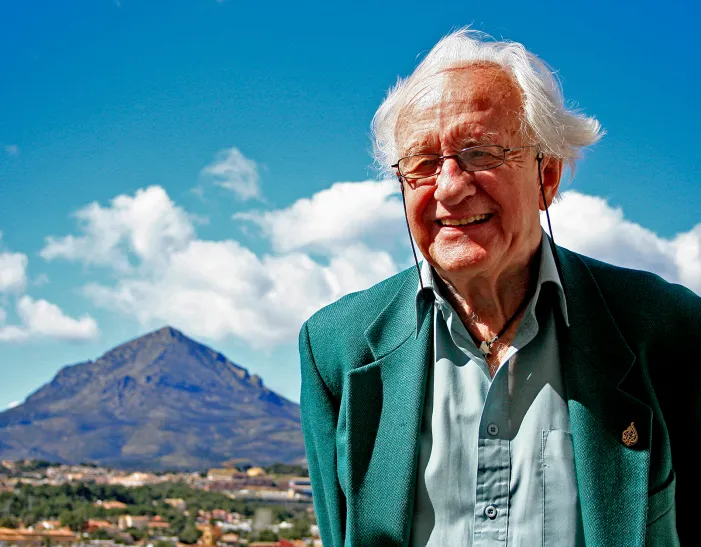
Photo by Jan Oberg.
2 Responses

  1. A reminder: The gods can either take away evil from the world and will not, or, being willing to do so cannot; or they neither can nor will, or lastly, they are able and willing. If they have the will to remove evil and cannot, then they are not omnipotent. If they can but will not, then they are not benevolent. If they are neither able nor willing, they are neither omnipotent nor benevolent. Lastly, if they are both able and willing to annihilate evil, why does it exist? Epicurus (341-270 B.C.E.) ————————————————————————————- No peace among the nations without peace among the religions. No peace among the religions without dialogue between the religions. No dialogue between the religions without investigation of the foundation of the religions, Hans Küng, University of Tübingen

Related Posts

Tony Robinson October 4, 2026 Violence is easy to recognise when someone is being beaten, shot or killed. It becomes more difficult when nobody is holding a weapon. Poverty, discrimination, exploitation and repression can restrict a human life just as effectively, although they do so in very different ways and with very different consequences. Simply adding more categories to an ever-growing list of forms of violence does not really solve the problem. The more interesting question is what all these different situations have in common and why it makes sense to describe them using the same word. Human beings do not simply react to what happens around them. They remember the past, imagine things that do not yet exist, make plans and undertake projects. Workers organise because they imagine different working conditions; people migrate because they imagine another life somewhere else; social movements emerge because people refuse to accept the...
It’s a matter of principles, courage, vision and pulling together – while the militarist world is falling apart… Peter Langille October 3, 2026 “Here, then, is the problem which we present to you, stark and dreadful and inescapable: Shall we put an end to the human race; or shall mankind renounce war?”The Bertrand Russell—Albert Einstein Manifesto, July 9, 1955 ⁕ The forecast for what’s ahead is worrisome. The sharp rise in armed conflicts over the past three years is adding to what was already the highest level in over seventy years. Genocides, which should be prevented are supported. A shared climate emergency that jeopardises survival is ignored. Diverse polls now suggest that people are war-weary, worried and interested in a more effective United Nations. And, there are viable policy options for a more secure world! Yet governments are doubling-down, betting on more war and investing heavily. If current trends persist,...
Johan Galtung 1930-2024October 2015 Published here on October 3, 2026 Let us focus on Civilization for conflict analysis and remedies. Major forms of disorder use violence; war is state organized violence. The most belligerent states are the United States of America and Israel, both with civilization roots. National Evangelism, the US Protestant Christian civilization– more national than evangelical–justifies US warfare as exceptionalism of a people chosen by God, with a manifest destiny to run the world. Orthodox Judaism justifies Israeli warfare to conquer and expand from Nile to Euphrates as a religious right and duty to the Eternal One. The third most belligerent country, the UK, no longer believes it is God-chosen but chosen by the USA; not quite the same but something. But the root cause of global disorder lies in the Occident–with Islam–seeing itself as the single, universal civilization valid for all at all times, all others being...

Recent Articles

Tony Robinson October 4, 2026 Violence is easy to recognise when someone is being beaten, shot or killed. It becomes more difficult when nobody is holding a weapon. Poverty, discrimination, exploitation and repression can restrict a human life just as effectively, although they do so in very different ways and with very different consequences. Simply adding more categories to an ever-growing list of forms of violence does not really solve the problem. The more interesting question is what all these different situations have in common and why it makes sense to describe them using the same word. Human beings do not simply react to what happens around them. They remember the past, imagine things that do not yet exist, make plans and undertake projects. Workers organise because they imagine different working conditions; people migrate because they imagine another life somewhere else; social movements emerge because people refuse to accept the...
It’s a matter of principles, courage, vision and pulling together – while the militarist world is falling apart… Peter Langille October 3, 2026 “Here, then, is the problem which we present to you, stark and dreadful and inescapable: Shall we put an end to the human race; or shall mankind renounce war?”The Bertrand Russell—Albert Einstein Manifesto, July 9, 1955 ⁕ The forecast for what’s ahead is worrisome. The sharp rise in armed conflicts over the past three years is adding to what was already the highest level in over seventy years. Genocides, which should be prevented are supported. A shared climate emergency that jeopardises survival is ignored. Diverse polls now suggest that people are war-weary, worried and interested in a more effective United Nations. And, there are viable policy options for a more secure world! Yet governments are doubling-down, betting on more war and investing heavily. If current trends persist,...
Johan Galtung 1930-2024October 2015 Published here on October 3, 2026 Let us focus on Civilization for conflict analysis and remedies. Major forms of disorder use violence; war is state organized violence. The most belligerent states are the United States of America and Israel, both with civilization roots. National Evangelism, the US Protestant Christian civilization– more national than evangelical–justifies US warfare as exceptionalism of a people chosen by God, with a manifest destiny to run the world. Orthodox Judaism justifies Israeli warfare to conquer and expand from Nile to Euphrates as a religious right and duty to the Eternal One. The third most belligerent country, the UK, no longer believes it is God-chosen but chosen by the USA; not quite the same but something. But the root cause of global disorder lies in the Occident–with Islam–seeing itself as the single, universal civilization valid for all at all times, all others being...

TFF on Substack

Discover and subscribe to more peace materials on TFF Substack

Most Popular

Tony Robinson October 4, 2026 Violence is easy to recognise when someone is being beaten, shot or killed. It becomes more difficult when nobody is holding a weapon. Poverty, discrimination, exploitation and repression can restrict a human life just as effectively, although they do so in very different ways and with very different consequences. Simply adding more categories to an ever-growing list of forms of violence does not really solve the problem. The more interesting question is what all these different situations have in common and why it makes sense to describe them using the same word. Human beings do not simply react to what happens around them. They remember the past, imagine things that do not yet exist, make plans and undertake projects. Workers organise because they imagine different working conditions; people migrate because they imagine another life somewhere else; social movements emerge because people refuse to accept the...
It’s a matter of principles, courage, vision and pulling together – while the militarist world is falling apart… Peter Langille October 3, 2026 “Here, then, is the problem which we present to you, stark and dreadful and inescapable: Shall we put an end to the human race; or shall mankind renounce war?”The Bertrand Russell—Albert Einstein Manifesto, July 9, 1955 ⁕ The forecast for what’s ahead is worrisome. The sharp rise in armed conflicts over the past three years is adding to what was already the highest level in over seventy years. Genocides, which should be prevented are supported. A shared climate emergency that jeopardises survival is ignored. Diverse polls now suggest that people are war-weary, worried and interested in a more effective United Nations. And, there are viable policy options for a more secure world! Yet governments are doubling-down, betting on more war and investing heavily. If current trends persist,...
Johan Galtung 1930-2024October 2015 Published here on October 3, 2026 Let us focus on Civilization for conflict analysis and remedies. Major forms of disorder use violence; war is state organized violence. The most belligerent states are the United States of America and Israel, both with civilization roots. National Evangelism, the US Protestant Christian civilization– more national than evangelical–justifies US warfare as exceptionalism of a people chosen by God, with a manifest destiny to run the world. Orthodox Judaism justifies Israeli warfare to conquer and expand from Nile to Euphrates as a religious right and duty to the Eternal One. The third most belligerent country, the UK, no longer believes it is God-chosen but chosen by the USA; not quite the same but something. But the root cause of global disorder lies in the Occident–with Islam–seeing itself as the single, universal civilization valid for all at all times, all others being...
Read More
Living-Peace-Sign-Budapest-copy
Tony Robinson October 4, 2026 Violence is easy to recognise when someone is being beaten, shot or killed. It becomes more difficult when nobody is holding a weapon. Poverty, discrimination, exploitation and repression can restrict a human life just as effectively, although they do so in very different ways and with very different consequences. Simply adding more categories to an ever-growing list of forms of violence does not really solve the problem. The more interesting question is what all these different situations have in common and why it makes sense to describe them using the same word. Human beings do not simply react to what happens around them. They remember the past, imagine things that do not yet exist, make plans and undertake projects. Workers organise because they imagine different working conditions; people migrate because they imagine another life somewhere else; social movements emerge because people refuse to accept the...
b54a1f10-8c65-4f0b-9dd5-4abc0a7d04cc_2659x2659
It’s a matter of principles, courage, vision and pulling together – while the militarist world is falling apart… Peter Langille October 3, 2026 “Here, then, is the problem which we present to you, stark and dreadful and inescapable: Shall we put an end to the human race; or shall mankind renounce war?”The Bertrand Russell—Albert Einstein Manifesto, July 9, 1955 ⁕ The forecast for what’s ahead is worrisome. The sharp rise in armed conflicts over the past three years is adding to what was already the highest level in over seventy years. Genocides, which should be prevented are supported. A shared climate emergency that jeopardises survival is ignored. Diverse polls now suggest that people are war-weary, worried and interested in a more effective United Nations. And, there are viable policy options for a more secure world! Yet governments are doubling-down, betting on more war and investing heavily. If current trends persist,...
010
Johan Galtung 1930-2024October 2015 Published here on October 3, 2026 Let us focus on Civilization for conflict analysis and remedies. Major forms of disorder use violence; war is state organized violence. The most belligerent states are the United States of America and Israel, both with civilization roots. National Evangelism, the US Protestant Christian civilization– more national than evangelical–justifies US warfare as exceptionalism of a people chosen by God, with a manifest destiny to run the world. Orthodox Judaism justifies Israeli warfare to conquer and expand from Nile to Euphrates as a religious right and duty to the Eternal One. The third most belligerent country, the UK, no longer believes it is God-chosen but chosen by the USA; not quite the same but something. But the root cause of global disorder lies in the Occident–with Islam–seeing itself as the single, universal civilization valid for all at all times, all others being...
Screenshot 2026-10-02 011738
Jan ObergPhD, director, The Transnational Foundation for Peace and Future Research, TFFLund, Sweden October 2, 2026 This is my full original manuscript. The Chinese Academy of Social Science, CASS, makes two publications out if it. 1. China’s Five-year plan emphasized the capabilities of basic research and original innovation. It is regarded as the goal of the future social development, which, as required, should be significantly enhanced. Can you comment on the importance of original innovation in research and academic study? I believe it is easier to define “original innovation” in the natural sciences than in social sciences. The breaking points of what constitutes something new, or innovative, are not quite as sharp in the latter. But in both fields it is about opening up something that was closed, unseen, unexplored before – making manifest what was earlier latent. Innovations come in many forms and shapes – naming something that was not...
arctic-circle-map
The agreement is catastrophic both because of what it says and what it doesn’t mention. It reduces further the major asset of security policies: Freedom of action. Jan Oberg TFF director September 25, 2026 A couple of hours before the agreement was signed on September 22, 2026, I published the following 13 hypotheses about what it would most likely contain on TFF Substack (in English). I was wrong on only the first point. Contrary to what Trump had written on his Truth Social platform, it does not appear to come into force immediately. In fact, it turned out to be worse than even I had anticipated. After these hypotheses now come a number of reflections in light of what the agreement actually contains, and does not contain, as well as the way in which it has generally been presented by major media outlets and by the public-service broadcaster DR. My...
girl-5894831_1280
Below are TFF-related media mentions, comments, videos and social media posts published elsewhere but not on this homepage. We happen to catch and list only a fraction. Regarding video comments and debates, we recommend that you go to the TFF Video Channel on Substack where many of them are reproduced. Jan Oberg is a contributor to China Daily – 52 million daily clicks – and Global Times, CGTN and CCTV (the national television), China Investment, Xinhua News Agency and several others. Articles and videos on these media very often multiply into countless Chinese (and Western media) that re-post them from these main media. Thanks to The China Academy, his analyses, interviews and comments are frequently posted on YouTube channels such as Thinkers Forum and Wave Media. These videos are often re-posted on Bilibili (China’s YouTube), the China Content Center on TikTok, and on the Chinese edition of TikTok, Douyin.com. This means reaching hundreds of millions of viewers worldwide over a year. While there are too many to catch on all these...