
Austere “shock therapy” after the Cold War only shocked the East into reaction. In the West, the corporate political center ultimately did the same.
November 18, 2019
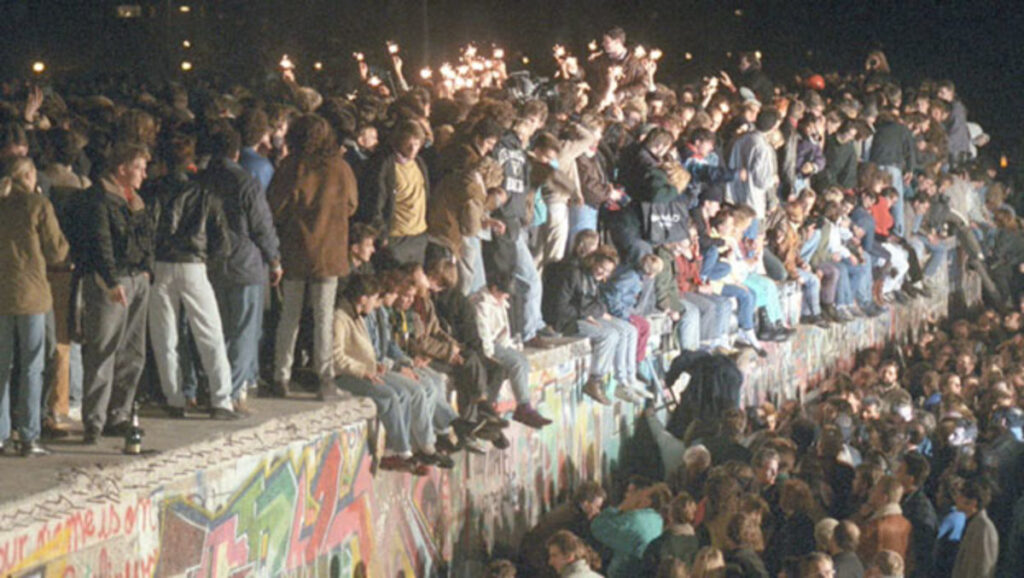
The Berlin Wall fell 30 years ago. It was one of the few unambiguously joyous moments in modern history. This popular, nonviolent explosion of dissent effectively toppled East Germany’s despotic regime. And it signaled, if only symbolically, the end of the Cold War that had divided Europe for nearly half a century.
Thirty years later, a united Germany remains far and away the largest economy in Europe (and the fourth largest in the world). Most of the countries of the former Warsaw Pact are members of the European Union, and their populations have seen dramatic improvements in living standards. After the horrendous bloodletting that tore apart Yugoslavia in the 1990s, the threat of war in Europe has again receded.
Who can argue with such success?
Originally published at fpif.org
It turns out: a lot of people. At some point, something seems to have gone terribly wrong with the transition from communism to liberalism to the end of history.
A new version of the Berlin Wall runs through Ukraine to divide east once again from west. Actual walls have been built throughout the Balkans to block desperate refugees and migrants from heading northward. Right-wing authoritarian leaders are challenging democracy in Poland, the Czech Republic, Hungary, and elsewhere in the region.
Frozen conflicts and kleptocracies prevail all over the former Soviet Union. Virulently racist movements have been consistently gaining political power throughout Europe, with Vox most recently becoming the third largest party in the Spanish parliament. The United Kingdom is involved in a slow-motion secession from the European Union.
And Donald Trump presides over the unraveling of the international order like some imp of the perverse.
I recently attended a conference at the University of Pennsylvania on the lessons of the “transition.” Two dozen scholars provided a variety of ground-level and big-picture analyses from the disciplines of economics, political science, and anthropology. Their goal: to reconcile these two pictures of the last 30 years.
On the one hand, there’s the purported triumph of liberalism. On the other, there’s the widely held view in the region that liberalism is the “god that failed,” as I’ve recounted in my book Aftershock: A Journey Through Eastern Europe’s Broken Dreams.
Economists and political scientists, looking at the numbers, have declared the transition over because the countries of Eastern Europe have become more or less “normal.”
Anthropologists, looking at people’s lived experience, have argued that the transition, in the sense of a continued legacy of the Communist period and a painful adjustment to life in a larger Europe, is still very much a flawed work in progress.
After two days of bifocal analysis — of scrutinizing the fine print and gazing into the distance, of trying to determine whether the glass is half full or half empty — I was convinced of one thing above all.
The “transition” is not unique to Eastern Europe or the former Soviet Union. The entire world, to one degree or another, has been undergoing a comparable transformation. That’s why Hungarians are suffering under Viktor Orban just as Americans are enduring Donald Trump.
In a circuitous, contradictory, and confounding way, the fall of the Berlin Wall and the reactions to it have produced both of these morbid symptoms.
The Short End of the Stick
Comparatively speaking, East Europeans got a raw deal after 1989. For one thing, they didn’t get a Marshall Plan, a huge influx of capital to repair their ravaged countries.
After World War II, an enormous helping hand from the West contributed to producing the Wirtschaftswunder — the economic miracle — that put West Germany on top of the European economic order only a decade after the war.
After 1989, some assistance flowed into Eastern Europe — and less into the former Soviet Union — but nothing on the order of a Marshall Plan. Instead, the West assumed that the invisible hand of the market would do the trick.
Nor did East European countries, as they entered the European Union, get the same kind of deal that earlier incoming members received. Tens of billions of dollars in EU structural funds helped Ireland, a primarily agricultural country, close the gap with the rest of the EU within a single generation.
By the time that Poland, Hungary, Slovakia, the Czech Republic, Slovenia, and the Baltic countries joined in 2004, the EU no longer had the funds or the collective commitment to bringing new members up to the community average. For Romania and Bulgaria, which joined in 2007, the gap was larger and the resources even scarcer.
Having shucked off their old Communist identities, the new populations of Eastern Europe expected to live like their counterparts in Austria or France or Sweden within five or ten years (or so they told me when I interviewed a couple of hundred folks throughout the region in 1990 and again nearly 25 years later).
That expectation gave meaning to their sacrifices when the new democratic governments pushed through “shock therapy” economic reforms that turned their lives upside down. They’d experience the pain of adjustment, but it would be worth it in the end.
Thirty years later, however, even the best performing countries in Eastern Europe haven’t closed the gap with the West. Slovenia’s per-capita GDP ($36,747) — adjusted for cost-of-living differences — is about three-quarters that of Austria ($52,137). Bulgaria ($23,156) is not even halfway there.
But even these figures are deceptive. After all, the metropolitan centers of Eastern Europe — Warsaw, Prague, Budapest, Bucharest, Sofia — have attracted the lion’s share of foreign investment and closed the gap more quickly with their western counterparts.
So, that means that smaller towns and the countryside in Eastern Europe are really far behind the West.
Poland B: that’s what Poles call the areas that have by and large not benefited from the economic transition. The “losers of transition” include pensioners, minority populations like the Roma, farmers who can’t compete with Western imports, and workers in industries with no future. You can find this “B team” throughout the region.
Anthropologist Kristen Ghodsee has chronicled the rise and fall of Madan, a predominantly Muslim city in southern Bulgaria. Once a mining town with a population of over 100,000 people, Madan has dwindled to a scant 6,000 or so.
The mines closed during the economic transformations of the 1990s and virtually everyone of working age left for the larger cities or to go abroad, leaving behind pensioners and children sent to live with their grandparents.
With many of the buildings in the town in ruins, Madan looks as if it were hit by war or natural disaster. There are many towns and cities like it in Bulgaria, where the population decline has been catastrophic: around 9 million in 1989, Bulgaria’s population is down to around 7 million today. It’s part of a region-wide demographic crisis.
For a lot of people in the region, then, it’s not a question of a glass half full versus a glass half empty. That metaphor implies a balanced scoresheet from the last 30 years and divergent perceptions of that scoresheet.
But this image is misleading. Instead, the glass overfloweth for a handful of super-wealthy, who made out like bandits during the economic upheaval, and the glass is practically empty for many others.
The political parties that pushed through the economic reforms, with the encouragement of international financial institutions and their advisers, also ended up as the losers of transition, as voters took revenge on them at the polls.
Liberal parties disappeared or drifted into irrelevance. Former Communist parties, which returned to power in the initial backlash against the economic reforms, by and large instituted the same austerity measures and were relegated to the political margins as well.
With both liberals and leftists discredited, a new kind of party emerged: nationalist, culturally conservative, and anti-liberal in its economic and political orientation.
These populist parties have consolidated control in Poland, Hungary, Bulgaria, and the Czech Republic. Even more reactionary movements — like Pegida in eastern Germany, the Our Homeland Movement in Hungary, and Ataka in Bulgaria — lurk in the wings.
Sound familiar?
Transition, Western Style
Consider the economic transformations that took place in Eastern Europe in the early 1990s as a transition not to the market per se, but to the global economy more generally.
After all, a number of Eastern European countries had experimented with market reforms prior to 1989 (like goulash communism in Hungary). But other than a few loans from and some anemic trade with the West, they all remained disconnected from global capitalism.
That would change after 1989. But instead of a gradual accommodation to the global economy, Eastern Europe and the former Soviet Union jumped off the high board into the deep end. The huge splash of chlorinated water has stung the eyes of all concerned, even the onlookers.
It turns out, however, that a lot of other countries preceded the Eastern bloc into the pool.
In the 1980s, conservative politicians like Margaret Thatcher in the UK and Ronald Reagan in the United States pushed a similar agenda of economic adjustment: cutting government spending (except on the military), reducing barriers to trade, promoting the financialization of the economy.
As in Eastern Europe a decade later, it wasn’t just conservative politicians who felt compelled to push this agenda. Socialist Francois Mitterrand pursued something similar in France.
Then, in the 1990s, it was the turn of Third Way liberals — Bill Clinton in the U.S. and Tony Blair in the U.S., but also the Labor parties in Australia and New Zealand and the Swedish Social Democratic Party — to move toward the neoliberal center.
Whether a project of market-oriented conservatives or liberals, this neoliberal accommodation to economic globalization has produced a similarly skewed pattern of benefits: Planet B if you will.
It has increased the gap between rich and poor nations — with a few notable exceptions like the Asian tigers — as well as the wealth divide within nations. Planet B contains some of the same communities left behind during the Eastern European transition: workers in sunset industries, minorities, pensioners.
The financial crisis of 2008-2009 only exacerbated the problem. In the United States, the government bailed out the big losers — like banks — and those in the top income brackets actually improved their position. Everyone else took a hit, with economic inequality widening.
In Europe, the EU failed to protect its member states from the crisis. In fact, the countries in the Eurozone had fewer government levers at their disposal — such as significant deficit spending — to pull themselves out of the crisis. The EU was beginning to look like part of the problem, not part of the solution.
After 2008, as Sheri Berman writes in a study of Why the Left Loses, “the center-left lacked a convincing message for dealing with the crisis, or a more general vision of how to promote growth while protecting citizens from the harsher aspects of free markets. Instead, it kept on trying to defend outdated policies or proposed watered-down versions of neoliberalism that barely differentiated it from the center-right.”
It’s no surprise, then, that the democratic world experienced the same political reaction as Eastern Europe after its particular economic disruption.
The benefits of economic globalization were unevenly distributed; so, too, was the pain of the financial crisis of 2008-2009. Politics
Unintended Consequences
Donald Trump and his populist coevals are not only the result of a revolt of the have-nots or a political backlash against the parties that supported undiluted economic globalization (and its industrial-strength version in Eastern Europe). They have taken advantage of another facet of globalization: migration.
There were two major sources for the major uptick in refugee flows in the last three decades.
The first is war, particularly wars launched by the United States. Those wars initially mobilized a wide range of support from both conservative and liberal governments (with some notable exceptions).
As the wars dragged on and produced an increasing flow of refugees, support waned, providing an opening for a populist like Donald Trump to claim opposition to America’s “endless wars.”
The migrants themselves, even if they served the economic needs of the receiving countries by taking jobs that the native-born didn’t want, became a rallying point for xenophobes of various political hues.
Right-wing populists giddily seized on the Afghans, Syrians, Libyans, and others fleeing war zones as yet another malign side effect of globalization, for was it not “globalists” in the EU elite who were welcoming these outsiders into Europe?
In the United States, meanwhile, Trump was railing against the influx of people from Mexico and points south and repeating the canard that his opponent Hillary Clinton, another “globalist,” supported “open borders.”
War, free trade, “open borders”: these became associated with a national elite supposedly addicted to all manner of malign activities beyond their national borders.
Even populists who’d supported various military operations and benefited personally from economic globalization — like Trump — saw advantages in championing the opposite: a nationalist fixation on sovereignty, strong borders, and government-sanctioned xenophobia.
Even populists who’d once championed fast-track transition, like Viktor Orban, switched sides at the first whiff of political opportunity.
The Roma, for instance, discovered that they weren’t welcome when they left their homes in Eastern Europe and went to Italy or France. A state could invoke concerns about “public safety” or “public health” to keep people out.
Established member states were also granted phase-in periods to block workers from the new states that joined in the 2000s.
But in general, EU accession created an enormous outflow of East European workers to the west. Roughly 750,000 Poles, for instance, went to Great Britain after accession, turning Polish into the second language in England after English.
Because of this influx, a sufficient number of Brits soured on the European project to give Brexit its thin margin of victory in the 2016 referendum.
Internal migration after the accession of the 1990s has likewise boosted Euroskepticism and nativism throughout the continent. One of the great virtues of the EU has turned out to be, thanks to a poorly thought-out accession process, an Achilles’ heel.
Rethinking the Transition
It’s not a direct line from the fall of the Berlin Wall to Donald Trump or Brexit. Rather, it’s the way Eastern Europe handled the transition — or had the transition handled for them — that has ultimately given rise to today’s populism.
Moreover, the same factors in play in Western Europe and in the United States, namely a “transition” to an economically and politically polarizing global economy, has produced a similar crop of political figures.
Yes, of course, other factors produced Trump, Brexit, and the like: feckless opposition, the impact of social media, outright fraud and misrepresentation.
But such idiocies could never have gotten within whispering distance of success without these underlying economic “adjustments” and the backlash to them.
Many East Europeans expected a kinder, gentler transition. When that didn’t happen, they either voted out the parties that orchestrated the shock-therapy adjustments or they voted with their feet. The disgruntled of Western Europe and the United States have focused their revenge on the polls.
Could it have happened differently 30 years ago?
Theoretically, yes. There could have been a Marshall Plan for Eastern Europe. The EU could have helped create a giant social safety net for its newest members. But resources were tight in the early 1990s because of an economic downturn that lasted from 1990 to 1994. And austerity, not largesse, was the watchword of that era.
Also, you could legitimately ask: why just Eastern Europe? Shouldn’t the former Soviet Union be included among the recipients? And why not South Africa after apartheid? Or, to backtrack just a couple years, the Philippines after Ferdinand Marcos? Were the people in these countries somehow less deserving?
Finally, Eastern European countries were not in a position to buck the status quo. Neither the United States nor Western Europe was interested in delaying the region’s entrance into the global economy.
There were choice properties in the region to acquire and lower-wage workers to exploit. But the even more salient point is that the West was engaged in a similar process of transition, though it had started earlier and could therefore attenuate the negative effects.
This larger transition is still ongoing. Economic globalization is now encountering two significant backlashes.
The first comes from the right-wing populists, who basically want to redirect the economic benefits accruing from their control of the state into their own pockets and those of their loyal clients.
The second comes from environmentalists, who recognize that an ever-expanding global economy has pumped a dangerously high amount of greenhouse gasses into the atmosphere.
Perhaps the notion of a largely unregulated market spreading into every nook and cranny of the earth will one day seem like a very quaint notion, like the spread of a single religion across the map or a single country’s domination of the globe.
As the waters continue to rise, let’s hope that there will still be economists, political scientists, and anthropologists who will debate the costs and benefits of this great transition.
But that will depend a great deal on whether the world embarks on a more sustainable transition to replace the one that has brought us all to this perilous crossroads.
Originally published at fpif.org
(Photo: history.com)

About the author:
John Feffer is the director of Foreign Policy In Focus and author of the dystopian novel





