

Heyerdahl Burns “Tigris” Reed Ship to Protest War 

By Betty Blair
ai@artnet.net
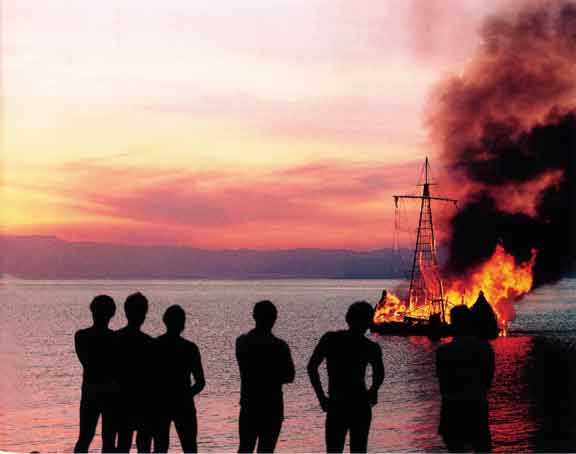
Thor Heyerdah with his international crew of 11 members had just completed a 5 month journey of 4,200 miles that began in the Tigris Valley. Here he sets his reed boat “Tigris” at Djibouti, Africa ablaze in protest of the numerous wars going on in the region which were fueled by Western and Soviet sales of military arms. Photo: April 3, 1978

© The Kon-Tiki Museum, Oslo, Norway. Used with Permission.

April 2, 2003

Twenty-five years ago, on April 3, 1978, Thor Heyerdahl (1914-2002) was just completing a 4,200-mile voyage on a 60-foot reed ship known as the Tigris. His journey had started at the place many consider to be the birth of civilization – the verdant valley between the Euphrates and Tigris rivers in Iraq. Setting sail from the banks of the Tigris, Thor and his crew navigated down the Persian Gulf to Oman and eastward to the Indus Delta of Pakistan. Then they reversed direction and headed back across the Indian Ocean in the direction of the Horn of Africa. It was the last of Thor’s four trans-oceanic voyages, the first being the well-known 1949 Kon-Tiki voyage made on a balsawood raft from the coast of Peru to the Polynesian Islands.

The Tigris’ crew comprised 11 multinational members: Thor Heyerdahl (Norway), navigator Norman Baker (USA), art student and interpreter Rashad Nazi Salim (Iraq), underwater cameraman Toru Suzuki (Japan), professional photographer Norris Brock (USA), young navy captain Detlef Zoltzek (Germany), physician Yuri Senkevitch (USSR), mountain climber and expert with ropes Carlo Mauri (Italy), amateur archeologist Ghermán Carrasco (Mexico) and students Hans Petter Bohn (Norway) and Asbjørn Damhus (Denmark).

After surviving the treacherous five-month journey at sea, Thor had wanted to end his voyage in the port of Mitsiwa (now Massawa) on the western (African) side of the Red Sea. It was through this port that Thor had originally brought the reeds from Lake Tana in Ethiopia for the building of two earlier experimental ships, Ra I and Ra II.

No Place to Land

But Ethiopia was involved with a breakaway war with the Eritreans. Nearby Somalia was at war, too. On the opposite side of the Gulf of Aden, civil war had erupted in Yemen. Thor and his crew decided to try to steer in the middle of the Gulf between Yemen and Somalia. However, when the winds died down, navigating the primitive reed craft became extremely difficult and they began drifting towards the island of Socotra, which belonged to South Yemen and on which the Soviets were installing military hardware at that time. Eventually, they had no choice but to land in the newly established African nation of Djibouti, a small neutral country squeezed in between Somalia and Ethiopia.

Heyerdahl’s experiment again proved that early man could have successfully navigated immense distances across seas and oceans thousands of years ago. The Tigris, constructed of buoyant river reeds, had been a fine sea-worthy vessel.

They had survived on sea, only to be denied a place to land because the entire region was engulfed in war. In the end, Heyerdahl decided to torch the Tigris, setting it ablaze as a bonfire for peace, protesting the wars that were raging, fueled by arms sales by the major Western powers, including the Soviet Union. The crew members stood on the coral reef in silent awe at the ironic fate of the Tigris, watching the hoisted sails flare up like a torch as the red sunset disappeared behind the dark African mountains.

Burning the Tigris was a difficult decision for Thor, but it was also his way of not letting the ship rot amidst the warships and man-made pollution found in the harbor off Djibouti. Also it meant that no one would be able to exploit the ship for their own commercial benefit. Saddam Hussein, too, had been eager to use the reed ship for his own public relations purposes, as it had originally been assembled in Iraq. Heyerdahl’s earlier vessels, the Kon Tiki (made of balsa logs) and Ra II (made of reed), are both on exhibition at the Kon Tiki Museum in Norway.

On April 3, 1978, Heyerdahl wrote the following Open Letter to Secretary-General Kurt Waldheim of the United Nations to explain why he had burned his ship as a desperate plea for world cooperation. His call for sanity is as relevant today as it was 25 years ago.

Open Letter to UN

Heyerdahl sent the following Open Letter to Secretary General Waldheim from the Republic of Djibouti, Africa on April 3, 1978.

As the multinational crew of the experimental reed-ship Tigris brings the test voyage to its conclusion today, we are grateful to the Secretary-General for the permission to have sailed under United Nations’ flag, and we are proud to report that the double objectives of the expedition [of succeeding on a transoceanic voyage with a primitive craft manned by an international crew] have been achieved to our complete satisfaction.

Ours has been a voyage into the past to study the qualities of a prehistoric type of vessel built upon ancient Sumerian principles. But it has also been a voyage into the future to demonstrate that no space is too restricted for peaceful coexistence of men who work for common survival. We are 11 men from countries governed by different political systems. We have sailed together on a small raft-ship of tender reeds and rope a distance of over 6,000km [4,200 miles] from the Republic of Iraq by way of the Emirates of Bahrain, the Sultanate of Oman and the Republic of Pakistan to the newly-born African nation of Djibouti.

We are able to report that in spite of different political views, we have lived and struggled together in perfect understanding and friendship, shoulder to shoulder in cramped quarters through calm and storms, always according to the ideals of the United Nations: cooperation for joint survival. When we embarked last November on our reed-ship Tigris, we knew we would sink or survive together, and this knowledge united us in friendship. When we now, in April, disperse to our respective homelands, we sincerely respect and feel sympathy for each other’s nations.

Our joint message is not directed to any one country but to modern man everywhere. We have shown that the ancient people in Mesopotamia, the Indus Valley and Egypt could have built man’s earliest civilizations through the benefit of mutual contact with the primitive vessels at their disposal 5,000 years ago. Culture arose through intelligent and profitable exchange of thoughts and products.

Today we burn our proud ship, though the sails and rigging are still up and the vessel is in perfect shape, to protest against inhuman elements in the world of 1978 to which we have come back as we reach land after sailing the open seas. Now we are forced to stop at the entrance to the Red Sea. Surrounded by military airplanes and warships from the world’s most civilized and developed nations, we have been denied permission by friendly governments, for reasons of security, to land anywhere, but in the tiny, and still neutral, republic of Djibouti. Elsewhere around us, brothers and neighbors are engaged in homicide with means made available to them by those who lead humanity on our joint road into the third millennium.

To the innocent masses in all industrialized countries, we direct our appeal. We must wake up to the insane reality of our time, which to all of us has been reduced to mere unpleasant headlines in the news. We are all irresponsible, unless we demand from the responsible decision makers that modern armaments must no longer be made available to people whose former battle axes and swords our ancestors condemned.

Our planet is bigger than the reed bundles that have carried us across the seas, and yet small enough to run the same risks unless those of us still alive open our eyes and minds to the desperate need of intelligent collaboration to save ourselves and our common civilization from what we are about to convert into a sinking ship.

_______

Please feel free to post and share this article about Thor Heyerdahl’s protest of war.

Further inquiries:
Betty Blair ai@artnet.net

Bjornar Storfjell, Director of Thor Heyerdahl Centre in English: jbs@thorheyerdahl.org

Related Posts

LONDON – So far so good, at least on the wider level. While internally Iraq seems on the edge of chaos, the much heralded clash of civilizations between the Muslim and Judaeo-Christian worlds has yet to become apparent. We have anger and despair aplenty in the Arab and Muslim worlds. But very little rushing to the standard and there was no great pilgrimage of warriors to join the fight, as happened when the Soviet Union invaded Afghanistan twenty years ago, and then, having driven the Red Army out, were left to ferment in that mountainous redoubt. With the armaments supplied by the CIA the mujahidin were transformed into Al Qaeda that became, for a relatively brief moment as these things go, ‘the greatest threat to the homeland that America has ever known.’ Nevertheless a ‘Cold War’ between much of the Muslim world and the West is certainly in full swing. Winston...
The Challenge of Nuclear Weaponsin the Twenty-first CenturyA Path Forward The peoples and governments of the world face an urgent challenge relating to weaponry of mass destruction and particularly to nuclear weaponry.  At the crossroads of technology, terrorism, geopolitical ambition, and policies of preemption are new and potent dangers for humanity. Despite ending the nuclear standoff of the Cold War era, nuclear weaponry is again menacing the peoples of the world with catastrophic possibilities.  We recognize the need for any government to pursue its security interests in accordance with international law; and further, we recognize that distinctive threats to these interests now exist as a result of an active international terrorist network having declared war on the United States and its allies. Nonetheless, we reject the assessment of the current US administration that upgrading a reliance on nuclear weapons is in any sense justified as a response. We find it...
By Karin Wegestal MP, the Social Democratic Partyon behalf of the Swedish Committee for Solidarity with the Yugoslav People During the last decade, the Federal Republic of Yugoslavia has received more than 500,000 refugees from Croatia and Bosnia, and another 300,000 internally displaced persons, mainly from the province Kosovo and Metohia. For a country with about ten million inhabitants, such an influx of homeless people is obviously a very heavy burden – even under peaceful conditions. But in addition to that, the Federal Republic of Yugoslavia has been the subject to sanctions from the western powers for close to ten years and its infrastructure was badly hurt through Nato’s intense bombardment during 78 days in 1999. The result of all this is that Yugoslavia, once the most developed industrial country in Eastern Europe, is today the poorest country in Europe. In Serbia excluding Kosovo, with about ten million inhabitants and...

Recent Articles

Photo above: Carl Fredrik Reuterswärd’s Non-Violence outside UN Headquarters in New York. Kirill Levin, CC BY-NC-SA 2. Jan Oberg November 3, 2026 I am happy to be published in Horizons which is produced by the Center for International Relations and Sustainable Development, CIRSD, in Belgrade. My contribution brings out a radical re-thinking of what concepts such as defence, security, deterrence – and peace – may mean if we want to create a more peaceful world. It also summarises a few things I have been working with the last few decades. Please read it here Og her er den på dansk, takket være Johnny Baltzersens lynhurtige oversættelse
UNITE-tillid, DREAM-velstand og andre konstruktive komponenter Normally we publish articles in English here. But this is a translation of a very important TFF document that should reach as many as possible in Denmark since this country’s government has been one of the most hardline in Europe and, up till now at least, has refused to use diplomacy and, instead, spent tremendous sums on arming Ukraine with the express goal of defeating Russia. Thus this – unique – article is in Danish. Vi er Johnny Baltzersen og hans Fælles Sikkerhed – Fælles Fremtid på Substack overmåde taknemmelige for at have oversat og publiceret TFF’s 2025-portfølje for fredsidéer med henblik på Ukraines fremtid. Vi håber den nu kan nå mange flere danskere – som også vil sprede den og skabe debat – nu den danske regerings og folketingspartiernes politik på dette område siden 2022 står nu – forudsigeligt – ved vejs ende....
Jan Oberg TFF director October 28, 2026 Exactly one month has now passed since I published my criticism of the introduction to the special issue on Johan Galtung published by the Journal of Global Security Studies, JoGSS, and of Tor Egil Førland’s chapter about Galtung which serves as a preview to his forthcoming biography of Galtung to be published by PRIO. See the original on The Transnational here and the same article on TFF Substack with many general and critical comments and, in particular, the people who decided to withdraw from the biography project in protest. The special issue itself was extraordinary. It was devoted to the intellectual legacy of one of the founders of peace research and contained a number of strong assessments of his personality, scholarship, intellectual trajectory, and public role. Such assessments are, of course, entirely legitimate. No scholar is beyond criticism, and neither was Johan Galtung....

TFF on Substack

Discover and subscribe to more peace materials on TFF Substack

Most Popular

Photo above: Carl Fredrik Reuterswärd’s Non-Violence outside UN Headquarters in New York. Kirill Levin, CC BY-NC-SA 2. Jan Oberg November 3, 2026 I am happy to be published in Horizons which is produced by the Center for International Relations and Sustainable Development, CIRSD, in Belgrade. My contribution brings out a radical re-thinking of what concepts such as defence, security, deterrence – and peace – may mean if we want to create a more peaceful world. It also summarises a few things I have been working with the last few decades. Please read it here Og her er den på dansk, takket være Johnny Baltzersens lynhurtige oversættelse
UNITE-tillid, DREAM-velstand og andre konstruktive komponenter Normally we publish articles in English here. But this is a translation of a very important TFF document that should reach as many as possible in Denmark since this country’s government has been one of the most hardline in Europe and, up till now at least, has refused to use diplomacy and, instead, spent tremendous sums on arming Ukraine with the express goal of defeating Russia. Thus this – unique – article is in Danish. Vi er Johnny Baltzersen og hans Fælles Sikkerhed – Fælles Fremtid på Substack overmåde taknemmelige for at have oversat og publiceret TFF’s 2025-portfølje for fredsidéer med henblik på Ukraines fremtid. Vi håber den nu kan nå mange flere danskere – som også vil sprede den og skabe debat – nu den danske regerings og folketingspartiernes politik på dette område siden 2022 står nu – forudsigeligt – ved vejs ende....
Jan Oberg TFF director October 28, 2026 Exactly one month has now passed since I published my criticism of the introduction to the special issue on Johan Galtung published by the Journal of Global Security Studies, JoGSS, and of Tor Egil Førland’s chapter about Galtung which serves as a preview to his forthcoming biography of Galtung to be published by PRIO. See the original on The Transnational here and the same article on TFF Substack with many general and critical comments and, in particular, the people who decided to withdraw from the biography project in protest. The special issue itself was extraordinary. It was devoted to the intellectual legacy of one of the founders of peace research and contained a number of strong assessments of his personality, scholarship, intellectual trajectory, and public role. Such assessments are, of course, entirely legitimate. No scholar is beyond criticism, and neither was Johan Galtung....
Read More
knotted gun
Photo above: Carl Fredrik Reuterswärd’s Non-Violence outside UN Headquarters in New York. Kirill Levin, CC BY-NC-SA 2. Jan Oberg November 3, 2026 I am happy to be published in Horizons which is produced by the Center for International Relations and Sustainable Development, CIRSD, in Belgrade. My contribution brings out a radical re-thinking of what concepts such as defence, security, deterrence – and peace – may mean if we want to create a more peaceful world. It also summarises a few things I have been working with the last few decades. Please read it here Og her er den på dansk, takket være Johnny Baltzersens lynhurtige oversættelse
TFFPortfolioVign
UNITE-tillid, DREAM-velstand og andre konstruktive komponenter Normally we publish articles in English here. But this is a translation of a very important TFF document that should reach as many as possible in Denmark since this country’s government has been one of the most hardline in Europe and, up till now at least, has refused to use diplomacy and, instead, spent tremendous sums on arming Ukraine with the express goal of defeating Russia. Thus this – unique – article is in Danish. Vi er Johnny Baltzersen og hans Fælles Sikkerhed – Fælles Fremtid på Substack overmåde taknemmelige for at have oversat og publiceret TFF’s 2025-portfølje for fredsidéer med henblik på Ukraines fremtid. Vi håber den nu kan nå mange flere danskere – som også vil sprede den og skabe debat – nu den danske regerings og folketingspartiernes politik på dette område siden 2022 står nu – forudsigeligt – ved vejs ende....
JoGSS-Silent
Jan Oberg TFF director October 28, 2026 Exactly one month has now passed since I published my criticism of the introduction to the special issue on Johan Galtung published by the Journal of Global Security Studies, JoGSS, and of Tor Egil Førland’s chapter about Galtung which serves as a preview to his forthcoming biography of Galtung to be published by PRIO. See the original on The Transnational here and the same article on TFF Substack with many general and critical comments and, in particular, the people who decided to withdraw from the biography project in protest. The special issue itself was extraordinary. It was devoted to the intellectual legacy of one of the founders of peace research and contained a number of strong assessments of his personality, scholarship, intellectual trajectory, and public role. Such assessments are, of course, entirely legitimate. No scholar is beyond criticism, and neither was Johan Galtung....
Screenshot 2026-10-26 115647
An aspect of Iran’s culture and civilisation you’ve probably never heard about. Don’t be surprised if the US and Israel also try to bomb them. Jan ObergTFF director October 26, 2026 Today – under the “USraeli” threat of new “annihilating” bombings – opens the 7th International Conference on Peace and Conflict Resolution at Tehran’s University. As far as I can tell, this is the only permanent, advanced peace research institution in West Asia/the Middle East. Perhaps more countries in that region could be inspired? I mean, how many military “security” institutes and military academies do they have? Many peace research institutes and university departments have been established since the 1950s in the West. They are now all under attack; some have closed down, some have gone mainstream, yet others kept the name but do nothing to research peace and disseminate results or advice; instead, they cooperate with militarism’s platforms such...
Screenshot 2026-10-15 141837
Let’s discuss using AI to create peace – in contrast to boring geopolitics devoid of creative healing and visions. Jan Oberg TFF director October 15, 2026 I asked VEED to create a short video exemplifying how peace is preferable to war, then chose the lady as a template. Simple as that. In less than a minute, it produced this video, which any peace-loving person would appreciate. The only problem is that human intelligence (HI), at least the one that exists among Western decision-makers, isn’t half as moral or smart as AI. I have used AI to dialogue about peace and peace plans, creative conflict resolution and visions of a better future for humankind. It so happens that I am having more stimulating, intelligent, creative and moral discussions with AI than I could possibly have with any EU or NATO leader today. Yes, AI has very problematic and dangerous aspects; used...
girl-5894831_1280
Below are TFF-related media mentions, comments, videos and social media posts published elsewhere but not on this homepage. We happen to catch and list only a fraction. Regarding video comments and debates, we recommend that you go to the TFF Video Channel on Substack where many of them are reproduced. Jan Oberg is a contributor to China Daily – 52 million daily clicks – and Global Times, CGTN and CCTV (the national television), China Investment, Xinhua News Agency and several others. Articles and videos on these media very often multiply into countless Chinese (and Western media) that re-post them from these main media. Thanks to The China Academy, his analyses, interviews and comments are frequently posted on YouTube channels such as Thinkers Forum and Wave Media. These videos are often re-posted on Bilibili (China’s YouTube), the China Content Center on TikTok, and on the Chinese edition of TikTok, Douyin.com. This means reaching hundreds of millions of viewers worldwide over a year. While there are too many to catch on all these...




