

Deborah Lehr: Trust in China – and in the West

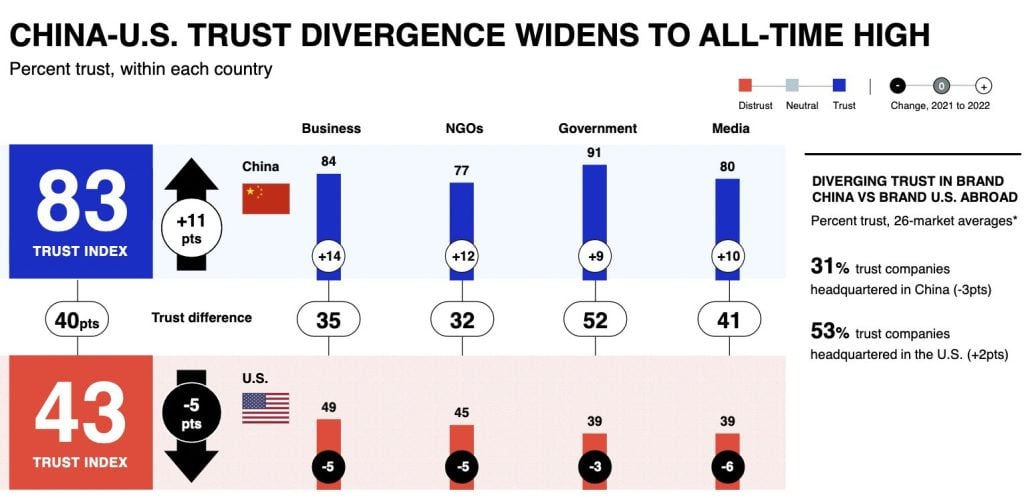
Trust among Chinese citizens in their government is a record 91 percent, the highest seen in a decade. The result is even more striking compared to the U.S., where trust in government is at 39 percent.

By Deborah Lehr

October 24, 2022

Fraught U.S.-China relations will continue entering 2022. This year, leaders of both countries will be focused on domestic politics, the ongoing pandemic and uneven economic recoveries — challenges that have further added to existing bilateral tensions.

Originally published at Edelman on January 18, 2022

It is an important political year in both countries. U.S. President Joe Biden is facing midterm elections with the Republicans likely to gain seats in the House and potentially the Senate, complicating his administration’s ability to implement its policy agenda. By contrast, China’s Xi Jinping is on the verge of assuming a third term as President and is strongly positioned to ensure that his vision for China is carried through.

POLITICS ASIDE, THIS SYSTEMIC DYNAMIC – DIMINUTION VS CONSOLIDATION OF CONTROL — IS REFLECTED IN THE VIEWS THAT AMERICAN AND CHINESE CITIZENS HAVE ABOUT THEIR RESPECTIVE GOVERNMENTS.

Politics aside, this systemic dynamic – diminution vs consolidation of control — is reflected in the views that American and Chinese citizens have about their respective governments. While accurate numbers are always hard to come by in China, our 2022 Edelman Trust Barometer allows us to follow the trends. Trust among Chinese citizens in their government is a record 91 percent, the highest seen in a decade. The result is even more striking compared to the U.S., where trust in government is at 39 percent.

Focusing on China, several internal and external factors explain why popular support was so high this past year.

China was the first major economy to reopen — and thrive — after the Covid-19 outbreak. It was the only major economy to see growth in 2020, and that momentum continued throughout most of 2021. The centralized system of governance allowed Chinese officials to take draconian measures — shutting down travel, instituting a zero-tolerance policy and strict quarantines, and monitoring its citizens —but the swift action and success in rapidly bringing the pandemic under control created confidence with Chinese citizens.

For much of China, life was relatively back to normal by spring of 2020. People were back to work, children returned to the classroom, and new tracking technologies on smartphones enabled individuals to move around with relative confidence that any outbreaks could be traced.

The government rolled out the Sinopharm vaccine for emergency use through the state-owned enterprise, China National Pharmaceutical Group, in the summer of 2020, rapidly distributing it throughout the country in early 2021. At one stage, China was vaccinating a staggering 20 million individuals a day.

China has since helped vaccinate the world. Chinese vaccines currently account for almost half of the over 7 billion shots distributed globally. Despite the controversial beginnings, the government’s “vaccine diplomacy” played well at home and contributed to confidence in the government.

Beyond Covid, in 2021, the Chinese government made progress in other areas. China’s war against pollution has seen real results. For the first time, this year, Beijing has met the state air quality standards as have other parts of the country.

President Xi’s anticorruption campaign — netting over 100,000 individuals — has provided a sense of a more level playing field for individuals and business. In China, over 90 percent of businesses are small or medium-sized, yet they are the engine of growth for the country. This is one reason why Xi has been focused on eliminating barriers and encouraging growth of the private sector, while cracking down on monopoly and other anti-competitive behaviors.

Yet the past two years were not all smooth sailing for China. Outside the country, China faces a growing “trust deficit.” As part of its early vaccine diplomacy, Chinese firms exported millions of masks and other emergency materials, often to lesser developed countries.

Unfortunately, quality issues reflected poorly on the Chinese companies distributing them. The Chinese government’s response to international criticism has increasingly tended toward so called “wolf warrior diplomacy,” reflecting the growing sense of nationalism and pride within China, but which has also further exacerbated geopolitical tensions, including with the United States, Australia and the European Union.

In the United States, President Biden largely continued his predecessor’s China policy. Since taking office, the administration has expanded sanctions on Chinese technology companies, implemented new accounting rules for U.S.-listed Chinese firms, and kept in place over $360 billion in tariffs on Chinese imports.

While it is essential that the United States (and other countries) protect sectors and technologies vital to their national security interests, the implication of some of these policies has been to propagate the view that Chinese firms overall are bad actors.

Rightly or wrongly, Chinese firms are often viewed as the representatives of the Chinese government. Given the tensions of the past year — both at the governmental level as well as at the firm level — the perception of China Inc, or trust outside of China of its firms, has dropped to a low of 31 percent.

Here there is an interesting contrast. In the developed economies surveyed, people expect firms to take on many of the social and economic issues that are traditionally the responsibility of the government. But in China, people still trust the government to remain the leader on social and economic issues and — at least abroad — Chinese companies have harmed rather than helped confidence in the country.

This year will remain a challenging one for U.S.-China relations, arguably the most important relationship globally. There is an obvious trust gap. Yet finding ways to work together rather than in conflict is important to effectively address many of the common global challenges — from the lingering pandemic to climate change, global economic growth, and nuclear proliferation.

Xi Jinping enters the year in a strong domestic position. And while President Biden is facing political challenges at home, the combined confidence in the U.S. business community with the U.S. government leaves the United States well placed to work with China in tackling many of these global challenges — if both leaders have the political will to do so.

Originally published at Edelman on January 18, 2022

About the author

Deborah Lehr is CEO, Edelman Global Advisory.

Note

Here is the full Edelman Trust Barometer. It is both reliable and shocking.

Just one illustration from it:
Please help TFF remain truly independent by contributing if you benefited from this article


Related Posts

Jan Oberg, TFF director April 9, 2026 I was recently invited to have a good, long talk about the world – and, of course, about peace too – with Boris Malagurski on his Weight of Chains Channel on YouTube. It was a real joy and seems to have been greatly appreciated by the viewers too. Mr Malagurski and I shall of course be grateful if you share this conversation in your circles – of course, only if you like what you see and hear 😉☮️ And remember that this one – like hundreds of others with TFF Associates – can be enjoyed at our TFF Video Collection.
A friendly quarrel while we agree that the US sanctions are a weapon of mass destruction and kill more people than wars do. And that we must talk much more about sanctions than we have so far. Jan Oberg, TFF director March 16, 2026 John Mearsheimer recently stated that U.S. sanctions murdered around 38 million people between 1971 and 2021 – see the video below. It is a dramatic figure, and it has spread quickly because it captures, in one sentence, the enormous human cost of modern sanctions. I share his concern about the destructive effects of economic coercion. But the specific number he cites — and the way he attributes it — deserves a friendly academic clarification. The figure comes from a 2023 Lancet Global Health article estimating the mortality effects of unilateral U.S. and EU sanctions over the past half‑century. This is the first point where Mearsheimer’s shorthand diverges from the text: the study...
By Jan ObergTFF co-founder and director February 11, 2026 PART 3 — ECONOMICS, TRADE & FINANCIAL SOVEREIGNTY A. Trade Measures & Market Signaling Economic pressure can be applied instantly and scaled without violence. Immediate Measures (within a week) Government boycott US goods and services  A very powerful signal which over time will be felt. Targeted tariffs on selected U.S. goods Symbolic but high-visibility sectors send a clear message. Suspend trade facilitation talks A peaceful pause that signals deep concern. Freeze U.S. participation in public procurement – military procurement in particular A nonviolent way to reduce influence. Competition law review of U.S. corporations A legal tool to scrutinise market dominance. Longer-Term Measures EU–Asia–Africa trade corridors Reducing reliance on U.S. markets. European supply chains for critical minerals Strategic autonomy in resource access. European Strategic Trade Authority Monitoring coercive practices globally. Euro-denominated commodity markets Weakening the dollar’s pricing monopoly. The EU must resume contacts and negotiations with Russia, focusing on energy cooperation To...

Recent Articles

Photo above: Carl Fredrik Reuterswärd’s Non-Violence outside UN Headquarters in New York. Kirill Levin, CC BY-NC-SA 2. Jan Oberg November 3, 2026 I am happy to be published in Horizons which is produced by the Center for International Relations and Sustainable Development, CIRSD, in Belgrade. My contribution brings out a radical re-thinking of what concepts such as defence, security, deterrence – and peace – may mean if we want to create a more peaceful world. It also summarises a few things I have been working with the last few decades. Please read it here Og her er den på dansk, takket være Johnny Baltzersens lynhurtige oversættelse
UNITE-tillid, DREAM-velstand og andre konstruktive komponenter Normally we publish articles in English here. But this is a translation of a very important TFF document that should reach as many as possible in Denmark since this country’s government has been one of the most hardline in Europe and, up till now at least, has refused to use diplomacy and, instead, spent tremendous sums on arming Ukraine with the express goal of defeating Russia. Thus this – unique – article is in Danish. Vi er Johnny Baltzersen og hans Fælles Sikkerhed – Fælles Fremtid på Substack overmåde taknemmelige for at have oversat og publiceret TFF’s 2025-portfølje for fredsidéer med henblik på Ukraines fremtid. Vi håber den nu kan nå mange flere danskere – som også vil sprede den og skabe debat – nu den danske regerings og folketingspartiernes politik på dette område siden 2022 står nu – forudsigeligt – ved vejs ende....
Jan Oberg TFF director October 28, 2026 Exactly one month has now passed since I published my criticism of the introduction to the special issue on Johan Galtung published by the Journal of Global Security Studies, JoGSS, and of Tor Egil Førland’s chapter about Galtung which serves as a preview to his forthcoming biography of Galtung to be published by PRIO. See the original on The Transnational here and the same article on TFF Substack with many general and critical comments and, in particular, the people who decided to withdraw from the biography project in protest. The special issue itself was extraordinary. It was devoted to the intellectual legacy of one of the founders of peace research and contained a number of strong assessments of his personality, scholarship, intellectual trajectory, and public role. Such assessments are, of course, entirely legitimate. No scholar is beyond criticism, and neither was Johan Galtung....

TFF on Substack

Discover and subscribe to more peace materials on TFF Substack

Most Popular

Photo above: Carl Fredrik Reuterswärd’s Non-Violence outside UN Headquarters in New York. Kirill Levin, CC BY-NC-SA 2. Jan Oberg November 3, 2026 I am happy to be published in Horizons which is produced by the Center for International Relations and Sustainable Development, CIRSD, in Belgrade. My contribution brings out a radical re-thinking of what concepts such as defence, security, deterrence – and peace – may mean if we want to create a more peaceful world. It also summarises a few things I have been working with the last few decades. Please read it here Og her er den på dansk, takket være Johnny Baltzersens lynhurtige oversættelse
UNITE-tillid, DREAM-velstand og andre konstruktive komponenter Normally we publish articles in English here. But this is a translation of a very important TFF document that should reach as many as possible in Denmark since this country’s government has been one of the most hardline in Europe and, up till now at least, has refused to use diplomacy and, instead, spent tremendous sums on arming Ukraine with the express goal of defeating Russia. Thus this – unique – article is in Danish. Vi er Johnny Baltzersen og hans Fælles Sikkerhed – Fælles Fremtid på Substack overmåde taknemmelige for at have oversat og publiceret TFF’s 2025-portfølje for fredsidéer med henblik på Ukraines fremtid. Vi håber den nu kan nå mange flere danskere – som også vil sprede den og skabe debat – nu den danske regerings og folketingspartiernes politik på dette område siden 2022 står nu – forudsigeligt – ved vejs ende....
Jan Oberg TFF director October 28, 2026 Exactly one month has now passed since I published my criticism of the introduction to the special issue on Johan Galtung published by the Journal of Global Security Studies, JoGSS, and of Tor Egil Førland’s chapter about Galtung which serves as a preview to his forthcoming biography of Galtung to be published by PRIO. See the original on The Transnational here and the same article on TFF Substack with many general and critical comments and, in particular, the people who decided to withdraw from the biography project in protest. The special issue itself was extraordinary. It was devoted to the intellectual legacy of one of the founders of peace research and contained a number of strong assessments of his personality, scholarship, intellectual trajectory, and public role. Such assessments are, of course, entirely legitimate. No scholar is beyond criticism, and neither was Johan Galtung....
Read More
knotted gun
Photo above: Carl Fredrik Reuterswärd’s Non-Violence outside UN Headquarters in New York. Kirill Levin, CC BY-NC-SA 2. Jan Oberg November 3, 2026 I am happy to be published in Horizons which is produced by the Center for International Relations and Sustainable Development, CIRSD, in Belgrade. My contribution brings out a radical re-thinking of what concepts such as defence, security, deterrence – and peace – may mean if we want to create a more peaceful world. It also summarises a few things I have been working with the last few decades. Please read it here Og her er den på dansk, takket være Johnny Baltzersens lynhurtige oversættelse
TFFPortfolioVign
UNITE-tillid, DREAM-velstand og andre konstruktive komponenter Normally we publish articles in English here. But this is a translation of a very important TFF document that should reach as many as possible in Denmark since this country’s government has been one of the most hardline in Europe and, up till now at least, has refused to use diplomacy and, instead, spent tremendous sums on arming Ukraine with the express goal of defeating Russia. Thus this – unique – article is in Danish. Vi er Johnny Baltzersen og hans Fælles Sikkerhed – Fælles Fremtid på Substack overmåde taknemmelige for at have oversat og publiceret TFF’s 2025-portfølje for fredsidéer med henblik på Ukraines fremtid. Vi håber den nu kan nå mange flere danskere – som også vil sprede den og skabe debat – nu den danske regerings og folketingspartiernes politik på dette område siden 2022 står nu – forudsigeligt – ved vejs ende....
JoGSS-Silent
Jan Oberg TFF director October 28, 2026 Exactly one month has now passed since I published my criticism of the introduction to the special issue on Johan Galtung published by the Journal of Global Security Studies, JoGSS, and of Tor Egil Førland’s chapter about Galtung which serves as a preview to his forthcoming biography of Galtung to be published by PRIO. See the original on The Transnational here and the same article on TFF Substack with many general and critical comments and, in particular, the people who decided to withdraw from the biography project in protest. The special issue itself was extraordinary. It was devoted to the intellectual legacy of one of the founders of peace research and contained a number of strong assessments of his personality, scholarship, intellectual trajectory, and public role. Such assessments are, of course, entirely legitimate. No scholar is beyond criticism, and neither was Johan Galtung....
Screenshot 2026-10-26 115647
An aspect of Iran’s culture and civilisation you’ve probably never heard about. Don’t be surprised if the US and Israel also try to bomb them. Jan ObergTFF director October 26, 2026 Today – under the “USraeli” threat of new “annihilating” bombings – opens the 7th International Conference on Peace and Conflict Resolution at Tehran’s University. As far as I can tell, this is the only permanent, advanced peace research institution in West Asia/the Middle East. Perhaps more countries in that region could be inspired? I mean, how many military “security” institutes and military academies do they have? Many peace research institutes and university departments have been established since the 1950s in the West. They are now all under attack; some have closed down, some have gone mainstream, yet others kept the name but do nothing to research peace and disseminate results or advice; instead, they cooperate with militarism’s platforms such...
Screenshot 2026-10-15 141837
Let’s discuss using AI to create peace – in contrast to boring geopolitics devoid of creative healing and visions. Jan Oberg TFF director October 15, 2026 I asked VEED to create a short video exemplifying how peace is preferable to war, then chose the lady as a template. Simple as that. In less than a minute, it produced this video, which any peace-loving person would appreciate. The only problem is that human intelligence (HI), at least the one that exists among Western decision-makers, isn’t half as moral or smart as AI. I have used AI to dialogue about peace and peace plans, creative conflict resolution and visions of a better future for humankind. It so happens that I am having more stimulating, intelligent, creative and moral discussions with AI than I could possibly have with any EU or NATO leader today. Yes, AI has very problematic and dangerous aspects; used...
girl-5894831_1280
Below are TFF-related media mentions, comments, videos and social media posts published elsewhere but not on this homepage. We happen to catch and list only a fraction. Regarding video comments and debates, we recommend that you go to the TFF Video Channel on Substack where many of them are reproduced. Jan Oberg is a contributor to China Daily – 52 million daily clicks – and Global Times, CGTN and CCTV (the national television), China Investment, Xinhua News Agency and several others. Articles and videos on these media very often multiply into countless Chinese (and Western media) that re-post them from these main media. Thanks to The China Academy, his analyses, interviews and comments are frequently posted on YouTube channels such as Thinkers Forum and Wave Media. These videos are often re-posted on Bilibili (China’s YouTube), the China Content Center on TikTok, and on the Chinese edition of TikTok, Douyin.com. This means reaching hundreds of millions of viewers worldwide over a year. While there are too many to catch on all these...



