
David Swanson

TFF Associate

May 25, 2023

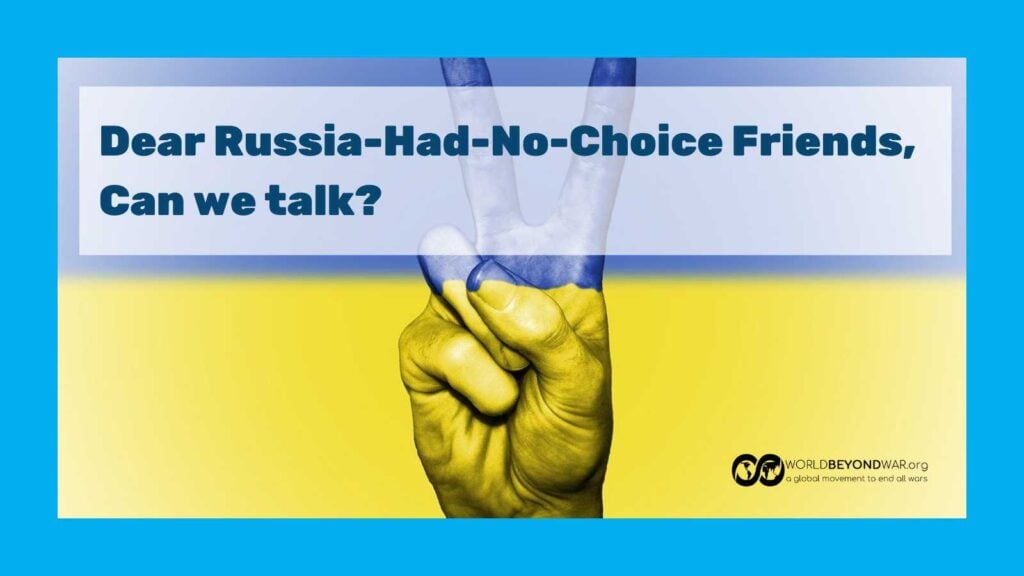
Here’s a terrible “syllogism” from a wonderful person, Ray McGovern, longtime CIA employee, then longtime peace activist, and now year-long contender, that Russia had no choice but to attack Ukraine.

“The Russians had other options to invading Ukraine.
They attacked Ukraine in a ‘war of choice’; also threaten NATO.
Ergo, the West must arm Ukraine to the teeth, risking wider war.”

This is supposedly an explanation of the thinking of we believers that Russia had some choice other than to invade Ukraine. In reality, it illustrates a very sad and enormous distance between the thinking of people who once agreed that war was immoral, but who have now spent over a year utterly failing to persuade each other of anything.

Of course the quote above is not a syllogism at all. This is a syllogism:

A threat of war requires war.
Russia is threatened with war.
Russia requires war.

(Or write the same thing substituting Ukraine for Russia.)

But so is this:

A threat of war does not require war.
Russia is threatened with war.
Russia does not require war.

(Or write the same thing substituting Ukraine for Russia.)

The disagreement is over the major premise. The syllogism is not actually a very useful tool for thinking; merely for a primitive sort of thinking about thinking. The world is actually complex, and someone could build a case for this one, too: “A threat of war sometimes requires war, depending.” (They’d be wrong.)

That the threat or war, and even actual war, in many cases has not required war in response but been defeated by other means is a matter of record. So the question is whether this time was different from all of those times.

Here’s another disagreement. Which of these is true?

“Opposing one side of a war requires defending the other side.”

or

“Opposing one side of a war could conceivably be part and parcel of opposing all sides of all wars.”

Originally posted on World Beyond War on May 24, 2023

This is a factual question, too, a matter of record. Those of us who have spent all these many months denouncing every war act by both sides of the war in Ukraine can show each side all the accusations we’ve received of supporting both their side and the other side — and all the evidence that they are all mistaken.

But maybe it doesn’t matter whether someone fantasizes that I’m cheering for NATO and secretly in the pay of Lockheed Martin. They simply want an answer to the staggeringly slam-dunk drop-the-mic win-the-whole-internet brilliant inquiry of “Well what the eff then could Russia have possibly, possibly done?”

Before I describe what Russia could have done, both in the moment of maximum crisis and in the previous months and years and decades, it’s worth digging up some ancient Greeks one more time:

Russia had to defend against NATO.
Attacking Ukraine was guaranteed to provide the biggest boost NATO had seen in a lifetime.
Therefore Russia had to attack Ukraine.

Maybe the syllogism can be helpful after all? The two premises are perfectly true. Can anyone spot the illogic? It seems not, at least not in the first year and a quarter. The U.S. set the trap and Russia simply had no choice but to take the bait? Really? How insulting to Russia!

Over a year ago, I wrote an article called “30 Nonviolent Things Russia Could Have Done and 30 Nonviolent Things Ukraine Could Do.” Here’s the Russian list:

Russia could have:

  1. Continued mocking the daily predictions of an invasion and created worldwide hilarity, rather than invading and making the predictions simply off by a matter of days.
  2. Continued evacuating people from Eastern Ukraine who felt threatened by the Ukrainian government, military, and Nazi thugs.
  3. Offered evacuees more than $29 to survive on; offered them in fact houses, jobs, and guaranteed income. (Remember, we’re talking about alternatives to militarism, so money is no object and no extravagant expense will ever be more than a drop in the bucket of war spending.)
  4. Made a motion for a vote in the UN Security Council to democratize the body and abolish the veto.
  5. Asked the UN to oversee a new vote in Crimea on whether to rejoin Russia.
  6. Joined the International Criminal Court.
  7. Asked the ICC to investigate crimes in Donbas.
  8. Sent into Donbas many thousands of unarmed civilian protectors.
  9. Sent into Donbas the world’s best trainers in nonviolent civil resistance.
  10. Funded educational programs across the world on the value of cultural diversity in friendships and communities, and the abysmal failures of racism, nationalism, and Nazism.
  11. Removed the most fascist members from the Russian military.
  12. Offered as gifts to Ukraine the world’s leading solar, wind, and water energy production facilities.
  13. Shut down the gas pipeline through Ukraine and committed to never building one north of there.
  14. Announced a commitment to leaving Russian fossil fuels in the ground for the sake of the Earth.
  15. Offered as a gift to Ukraine electric infrastructure.
  16. Offered as a gift of friendship to Ukraine railway infrastructure.
  17. Declared support for the public diplomacy that Woodrow Wilson pretended to support.
  18. Announced again the eight demands it began making in December, and requested public responses to each from the U.S. government.
  19. Asked Russian-Americans to celebrate Russian-American friendship at the teardrop monument given to the United States by Russia off New York Harbor.
  20. Joined the major human rights treaties it has yet to ratify, and asked that others do the same.
  21. Announced its commitment to unilaterally uphold disarmament treaties shredded by the United States, and encouraged reciprocation.
  22. Announced a no-first-use nuclear policy, and encouraged the same.
  23. Announced a policy of disarming nuclear missiles and keeping them off alert status to allow more than mere minutes before launching an apocalypse, and encouraged the same.
  24. Proposed a ban on international weapons sales.
  25. Proposed negotiations by all nuclear-armed governments, including those with U.S. nuclear weapons in their countries, to reduce and eliminate nuclear weapons.
  26. Committed to not maintaining weapons or troops within 100, 200, 300, 400 km of any borders, and requested the same of its neighbors.
  27. Organized a nonviolent unarmed army to walk to and protest any weapons or troops near borders.
  28. Put out a call to the world for volunteers to join the walk and protest.
  29. Celebrated the diversity of the global community of activists and organized cultural events as part of the protest.
  30. Asked the Baltic states that have planned nonviolent responses to Russian invasion to help train Russians and other Europeans in the same.

I discussed this on this radio show.

I’m sure it’s in vain, but please make a real effort to remember that this was in an article about what each side could do instead of the insanity of organized mass-murder, risking nuclear apocalypse, starving the globe, impeding climate collaboration, and ruining a country. Please make a real effort to remember that we all have always been painfully aware of all the U.S. aggression toward Russia. So, the answer to “How dare I suggest that Russia behave better than the horrible worst-government-on-Earth of the country where I myself live, the United States?” is the usual one: I spend most of my time demanding that the United States behave better, but if the rest of the world can find it within itself to behave so well that life on Earth is preserved despite every effort of Washington, I’m going to be grateful for that — and I’m certainly not going to discourage it.

Maybe the Russian peace activists so bravely opposing their nation’s warmaking, as we all must oppose our own, are deeply misguided, but I don’t think they are.

So, why is it so impossible to even make each other understand where we’re coming from, you Russia-Had-No-Choicers and I? You suspect that either Ray’s old outfit is slipping me cash or that I’m scared of getting called a “Putin Lover” — as if I haven’t had plenty of death threats for opposing a war on Iraq that I would have traded in a heartbeat to simply be called an “Iraq Lover.”

My suspicions of you may be as wildly off as yours of me, but I don’t think they are, and I mean them with total respect.

I suspect that you think if one side of a war is wrong, the other is probably right — and right in every detail. I suspect you opposed the U.S. side of the war on Iraq but not the Iraqi side. I suspect you oppose the U.S. side of the war in Ukraine, and that you think it simply follows that whatever the Russian side does is admirable. I imagine the two of us going back to an age of dueling. I’d be screaming “Stop this idiotic barbarism, you two!” and you’d be hurriedly asking around to determine which idiot was the good one and which the evil one. Or would you?

I suspect that you don’t want to give any thought to the years that the two sides spent failing to prepare unarmed defenses, and that you think that no matter what Russia did to appeal to the morality and fairness of the world, the world would have spat at Russia and grabbed some popcorn to watch the U.S./NATO buildup. Yet, even with Russia committing hideous murderous acts, we’ve nonetheless seen much of the world — and many of the world’s governments! — refuse to side with NATO, despite enormous pressure, and despite the horrible embarrassment of having to seem to defend, or being accused of defending, Russia’s warmaking. We’ll never know how the world would have responded had Russia used massive and creative nonviolent action, had Russia joined international bodies of law, had Russia signed onto human rights treaties, had Russia sought to democratize world institutions, had Russia appealed to the world to reject U.S. imperialism in favor of a world run by the entire world.

Maybe the Russian government doesn’t want to fall under the rule of law any more than the U.S. government does. Maybe it wants a balance of power, not a balance of justice. Or maybe it thinks like most people in Western society — even many who have acted as peace activists for years — that war is the only answer in the end. And maybe nonviolent action would have failed. But there are two weaknesses in that thought that I think are indisputable.

One is that we are now closer than ever to nuclear apocalypse, and when we’re gone we won’t really get to argue who was more in the right than whom.

The other is that the U.S./NATO build-up was over decades and years and months. Russia could have waited another day or 10 or 200, and in that time it could have begun to try something else. Nobody picked the timing of Russia’s escalation other than Russia. And when you pick the timing of something, you had a choice to give something else a try first.

Even more importantly, unless both sides admit some wrong and agree to some compromise, the war will not end and life on Earth might. It would be a real shame if we couldn’t agree on that much.

Notes

Ray McGovern also has this entry with text and video on his homepage to how Professor Mearsheimer perceives the question of whether or not Russia had alternatives to the invasion of Ukraine.

The editor of The Transnational here, Jan Oberg, likewise argued, on February 25, 2022, that Russia had some alternatives – “There were alternatives: Why Russia should not have bombed Ukraine.” He offers 8 reasons to be against the invasion and 5 alternative actions at the time.

We find this debate very useful and have the highest respect for both – Ray as a friend since the 1980s and David as a friend and TFF Associates for many years too. And we all adhere to the idea that explaining something does not mean an automatic, uncritical endorsement of the act and its consequences.


3 Responses

  1. Thank you very much for this article. It’s really good that David has taken the trouble to make it crystal clear that Russia HAD indeed other choices than to attack Ukraine. And what a list! War is NEVER a solution. The costs are far too high, not just for the warring parties, but – most importantly – for all the people on earth who have absolutely no stake in the conflict. And they are always the biggest victims. The war criminals are on both sides of this conflict, and they should all – without exception – be brought to justice.

  2. The thinking that leads to war and war itself leads to more war. It is a never ending cycle that history shows is true. Change the thinking and look at options. There is a choice. When premises are based on suspicion, mistrust, and fear sewn by leaders filled with grandiose dreams alternatives to war rarely are considered. I like your 30 ways to avoid war. A diplomat offering one or more of them in a negotiation would certainly make the other side stop and think. Unless attitudes and thinking change, I won’t find out if truthful and honest negotiation can create a lasting peace in Europe.

Related Posts

Johan Galtung 1930-2024October 2015 Published here on October 3, 2026 Let us focus on Civilization for conflict analysis and remedies. Major forms of disorder use violence; war is state organized violence. The most belligerent states are the United States of America and Israel, both with civilization roots. National Evangelism, the US Protestant Christian civilization– more national than evangelical–justifies US warfare as exceptionalism of a people chosen by God, with a manifest destiny to run the world. Orthodox Judaism justifies Israeli warfare to conquer and expand from Nile to Euphrates as a religious right and duty to the Eternal One. The third most belligerent country, the UK, no longer believes it is God-chosen but chosen by the USA; not quite the same but something. But the root cause of global disorder lies in the Occident–with Islam–seeing itself as the single, universal civilization valid for all at all times, all others being...
Jan ObergPhD, director, The Transnational Foundation for Peace and Future Research, TFFLund, Sweden October 2, 2026 This is my full original manuscript. The Chinese Academy of Social Science, CASS, makes two publications out if it. 1. China’s Five-year plan emphasized the capabilities of basic research and original innovation. It is regarded as the goal of the future social development, which, as required, should be significantly enhanced. Can you comment on the importance of original innovation in research and academic study? I believe it is easier to define “original innovation” in the natural sciences than in social sciences. The breaking points of what constitutes something new, or innovative, are not quite as sharp in the latter. But in both fields it is about opening up something that was closed, unseen, unexplored before – making manifest what was earlier latent. Innovations come in many forms and shapes – naming something that was not...
The agreement is catastrophic both because of what it says and what it doesn’t mention. It reduces further the major asset of security policies: Freedom of action. Jan Oberg TFF director September 25, 2026 A couple of hours before the agreement was signed on September 22, 2026, I published the following 13 hypotheses about what it would most likely contain on TFF Substack (in English). I was wrong on only the first point. Contrary to what Trump had written on his Truth Social platform, it does not appear to come into force immediately. In fact, it turned out to be worse than even I had anticipated. After these hypotheses now come a number of reflections in light of what the agreement actually contains, and does not contain, as well as the way in which it has generally been presented by major media outlets and by the public-service broadcaster DR. My...

Recent Articles

Tony Robinson October 4, 2026 Violence is easy to recognise when someone is being beaten, shot or killed. It becomes more difficult when nobody is holding a weapon. Poverty, discrimination, exploitation and repression can restrict a human life just as effectively, although they do so in very different ways and with very different consequences. Simply adding more categories to an ever-growing list of forms of violence does not really solve the problem. The more interesting question is what all these different situations have in common and why it makes sense to describe them using the same word. Human beings do not simply react to what happens around them. They remember the past, imagine things that do not yet exist, make plans and undertake projects. Workers organise because they imagine different working conditions; people migrate because they imagine another life somewhere else; social movements emerge because people refuse to accept the...
It’s a matter of principles, courage, vision and pulling together – while the militarist world is falling apart… Peter Langille October 3, 2026 “Here, then, is the problem which we present to you, stark and dreadful and inescapable: Shall we put an end to the human race; or shall mankind renounce war?”The Bertrand Russell—Albert Einstein Manifesto, July 9, 1955 ⁕ The forecast for what’s ahead is worrisome. The sharp rise in armed conflicts over the past three years is adding to what was already the highest level in over seventy years. Genocides, which should be prevented are supported. A shared climate emergency that jeopardises survival is ignored. Diverse polls now suggest that people are war-weary, worried and interested in a more effective United Nations. And, there are viable policy options for a more secure world! Yet governments are doubling-down, betting on more war and investing heavily. If current trends persist,...
Johan Galtung 1930-2024October 2015 Published here on October 3, 2026 Let us focus on Civilization for conflict analysis and remedies. Major forms of disorder use violence; war is state organized violence. The most belligerent states are the United States of America and Israel, both with civilization roots. National Evangelism, the US Protestant Christian civilization– more national than evangelical–justifies US warfare as exceptionalism of a people chosen by God, with a manifest destiny to run the world. Orthodox Judaism justifies Israeli warfare to conquer and expand from Nile to Euphrates as a religious right and duty to the Eternal One. The third most belligerent country, the UK, no longer believes it is God-chosen but chosen by the USA; not quite the same but something. But the root cause of global disorder lies in the Occident–with Islam–seeing itself as the single, universal civilization valid for all at all times, all others being...

TFF on Substack

Discover and subscribe to more peace materials on TFF Substack

Most Popular

Tony Robinson October 4, 2026 Violence is easy to recognise when someone is being beaten, shot or killed. It becomes more difficult when nobody is holding a weapon. Poverty, discrimination, exploitation and repression can restrict a human life just as effectively, although they do so in very different ways and with very different consequences. Simply adding more categories to an ever-growing list of forms of violence does not really solve the problem. The more interesting question is what all these different situations have in common and why it makes sense to describe them using the same word. Human beings do not simply react to what happens around them. They remember the past, imagine things that do not yet exist, make plans and undertake projects. Workers organise because they imagine different working conditions; people migrate because they imagine another life somewhere else; social movements emerge because people refuse to accept the...
It’s a matter of principles, courage, vision and pulling together – while the militarist world is falling apart… Peter Langille October 3, 2026 “Here, then, is the problem which we present to you, stark and dreadful and inescapable: Shall we put an end to the human race; or shall mankind renounce war?”The Bertrand Russell—Albert Einstein Manifesto, July 9, 1955 ⁕ The forecast for what’s ahead is worrisome. The sharp rise in armed conflicts over the past three years is adding to what was already the highest level in over seventy years. Genocides, which should be prevented are supported. A shared climate emergency that jeopardises survival is ignored. Diverse polls now suggest that people are war-weary, worried and interested in a more effective United Nations. And, there are viable policy options for a more secure world! Yet governments are doubling-down, betting on more war and investing heavily. If current trends persist,...
Johan Galtung 1930-2024October 2015 Published here on October 3, 2026 Let us focus on Civilization for conflict analysis and remedies. Major forms of disorder use violence; war is state organized violence. The most belligerent states are the United States of America and Israel, both with civilization roots. National Evangelism, the US Protestant Christian civilization– more national than evangelical–justifies US warfare as exceptionalism of a people chosen by God, with a manifest destiny to run the world. Orthodox Judaism justifies Israeli warfare to conquer and expand from Nile to Euphrates as a religious right and duty to the Eternal One. The third most belligerent country, the UK, no longer believes it is God-chosen but chosen by the USA; not quite the same but something. But the root cause of global disorder lies in the Occident–with Islam–seeing itself as the single, universal civilization valid for all at all times, all others being...
Read More
Living-Peace-Sign-Budapest-copy
Tony Robinson October 4, 2026 Violence is easy to recognise when someone is being beaten, shot or killed. It becomes more difficult when nobody is holding a weapon. Poverty, discrimination, exploitation and repression can restrict a human life just as effectively, although they do so in very different ways and with very different consequences. Simply adding more categories to an ever-growing list of forms of violence does not really solve the problem. The more interesting question is what all these different situations have in common and why it makes sense to describe them using the same word. Human beings do not simply react to what happens around them. They remember the past, imagine things that do not yet exist, make plans and undertake projects. Workers organise because they imagine different working conditions; people migrate because they imagine another life somewhere else; social movements emerge because people refuse to accept the...
b54a1f10-8c65-4f0b-9dd5-4abc0a7d04cc_2659x2659
It’s a matter of principles, courage, vision and pulling together – while the militarist world is falling apart… Peter Langille October 3, 2026 “Here, then, is the problem which we present to you, stark and dreadful and inescapable: Shall we put an end to the human race; or shall mankind renounce war?”The Bertrand Russell—Albert Einstein Manifesto, July 9, 1955 ⁕ The forecast for what’s ahead is worrisome. The sharp rise in armed conflicts over the past three years is adding to what was already the highest level in over seventy years. Genocides, which should be prevented are supported. A shared climate emergency that jeopardises survival is ignored. Diverse polls now suggest that people are war-weary, worried and interested in a more effective United Nations. And, there are viable policy options for a more secure world! Yet governments are doubling-down, betting on more war and investing heavily. If current trends persist,...
010
Johan Galtung 1930-2024October 2015 Published here on October 3, 2026 Let us focus on Civilization for conflict analysis and remedies. Major forms of disorder use violence; war is state organized violence. The most belligerent states are the United States of America and Israel, both with civilization roots. National Evangelism, the US Protestant Christian civilization– more national than evangelical–justifies US warfare as exceptionalism of a people chosen by God, with a manifest destiny to run the world. Orthodox Judaism justifies Israeli warfare to conquer and expand from Nile to Euphrates as a religious right and duty to the Eternal One. The third most belligerent country, the UK, no longer believes it is God-chosen but chosen by the USA; not quite the same but something. But the root cause of global disorder lies in the Occident–with Islam–seeing itself as the single, universal civilization valid for all at all times, all others being...
Screenshot 2026-10-02 011738
Jan ObergPhD, director, The Transnational Foundation for Peace and Future Research, TFFLund, Sweden October 2, 2026 This is my full original manuscript. The Chinese Academy of Social Science, CASS, makes two publications out if it. 1. China’s Five-year plan emphasized the capabilities of basic research and original innovation. It is regarded as the goal of the future social development, which, as required, should be significantly enhanced. Can you comment on the importance of original innovation in research and academic study? I believe it is easier to define “original innovation” in the natural sciences than in social sciences. The breaking points of what constitutes something new, or innovative, are not quite as sharp in the latter. But in both fields it is about opening up something that was closed, unseen, unexplored before – making manifest what was earlier latent. Innovations come in many forms and shapes – naming something that was not...
arctic-circle-map
The agreement is catastrophic both because of what it says and what it doesn’t mention. It reduces further the major asset of security policies: Freedom of action. Jan Oberg TFF director September 25, 2026 A couple of hours before the agreement was signed on September 22, 2026, I published the following 13 hypotheses about what it would most likely contain on TFF Substack (in English). I was wrong on only the first point. Contrary to what Trump had written on his Truth Social platform, it does not appear to come into force immediately. In fact, it turned out to be worse than even I had anticipated. After these hypotheses now come a number of reflections in light of what the agreement actually contains, and does not contain, as well as the way in which it has generally been presented by major media outlets and by the public-service broadcaster DR. My...
girl-5894831_1280
Below are TFF-related media mentions, comments, videos and social media posts published elsewhere but not on this homepage. We happen to catch and list only a fraction. Regarding video comments and debates, we recommend that you go to the TFF Video Channel on Substack where many of them are reproduced. Jan Oberg is a contributor to China Daily – 52 million daily clicks – and Global Times, CGTN and CCTV (the national television), China Investment, Xinhua News Agency and several others. Articles and videos on these media very often multiply into countless Chinese (and Western media) that re-post them from these main media. Thanks to The China Academy, his analyses, interviews and comments are frequently posted on YouTube channels such as Thinkers Forum and Wave Media. These videos are often re-posted on Bilibili (China’s YouTube), the China Content Center on TikTok, and on the Chinese edition of TikTok, Douyin.com. This means reaching hundreds of millions of viewers worldwide over a year. While there are too many to catch on all these...




