
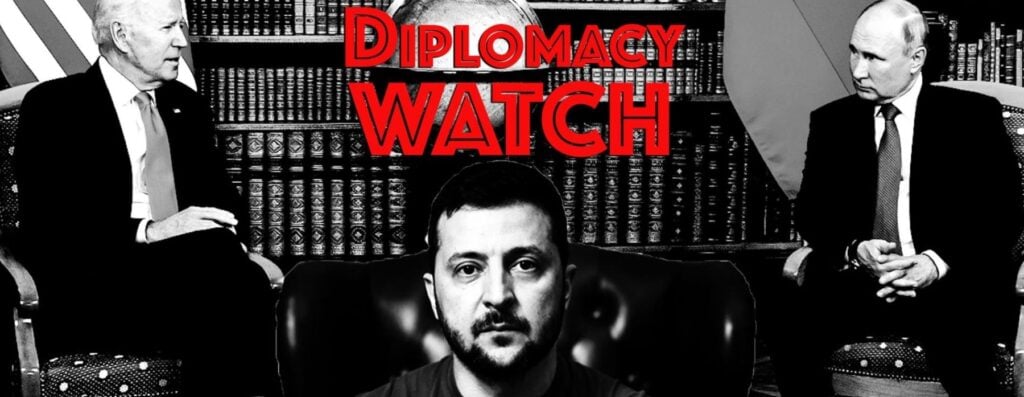
Connor Echols: Did Boris Johnson help stop a peace deal in Ukraine?

By Connor Echols

October 17, 2022

A recent piece in Foreign Affairs revealed that Kyiv and Moscow may have had a tentative deal to end the war all the way back in April.

Russia and Ukraine may have agreed on a tentative deal to end the war in April, according to a recent piece in Foreign Affairs.

“Russian and Ukrainian negotiators appeared to have tentatively agreed on the outlines of a negotiated interim settlement,” wrote Fiona Hill and Angela Stent. “Russia would withdraw to its position on February 23, when it controlled part of the Donbas region and all of Crimea, and in exchange, Ukraine would promise not to seek NATO membership and instead receive security guarantees from a number of countries.”

Originally published at Responsible Statecraft on September 2, 2022

The news highlights the impact of former British Prime Minister Boris Johnson’s efforts to stop negotiations, as journalist Branko Marcetic noted on Twitter. The decision to scuttle the deal coincided with Johnson’s April visit to Kyiv, during which he reportedly urged Ukrainian President Volodymyr Zelensky to break off talks with Russia for two key reasons: Putin cannot be negotiated with, and the West isn’t ready for the war to end.

The apparent revelation raises some key questions: Why did Western leaders want to stop Kyiv from signing a seemingly good deal with Moscow? Do they consider the conflict a proxy war with Russia? And, most importantly, what would it take to get back to a deal?

For now, we can only speculate about the answers to the first two questions. The third is perhaps no less challenging, especially given the fact that both Ukraine and Russia have (at least publicly) hardened their negotiating positions significantly in recent months. But there are some clues that could help us answer it.

One possible path back to a peace deal is to build on July’s grain agreement, in which Kyiv and Moscow agreed to restart wheat exports from Ukraine’s Black Sea ports. The deal has held strong despite continued hostilities, allowing more than one million metric tons of grain to enter the world market so far. This accord shows that each side is at least interested in reducing the global impact of the war.

The other option is more complex but no less important. Just yesterday, a team of international inspectors arrived at the Russian-held Zaporizhzhia nuclear power plant, which has been threatened by nearby shelling in recent weeks. The visit, which will allow experts to ensure that the plant remains in safe condition, is the result of intensive talks, backed by pressure from the international community. In this case, both Russia and Ukraine are signalling their commitment to avoiding a nuclear catastrophe.

In other words, Kyiv and Moscow have both shown that they want to mitigate the secondary effects of the conflict, and they’re willing to negotiate with the enemy in order to do it.

But, as long as this war drags on, people around the world will continue to suffer, and the spectre of a catastrophic event — whether through an errant strike on a power plant or an uncontrolled escalation to nuclear war — will continue to loom. It’s time for Russia, Ukraine, and the West to recognize that there’s only one way to put an end to those risks: Lay down arms and come to the negotiating table.

In other diplomatic news related to the war in Ukraine:

— The European Union is expected to suspend a visa agreement with Russia, which will make it more difficult (and more expensive) for Russian tourists to visit countries in the bloc, according to Reuters. The decision is a compromise between EU members that want to ban all Russian travellers from entering the Schengen Zone and others that see such a move as counter-productive. In a joint statement, France and Germany explained their opposition to a full ban: “We caution against far-reaching restrictions on our visa policy, in order to prevent feeding the Russian narrative and trigger unintended rallying-around the flag effects and/or estranging future generations.”

— Russia blocked a UN agreement aimed at shoring up the nuclear non-proliferation treaty (NPT), citing concerns about clauses related to the situation at the Zaporizhzhia nuclear plant, according to the Guardian. The move highlights the negative effect that Russia’s invasion has had on non-proliferation efforts in recent months. But, as Shannon Bugos argued in Responsible Statecraft, Washington should still do everything in its power to work with Moscow to reduce each country’s nuclear stockpiles. “The framework for a U.S.-Russian arms control arrangement is not perfect and will require concessions from both Washington and Moscow,” Bugos wrote. “[B]ut this is part of the arms control bargain, and the benefits, like the non-use of nuclear weapons in warfare since 1945, have consistently outweighed the perceived costs.”

— On Thursday, French President Emmanuel Macron gave a detailed run-down of his stance toward the war in Ukraine, according to AP. Macron argued that Europe “must get prepared for a long war” in order to put Ukraine in the best possible position for negotiations. He also defended his decision to keep talking with Putin, arguing that “we must do everything to make a negotiated peace possible.”

U.S. State Department News:

In a Tuesday press briefing, spokesperson Vedant Patel responded to concerns that U.S. weapons transfers to Ukraine have dropped Pentagon weapons stockpiles to “uncomfortably low” levels. “The United States has stood with the people of Ukraine for 31 years, and we will continue to firmly stand with them as they defend their freedom and independence,” Patel said. “We are going to continue to stand with Ukraine for as long as that takes.”

Originally published at Responsible Statecraft on September 2, 2022

About the author

Connor Echols is a reporter for Responsible Statecraft. He was previously an associate editor at the Nonzero Foundation, where he co-wrote a weekly foreign policy newsletter. Echols recently completed a fellowship with the Center for Arabic Study Abroad in Amman, Jordan, and he received his bachelor’s degree from Northwestern University, where he studied journalism and Middle East and North African Studies

Please help TFF remain truly independent by contributing if you benefited from this article

Note
Here is another fine analysis of Boris Johnson’s pro-war activity, Jake Johnson’s “Boris Johnson Says Ukraine Should Not Accept ‘Bad Peace’ With Russia”.


Related Posts

Advocates of nuclear disarmament are regularly dismissed by the champions of nuclear deterrence as naïve and unrealistic, utopian or even irresponsible. Yet this ‘doctrine’ of deterrence, regarded by France as the ‘cornerstone’ of its national security, is based on quasi-religious beliefs, a theory that cannot be proven, risky gambles and fragile assumptions. So much so that one might legitimately ask which side the ‘Care Bears’ are on. Marc FinaudVice-President of Initiatives for Nuclear Disarmament (IDN) October 9, 2026 This article was originally published on Pressenza When it comes to these things being treated as religious concepts, look here. Idealists and realists It was Hubert Védrine, François Mitterrand’s former Foreign Minister, who repeatedly coined the phrase: ‘Europeans are a sort of Care Bears who don’t realise they’re living in Jurassic Park’. He applies this reference to the cartoon for well-behaved children not only to what he regards as weakness or idealism...
The agreement is catastrophic both because of what it says and what it doesn’t mention. It reduces further the major asset of security policies: Freedom of action. Jan Oberg TFF director September 25, 2026 A couple of hours before the agreement was signed on September 22, 2026, I published the following 13 hypotheses about what it would most likely contain on TFF Substack (in English). I was wrong on only the first point. Contrary to what Trump had written on his Truth Social platform, it does not appear to come into force immediately. In fact, it turned out to be worse than even I had anticipated. After these hypotheses now come a number of reflections in light of what the agreement actually contains, and does not contain, as well as the way in which it has generally been presented by major media outlets and by the public-service broadcaster DR. My...
Jan Oberg May 15, 2026 Go to this Fox News page and scroll the whole way down: President Donald Trump tells the world that his meeting with President Xi Jinping yielded a lot of very concrete political and economic results – of course, only where the Chinese side, according to him, agreed with him. He does not mention the Taiwan issue, but Secretary of State, Marco Rubio, says that it did not feature prominently in their talks and that the US policy on Taiwan has not changed. Then go to China Daily – or Global Times – and you will see that for the Chinese it is framework, principles, structure of cooperation etc. that matters – all embedded in the overall idea of “constructive bilateral relationship of strategic stability.” Nowhere is any concrete agreement or deal – all that Trump refers to – mentioned. At the general level, this gives you insights into the very different social...

Recent Articles

Photo above: Carl Fredrik Reuterswärd’s Non-Violence outside UN Headquarters in New York. Kirill Levin, CC BY-NC-SA 2. Jan Oberg November 3, 2026 I am happy to be published in Horizons which is produced by the Center for International Relations and Sustainable Development, CIRSD, in Belgrade. My contribution brings out a radical re-thinking of what concepts such as defence, security, deterrence – and peace – may mean if we want to create a more peaceful world. It also summarises a few things I have been working with the last few decades. Please read it here Og her er den på dansk, takket være Johnny Baltzersens lynhurtige oversættelse
UNITE-tillid, DREAM-velstand og andre konstruktive komponenter Normally we publish articles in English here. But this is a translation of a very important TFF document that should reach as many as possible in Denmark since this country’s government has been one of the most hardline in Europe and, up till now at least, has refused to use diplomacy and, instead, spent tremendous sums on arming Ukraine with the express goal of defeating Russia. Thus this – unique – article is in Danish. Vi er Johnny Baltzersen og hans Fælles Sikkerhed – Fælles Fremtid på Substack overmåde taknemmelige for at have oversat og publiceret TFF’s 2025-portfølje for fredsidéer med henblik på Ukraines fremtid. Vi håber den nu kan nå mange flere danskere – som også vil sprede den og skabe debat – nu den danske regerings og folketingspartiernes politik på dette område siden 2022 står nu – forudsigeligt – ved vejs ende....
Jan Oberg TFF director October 28, 2026 Exactly one month has now passed since I published my criticism of the introduction to the special issue on Johan Galtung published by the Journal of Global Security Studies, JoGSS, and of Tor Egil Førland’s chapter about Galtung which serves as a preview to his forthcoming biography of Galtung to be published by PRIO. See the original on The Transnational here and the same article on TFF Substack with many general and critical comments and, in particular, the people who decided to withdraw from the biography project in protest. The special issue itself was extraordinary. It was devoted to the intellectual legacy of one of the founders of peace research and contained a number of strong assessments of his personality, scholarship, intellectual trajectory, and public role. Such assessments are, of course, entirely legitimate. No scholar is beyond criticism, and neither was Johan Galtung....

TFF on Substack

Discover and subscribe to more peace materials on TFF Substack

Most Popular

Photo above: Carl Fredrik Reuterswärd’s Non-Violence outside UN Headquarters in New York. Kirill Levin, CC BY-NC-SA 2. Jan Oberg November 3, 2026 I am happy to be published in Horizons which is produced by the Center for International Relations and Sustainable Development, CIRSD, in Belgrade. My contribution brings out a radical re-thinking of what concepts such as defence, security, deterrence – and peace – may mean if we want to create a more peaceful world. It also summarises a few things I have been working with the last few decades. Please read it here Og her er den på dansk, takket være Johnny Baltzersens lynhurtige oversættelse
UNITE-tillid, DREAM-velstand og andre konstruktive komponenter Normally we publish articles in English here. But this is a translation of a very important TFF document that should reach as many as possible in Denmark since this country’s government has been one of the most hardline in Europe and, up till now at least, has refused to use diplomacy and, instead, spent tremendous sums on arming Ukraine with the express goal of defeating Russia. Thus this – unique – article is in Danish. Vi er Johnny Baltzersen og hans Fælles Sikkerhed – Fælles Fremtid på Substack overmåde taknemmelige for at have oversat og publiceret TFF’s 2025-portfølje for fredsidéer med henblik på Ukraines fremtid. Vi håber den nu kan nå mange flere danskere – som også vil sprede den og skabe debat – nu den danske regerings og folketingspartiernes politik på dette område siden 2022 står nu – forudsigeligt – ved vejs ende....
Jan Oberg TFF director October 28, 2026 Exactly one month has now passed since I published my criticism of the introduction to the special issue on Johan Galtung published by the Journal of Global Security Studies, JoGSS, and of Tor Egil Førland’s chapter about Galtung which serves as a preview to his forthcoming biography of Galtung to be published by PRIO. See the original on The Transnational here and the same article on TFF Substack with many general and critical comments and, in particular, the people who decided to withdraw from the biography project in protest. The special issue itself was extraordinary. It was devoted to the intellectual legacy of one of the founders of peace research and contained a number of strong assessments of his personality, scholarship, intellectual trajectory, and public role. Such assessments are, of course, entirely legitimate. No scholar is beyond criticism, and neither was Johan Galtung....
Read More
knotted gun
Photo above: Carl Fredrik Reuterswärd’s Non-Violence outside UN Headquarters in New York. Kirill Levin, CC BY-NC-SA 2. Jan Oberg November 3, 2026 I am happy to be published in Horizons which is produced by the Center for International Relations and Sustainable Development, CIRSD, in Belgrade. My contribution brings out a radical re-thinking of what concepts such as defence, security, deterrence – and peace – may mean if we want to create a more peaceful world. It also summarises a few things I have been working with the last few decades. Please read it here Og her er den på dansk, takket være Johnny Baltzersens lynhurtige oversættelse
TFFPortfolioVign
UNITE-tillid, DREAM-velstand og andre konstruktive komponenter Normally we publish articles in English here. But this is a translation of a very important TFF document that should reach as many as possible in Denmark since this country’s government has been one of the most hardline in Europe and, up till now at least, has refused to use diplomacy and, instead, spent tremendous sums on arming Ukraine with the express goal of defeating Russia. Thus this – unique – article is in Danish. Vi er Johnny Baltzersen og hans Fælles Sikkerhed – Fælles Fremtid på Substack overmåde taknemmelige for at have oversat og publiceret TFF’s 2025-portfølje for fredsidéer med henblik på Ukraines fremtid. Vi håber den nu kan nå mange flere danskere – som også vil sprede den og skabe debat – nu den danske regerings og folketingspartiernes politik på dette område siden 2022 står nu – forudsigeligt – ved vejs ende....
JoGSS-Silent
Jan Oberg TFF director October 28, 2026 Exactly one month has now passed since I published my criticism of the introduction to the special issue on Johan Galtung published by the Journal of Global Security Studies, JoGSS, and of Tor Egil Førland’s chapter about Galtung which serves as a preview to his forthcoming biography of Galtung to be published by PRIO. See the original on The Transnational here and the same article on TFF Substack with many general and critical comments and, in particular, the people who decided to withdraw from the biography project in protest. The special issue itself was extraordinary. It was devoted to the intellectual legacy of one of the founders of peace research and contained a number of strong assessments of his personality, scholarship, intellectual trajectory, and public role. Such assessments are, of course, entirely legitimate. No scholar is beyond criticism, and neither was Johan Galtung....
Screenshot 2026-10-26 115647
An aspect of Iran’s culture and civilisation you’ve probably never heard about. Don’t be surprised if the US and Israel also try to bomb them. Jan ObergTFF director October 26, 2026 Today – under the “USraeli” threat of new “annihilating” bombings – opens the 7th International Conference on Peace and Conflict Resolution at Tehran’s University. As far as I can tell, this is the only permanent, advanced peace research institution in West Asia/the Middle East. Perhaps more countries in that region could be inspired? I mean, how many military “security” institutes and military academies do they have? Many peace research institutes and university departments have been established since the 1950s in the West. They are now all under attack; some have closed down, some have gone mainstream, yet others kept the name but do nothing to research peace and disseminate results or advice; instead, they cooperate with militarism’s platforms such...
Screenshot 2026-10-15 141837
Let’s discuss using AI to create peace – in contrast to boring geopolitics devoid of creative healing and visions. Jan Oberg TFF director October 15, 2026 I asked VEED to create a short video exemplifying how peace is preferable to war, then chose the lady as a template. Simple as that. In less than a minute, it produced this video, which any peace-loving person would appreciate. The only problem is that human intelligence (HI), at least the one that exists among Western decision-makers, isn’t half as moral or smart as AI. I have used AI to dialogue about peace and peace plans, creative conflict resolution and visions of a better future for humankind. It so happens that I am having more stimulating, intelligent, creative and moral discussions with AI than I could possibly have with any EU or NATO leader today. Yes, AI has very problematic and dangerous aspects; used...
girl-5894831_1280
Below are TFF-related media mentions, comments, videos and social media posts published elsewhere but not on this homepage. We happen to catch and list only a fraction. Regarding video comments and debates, we recommend that you go to the TFF Video Channel on Substack where many of them are reproduced. Jan Oberg is a contributor to China Daily – 52 million daily clicks – and Global Times, CGTN and CCTV (the national television), China Investment, Xinhua News Agency and several others. Articles and videos on these media very often multiply into countless Chinese (and Western media) that re-post them from these main media. Thanks to The China Academy, his analyses, interviews and comments are frequently posted on YouTube channels such as Thinkers Forum and Wave Media. These videos are often re-posted on Bilibili (China’s YouTube), the China Content Center on TikTok, and on the Chinese edition of TikTok, Douyin.com. This means reaching hundreds of millions of viewers worldwide over a year. While there are too many to catch on all these...



