
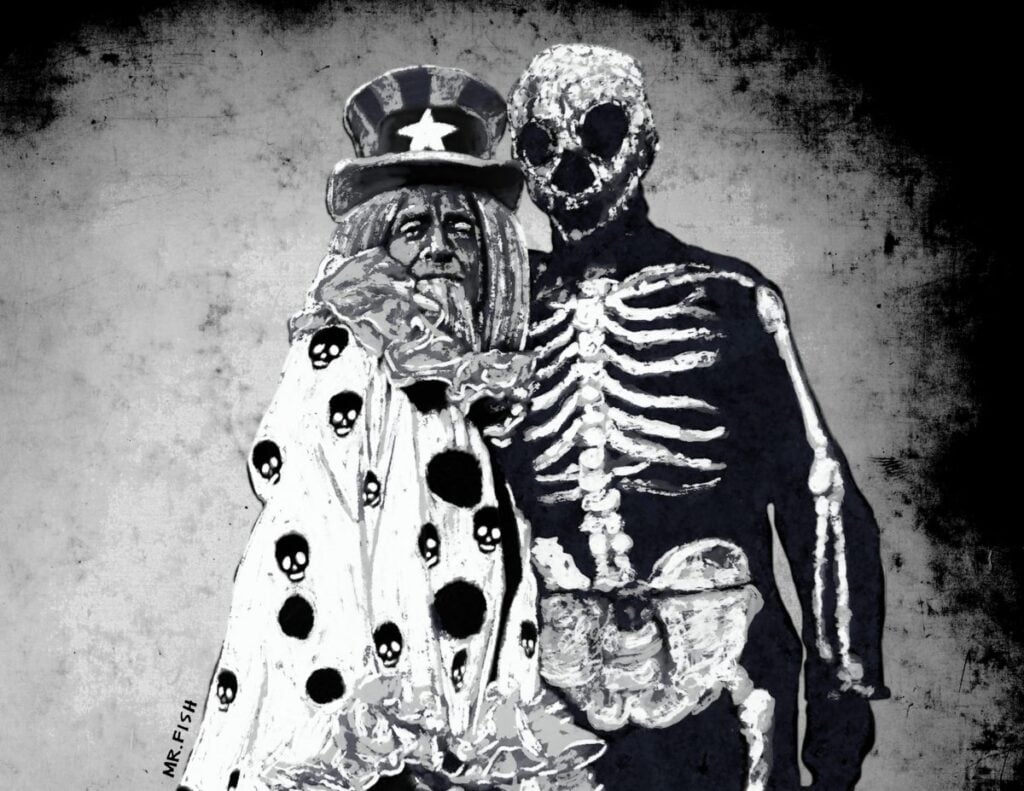
(Photo: Art by Mr. Fish/Original to Scheerpost)
Regardless of the outcome, the election will not stop the rise of hypernationalism, crisis cults and other signs of an empire’s terminal decline.
September 1, 2020
The terminal decline of the United States will not be solved by elections. The political rot and depravity will continue to eat away at the soul of the nation, spawning what anthropologists call crisis cults — movements led by demagogues that prey on an unbearable psychological and financial distress.
These crisis cults, already well established among followers of the Christian Right and Donald Trump, peddle magical thinking and an infantilism that promises — in exchange for all autonomy — prosperity, a return to a mythical past, order and security.
The dark yearnings among the white working class for vengeance and moral renewal through violence, the unchecked greed and corruption of the corporate oligarchs and billionaires who manage our failed democracy, which has already instituted wholesale government surveillance and revoked most civil liberties, are part of the twisted pathologies that infect all civilizations sputtering towards oblivion.
I witnessed the deaths of other nations during the collapse of the communist regimes in Eastern Europe and later in the former Yugoslavia. I have smelled this stench before.
Originally published at Scheerpost.com
The removal of Trump from office will only exacerbate the lust for racist violence he incites and the intoxicating elixir of white nationalism. The ruling elites, who first built a mafia economy and then built a mafia state, will continue under Biden, as they did under Trump, Barack Obama, George W. Bush, Bill Clinton and Ronald Reagan, to wantonly pillage and loot.
The militarized police will not stop their lethal rampages in poor neighborhoods. The endless wars will not end. The bloated military budget will not be reduced.
The world’s largest prison population will remain a stain upon the country. The manufacturing jobs shipped overseas will not return and the social inequality will grow.
The for-profit health care system will gouge the public and price millions more out of the health care system. The language of hate and bigotry will be normalized as the primary form of communication.
Internal enemies, including Muslims, immigrants and dissidents, will be defamed and attacked. The hypermasculinity that compensates for feelings of impotence will intensify. It will direct its venom towards women and all who fail to conform to rigid male stereotypes, especially artists, LGBTQ people and intellectuals.
Lies, conspiracy theories, trivia and fake news — what Hannah Arendt called “nihilistic relativism” — will still dominate the airwaves and social media, mocking verifiable fact and truth.
The ecocide, which presages the extinction of the human species and most other life forms, will barrel unabated towards its apocalyptic conclusion.
“We run heedlessly into the abyss after putting something in front of us to stop us seeing it,” Pascal wrote.
The worse it gets — and it will get worse as the pandemic hits us in wave after deadly wave with an estimated 300,000 Americans dead by December and possibly 400,000 by January — the more desperate the nation will become.
Tens of millions of people will be thrown into destitution, evicted from their homes and abandoned. Social collapse, as Peter Drucker observed in Weimar Germany in the 1930s, brings with it a loss of faith in ruling institutions and ruling ideologies.
With no apparent answers or solutions to mounting chaos and catastrophe — and Biden and the Democratic Party have already precluded the kind of New Deal programs and assault on oligarchic power that saved us during the Great Depression — demagogues and charlatans need only denounce all institutions, all politicians, and all political and social conventions while conjuring up hosts of phantom enemies.
Drucker saw that Nazism succeeded not because people believed in its fantastic promises, but in spite of them. Nazi absurdities, he pointed out, had been “witnessed by a hostile press, a hostile radio, a hostile cinema, a hostile church, and a hostile government which untiringly pointed out the Nazi lies, the Nazi inconsistency, the unattainability of their promises, and the dangers and folly of their course.”
Nobody, he noted, “would have been a Nazi if rational belief in the Nazi promises had been a prerequisite.”
The poet, playwright and socialist revolutionary Ernst Toller, who was forced into exile and stripped of his citizenship when the Nazis took power in 1933, wrote much the same in his autobiography: “The people are tired of reason, tired of thought and reflection. They ask, what has reason done in the last few years, what good have insights and knowledge done us.”
After Toller committed suicide in 1939, W.H. Auden in his poem “In Memory of Ernst Toller” wrote:
We are lived by powers we pretend to understand:
They arrange our loves; it is they who direct at the end
The enemy bullet, the sickness, or even our hand.
The poor, the vulnerable, those who are not white or not Christian, those who are undocumented or who do not mindlessly repeat the cant of a perverted Christian nationalism, will be offered up in a crisis to the god of death, a familiar form of human sacrifice that plagues sick societies.
Once these enemies are purged from the nation, we are promised, America will recover its lost glory, except that once one enemy is obliterated another takes its place.
Crisis cults require a steady escalation of conflict. This is what made the war in the former Yugoslavia inevitable. Once one stage of conflict reaches a crescendo it loses its efficacy.
It must be replaced by ever more brutal and deadly confrontations. The intoxication and addiction to greater and greater levels of violence to purge the society of evil led to genocide in Germany and the former Yugoslavia. We are not immune. It is what Ernst Jünger called a “feast of death.”
These crisis cults are, as Drucker understood, irrational and schizophrenic. They have no coherent ideology. They turn morality upside down. They appeal exclusively to emotions.
Burlesque and celebrity culture become politics. Depravity becomes morality. Atrocities and murder become heroism. Crime and fraud become justice.
Greed and nepotism become civic virtues. What these cults stand for today, they condemn tomorrow. At the height of the reign of terror on May 6, 1794 during the French Revolution, Maximilien Robespierre announced that the Committee for Public Safety now recognized the existence of God.
The French revolutionaries, fanatical atheists who had desecrated churches and confiscated church property, murdered hundreds of priests and forced another 30,000 into exile, instantly reversed themselves to send to the guillotine those who disparaged religion.
In the end, exhausted by the moral confusion and internal contradictions, these crisis cults yearn for self-annihilation.
The French sociologist Emile Durkheim in his classic book “On Suicide” found that when social bonds are shattered, when a population no longer feels it has a place or meaning in a society, personal and collective acts of self-destruction proliferate.
Societies are held together by a web of social bonds that give individuals a sense of being part of a collective and engaged in a project larger than the self. This collective expresses itself through rituals, such as elections and democratic participation or an appeal to patriotism, and shared national beliefs.
The bonds provide meaning, a sense of purpose, status and dignity. They offer psychological protection from impending mortality and the meaninglessness that comes with being isolated and alone.
The breaking of these bonds plunges individuals into deep psychological distress. Durkheim called this state of hopelessness and despair anomie, which he defined as “ruleless-ness.”
Ruleless-ness means the norms that govern a society and create a sense of organic solidarity no longer function.
The belief, for example, that if we work hard, obey the law and get a good education we can achieve stable employment, social status and mobility along with financial security becomes a lie.
The old rules, imperfect and often untrue for poor people of color, nevertheless were not a complete fiction in the United States. They offered some Americans — especially those from the white working and middle class — modest social and economic advancement.
The disintegration of these bonds has unleashed a widespread malaise Durkheim would have recognized. The self-destructive pathologies that plague the United States — opioid addiction, gambling, suicide, sexual sadism, hate groups and mass shootings — are products of this anomie. So is our political dysfunction. My book, “America: The Farewell Tour,” is an examination of these pathologies and the widespread anomie that defines American society.
The economic structures, even before the pandemic, were reconfigured to mock faith in a meritocracy and the belief that hard work leads to a productive and valued role in society. American productivity, as The New York Times pointed out, has increased 77 percent since 1973 but hourly pay has grown only 12 percent.
If the federal minimum wage was attached to productivity, the newspaper wrote, it would be more than $20 an hour now, not $7.25. Some 41.7 million workers, a third of the workforce, earn less than $12 an hour, and most of them do not have access to employer-sponsored health insurance.
A decade after the 2008 financial meltdown, the Times wrote, the average middle class family’s net worth is more than $40,000 below what it was in 2007. The net worth of black families is down 40 percent, and for Latino families the figure has dropped 46 percent.
Some four million evictions are filed each year. One in four tenant households spends about half its pretax income on rent. Each night some 200,000 people sleep in their cars, on streets or under bridges.
And these stark figures represent the good times Biden and the Democratic Party leaders promise to restore. Now, with real unemployment probably close to 20 percent — the official figure of 10 percent excludes those furloughed or those who have stopped looking for work — some 40 million people are at risk of being evicted by the end of the year.
An estimated 27 million people are expected to lose their health insurance.
Banks are stockpiling reserves of cash to cope with the expected wave of bankruptcies and defaults on mortgages, student loans, car loans, personal loans and credit card debt. The ruleless-ness and anomie that defines the lives of tens of millions of Americans was orchestrated by the two ruling parties in the service of a corporate oligarchy.
If we do not address this anomie, if we do not restore the social bonds shattered by predatory corporate capitalism, the decay will accelerate.
This dark human pathology is as old as civilization itself, repeated in varying forms in the twilight of ancient Greece and Rome, the finale of the Ottoman and Austro-Hungarian empires, revolutionary France, the Weimar Republic and the former Yugoslavia.
The social inequality that characterizes all states and civilizations seized by a tiny and corrupt cabal — in our case corporate — leads to an inchoate desire by huge segments of the population to destroy.
The ethnic nationalists Slobodan Milošević, Franjo Tudjman, Radovan Karadžić and Alija Izetbegović in the former Yugoslavia assumed power in a similar period of economic chaos and political stagnation.
Yugoslavs by 1991 were suffering from widespread unemployment and had seen their real incomes reduced by half from what they had been a generation before.
These nationalist demagogues sanctified their followers as righteous victims stalked by an array of elusive enemies. They spoke in the language of vengeance and violence, leading, as it always does, to actual violence.
They trafficked in historical myth, deifying the past exploits of their race or ethnicity in a perverse kind of ancestor worship, a mechanism to give to those who suffered from anomie, who had lost their identity, dignity and self-worth, a new, glorious identity as part of a master race.
When I walked through Montgomery, Alabama, a city where half of the population is African-American, with the civil rights attorney Bryan Stevenson a few years ago, he pointed out the numerous Confederate memorials, noting that most had been put up in the last decade. “This,” I told him, “is exactly what happened in Yugoslavia.”
A hyper-nationalism always infects a dying civilization. It feeds the collective self-worship. This hyper-nationalism celebrates the supposedly unique virtues of the race or the national group.
It strips all who are outside the closed circle of worth and humanity. The world instantly becomes understandable, a black and white tableau of them and us.
These tragic moments in history see people fall into collective insanity. They suspend thought, especially self-critical thought. None of this is going away in November, in fact it will get worse.
Joe Biden, a shallow, political hack devoid of fixed beliefs or intellectual depth, is an expression of the nostalgia of a ruling class that yearns to return to the pantomime of democracy.
They want to restore the decorum and civic religion that makes the presidency a form of monarchy and sacralizes the organs of state power.
Donald Trump’s vulgarity and ineptitude is an embarrassment to the architects of empire. He has ripped back the veil that covered our failed democracy. But no matter how hard the elites try this veil cannot be restored. The mask is off. The façade is gone. Biden cannot bring it back.
Political, economic and social dysfunction define the American empire. Our staggering inability to contain the pandemic, which now infects over 5 million Americans, and the failure to cope with the economic fallout the pandemic has caused, has exposed the American capitalist model as bankrupt.
It has freed the world, dominated by the United States for seven decades, to look at other social and political systems that serve the common good rather than corporate greed.
The diminished stature of the United States, even among our European allies, brings with it the hope for new forms of government and new forms of power.
It is up to us to abolish the American kleptocracy. It is up to us to mount sustained acts of mass civil disobedience to bring down the empire.
It poisons the world as it poisons us. If we mobilize to build an open society, we hold out the possibility of beating back these crisis cults as well as slowing and disrupting the march towards ecocide.
This requires us to acknowledge, like those protesting in the streets of Beirut, that our kleptocracy, like Lebanon’s, is incapable of being salvaged. The American system of inverted totalitarianism, as the political philosopher Sheldon Wolin called it, must be eradicated if we are to wrest back our democracy and save ourselves from mass extinction.
We need to echo the chants by the crowds in Lebanon calling for the wholesale removal of its ruling class — kulyan-yani-kulyan — everyone means everyone.
Originally published at Scheerpost.com
About the author
Chris Hedges is a Pulitzer Prize–winning journalist who was a foreign correspondent for fifteen years for The New York Times, where he served as the Middle East Bureau Chief and Balkan Bureau Chief for the paper. He previously worked overseas for The Dallas Morning News, The Christian Science Monitor, and NPR. He is the host of the Emmy Award-nominated RT America show On Contact.
If you appreciate this article, please show it here. Thanks!





