Theories and concepts

Category

Year

Author / Contributor

Region

Sort by

Showing 1-10 of 214 stories

OlaFriholt_PaintingCropped_PhSh
Det är nu 15 år sedan den ödesdigra dagen 11 september 2001. Sedan dess har kriget mot terrorismen utvecklats och krävt minst två miljoner liv och lika många psykiskt och fysiskt skadade, allt enligt en utredning från USAs läkarsällskap, ”Physicians for Social Responsibility” (med 50 000 medlemmar och medlem av Läkare mot kärnvapen). Resultatet av kriget mot terrorismen är dessutom negativt även för väst. Idag har attentaten och offren i väst mångdubblats. Lika anmärkningsvärt är att medborgarnas fri- och rättigheter i väst dramatiskt har urholkats. Kontrollen uppifrån är närmast total med avlyssning utan praktisk begränsning. Hemliga fångläger med tortyr av godtyckligt fängslade har avslöjats i Polen, Tjeckien, Kosovo och Egypten, utöver de öppet erkända på Guantanamo, i Afghanistan och Pakistan. Ett sextiotal personer har suttit på Guantanamo i fjorton år utan rannsakan och dom från USA, som förr kallats ”Världens största demokrati”. Den 11 september kan alltså kopplas till urholkning...
gunnarwestberg
By Gunnar Westberg Formuleringen “”NATO:s nya, mer aggressiva kärnvapenpolicy” har två grunder, nämligen de nya vapnen och de nya formuleringarna av doktriner. Jag föreslår att vi, när vi talar om NATO och kärnvapen, använder formuleringar liknande den första meningen. Vill man förklara sig ger andra meningen ett svar. Men det är under alla omständigheter bra om man har tillgång till nedanstående argument: De gamla B61 var symboliska vapen. De skulle, enligt ofta upprepade försäkringar, inte användas. De var en pant på att USA inte skulle överge Europa vid ett sovjetiskt/ryskt anfall. USA har föreslagit att dessa vapen skulle tas bort, men öst-europeiska NATO-medlemmar och framför allt Frankrike (!) har starkt reagerat emot. De nya vapnen är B 61-12. Denna bomb skiljer sig från tidigare versioner av B61 som var ”gravity bombs”, d v s föll fritt från bombplanet. B 61-12 är styrbart och har därför en träffsäkerhet inom 30 m...
johangaltung
Editorial, 5 September 2016 Nº 445 – TRANSCEND Media Service Watching Christianity nearly a century–fundamentalist Christians fighting ritualistic Christians fighting secularism, generally moving fundamentalism–>ritualism–>secularism–maybe the same for Islam? Their similarities make “Islam right now” a repetition of Christianity; their differences shout, Watch Out! Let us see where this leads us. Violence-prone fundamentalist evangelical Christians are still on top of the USA and some Nordic countries; but much less in ritualistic Catholic-Orthodox Christianity, meaning by far most of Europe. Beauty of worship, the psychology of confession, less verbalism; all help. Secularism makes faith so metaphorical for many that Christianity becomes only a ritual for Christmas-Easter, baptism-marriage-funeral (if there are no secular alternatives). Result: empty churches. Our secular age makes literal faith in dogmas difficult, and that tears at the faith. But this is where two major differences enter: Islam is much less dogmatic, there is much less to tear at, only...
johangaltung
Dear Reader: This editorial 444 – the number calls for attention – is dedicated to a global overview, the world “right now”, so unstable with imbalances everywhere that what we are living is fluxes and jumps. Let us start with two major relations: Nature-human, the US-the Rest. Look at the human-nature relations. We are used to being on top, killing and taming animals, protected against many of nature’s hazards including micro-organisms. But nature comes up with ever smaller viri, and larger, or more, tsunamis and earthquakes, and an erratic climate. We oscillate between blaming ourselves, including military scheming, and the anthropomorphic “Mother Nature is angry” (Evo Morales). If nature is angry, she has good reasons for a good riddance of us. And we are slow at a deeper human-nature relations respecting and enhancing both. Nature is on top and our natural sciences are simply not good enough, taken by surprise...
ObergPhoto2cmB-W-3
TFF Series ”The New Cold War” # 6 How did Western Europe survive the much stronger Soviet Union & Warsaw Pact 30-40 years ago? A pact that had about 70% of NATO’s military expenditures where today’s Russia has 8%? How did we get on after the Soviet invasion of Hungary and Czechoslovakia – and a Union with much more global military and political influence? Europe did so through a well-maintained military capacity, or superiority, technical superiority and, of fundamental importance to security – confidence-building measures (CBM). And through a political leadership by personalities who knew what the 2nd World War had implied and why it must never happen again. One towering figure of course being Willy Brandt, the German chancellor who had himself been a refugee in Norway during the war. CBMs were meant to both uphold a high level of war-fighting capacity while also seeking military early information/warning, attending...
ChatGPT Image 9 jun 2026, 11_11_33
 The announcement was made yesterday – August 15 – by Japan’s Finance Ministry: In the last quarter of the year the Japanese economy grew at an annualised rate of 0.2%. “One wonders if the economy will remain at a standstill for the rest of the year”, the Financial Times asks. But then Japan’s economy has been becalmed for 30 years. Even though the government has poured billions of dollars into the economy it has had only a small effect in boosting demand. One wonders when the government will give up and what happens then – another decade of minimal growth? If that is what happens how much does it matter? To the Japanese themselves it seems not that much. By and large they are contented with their lot. The rest of the word may be worried as a powerful country is importing less and less. It does not contribute to...
file
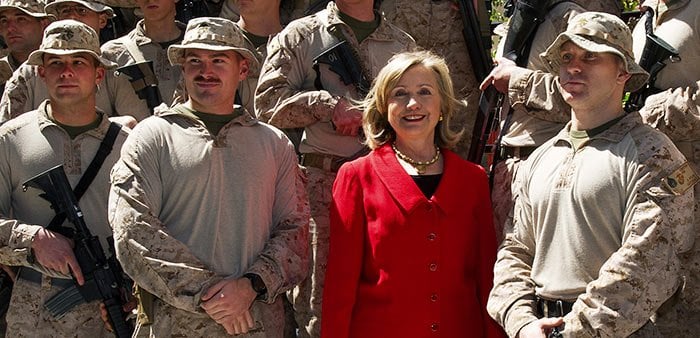
The most comprehensive documentation of Hillary Clinton’s systematic support for military action and of her deceptive talk, if not lies. From The Cairo Review of Global Affairs
Imagen-thumbnail-The-Transnational-1
This article is a short version of a text which was first published with the title “Nonviolent Conflict Escalation” in Conflict Resolution Quarterly, 2016. DOI: 10.1002/crq.21173. In this longer article you can find references to all our sources. ”We have mapped all the conflicts in the world” a senior researcher at PRIO (Peace Research Institute Oslo) told one of the authors at a seminar a couple of weeks ago. If that was true, it would be pretty impressive. Each of the seven billion people living on earth at the moment are likely to have a considerably number of conflicts every year with their partners, neighbours, friends and family members. However, the large majority of these conflicts are dealt with in a peaceful and creative manner. Although they can feel burdensome in the heat of the moment, many of them are a way for people to grow as persons and learn...
gunnarwestberg
By Gunnar Westberg After the terrorist attack on the World Trade Centre in New York on the 11th of September 2001 President George W. Bush felt the need for revenge. Since years back, the US had developed plans to attack Iraq. Its dictator Saddam Hussein had been left in power after the First Gulf War in 1991, a war which the father of George W. Bush had left unfinished. The real reasons for this renewed war on Iraq are not known. Saddam Hussein had previously had a program to produce nuclear weapons. After thorough investigations lead by the UN representatives Rolf Ekéus and Hans Blix it became clear that all weapons of mass destruction had been eliminated. There were no nuclear weapons. However, Saddam Hussein could of course start the production of nuclear weapons at some point in the future. And the US leaders choose to disregard the reports by...
RichardFalk20141
What follows are preliminary reactions to both the BREXIT vote and the world according to Trump, but also a commentary on the related alienation of large segments of the public that are being badly served by both the established elites and their demagogic adversaries. The failures of neoliberalism, the successes of digitization, the scourge of random violence, and more broadly, the dilemmas posed by late modernity are among the root causes of this global crisis of legitimate governance, which is deepened while being mishandled by unprecedented ecological challenges, extremely irresponsible geopolitical leadership, and a variety of ultra-nationalist backlashes against the encroachments of economic globalization. Imagining the World After the Cold War After the end of the Cold War there were various projections that tried to anticipate the likely future of the world in broad interpretative strokes. Three of the most influential conjectures by three prominent American authors received attention in...
johangaltung
PPI pretends to be an index of positive peace/peaceful society. But is more like an index of “positive for business environment”; by the Institute for Economics & Peace, more economics than peace. To explore this, imagine we want an index of health. Obviously, we need criteria of health to know what we are talking about, like: For negative health: absence of illness from the outside–contagion- shocks–and structural from the inside–cardiovascular-tumors-mental. For positive health: balance in body-mind-spirit and socially; a sense of wellness being alive using body-mind-spirit at work, and in love. Then, the indicators, the index, the forefinger pointing the way: preventive health, protection–distance–inoculation-quarantine, of the body with clothes-housing; avoiding fire and shocks (not falling for elderly!); adequate sewage-personal hygiene-nutrition-exercise; curative health for acute and chronic diseases. However, we also need an index of illness to know what we are up against, defined as inability to work, to love, morbidity....

johangaltung
The background is the two major communist parties in the world. Russia Communist Party-Bolshevik made the November 1917 revolution; from 1922 the Communist Party of the Soviet Union, CPSU(b). CPC, the Communist Party of China, now celebrating its 95th anniversary, made the 1 October 1949 revolution. World-shaking events; in the world’s biggest state in area and in the world’s biggest state in population. The revolutions cut into the modernity contradictions in the State-Capital-People triangle by conquering State-military and police. Two lasting achievements of CPSU(b): State Planning of the economy – maybe five years at the time, pjatiletka – now found in most countries; and lifting some bottom up to meet basic needs, surprisingly quickly. But CPSU(b) exercised gross structural violence in the countryside. And CPC, imitating CPSU(b), made the same mistake to start with. Then they became different. Russia got stuck with the Party on top of the State, for...
Categories

Year

Author / Contributor

Region