TFF global posts 2018

Category

Year

Author / Contributor

Region

Sort by

Showing 1-10 of 236 stories

richard-falk-cropped-internal
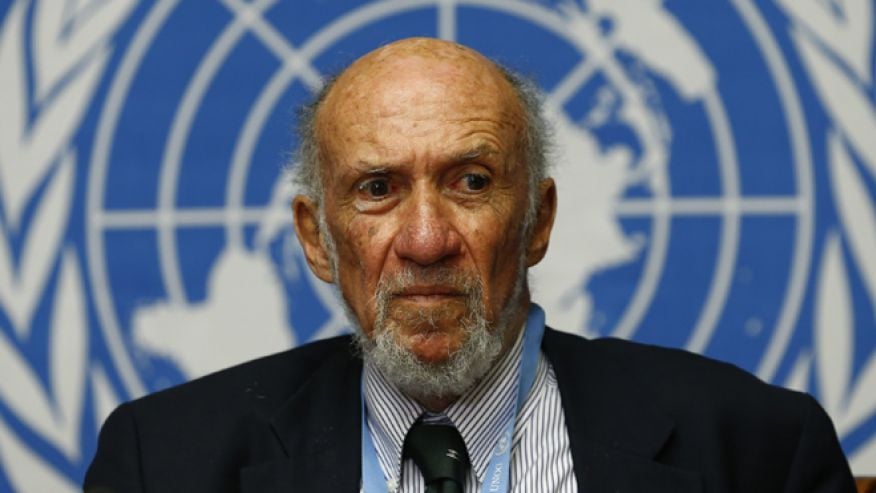
This post is an assessment of the recent Syrian missile attack by the armed forces of the U.S., UK, and France from a variety of perspectives. It is a modified and expanded version of a text earlier published in The Wire  (Delhi) and Il Manifesto(Rome). I intend to write two further posts suggested by the controversy generated by the airstrikes of April 14, 2018, against sites associated with Syria’s alleged chemical weapons capabilities. These strikes raise questions of international law, domestic constitutional authorization for international uses of force, strategic logic, and moral imperatives and rationalizations. Each of these issues is capable of multiple interpretations raising further concerns about the appropriate location of the authority to decide given the nature of world order in the 21stcentury.  Preliminary reflections At this stage, it seems reasonable to wonder whether Syria was attacked because it didn’t use chemical weapons rather than because it did....
ChatGPT Image 9 jun 2026, 11_11_33
  500,000 dead and counting. President Bashar al-Assad is going full blast at reducing the parts of his country still standing, but not under his control, to rubble. Russia hangs on his tail, providing both planes and soldiers but seemingly unable to wag the dog. The US launches, along with Britain and France, a brief rocket attack. (Should we now after two such attacks call President Donald Trump “Rocket Man 2”?) The attack is supposedly to draw the line on Assad’s use of chemical weapons. Perhaps he did do it, or possibly one of his local commanders took the initiative, but it is small beer compared with the horrors inflicted by conventional weapons day in day out. The UN Convention outlawing the use of chemical weapons was aimed at big time use of them when they become dangerous enough to dominate a battle field – as the Germans used them in...
Screenshot
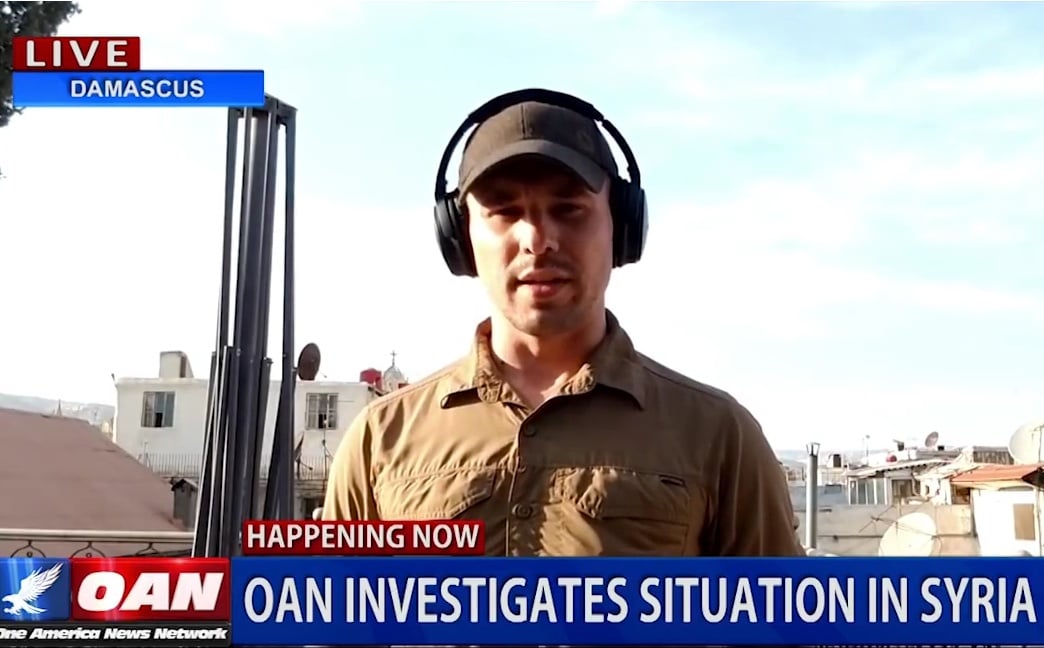
  By One American News Network April 17, 2018 This reporter, Pearson Sharp, tells you what he believes he knows and does not know. He tells you how he did his investigation and whether or not he felt free to report from this very difficult site – in Douma, Ghouta in Syria, after the alleged chemical attack on April 7, 2018 which caused the U.S., Britain and France to bomb what they believe to be chemical weapons facilities and stores in Syria on April 14, 2018. Being on the spot with that sort of quality reporting lends more credibility to this report than the far majority of reporters, editors and media that did not do their own investigations but quoted someone else – leading, as it often does, to dangerous “group think” and uniform, dependent reporting in support of an already constructed media narrative. Mainstream media in the bombing countries...
Screenshot
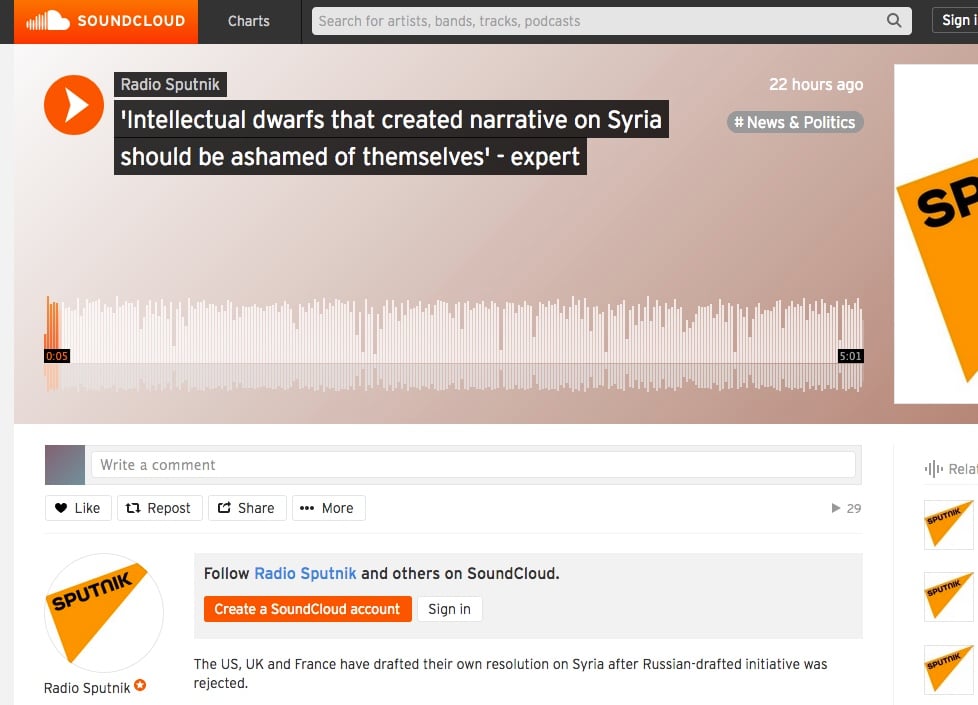
  By Jan Oberg At Sputnik Radio on April 15, 2018 Conversation after the US-French-British bombing of Syria in April 2018 The US, UK and France have drafted their own resolution on Syria after Russian-drafted initiative was rejected. The resolution proposed by the three nations condemns Syrian alleged chemical attacks and calls for creating an independent mechanism for investigation of similar incidents. Earlier, the United Nation Security Council rejected a Russia-drafted resolution condemning the missile strikes against Syria. The Russian mission to the UN reported that eight nations opposed the initiative, while four members abstained from voting. Radio Sputnik discussed the West’s actions against Syria from the international law perspective with Dr. Jan Oberg, the director of the Transnational Foundation for Peace and Future Research. Listen to the conversation here For more stories visit our website www.sputniknews.com
Logo2018-Green-1
Lund, Sweden – April 14, 2018 Statement by Associates of TFF – The Transnational Foundation for Peace and Future Research Summary The US-British-French attack is a clear and indisputable case of aggression according to international law, and to the UN Charter in particular. And it lacks, like many unilateral wars before it, a UN Security Council mandate. It comes as a consequence of interventionist impulses and militarism and lacks every element of a comprehensive conflict analysis, or diagnosis. Even if one assumes that the government and president of Syria are the main/only culprits and the worst violaters of human rights on earth, the way that the Syrian conflict has been handled by Western governments over the past seven years has been outrageously wrong and counterproductive. It’s been deliberate conflict-mismanagement combined with peace-prevention. Conspicuously, this aggression on Syria takes place before there is a shred of evidence of what chemical weapons...
cropped-david6
 In the park today I saw a teenager watching two little kids, one of whom apparently stole a piece of candy from the other. The teenager rushed up to the two of them, reprimanded one of them, and stole both of their bicycles. I felt like it was my turn to step in at that point, and I confronted the bicycle thief. “Excuse me,” I said, “what makes you think you can commit a larger crime just because you witnessed a smaller one? Who do you think you are?” He stared at me for a while, and replied: “the U.S. military.” Originally published at David Swanson here There is no crime larger than war. There is no way to legalize it. The Kellogg-Briand Pact bans it, and the United Nations Charter bans it with narrow exceptions that have not remotely been met by any of the U.S. wars of the...
ChatGPT Image 9 jun 2026, 11_11_33
  President Barack Obama said that the then president of Brazil, Luiz Inacio “Lula” da Silva, was “the most popular president on earth”. Now, while fighting for a new term in office, he has been brought low, imprisoned for 12 years for corruption. He is still the most popular politician in Brazil and until he went to prison at the beginning of the week was the favourite to win October’s election. After his previous terms in office, he left behind a country, one that had been the most unequal society on earth, see a quarter of its population lifted out of poverty, a fast-growing economy and a sharp increase in its lower-middle class as millions got jobs and/or pay rises. Observers in Brazil appear divided about the nature of the senior judiciary. Some say the prosecutors are crusading judges determined to root out the corruption that is a gangrene on...
RichardFalk
As demagogic leaders with popular approval or at least acquiescence dominate the political process of several important ‘democratic’ states questions need to be asked about the core or indispensable content of democracy. Other states seek the imprimatur of ‘democracy’ but limit drastically the choices open to the citizenry or proclaim themselves ‘a Jewish state’ or ‘an Islamic Republic,’ and are more accurately regarded as an ‘technocracy or ‘theocracy.’ The legitimating impact of being a democracy should be based on something more objective than the language of self-identification, that is, claiming that we are a democracy because we describe our governing arrangements as a democracy, nothing more, nothing less. Procedural and Republican Democracy The idea of ‘free elections’ is certainly a prerequisite. It is not possible to think of a political system as democratic if it does not allow its citizens to choose without fear or interference among a wide range of candidates...
cropped-david6
    By David Swanson April 9, 2018 Back in the 1890s those who believed conquering a continent was killing enough (without taking over Hawaii, the Philippines, Cuba, Puerto Rico, etc.) included Speaker of the House Thomas Reed. He clipped an article out of a newspaper about a lynching in South Carolina. He clipped a headline about “Another Outrage in Cuba.” He pasted the two together (fake news!) and gave them to a Congressman from South Carolina who was pushing for a war on Cuba. The Congressman eagerly read the article, then stopped, looked puzzled, and remarked “Why, this isn’t Cuba.” Originally published on David Swanson’s Lets’ Try Democracy here I recommend trying this trick. Clip an article about Israelis murdering Palestinians, or some outrage in a U.S. prison or a Saudi square or under the rain of humanitarian bombs in Afghanistan, Pakistan, Syria, Yemen, Somalia, Iraq, Libya, or elsewhere;...

bookshelve
We’re beginning this in and with the year 2018. It will be updated “backwards” in time as we get the time to do so. We live in a time where short articles, secondary literature – as well as images and videos – dominate and is, mostly, accessible on the Internet. Readily available information of course has many good sides. But, while people have easy access to lots of information, what do they know? Information and knowledge is not the same. Knowledge is structured information, based on some categorisations of types of information which are again based on theories and concepts: How do things work, how are different types of information/facts/data related to each other, how complex is a problem that we need to solve? Knowledge is a tool to avoid superficiality, and the more you know, the more you are likely to want to know more. It’s about a never-ending...
1
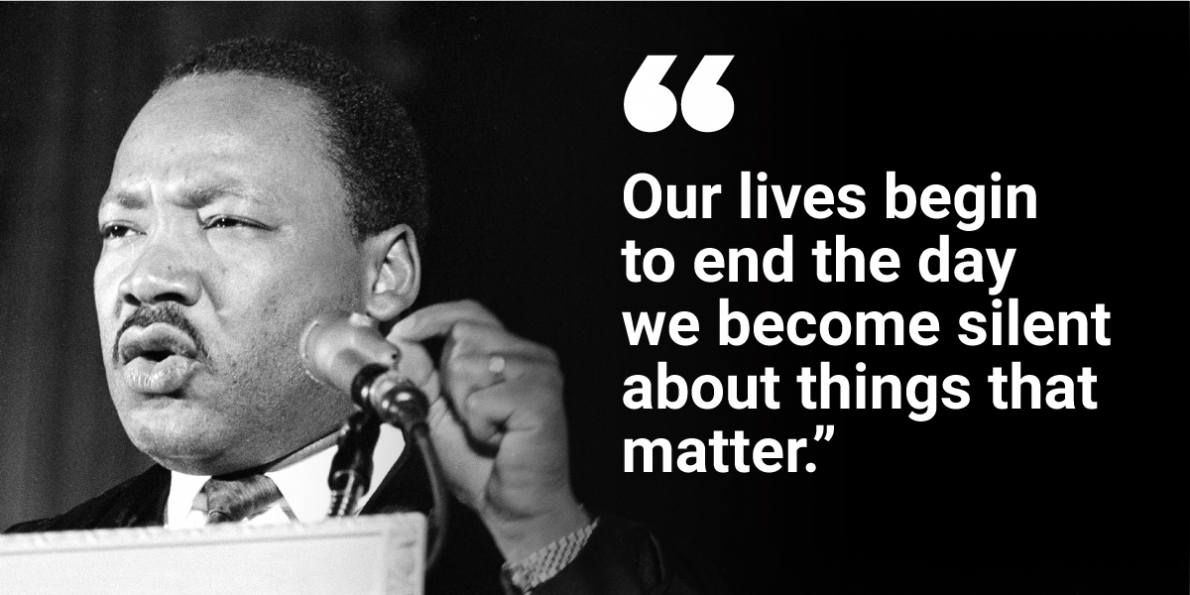
We should carefully reflect on Martin Luther King’s  message to the World. MLK understood the relationship between America’s war agenda and social justice and civil rights in America. “No one who has any concern for the integrity and life of America today can ignore the present war [Vietnam]”. One cannot be a civil rights leader without taking a stance against U.S. led wars. In the words of Martin Luther King: “Silence is Betrayal”. Today with war hawks in the White House and the U.S. State department, America is leading a military adventure which in the real sense of the word threatens the future of humanity. But this is not a talking point on network TV. Nor is it a concern of the “antiwar” movement. Meanwhile, the media is “killing the truth” either through distortion or omission. Today we commemorate the passing of Martin Luther King who was assassinated in a...
GarethPorter-e1540558470864
  By Gareth Porter Published on Apr 3, 2014     National Summit to Reassess the U.S.-Israel “Special Relationship” Presentation at the National Summit to Reassess the U.S.-Israel “Special Relationship” on March 7, 2014 at the National Press Club. Gareth Porter is an independent investigative journalist and historian who specializes in U.S. national security policy. He writes regularly for IPS and has also published investigative articles on Salon.com, the Nation, the American Prospect, Truthout and The Raw Story. His blogs have been published on Huffington Post, Firedoglake, Counterpunch and many other websites. Porter was Saigon bureau chief of Dispatch News Service International in 1971 and later reported on trips to Southeast Asia for The Guardian, Asian Wall Street Journal and Pacific News Service. He is the author of four books on the Vietnam War and the political system of Vietnam. His most recent book is Manufactured Crisis: The Untold Story...
Categories

Year

Author / Contributor

Region