Politics

Category

Year

Author / Contributor

Region

Sort by

Showing 1-10 of 136 stories

Qianlong-Emperor-and-Lord-Macartney
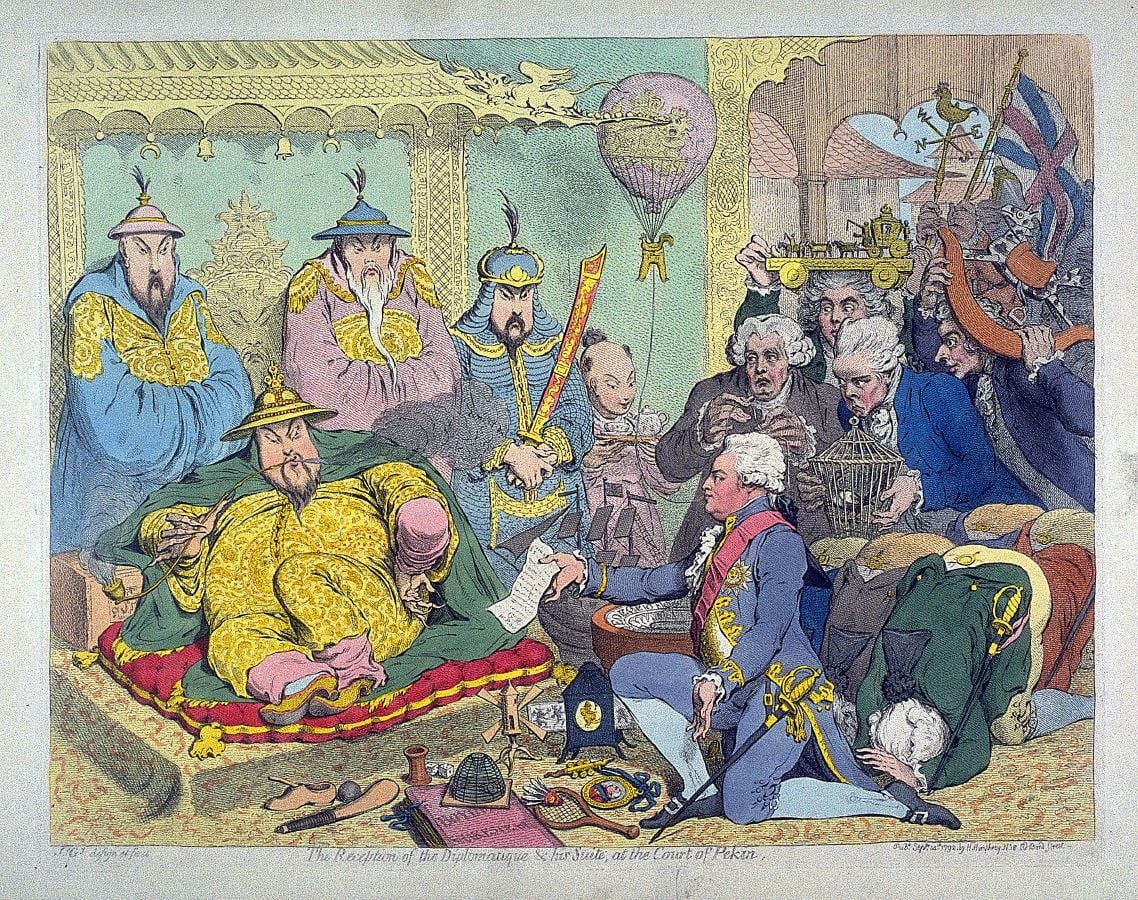
James Carter February 25, 2020 In popular understanding, the Qianlong Emperor’s rejection of Lord Macartney and King George III was an act of hubris, a failure to recognize the military might of Britain and the West, the last prideful act of a waning empire before a “century of humiliation.” But what if our understanding is all wrong? Originally posted on SupChina on September 9, 2020 “Our Celestial Empire possesses all things in prolific abundance and lacks no product within its borders. There was therefore no need to import the manufactures of outside barbarians in exchange for our own produce.” This was the Qianlong Emperor’s response, in part, to British Lord Macartney in September 1793. For a century, the British, like other seafaring Europeans, had been restricted by the “Canton System” that permitted commerce only at the port of Guangzhou (Canton), through official government monopolies, and during a certain season. Industrialists...
RichardFalk
Richard Falk February 3, 2021 This article is a repost from TFF’s homepage, January 20, 2015 By chance I was reading César Vallejo’s poem, “Black Stone on a White Stone,” in a translation by Geoffrey Brock, and was struck by the opening stanza: I’ll die in Paris in the pouring rain a day I have a memory of already. I’ll die in Paris – I won’t try to run – a Thursday perhaps, in Autumn, like today. Without being literal, I was reminded that I could appraise my death while alive, and not leave a final reckoning to some solemn memorial event in which speakers are challenged to find humorous anecdotes to lighten the occasion, otherwise uttering honorific platitudes quite unrelated to the experiential core of my being. I had been thinking quite a bit recently about ‘lost causes.’ Recently I gave a lecture at Columbia University on this theme,...
shutterstock_1158237289
Credit: amagnawa1092/Shutterstock Andrew J. Bacevich February 1, 2020 A new essay casts doubt on the China threat as promulgated by our nation’s ruling elite. Writing in the journal Palladium, Richard Hanania has produced the first must-read essay of 2021. A research fellow at Columbia University’s Saltzman Institute of War and Peace Studies, Hanania is part of an emerging generation of young scholars who reject the increasingly dubious verities of the Cold War and post-Cold War eras. Their arrival comes not a moment too soon. Originally published by The American Conservative on January 4, 2021 The title of Hanania’s piece is “China’s Real Threat is to America’s Ruling Ideology.” In this context, ideology refers not only to a belief system – liberal democratic capitalism, in our case – but also to a theory of history. Hanania’s real subject is delusion: Washington’s insistence despite abundant evidence to the contrary that the American way of life defines the...
Sergi-Delgado-artwork-865x577-1
Pankaj Mishra January 13, 2020 It’s time to abandon the intellectual narcissism of cold war Western liberalism. In Radical Hope: Ethics in the Face of Cultural Devastation (2006), Jonathan Lear writes of the intellectual trauma of the Crow Indians. Forced to move in the mid-nineteenth century from a nomadic to a settled existence, they catastrophically lost not only their immemorial world but also “the conceptual resources” to understand their past and present. The problem for a Crow Indian, Lear writes, wasn’t just that “my way of life has come to an end.” It was that “I no longer have the concepts with which to understand myself or the world…. I have no idea what is going on.” It is no exaggeration to say that many in the Anglo-American intelligentsia today resemble the Crow Indians, after being successively blindsided by far-right insurgencies, an uncontainable pandemic, and political revolts by disenfranchised minorities. For nearly three decades...
Orust
SummaryOn top of all the global problems we must solve as soon as possible comes the Corona. This statement argues that the priorities of the world are – well, perverse; everything the UN does amounts to 3% of the global military expenditures.TFF’s Board suggests that all countries reduce their military by 50% immediately. That would save about US$ 1000 billion. And that that huge sum should be re-allocated to solve the problems we had and the socio-economic consequences of the Corona pandemic. That would also – finally – be a step to prove that governments are willing to implement a policy for true disarmament and move towards human and common security for the common good.In a civilised world, this should be common sense. If you do not want to read the whole argument, just scroll down and sign this statement. “We’ve likely only seen the beginnings of the worldwide economic...
millions-of-new-poor
Photo credit: wsimag.com By Roberto Savio December 5, 2020 The recent meeting of the G20 – scheduled to take place in Riyadh but held virtually due to the Coronavirus pandemic – has been an eloquent example of how the world is drifting, in a crisis of leadership. It was, in a sense, a showcase. Everybody had to accept the view that the host of the meeting, the ailing King Salman of Saudi Arabia, was accompanied on TV screens by his apparent heir, Prince Mohamed bin Salman, who is clearly the mastermind of the brutal assassination, dismembering and disappearance of the body of dissident Saudi journalist Jamal Khashoggi. Originally published at the Wall Street International Mohamed bin Salman got away with it, also because of the support of Donald Trump who, in his video intervention said, among other pearls, that nobody in US history had done as much as he had...
trump
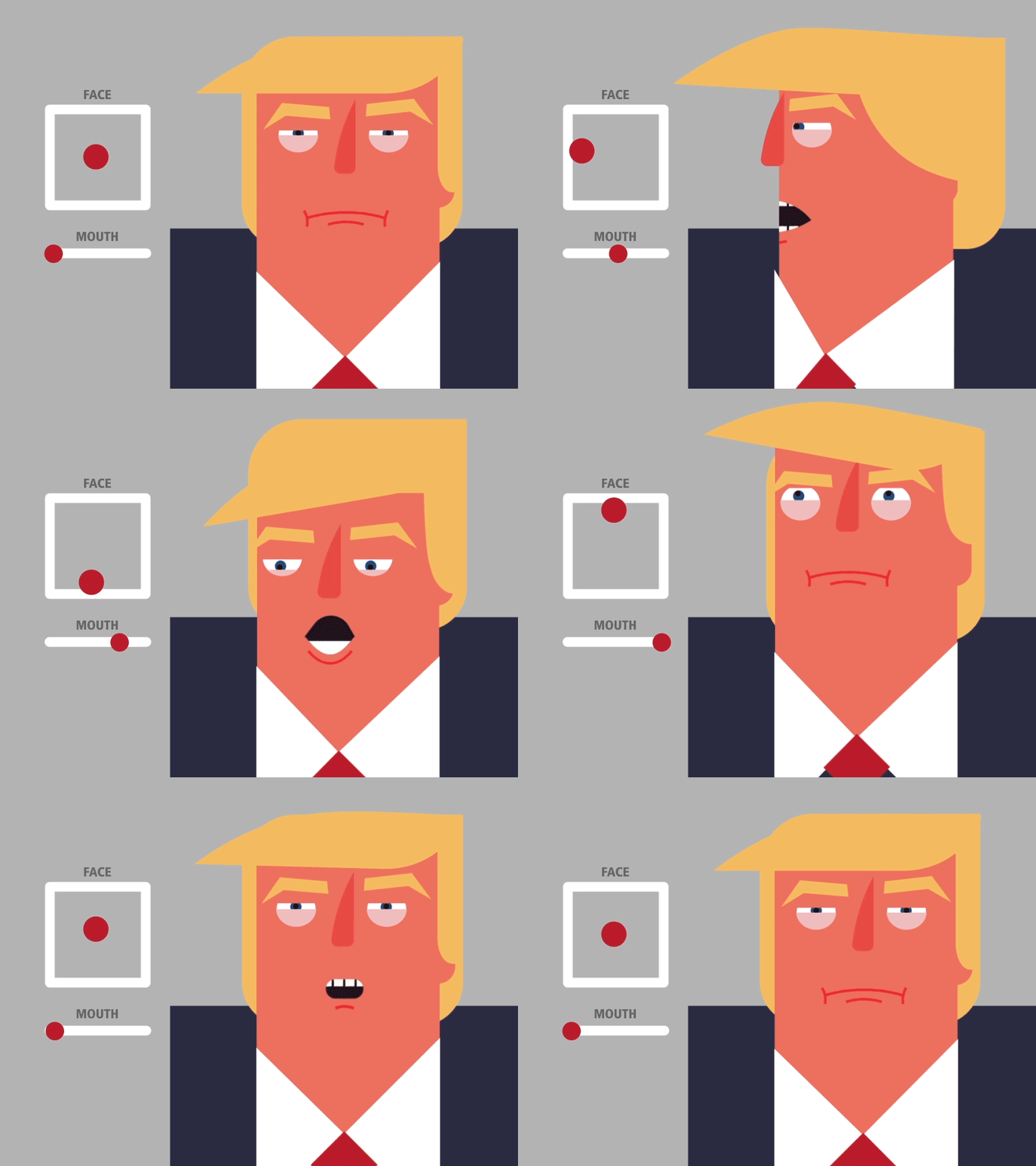
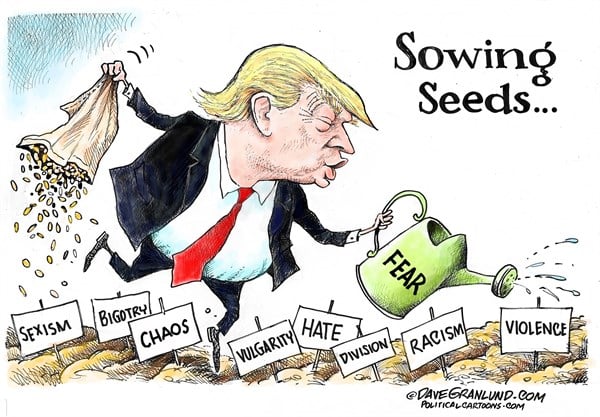
Picture design by Saulo Castro at Dribble Farhang Jahanpour TFF Associate November 20, 2020 – December 1, 2020 This is a four-part series by the author, published by the International Press Service, IPS. Below is Part 1 and this is where you find the next two:Part 2 • US Presidential Election: A Campaign of Insults and Lies – November 23, 2020Part 3 • US Presidential Election: President Trump’s Legacy of Mismanagement of the Pandemic – December 1, 2020Part 4 • The Legacy of Slavery and Racism – December 9, 2020 American democracy has survived a dangerous virus, and it has even come off the ventilator, but whether it will be restored to full health or will suffer for a long time (like a long Covid) from the negative effects of the virus of personality cult, chauvinism, populism, racism, militarism and, yes let’s say it, fascism, remains to be seen. So...

217691_600-1
Dr. Jennifer Mercieca December 02, 2020 Donald Trump’s December 7 Statement on Preventing Muslim Immigration has attracted worldwide disdain. Nearly 500,000 Britons have signed a petition asking their government to prevent Trump from entering their country. In the US, Trump’s comments have been denounced by Democrats, Republicans, the media and religious groups. Originally posted on The Conversation on December 11, 2015 Yet a recent poll has found that 37% of likely voters across the political spectrum agree with a “temporary ban” on Muslims entering the US. Trump possesses an arrogance and volatility that makes most voters recoil. So how has he maintained a grip on a segment of the Republican base that – at least, for now – seems unshakable? And how has his support persisted, despite the fact that some have called him a demagogue and a fascist, or that political observers have found parallels between him and polarizing figures like George Wallace, Joseph McCarthy, Father Coughlin – even Hitler? As a scholar of American...
bigstock-Woman-changing-reality-091013
Karel Van Wolferen November 17th, 2020 In a famous exchange between a high official at the court of George W. Bush and journalist Ron Susskind, the official – later acknowledged to have been Karl Rove – takes the journalist to task for working in “the reality-based community.” He defined that as believing “that solutions emerge from your judicious study of discernible reality.” Rove then asserted that this was no longer the way in which the world worked. “We’re an empire now, and when we act, we create our own reality. And while you’re studying that reality – judiciously, as you will – we’ll act again, creating other new realities, which you can study too, and that’s how things will sort out. We’re history’s actors . . . and you, all of you, will be left to just study what we do.” (Ron Suskind, NYTimes Magazine, Oct. 17, 2004). Originally posted on Karel...
osama-750_1439889739_725x725
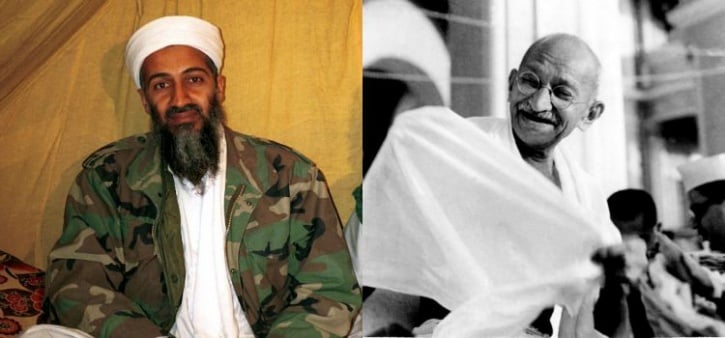
By Bhikhu Parekh November 5, 2020 If he were alive today, how might Mahatma Gandhi, the greatest apostle of non-violence, challenge Osama Bin Laden’s worldview? Bhikhu Parekh is Vice-President of The Gandhi Foundation, a professor of political philosophy, a Labour peer, and the author of three books on Gandhi. This article first appeared in Prospect Magazine in April 2004. Originally published at Gandhifoundation.org Bhikhu Parekh’s preface Like millions around the world, I found the atrocities of 9/11 abhorrent and utterly condemn such acts of terror. Despite the war against terror, we continue to see more horrors such as that in Madrid. What drives the bombers? How do they live with their deeds? Is there no alternative to the cycle of violence? No one is better qualified to advise on this than Mahatma Gandhi, the great apostle of non-violence. My imaginary exchange between him and Bin Laden tries to do two things: to comprehend...
US-VOTE-TRUMP
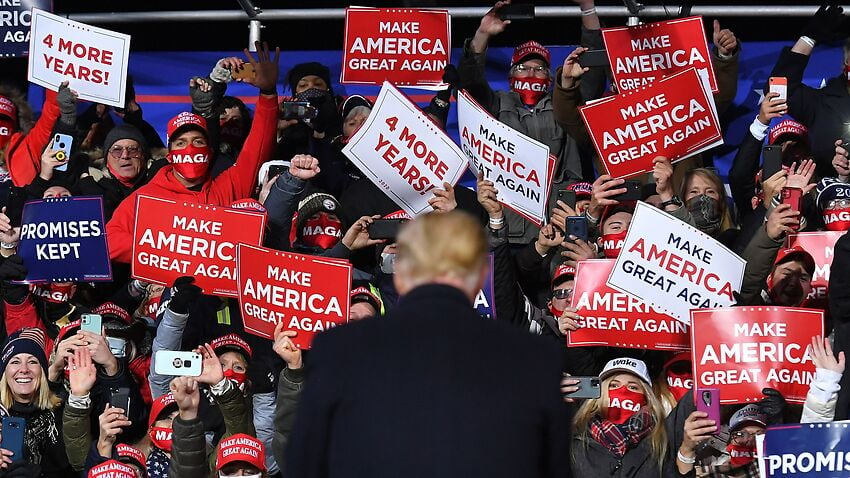
Photo credit: Donald Trump at a rally in Montoursville, Pennsylvania. Source: AFP/Getty Images/sbs.com The Frankfurt School on the appeal of authoritarianism – and how to counteract it. By Charles H. Clavey* November 5, 2020 A number of recent books have put the methods of the social sciences in the service of understanding Trump, his movement, and his enablers, from Russell Muirhead and Nancy Rosenblum’s A Lot of People Are Saying (2019) to Jennifer Mercieca’s Demagogue for President (2020). But it may be equally constructive to examine the older works of social science and theory upon which these new studies, at least implicitly, rest. On this list would be canonical sociological studies such as Max Weber’s Economy and Society (1922) and historical essays such as Richard Hofstadter’s “The Paranoid Style in American Politics” (1964) as well as the radically interdisciplinary projects undertaken by the researchers and theorists who comprised the Frankfurt School—Max Horkheimer, Theodor Adorno, and Herbert...
weyant
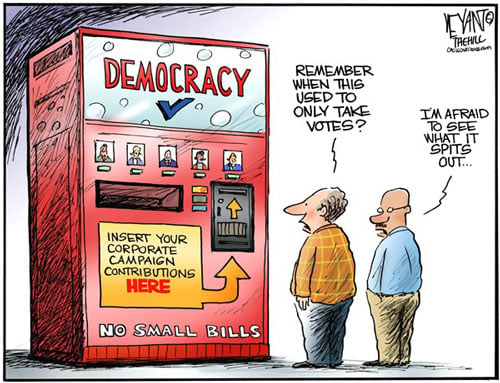
Peter Isackson November 10, 2020 The chaos of this year’s election may well be enough to dispel all remaining illusions about American democracy. A functioning democracy requires an educated, informed population that understands its role in the processes that define how the democratic nation is governed. Ordinary citizens have two opportunities for actively participating in those processes. They can run for office or help those who are running for office get elected. And they can vote. Most people settle for voting. Actually, in the best of years, only slightly more than the majority of eligible voters actually vote. American democracy has never fired on all its cylinders. Originally posted on Fair Observer on October 14, 2020. The failure of half of Americans to participate is surprising because America has sedulously made the effort to educate its future voters. From day one, every schoolchild in the United States learns not only...
Categories

Year

Author / Contributor

Region