Peace research

Category

Year

Author / Contributor

Region

Sort by

Showing 1-10 of 66 stories

We-suffer-through-todays-a-difficult-complicated-and-partially-obfuscated-time
This paper was written in 2015. Republished here on the occasion of Galtung’s 90th birthday, October 24, 2020. It was originally published at TMS, Transcend Media Service 1.  Definitions and Hypotheses: An Overview Definition: An empire is a transborder Center-Periphery system, in macro-space and in macro-time, with a culture legitimizing a structure of unequal exchange between center and periphery: Empires have different profiles. The US Empire has a complete configuration, articulated in a statement by a Pentagon planner: “The de facto role of the United States Armed Forces will be to keep the world safe for our economy and open to our cultural assault. To those ends, we will do a fair amount of killing”. (1) In other words, direct violence to protect structural violence legitimized by cultural violence. (2) The Center is the continental USA and the Periphery much of the world.  Like any system it has a life-cycle reminiscent of an organism, with...
420836_1_En_1_Fig7_HTML
Louis Kriesberg October 21, 2020 Louis Kriesberg This post also appears on the  Beyond Intractability website.  The blog is the Constructive Conflict Initiative / COVID-19 Blog and Lou’s essay is here.   We Americans are beset by many awful circumstances in our country and in the world. As analysts and sometimes as activists we examine such developments, analyzing why they are bad and how they have happened. So many bad things are occurring every day, it is hard to fight against any one of them, as new ones distract us. Below, I sketch out an approach to taking actions that have a good chance to be effective and satisfying in overcoming objectionable circumstances. First, we should select three or four matters that we believe should be bettered. We can each choose those matters that particularly concern us. The matters may or may not be connected and they will vary in...
1Stephen_Cohen_RT
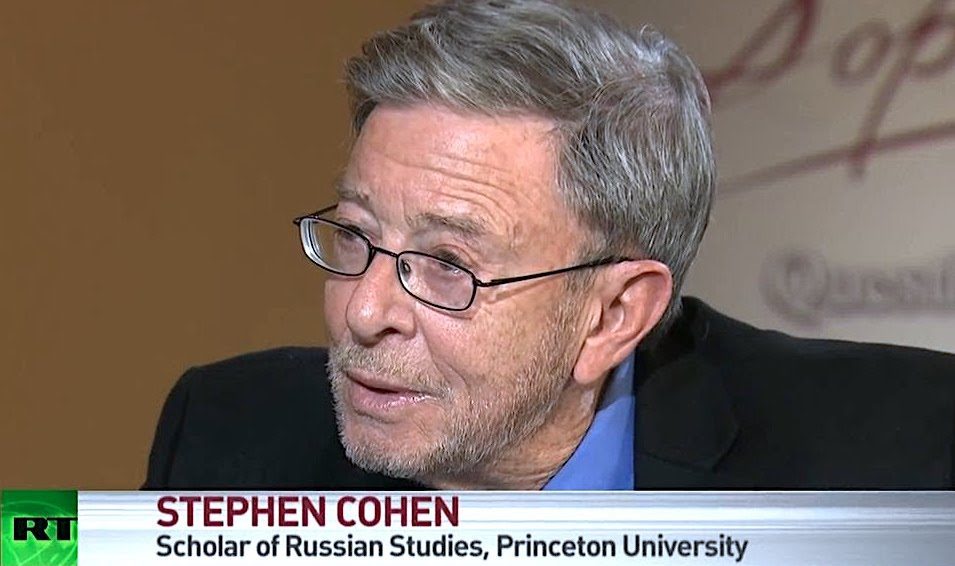
Collected Stephen Frand Cohen was an American scholar of Russian studies. His academic work concentrated on modern Russian history since the Bolshevik Revolution and Russia’s relationship with the United States. Cohen was a contributing editor to The Nation magazine, published and partially owned by his wife Katrina vanden Heuvel. Cohen was a founding director of the reestablished American Committee for East–West Accord which was revived in 2015. Wikipedia Born Stephen Frand Cohen, November 25, 1938, Indianapolis, Indiana, U.S.Died on September 18, 2020, New York City, U.S. Considering him one of the most important, knowledgeable and wise voices, TFF is proud to have printed some of his articles and interviews here at The Transnational. Here his many contributions to The Nation. Katrina vanden Heuvel – “My Steve” The New York Times obituary Bill Bradley, in The National InterestA man who knew Russia: A tribute to Stephen F. Cohen War with Russia?...
ObergComment_OnSite
In times of fake and omission – not to speak of deliberate deception and lies – society’s very foundation is shaken: What can we believe? Who can we trust? What is reliable and truthful information – and how do I know? Tragically, substantial knowledge with complex reasoning about our complex world and its problems has been overwhelmed by marketing, smart soundbites, tweets and ignorance. Diversity has been substituted by uniformity, political correctness and, more recently, the awfully destructive cancel culture and its close companion, self-censorship. People read less, and less and less the long argument – such as (good) books about global problems. Perhaps because we think we are so busy? Whatever the reason, the attention span has shrunk and many have a comfort zone the size of a pinhead. It bodes ill – no matter the kind of social body in which this disease takes root. It spread like...
mahatma-gandhi-1
Human nature, Gandhi said, “will only find itself when it fully realises that to be human it has to cease to be beastly or brutal”. (Illustration: C R Sasikumar) Charles P. Webel with Sofia Khaydari July 28, 2020 The UN’s peacekeeping mission is premised on the Declaration of Universal Human Rights, based on the assumptions that nonviolent means of conflict resolution are preferable to violence, and that all nations and trans-national organizations need to affirm and institutionalize global values. Unfortunately, despite the UN, humanity is far from being delivered from its bellicosity, and a “global ethics” in general, with nonviolence at its core, is far from realization. To understand the desirability but seeming fancifulness of a “Global Ethics” with nonviolence as one of its cardinal values, it is helpful to examine the theoretical and empirical foundations, as well as the possible shortcomings, of global values in general and nonviolence in...
internationallaw_ShenukaCorea
Illustration by Shenuka Corea By Richard Falk, TFF Associate March 12, 2020 Prefatory Note International law – as so much else of value – has fallen on hard times, violated and ignored, where applicable and needed. Although this is a deplorable state of affairs as the planet burns and vulnerable people suffer from ecological hazards and predatory geopolitics, it is the time to heighten struggle, and not sit home in despair. This essay in a slightly modified form was written at the request of Fikir Turu, an online source of commentary operating from Turkey, and published in Turkish. An English version was also published in Transcend Media Service, TMS, 17 February 2020. Published at Richard Falk’s personal blog  Respecting International Law: A Practical Argument International law disappoints in so many ways, making it easy to overlook why, despite its flaws, it remains valuable and indeed vital for human wellbeing. I put here...
soldiersnature
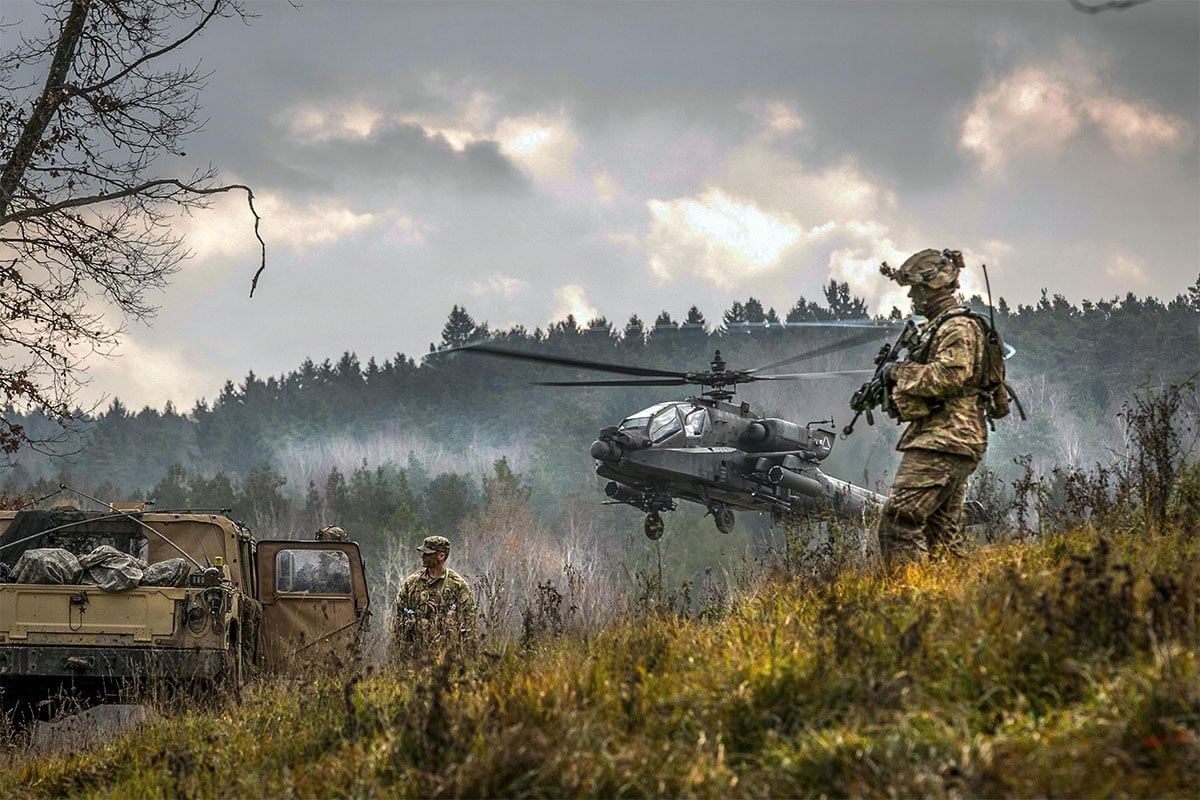
Today TFF launches “Bootprint – Militarism and Environment” – a curated, free-of-charge online magazine that brings you quality knowledge about the connections between the two most urgent problems that humanity faces. These two main clusters of problems which, if not solved, threaten to destroy humanity, our Earth and all future potentials are: Environment – with catchwords such as climate change, global warming, CO2 footprint, non-sustainability, pollution, resource depletion, species extinction, variety and diversity reduction, rain forest destruction, overconsumption, fossil fuels economy, limitless material growth, etc. etc. – and Militarism – with catchwords such as warfare, nuclear weapons, arms production and trade, militarization of land, air, space and oceans, tension creating, interventionism, base networks, terrorism, cyber and propaganda warfare, other weapons of mass destruction, special forces operations, intelligence agency crimes, imperialism, etc. The two clusters a fundamentally connected – militarism is enormously destructive of the environment; climate change and other processes...

1024px-Universitetshuset_i_lund
The main building of Lund University, situated next to the Lund Cathedral in the centre of town And why I lived happily ever after Albeit small, this is a piece of Nordic academic history that deserves to be shared. It’s an early example of the destruction of Nordic peace and conflict research and education that followed By Jan Oberg February 10, 2020 Last November 2019, it was 30 years since I left Lund University as associate professor and head of the Lund University Peace Research Institute, LUPRI, from 1983-1989. I did so, and have been a freelancer ever since because the Faculty of Social Sciences that year had decided to close down all inter or multi-disciplinary research and teaching, units and departments at the university – that is, peace and conflict research, women studies, human rights studies, environmental studies and human ecology studies. In my view, this was a disastrous...
IMG_9126
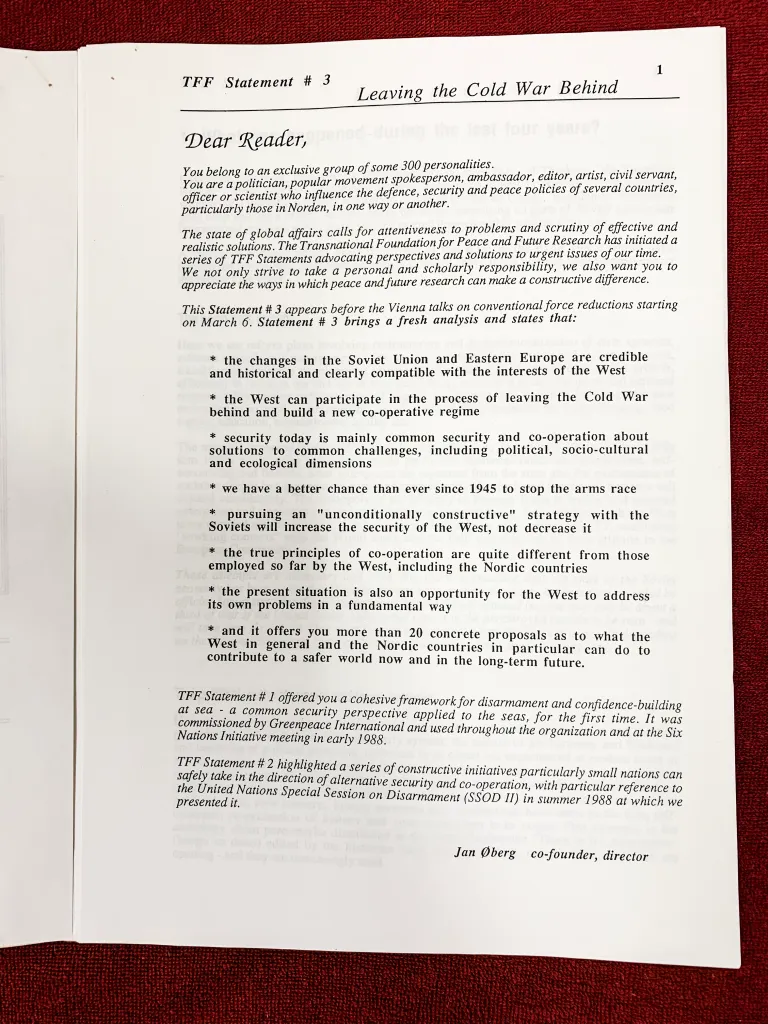
This is the digitalized version of a TFF Statement published by TFF’s Board almost 31 years ago. Could that be of any interest today? First, it reflects the situation and the issues discussed at the time as well as the hopes for a better future – now sadly lost. Secondly, it is one example of how peace researchers were thinking and made constructive political recommendations, available for anyone to take inspiration from – which virtually no one in power did. So, it’s a piece of international political as well as intellectual history. Third, it is an indicator of what the West could – and should – have done to have been in a much better situation than it is today. Admittedly, this is a contra-factual argument, but it can be defended on intellectual grounds although not empirically proven. Fourth, the authors pointed out a series of longterm priorities which match...
Peace-Sign-HD-Background-620x349
March 26, 2010, and July 3, 2019 Why Johan Galtung (born 1930) decided to devote his life to waging peace through research and action. Galtung who is one of the world’s most prolific and innovative social scientists – for instance, the author of more than 160 books and a global lecturer, mediator and professor – has been a TFF Associate since 1986 and has been published hundreds of times at TFF’s old and present site. He is also one of my two mentors in peace research – the other being Håkan Wiberg – says TFF director and co-founder, Jan Oberg.
kennedy_sotu1-P
By Dr. Lawrence Wittner June 5, 2019 In late April, the highly-respected Stockholm International Peace Research Institute reported that, in 2018, world military expenditures rose to a record $1.82 trillion. The biggest military spender by far was the United States, which increased its military budget by nearly 5 percent to $649 billion (36 percent of the global total). But most other nations also joined the race for bigger and better ways to destroy one another through war. Originally publishes on Counterpunch.org on May 29th, 2019 here This situation represents a double tragedy. First, in a world bristling with weapons of vast destructive power, it threatens the annihilation of the human race. Second, as vast resources are poured into war and preparations for it, a host of other problems―poverty, environmental catastrophe, access to education and healthcare, and more―fail to be adequately addressed. But these circumstances can be changed, as shown by...
1-19-Martin-Luther-King-ftr
– Martin Luther King Day Since The Transnational is also a public education site, we believe a handy, comprehensive guide to materials about Martin Luther King, Jr. should be found here: For his indisputable greatness as a human being, thinker and activist and for you to see just how far today’s United States of America is from its basic ideals, ideals that he stated so clearly and convincingly. Such ideals must never be allowed to die, neither be turned into lifeless traditions over time that are only paid lip service to at memorial occasions. Martin Luther King, Jr. has a series of messages for today’s world – and inspires anyone who wants to bring about change towards peace. We are particularly fascinated by his elaborations of the concept of The Beloved Community. And we’ve published two other guides earlier: Michel Chossudovsky, TFF Associate, Global Research Guide to Martin Luther King,...
Categories

Year

Author / Contributor

Region