Nuclear

Category

Year

Author / Contributor

Region

Sort by

Showing 1-10 of 379 stories

33b1c0ef5b802f0eb18a9f1bd16ce786
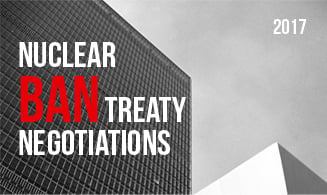
  By Manlio Dinucci • Not a single nuclear power has agreed to sign the new Treaty banning nuclear weapons. We all appreciate that unilateral disarmament would be a genuine concern for such states. However, Nato, which violates the NPT (the treaty aiming at containing the proliferation of nuclear arms) every day, has gone much further. Last week, it issued a declaration stating (para 7) that atomic bombs are a factor contributing to peace; and there is no way it would contemplate relinquishing these arms, if other states retained them. Furthermore, the wording of the final paragraph is a pre-emptive strike, aimed at destroying the potential of the new Treaty from slipping into the class of treaties that create norms for inter-state relations. On 20 September, the day after President Trump presents a scenario of nuclear war in the United Nations, threatening to “totally destroy North Korea”, the “Treaty on...
nego
  By ICAN • In a document from October 17, the United States warned other NATO members that efforts to negotiate a treaty prohibiting nuclear weapons or to delegitimise nuclear deterrence “are fundamentally at odds with NATO’s basic policies on deterrence”. In the letter, the US government strongly urges allies and partners to vote no to the resolution, and “not to merely abstain.” and continues to argue that “if negotiations do commence, we ask allies and partners to refrain from joining them.” Via icanw.org Despite claiming that a ban treaty without the nuclear armed states would be meaningless, the US letter outline what they believe would be clear military implications of a ban treaty and for NATO. The document shows that the United States believe a treaty prohibiting nuclear weapons, even without the participation of nuclear-armed states, would indeed have a significant impact. The document was circulated the week before governments...
DoomsdayMachine
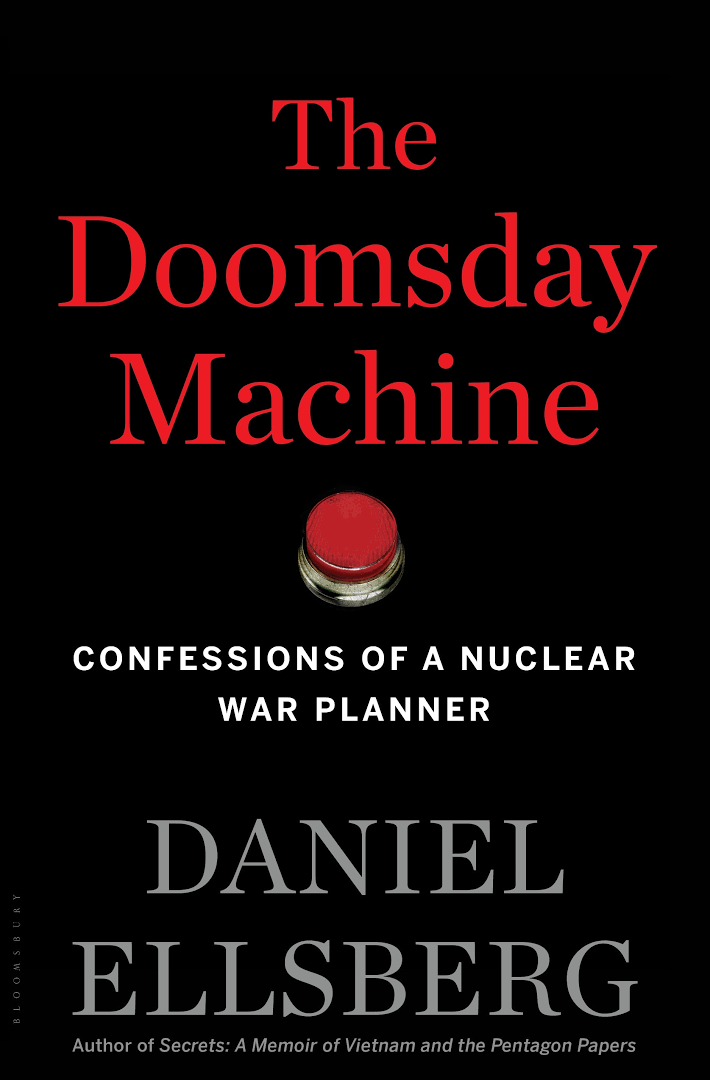
  By Daniel Ellsberg • From the legendary whistle-blower who revealed the Pentagon Papers, an eyewitness exposé of the dangers of America’s Top Secret, seventy-year-long nuclear policy that–chillingly–continues to this day. Here, for the first time, former high level defense analyst Daniel Ellsberg reveals his shocking first-hand account of America’s nuclear program in the 1960s. From the remotest air bases in the Pacific Command, where he discovered that the authority to initiate use of nuclear weapons was widely delegated, to the secret plans for general nuclear war under Eisenhower, which, if executed, would cause the near-extinction of humanity, Ellsberg shows that the legacy of this most dangerous arms buildup in the history of civilization–and its proposed renewal under the Trump administration–threatens our very survival. No other insider with high level access has written so candidly of the nuclear strategy of the late Eisenhower and early Kennedy years, and nothing has...
ObergPhoto2cmB-W-3
/11/tff-pressinfo-434-nuclear-weapons-use-within-months-part-1-why/”>Part 1 about the risks here Fact is that we are dealing here with a conflict that is the most threatening to humankind’s survival and it would be rather more easy to solve than most other conflicts. This has recently been pointed out by TFF Board Member and former Co-President of International Physicians for the Prevention of Nuclear War, IPPNW, 2004-2008, Gunnar Westberg, in a short analysis.
ObergPhoto2cmB-W-3
/11/pi-435-likely-nuclear-use-within-months-part-2-how-to-avoid-it/”>Part II here. That’s what I hold quite likely in case the present US administration under Donald Trump’s formal leadership continues down the path its in-fighting militarist fractions seem to have chosen. We’re in the worst, most dangerous situation since the Cuban Missile Crisis. Sitting down and hoping for the best is neither responsible nor viable or wise. I can only hope that I will be proved wrong. That the present extremely dangerous tension-building will die down by some kind of unforeseen events or attention being directed elsewhere. The world could quite well be drifting toward what Albert Einstein called ’unparalleled catastrophe’. It’s something we may – or may not – know more about when President Trump returns from his trip to Japan, South Korea, China, Vietnam (APEC where he also likely to meet Russian President Putin) and the Philippines. Except for 93-year old Jimmy Carter offering to go to...
GarethPorter-e1540558470864
By Gareth Porter U.S-Iran policy is closer to Israel than it has been in years. President Donald Trump’s new Iran policy clearly represents a dangerous rejection of diplomacy in favor of confrontation. But it’s more than that: It’s a major shift toward a much closer alignment of U.S. policy with that of the Israeli government of Prime Minister Benjamin Netanyahu. Whether explicitly or not, Trump’s vow to work with Congress to renegotiate the Iran nuclear agreement, and his explicit threat to withdraw from the deal if no renegotiation takes place, appear to be satisfying the hardline demands Netanyahu has made of Washington’s policy toward Tehran. Specifically, Netanyahu has continued to demand… Continue reading Porter’s article here.
ObergPhoto2cmB-W-3
October 19, 2017 Comments on EU leaders stating their support for the nuclear deal with Iran (JCPOA) and sending strong signals to Trump: But more is needed now. Oberg also asks: Where is the similar statement from NATO, the allegedly peace and security organisation when its leader, the U.S., is moving towards war with Iran?
RichardFalk20141
Professor emeritus of international law at Princeton University and University of California, Santa Barbara, board member of The Nuclear Age Peace Foundation and TFF Associate since 1985 Finally, the committee in Oslo that picks a winner of the Nobel Peace Prize each year selected in 2017 an awardee that is a true embodiment of the intended legacy of Alfred Nobel when he established the prize more than a century ago. It is also a long overdue acknowledgement of the extraordinary dedication of anti-nuclear activists around the planet who for decades have done all in their power to rid the world of this infernal weaponry before it inflicts catastrophe upon all living beings even more unspeakable that what befell the cities of Hiroshima and Nagasaki on two infamous days in August 1945. Such a prize result was actually anticipated days before the announcement by Fredrik Heffermehl, a crusading Norwegian critic of...
ObergPhoto2cmB-W-3
Prize to ICAN – the International Campaign to Abolish Nuclear Weapons. Undoubtedly nuclear disarmament and, ultimately, nuclear abolition is a major – if not the major – goal of humankind. There can be no lasting peace with these weapons and there exists no goal the achievement of which would legitimate the use of this type of weapons. Even when not used, nuclear weapons cause problems, distrust, risks and pretext for wars – think Russia-NATO, Iraq, the nuclear deal (JCPOA) with Iran, US-North Korea, Israel, India-Pakistan – and documented technical malfunctions, human failures, and accidents with nuclear weapons. Secondly, this year’s award honours the UN Charter, Article 1 of which states the essentially important norm that peace shall be brought about by peaceful means. It is also in clear support – as was emphasized by the Committee’s chairwoman, Berit Reiss-Andersen, herself a lawyer – of the NPT of 1970, the Non-Proliferation...

ChatGPT Image 9 jun 2026, 11_51_46
What Americans Really Think about Using Nuclear Weapons and Killing Noncombatants By Gunnar Westberg TFF Board member “Revisiting Hiroshima in Iran: What Americans Really Think about Using Nuclear Weapons and Killing Noncombatants” Scott D. Sagan and Benjamin A. Valentino International Security, August 2017 This is a summary and a few reflections upon reading a very comprehensive academic study recently published in International Security. See it’s full text here. The nuclear taboo is no longer strong In this extensive and scholarly report of 67 pages the authors report on several opinion polls they have conducted in order to learn about the attitudes of Americans to the use of nuclear weapons compared to conventional weapons. They also review the field extensively comparing with other studies. Shortly after the bombing of Hiroshima and Nagasaki the Americans strongly supported the use of nuclear weapons in that situation. The approval rate decreased to a large...
Categories

Year

Author / Contributor

Region