Military

Category

Year

Author / Contributor

Region

Sort by

Showing 1-10 of 287 stories

NotIranToo_FR_4_72dpi_ForNet
    By Farhang Jahanpour September 20, 2018   1. An ally in warfare and torture Although the tragic events in Syria are too close to us to pass a definitive judgement about what has happened there and we need some perspective before we can make any definitive statements, nevertheless, some of the outlines of what led to that catastrophe are already clear for all to see. When the United States invaded Kuwait in order to dislodge the Iraqi forces that had occupied that country, Syria was one of the countries that joined the US-led coalition. Shortly after the invasion of Iraq in 2003, Syria was one of the main destinations for rendered suspects to be tortured in Syrian black sites. In the chilling words of former CIA agent Robert Baer in 2004: “If you want a serious interrogation, you send a prisoner to Jordan. If you want them to be tortured,...
NotIranToo_FR_4_72dpi_ForNet
    By Farhang Jahanpour September 20, 2018   On 20 March 2018, the former French President Nicolas Sarkozy was taken into police custody in Paris to be questioned over allegations that he received millions of Euros in illegal funding from Qadhafi for his presidential campaign. Investigators were examining claims that Qadhafi’s regime secretly gave Sarkozy €50 million overall for the 2007 campaign. Such a sum would be more than double the legal campaign funding limit and also violates French rules against foreign financing of elections. (See: “Former French President Nicolas Sarkozy in police custody over investigation into Gaddafi funding”, The Independent, 20 March 2018. Sarkozy entertained Qadhafi lavishly at the Elyse Palace, even allowing him to pitch his tent in the grounds of the palace. Yet, later on, Sarkozy was the cheerleader for the attack on Libya, which resulted in the brutal murder of Qadhafi and the destruction of...
militarism_vs._diplomacy_in_the_us_fy2016_budget_bar_chart-1
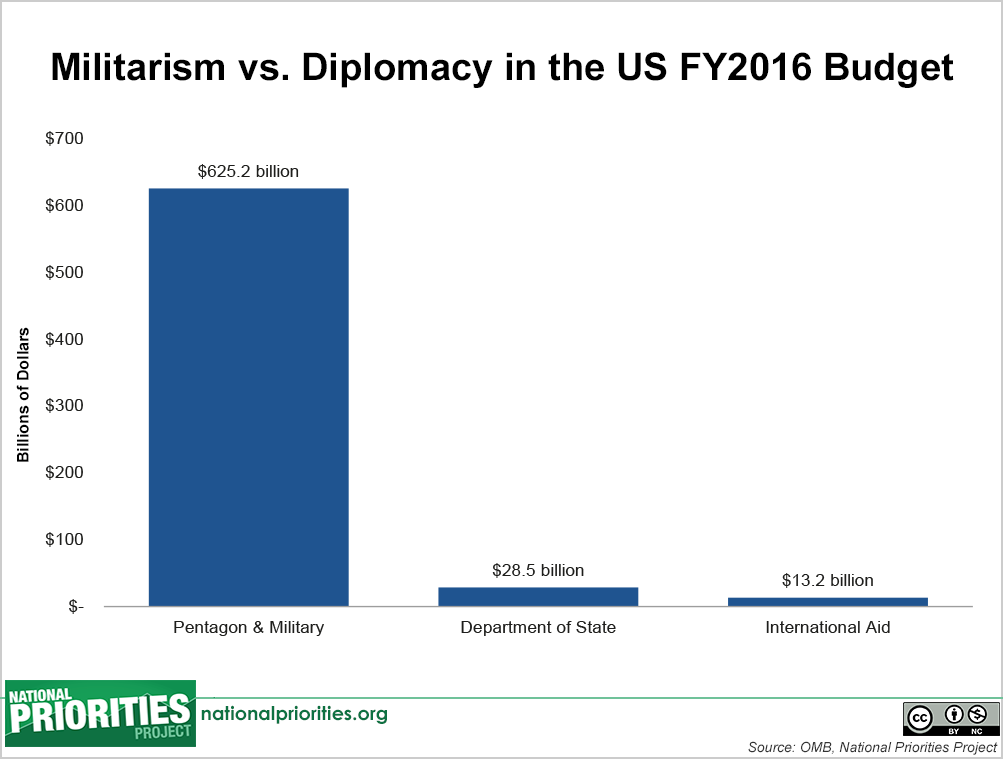
By David Swanson TFF Associate David Swanson delivers, in his usual crystal clear and well-documented manner, the arguments against higher U.S. military spending and illustrates how much better it would be for the U.S. itself and for the world to reduce the military expenditures and allocate even just a fraction of these incomprehensibly huge sums to constructive purposes. TFF is proud to inform you that David has been awarded the US Peace Memorial Foundation’s 2018 Peace Prize. Congratulations, David! So well deserved.
pence-montenegro-markovic-ap-img
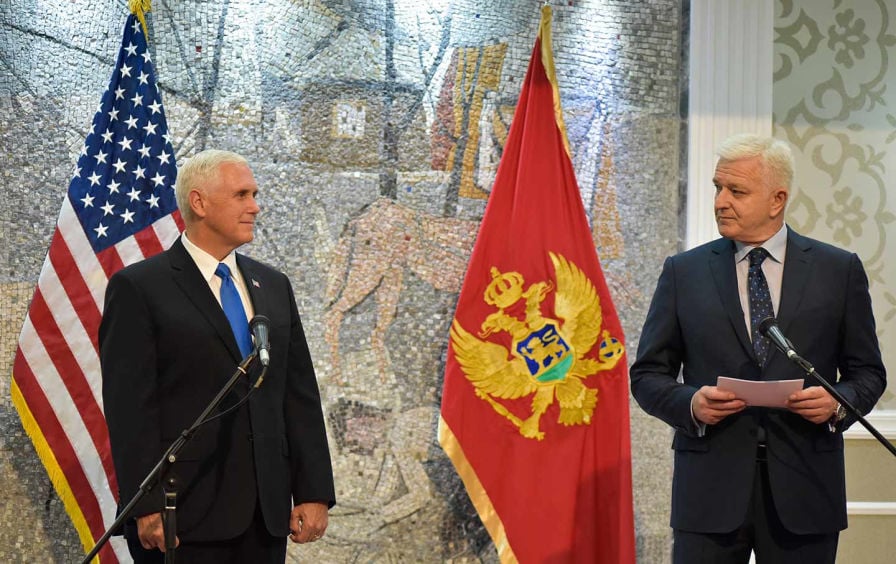
U.S Vice President Mike Pence, left, joined by Montenegro’s Prime Minister Dusko Markovic during a joint press conference in Villa Gorica in Podgorica, Montenegro on August 2, 2017. (AP Photo / Risto Bozovic)   Did Montenegro’s NATO accession increase the collective defense of the West or merely protect a corrupt regime? When Fox News host Tucker Carlson recently asked President Donald Trump why the United States should defend Montenegro, Trump responded by saying that if Montenegrins decided to “get aggressive.… Congratulations, you’re in World War III.” The subsequent outcry was predictable; a New York Times editorial quickly attacked Trump’s comments as revealing “another facet of his ignorance of and disdain for America’s historic place in the world and its alliances.” Yet Trump’s comments—inarticulately expressed as they were—were in fact in line with the thinking of past American presidents leery of getting the country involved in foreign problems with no bearing...
nato
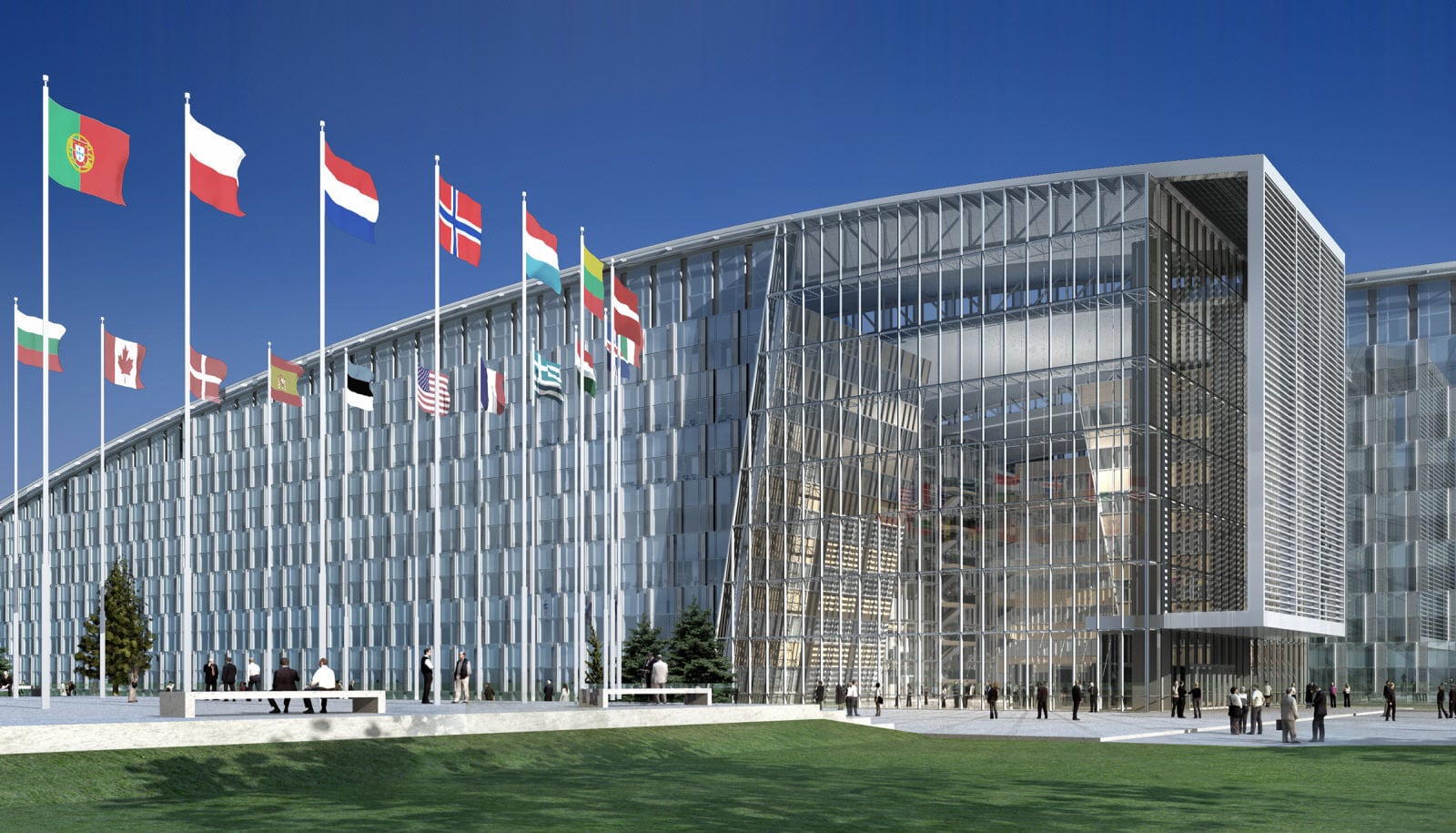
• On the occasion of the NATO Summit in Brussels and the Putin-Trump meeting in Helsinki This analysis comes in two parts – one critical and one constructive: This one on “NATO’s crisis and the Transatlantic conflict” and the second on “Make NATO civilian and civilised.” My apologies for writing a bit long, it isn’t comme il faut nowadays. But I happen to be a researcher who believes in knowledge, background and intellectual arguments in fields such as defence, security and peace – in other words, belonging to a race threatened by extinction in the era of fake and marketing. Indeed, so old fashioned am I that I don’t believe in world security matters being dealt with in Twitter- or spin doctor- style or in narratives and diplomacy conducted through advertisement videos. The follow-up second part of this analysis can be found here. • • When the Berlin Wall came...
b979527b-b22b-0047-0000-000000000000
  Danish media have just informed the gaping Danes that their country is entering no less than “two military alliances” this week. That’s how the Ritzau News Bureau describes it and since a decent basic journalist capacity to problematize security and defence issue – as well as the peace discourse – has vanished, or been abolished, years ago, this is how both the leading conservative daily Berlingske Tidende and the Danish Broadcasting Corporation, Danmarks Radio, describe it too. Such headlines should raise a few eyebrows. They don’t. The Danes have – also long ago – willingly accepted that their country is among the most interventionist and war-fighting in Europe. One reason is that the media have virtually no people left who could perform deeper research or ask critical questions, especially about US/NATO affairs, let alone provide a diversity of perspectives. Abroad few bother to know about H.C. Andersen’s idyllic little...
JO-Arb
  A short comment to a very good statement by Madam Mogherini about Syria. She is right – and one must wonder why virtually every big power anyhow does not invest in political, negotiated solutions but in weapons. And why the world is so woefully unbalanced in terms of war-making versus peace-making. The simple truth is that every and each conflict on earth gets more difficult to solve from the moment some type of violence is introduced into it. That is why the world should focus on reducing  military development, production and sales. If Syria had been cordoned off and no weapons had entered its space, it would have been much much easier to solve the underlying conflicts – which, by the way, have little to do with Darrah in spring 2011 but much more complex things. I find it relevant to here also mention how pervasively all Security Council...
StephenFCohen
Several factors make this US-Russian Cold War more dangerous than its predecessor – is “Russo-madness” one of them?   By Stephen F. Cohen April 4, 2018 Stephen F. Cohen, professor emeritus of Russian Studies and Politics at NYU and Princeton, and John Batchelor continue their (usually) weekly discussions of the new US-Russian Cold War. (Previous installments, now in their fourth year, are at TheNation.com.) Originally published by The Nation here   Cohen has previously explained why the new Cold War is potentially even more dangerous than was its 40-year predecessor, citing factors such as the political epicenter’s now being on Russia’s borders, lack of a mutual code of conduct, and the unprecedented demonization of the Kremlin leader. He had not much considered the role of Russophobia because he thought it had not been a large causal factor, unlike anti-Communism, in the preceding one, recalling an episode in his own family...
John-Scales-Avery
TFF Associate John Scales Avery presents his latest book on one of the most destructive institutions in modern societies and of our time. I would like to announce the publication of a new book entitled “The Devil’s Dynamo”. It is a collection of articles and book chapters that I have written about the way in which military-industrial complexes throughout the world drive and perpetuate the institution of war. A considerable amount of new material has also been added. The book can be freely downloaded and circulated from the Danish Peace Academy. Why call a book about military-industrial complexes “The Devil’s Dynamo”? A military-industrial complex involves a circular flow of money. The money flows like the electrical current in a dynamo, driving a diabolical machine. Money from immensely rich corporate oligarchs buys the votes of politicians and the propaganda of the mainstream media. Numbed by the propaganda, citizens allow the politicians...
PressTV
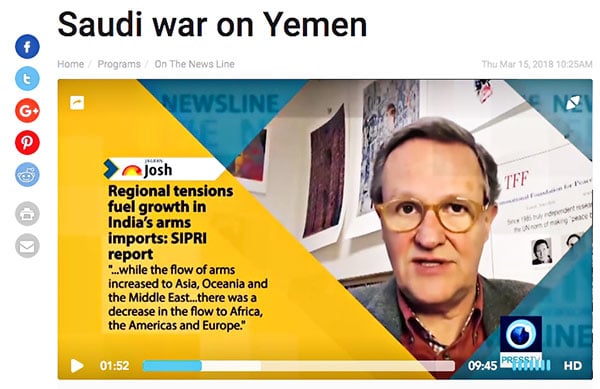
  Comment by Jan Oberg With a focus on the Saudi war on Yemen, this episode of PressTV’s News Line takes up the larger problem of the “weaponization” of conflicts that makes them almost impossible to solve. Syria would be another good example of this insanity. Jan Oberg has argued before that governments and private arms traders who transfer arms to places where there is war already ought to be perceived as war criminals. But today, most see only politicians and military commanders as such. See comment 5 here.  
figure_1_trends_1978_2018-01-03-01_9
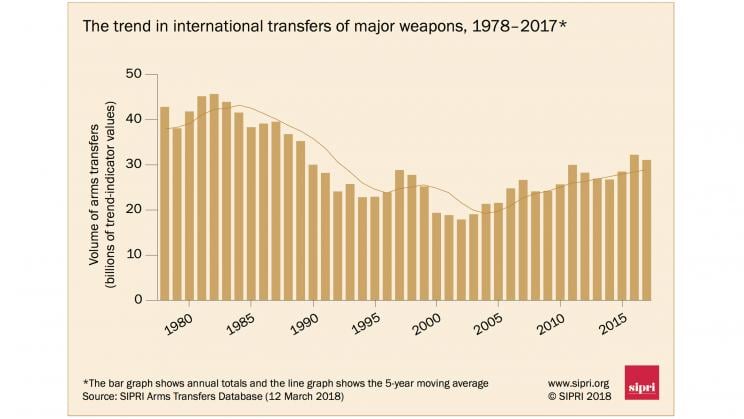
  Asia and the Middle East lead rising trend in arms imports, US exports grow significantly, says SIPRI March 12, 2018 Via sipri.org Continuing the upward trend that began in the early 2000s, the volume of international transfers of major weapons in 2013-17 was 10 per cent higher than in 2008-12, according to new data on arms transfers published today by the Stockholm International Peace Research Institute (SIPRI). The flow of arms increased to Asia and Oceania and the Middle East between 2008–12 and 2013–17, while there was a decrease in the flow to Africa, the Americas and Europe. The five biggest exporters – the United States, Russia, France, Germany and China – together accounted for 74 per cent of all arms exports in 2013–17. ‘The increased flow of arms raises concerns over their impact on international peace and security’, says Ambassador Jan Eliasson, Chair of the SIPRI Governing Board. ‘It stresses the...

1
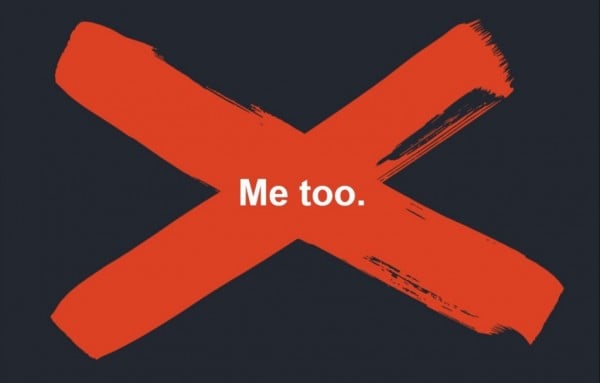
  About 1:50 into this video comment I suggest that we should think of elevating the idea of #MeToo to the international level and apply it when a country is abusing another country against its will – even to the extent that we can justifiably talk about rape and death. Apart from the obvious similarity – the lack of consent and the violence and humiliation it is expressive of – there is also the issue of proportions: People – i.e. entertainment celebrities in particular – engage very much (and rightly so) in the present #MeToo campaign – and many also in the issue of domestic gun violence (again, rightly so) but the same people hardly every have a critical word to say about their own government raping entire countries, violating international law, killing thousands of people, building bases and selling the arms that have only one result apart from profit:...
Categories

Year

Author / Contributor

Region