Middle East conflict formation

Category

Year

Author / Contributor

Region

Sort by

Showing 1-10 of 118 stories

GrahamFuller
By Graham Fuller • With the emergence of demonstrations and rioting in various Iranian cities earlier this month, Washington’s neoconservatives and interventionist/ imperial-minded “liberals” have been given a new lease on life in promoting their aspirations for “regime change” in Tehran. Indeed, of the three current potential global flashpoints—North Korea, Russian borderlands, and Iran in the Gulf—Iran arguably presents the most likely situation to actually turn into war. Originally published on LobeLog and Graham Fuller’s blog   The other two regions, Russia and Korea, pose such potentially appalling nuclear dangers that, rhetoric aside, one would hope will seriously deter national leadership from contemplating. War with Iran, on the other hand, presents no such nuclear threats. It is therefore perhaps the more dangerous situation since conflict with Iran is therefore quite “thinkable” and could potentially drag in Saudi Arabia, Qatar, Syria, Iraq, Russia, Turkey, and of course the supreme fomenter of...

RichardFalk
  By Richard Falk This post is a modified version of an article published in Middle East Eye on Jan. 1, 2018. It contends that the proper priority for genuine advocates of peace between Israelis and Palestinians should be centered around apartheid rather than be devoted to reviving an Oslo style ‘peace process’ (always a sham) or proclaiming the goal of an independent and sovereign Palestine as attainable without first dismantling the apartheid structures that subjugate the Palestinian people as a whole so as to maintain the Zionist insistence on Israel as the state of the Jewish people (rather than providing a homeland within a normal and legitimate state based on ethnic and religious equality, human rights, and secular principles.   Originally published on the “Global Justice in the 21st Century” blog   Despite all appearances to the contrary, those in the West who do not want to join the premature...
3333-14
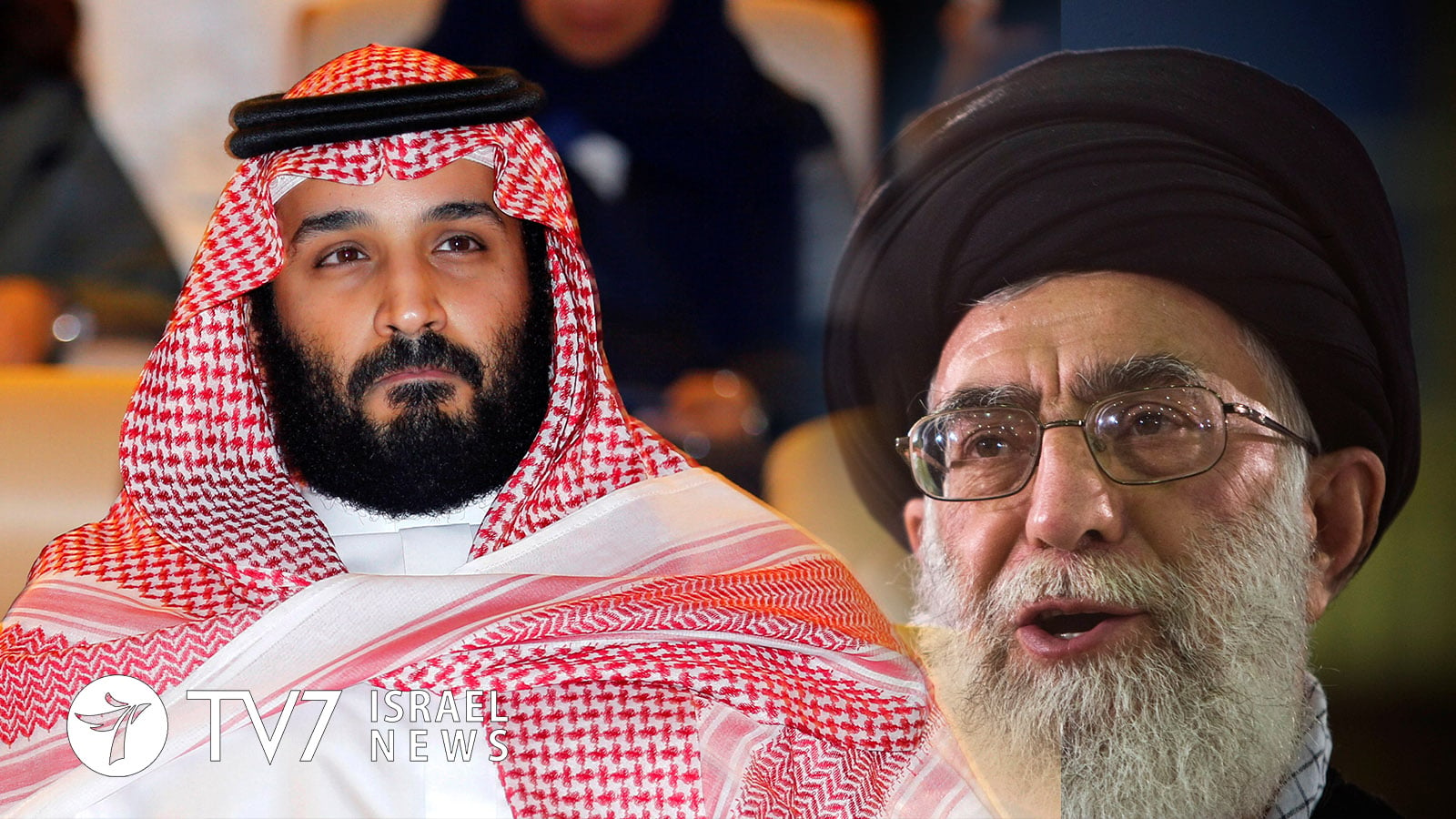
By Seyed Hossein Mousavian • Saudi Crown Prince Mohammad bin Salman (MBS) is steadily consolidating power in Riyadh and positioning himself to become the most powerful ruler in Saudi history. His rise has been accompanied with a ratcheting up of hostilities against Iran and even war rhetoric. As Saudi-Iran tensions increase, the lived experiences and leadership styles of the 78-year-old Iranian Supreme Leader Ayatollah Ali Khamenei and 32-year-old MBS will decide the future of peace and stability in the region. Via LobeLog Before Iran’s 1979 Islamic revolution, Ayatollah Khamenei was a political activist who opposed the dictatorship of the Shah and endured 15 years of prison, torture, and exile. He rose through the revolutionary ranks after the revolution and in 1981, was elected president. During the Iran-Iraq war (1980-1988)—which saw the United States and other global powers as well as regional Arab states support the aggressor Saddam Hussein—Ayatollah Khamenei played a key role in overseeing...
1
By Emile Nakhleh December 29, 2017 • President Trump’s new National Security Strategy and the negative reaction his announcement on Jerusalem has generated in the UN Security Council and General Assembly do not bode well for America’s relations with friendly Arab countries and the wider Islamic world. Arab peoples and media seem bewildered by the president’s recent decision to move the American embassy to Jerusalem, and baffled by the apparent lack of a coherent American policy toward the Arab world generally and the Israeli-Palestinian conflict specifically. Via LobeLog The inconsistency and discontinuity in the president’s varied positions and tweets on complex Middle Eastern issues do not present the region with a clear trajectory for Arab-American relations in the coming years. This risks leaving the region on a precarious path to nowhere. The view from the Middle East is that the lack of coherence in American policy toward critical war and...
2011521418580572_8
By Mark LeVine • Regime sponsorship of the arts could hurt artistic freedom of expression. Last month’s purchase of Leonardo da Vinci’s painting, Salvator Mundi, for $450m by an associate of Crown Prince Mohammad bin Salman (MBS) rocked the art world. It also called into question an already suspect anti-corruption drive launched by bin Salman in the weeks before the purchase. MBS’ earlier purchases of a $500 million yacht and a $300 million French chateau haven’t helped his cause either. Whatever bin Salman’s aesthetic proclivities, it’s not surprising that Saudi leaders are attempting to use art to signal a major change in the country’s culture and, less so, politics. In the past few months, Saudi authorities have permitted concerts and reopened cinemas, pledged to allow women to attend sporting events and even drive. Via aljazeera.com All this, along with the recent announcement of the creation of a new art institute under...
RichardFalk
By Richard Falk • Prefatory Note -This post addresses the need for dialogue with the political, economic, and cultural ‘other,’ that is, those multitudes acutely alienated from and angry with secular globalism and the Enlightenment legacy often equated with ‘modernity’ and ‘modernization.’ At the core is a search for closure on the nature of reality as well as feelings about equity (given many dimensions of inequality) and ethical innovation (revisionist approaches to gender, sexuality, marriage). Does reason or faith or tradition provide greater closure? Can the Thomistic grand synthesis of the 13th Century be repeated under 21st Century condition in the rough waters of controversy generated by Trump and Trumpism? Is this too Western a way of putting the problem? I write as an American, but there are many parallels in other countries. The first step is to admit being out of touch with the ferment below the surface. A...
davison-headshot
By Derek Davison and Jim Lobe At LobeLog, December 27, 2017 • The 20th century was rife with partitions, many of them involving European powers carving up colonial possessions in Africa and the Middle East with what often appears to have been little or no concern for local realities. Perhaps the most famous of these free-hand attempts at state creation is the Sykes-Picot Line, whose legacy is very much still with us (and not for the better). But Sykes-Picot is far from the only example of European colonial borders that are still causing problems decades after they were drawn. But who cares about all of that? It doesn’t seem to be an issue for at least some of America’s anti-Iran hawks. In response to Iran’s rising profile in the Middle East, fueled mostly by a war those neocons ardently championed and the striking ineptitude of the hawks’ new favorite Persian Gulf...
ChatGPT Image 9 jun 2026, 11_11_33
  By Jonathan Power • Poets as diverse as William Blake and Yehuda Amichai have sung the praises of the heavenly Jerusalem, a land without strife or rancour, war or bitterness, envy, acquisitiveness or hatred. Until last week and President Donald Trump’s decision to recognize Jerusalem as Israel’s de facto capital, Israel, Fatah, Hamas and their common interlocutor, the US, had the historic opportunity to take a giant step towards making the present day Jerusalem acquire, at least in some of its aspects, the earthly prototype of the heavenly Jerusalem. Some of us have long hoped to see whether the work over decades of many imams, rabbis, ministers and priests could bear fruit. The secular politicians may be the ones doing the negotiations and ordering the compromises but it is the teachers of the three great deistic religions who have been charged from above to exert their mandate to teach...
cover-banners-6-e1512921954788
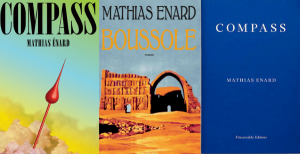
Via theculturetrip.com • If there ever were any doubts about the standing of Mathias Énard, the reception garnered by his latest novel Compass ought to disperse them. After the book won him the Prix Goncourt in 2015, its English translation—out last month—was shortlisted for this year’s Man Booker International Prize (and garnered glowing reviews in the American press), a distinction outdone days later by the Italian Bussola, which was awarded the von Rezzori prize at the Festival degli Scrittori in Florence. Surely it isn’t premature anymore, or in poor taste, to write what many have for years been thinking: that once again a whole new generation of French writers have their virtuosic frontman? In Compass, Énard’s long-winded, meticulous artful prose takes the reader on a grand historical tour of the cultural exchanges between Europe and the Middle East. We spend a sleepless night with the thoughts of Austrian musicologist Franz Ritter, recently diagnosed with a terminal illness. The narrative follows his memories of travels and studies around the...
ObergPhoto2cmB-W-3
Fifteen months ago TFF predicted, grosso modo, what has now become clear in the Middle East namely a rather new power constellation. It centers around Saudi Arabia – the world’s third largest military power and main supporter of global terrorism – and its allies of Gulf States, Israel and various terrorist organisations including ISIS. See “A Sunni-Salafist-Zionist Coalition Changing Middle East?” The main characteristics that holds this coalition or alliance together is hatred of Syria’s and Iran’s governments. The alliance is – albeit with nuances – supported by the US, England, France and Turkey and others, e.g. Denmark. Flashback We’ve described the liberation of Aleppo as a fundamental turning point after exactly 4 years of anti-intellectual, immoral and illegal Western policies. It started on December 12, 2012 in Marrakech with the so-called “Friends of Syria” declaring that the elected president of Syria (with over 80% in internationally monitored elections) was no longer the country’s leader. Secondly, that...
Categories

Year

Author / Contributor

Region