Economics

Category

Year

Author / Contributor

Region

Sort by

Showing 1-10 of 97 stories

Picture1
The Future of Human Rights: Regressive Trends and Restorative Prospects Points of Departure Reviewing the global situation, the then UN High Commissioner for Human Rights, Zaed Raad Al Hussein of Jordan, opened a 2018 conference devoted to the 25th anniversary of the 1993 UN Conference on Human Rights and Development held in Vienna, on a decidedly pessimistic note. Instead of doing the usual on such occasions, that is, celebrating the progress made since the earlier event, Prince Zaed emphasized the disturbing evidence of regression with respect to a broad range of issues bearing on the protection of human rights embedded in international treaty instruments as evidenced by the practice of states. He insisted that without fundamental changes in patterns of governance by sovereign states and in the operation of the world economy it would be naïve to expect an improved international atmosphere for human rights. Originally posted on Richard Falk’s blog...
ShanghaiPanoPeople_Warped_Canvas_1000_100dpi
Asia specialist and distinguished columnist David P Goldman is convinced the US and Europe stand a chance against the Red Dragon – but the clock is ticking He was a phantom amongjournalists, using the mysterious nom de plume, “Spengler.” Like his German philosopher namesake, the cultural critic returned again and again to his despairing theories of the decline of the West. The work of “Spengler” drew from a deep and rich intellectual pool.And since the herald has revealed his true identity, we learn why. David P Goldman – philosopher, economist, mathematician and musicologist – is a Renaissance man. A former investment banker for the Bank of Americaand Credit Suisse, the American is known for his widely read column for Forbes magazine and Asia Times. Dutch writer Leon de Winter crowns Goldman’s work as “among the most interesting in the world.” This article was originally published by Switzerland’s Weltwoche We meet at the noble Princeton...
sustainable-development-and-the-earth-charter-23-728
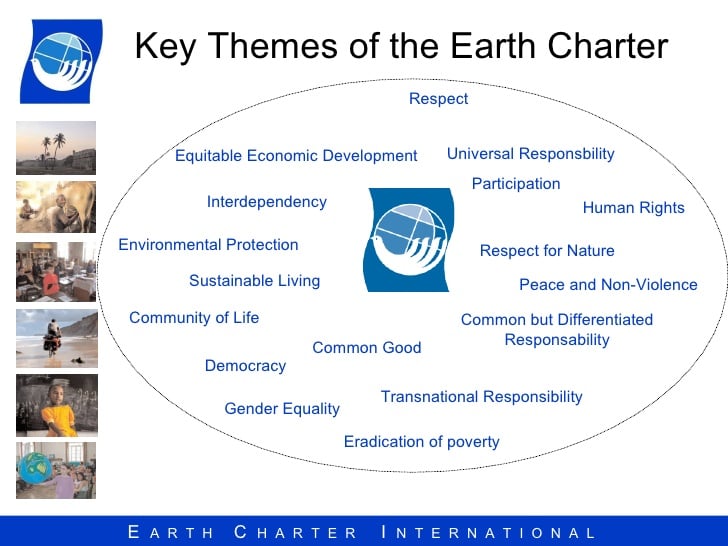
Prefatory Note: The following essay will appear as a chapter in Peter Burden & Klaus Bosselmann, eds., The Future of Global Ethics (Edward Elgar, 2018),  with the title: Revisiting the Earth Charter 20 Years Later: A Response to Ron Engel Ron Engel has articulated an insider review of the Earth Charter so thoughtfully, urbanely, and persuasively that my initial temptation was to restrict my response to a single word: ‘Amen!’ Yet I am familiar enough with the academic ways of gathering diverse voices to explore a topic or to evaluate the scholarship of a distinguished author, as to discard my one-word option. At the same time, it would be misleading if I didn’t praise Ron Engel for putting so many elusive issues before us in such a lucid and compelling manner as to make my efforts at dialogue feel a bit forced, given the high level of agreement. Originally posted on...
xjp-iranrowhani-705x437
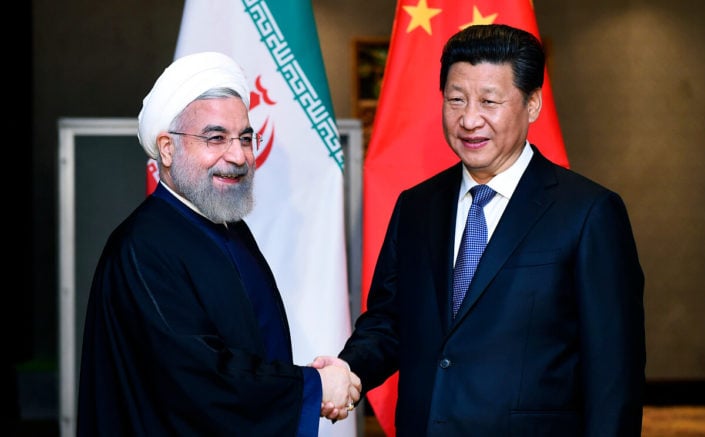
By Sabena Siddiqui September 20, 2019 Facing an economic crisis in large part due to US sanctions, Iran soon may be aligning its policies toward China’s. Having recently updated the terms of a 25-year strategic partnership signed with Beijing in 2016, it looks like Tehran is indeed returning to its Look East foreign policy. Originally posted on Al-Monitor’s website September 17, 2019 here Considered an important player in Chinese President Xi Jinping’s Belt and Road Initiative (BRI) megaproject, introduced in 2013, Iran has been pursued by Beijing for its energy resources and strategic location. But when economic sanctions on Iran were lifted under the Joint Comprehensive Plan of Action (JCPOA) nuclear deal in 2015, Iran preferred to do business on a global basis. Instead of committing to an eastward-looking foreign policy at that time, Tehran tried to maintain a balance. However, since the United States withdrew from the nuclear deal in May 2018, Europe...
RichardFalk
The World Order Backdrop Arguably, even before the atom bomb was dropped on Hiroshima, there was a widespread sense that a state-centric form of world order was morally and functionally deficient in certain fundamental respects. Political actors were indifferent to the outbreaks of war, disease, and famine outside of their sovereign territory absent serious extraterritorial reverberations. At the same time lesser states were vulnerable to the manipulations and territorial/imperial ambitions of leading states that generated colonialism, interventions, and sustained an exploitative Europeanization of world order. Originally posted on Richard Falk’s blog Citizen Pilgrimage on September 5, 2019, here World War I with massive casualties, closely followed by the Russian Revolution, which posed a normative challenge to the capitalist/market– driven organization of national societies, led to some groping toward a new global order taking the institutional form of the League of Nations. It became soon obvious that the League, a project...
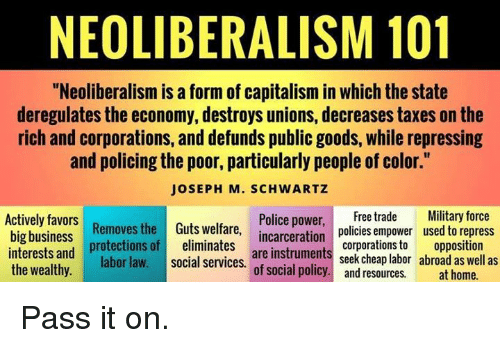
neoliberalism-101-neoliberalism-is-a-form-of-capitalism-in-which-26584797
By Ellen Brown September 1, 2019 When the Federal Reserve cut interest rates on July 31st for the first time in more than a decade, commentators were asking why. According to official data, the economy was rebounding, unemployment was below 4%, and GDP growth was above 3%. If anything, by the Fed’s own reasoning, it should have been raising rates. Originally posted Ellen Brown’s official website on August 9, 2019 here The explanation of market pundits was that we’re in a trade war and a currency war. Other central banks were cutting their rates and the Fed had to follow suit, in order to prevent the dollar from becoming overvalued relative to other currencies. The theory is that a cheaper dollar will make American products more attractive on foreign markets, helping our manufacturing and labor bases. Over the weekend, President Trump followed the rate cuts by threatening to impose a new 10% tariff on $300...
economics
I would like to announce the publication of a book describing the lives of some of the people who have contributed importantly to economic thought. Their lives can help us today, as the world faces a crisis that has profound economic dimensions. Here is the table of content of this large book: The book can be freely downloaded as PDF here. The climate crisis Appendix A outlines the present climate emergency, made vivid by the October 2018 report of the Intergovernmental Panel on Climate Change. In the words of 16-year-old Swedish climate activist Greta Thunberg, “According to the IPCC, we are less than 12 years away from not being able to undo our mistakes. In that time, unprecedented changes in all aspects of society need to have taken place, including a reduction of our CO2 emissions by at least 50%…” Although the worst consequences of out-of-control catastrophic climate change lie...
Imagen-thumbnail-The-Transnational
Immediate action is needed to save the future The central problem which the world faces in its attempts to avoid catastrophic climate change is a contrast of time scales. In order to save human civilization and the biosphere from the most disastrous effects of climate change, we need to act immediately. But it is difficult to mobilize public opinion behind urgently needed action because the most severe effects of global warming belong to the long-term future. However, the Intergovernmental Panel on Climate Change, in their October 2018 report, used strong enough language to wake up at least part of the public: the children whose future is at stake. Here is an excerpt from a speech which 16-year-old Swedish climate activist Greta Thunberg made at the Davos Economic Forum in January 2019: “Our house is on fire. I am here to say our house is on fire. According to the IPCC...
JeffSachs
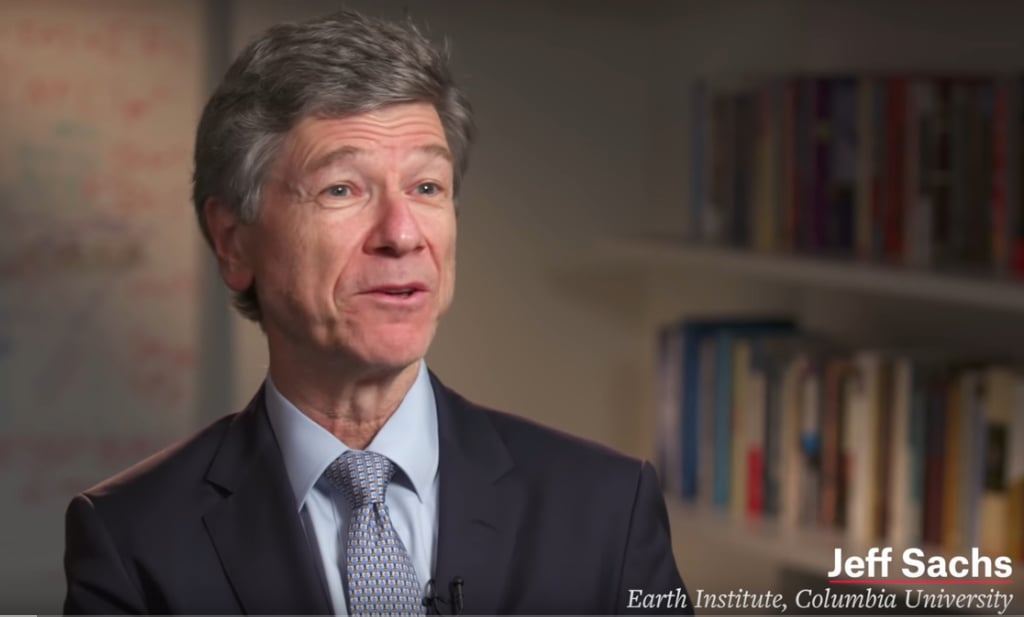
January 19, 2019 “The naive and dangerous idea that the U.S. is exceptional has made us a danger to ourselves.” Jeffrey Sachs sits down with Rob Johnson to discuss his new book, A New Foreign Policy: Beyond American Exceptionalism, Columbia University Press, 2018.
China-US
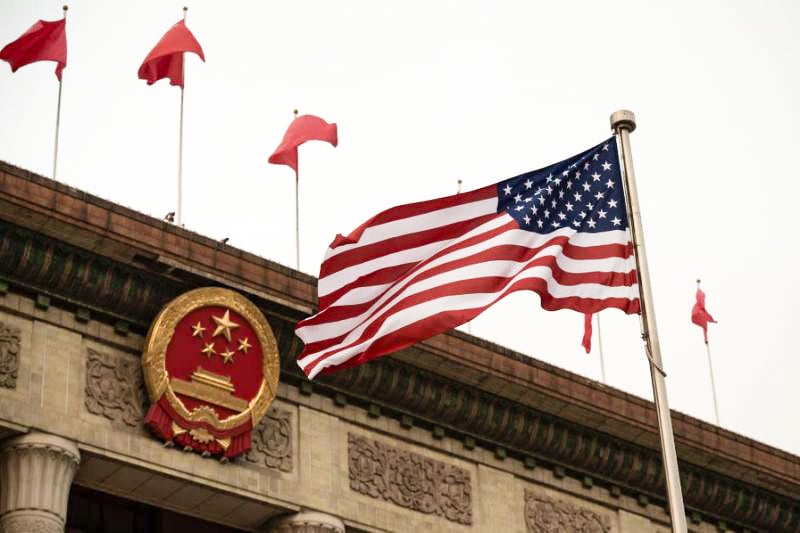
  Thwarting the anti-dollar coalition should be Washington’s top national priority   By Gal Luft August 30, 2018   The United States is currently waging economic warfare against one tenth of the world’s countries with cumulative population of nearly 2 billion people and combined gross domestic product (GDP) of more than $15 trillion. These include Russia, Iran, Venezuela, Cuba, Sudan, Zimbabwe, Myanmar, the Democratic Republic of Congo, North Korea and others on which Washington has imposed sanctions over the years, but also countries like China, Pakistan and Turkey which are not under full sanctions but rather targets of other punitive economic measures. In addition, thousands of individuals from scores of countries are included in the Treasury Department’s list of Specially Designated Nationals who are effectively blocked from the U.S.-dominated global financial system. Many of those designated are either part of or closely linked to their countries’ leadership. Published by Yahoo...
Russia-Saudi-meet-630x378
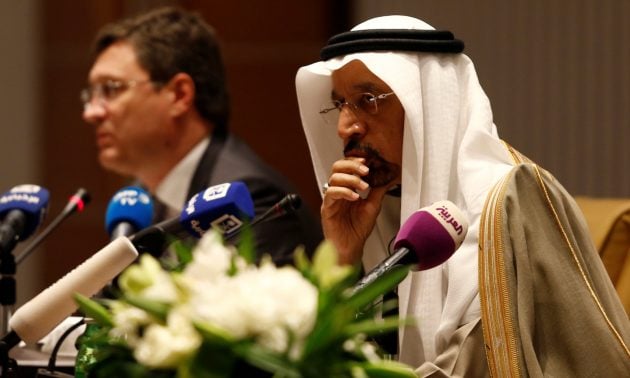
Hardly 10 months after honoring the visiting US president, the Saudis are open to a Russian-Chinese consortium investing in the upcoming Aramco IPO*   By M. K. Bhadrakumar February 16, 2018 In the slideshow that is Middle Eastern politics, the series of still images seldom add up to make an enduring narrative. And the probability is high that when an indelible image appears, it might go unnoticed – such as Russia and Saudi Arabia wrapping up huge energy deals on Wednesday underscoring a new narrative in regional and international security. Originally published by Asia Times here The ebb and flow of events in Syria – Turkey’s campaign in Afrin and its threat to administer an “Ottoman slap” to the United States, and the shooting down of an Israeli F-16 jet – hogged the attention. But something of far greater importance was unfolding in Riyadh, as Saudi and Russian officials met...
1-1
Most bankers, economists and investors after a couple of drinks, will admit that money is not wealth. Money is a metric, like inches and centimeters, for tracking real wealth: human ingenuity and technological productivity interacting with natural resources and biodiversity undergirding all human societies along with the daily free photons from our Sun, as described in “Valuing Today’s Circular Services Information Economies”. So brainwashed are we by the false money meme of “money as wealth” that whenever anyone proposes needed infrastructure maintenance, better schools and healthcare or any public goods, we are intimidated by some defunct economist who says “Where’s the money coming from?” They ought to know better, since, of course money is not scarce, it’s just information as I pointed out in 2001 at the annual meeting of the Inter-American Development Bank in an invited talk “Information, The World’s Real Currency, Is Not Scarce “(see World Affairs, April-June, Vol. 5, 2001, Delhi,...

Categories

Year

Author / Contributor

Region