
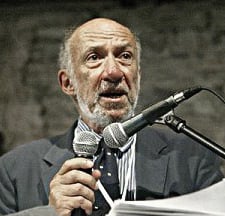
Poetry at its finest stretches the expressiveness of language beyond its prior limits, not necessarily by its choice of words, but through the magical invocation of feelings embedded deeply within consciousness. Yes even poetry has its own frontiers that if crossed lead to a word-less terrain littered with corpses of atrocity, what Thomas Merton and James Douglass have soulfully identified for us as the realm of ‘the unspeakable,’ and then are brave enough to explore forbidden terrain.

When we do not respect the unspeakable by our silence we domesticate the criminality of the horror that human beings are capable of inflicting on one another, and give way to the eventual emergence of normalcy as has happened with nuclear weapons detached from the happenings of Hiroshima and Nagasaki.

I came across an utterance by one of my heroes, the Jesuit priest/poet, Daniel Berrigan, while on trial for pouring blood on draft cards during the Vietnam War: “I was in danger of verbalizing my moral impulses out of existence.” These words appear at the start of a haunting poem by another one of my heroes, the recently dead poet, Adrienne Rich; the poem’s title is “The Burning of Paper Instead of Children” and I recommend it not only as a stunning poetic achievement but also as a text for meditation.

Such thoughts seem far from the recent controversies on this blog about the competing justice and victimization claims of Israelis and Palestinians, and the sort of language that seems historically validated for some to discuss such matters of life and death, while being hateful to others.

It made me appreciate anew that there are some rivers of divergence that are too wide to cross, and that the attempt, first generates anger and frustration, but eventually brings despair, even sadness.

Of course, the blogosphere is a new kind of undefended public space that can be entered by anyone with good will or ill. To appoint myself as a kind of censor, given the capacity to exclude or include comments, was neither congenial nor tenable as a role, and I have decided to give it up except in relation to hate speech or defamatory material, although even here I acknowledge that some degree of subjectivity will always be present, at least unconsciously.

I am of course aware that the Israel/Palestine conflict is almost impossible to approach in a spirit of moderation, and I realize that many of the hostile comments are directed at my particular understanding and way of presenting the issues. Indeed, my posts have been scrutinized by pro-Israeli zealots so as to find some turn of language or alleged opinion that can be used to discredit me in other settings, especially in relation to my role as Special Rapporteur for Occupied Palestine on behalf of the UN Human Rights Council.

Unlike comments that can be excluded, the posts are in the public domain, source material for those who seek to mount a personal attack, and there are no rules of the game to ensure that allegations are at least fair and reasonable. I have tried my best not to be intimidated or hurt by such concerted efforts to harm my reputation and destroy my self-esteem, but have not always succeeded.

As the person who dares to continue to write a blog under such circumstances, I have tried to devise for myself a code of responsible behavior for my own benefit, and to establish an atmosphere of trust and respect. I have selected two main principles as guidelines:

(1) Sustain integrity, especially whenever the suffering of others is involved, especially if it is unpopular to complain about what is happening, or worse, to mount sharp criticism of the perpetrators; in effect, talk truth to power, acknowledging, as I do, in the process that for Gandhi a dedication to truthfulness should never be separated from a dedication to nonviolence.

(2) Admit mistakes, and explain their occurrence as honestly and helpfully as possible.

In addition, I would add a couple further principles to this informal code, which like the Japanese game of Go has never put its rules in the form of an authoritative written text:

(3) Use the blog space to challenge whenever possible the ‘politics of invisibility’ that shields from our awareness structures of suffering, abuse, and exploitation; I attempted to do this, for instance, by calling attention to the extraordinary Palestinian hunger strikes that were almost totally ignored by the mainstream media in North America while giving daily coverage to Chinese human rights activists who were enduring far less.

(4) Use the blog space from time to time to consider a complementary aspect of the way reality is so often obscured and twisted by media, government, special interests, a pattern I label ‘the politics of deflection,’ that is, diverting attention from the message to the messenger, or condemning the auspices under which allegations were made while ignoring their substance; this is happening all the time, perhaps most damagingly by convincing much of the public for decades that the menace of nuclear weaponry has to do mostly with its proliferation rather than with its possession, deployment, threat, and possible use; more controversially, to obscure the violence of energy geopolitics behind a protective screen of counter-terrorism as in fashioning a rationale for attacking Iraq in 2003.

The work of poetry is poetry, but there are times when poets do produce lines here and there that illuminate the human predicament in unforgettable ways. Of course, the recognition of such an illumination is highly personal, and should never be defended.

For me the following lines from Rainer Maria Rilke’s Fragment of an Elegy had this kind of explosive impact upon my imagination:

Once poets resounded over the battlefield, what voice

can outshout the rattle of this metallic age

that is struggling on toward its careening future?

Although composed almost a hundred years ago, this image of triumphal militarism illuminates current conditions and obliquely addresses our worst fears. We need to be thankful for these poems that make the outer limits of the speakable more accessible, especially in dark times of torment, great risk, and confusion.
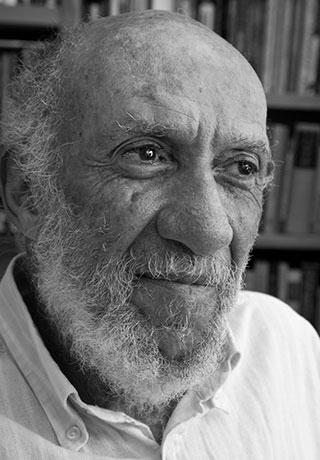

Professor Falk became an adviser to TFF when it was established in 1985.

Related Posts

PART 2 — Diplomacy, Law and Nonviolent Power By Jan ObergTFF co-founder and director January 26, 2026 This is the second of four TFF-created idea portfolios designed to curb the global reach of the United States and, in both the short and long term, help catalyse a worldwide nonviolent resistance to what many observers describe as the Trump administration’s uniquely confrontational, destructive and world-threatening policies. These portfolios outline what governments and citizens across the world can do through dynamic diplomacy, creative initiatives, and strictly nonviolent means. They are typical TFF works in that we do not only tell what the problem is and how bad it will go – as 90+% of all commentators, experts and scholars do – we tell what we think can be done, inviting you to think of what you think you can do. It seems painfully clear to me that the current political dynamics in Washington increasingly resemble the most dangerous...
TFF’s comprehensive proposal for dialogue about true peace in Ukraine is due in a day or two Jan Oberg November 20, 2025 What is being whispered through diplomatic corridors today is not peace, but quackery. The alleged 28‑point plan drafted in Washington and Moscow is mentioned as a solution to the Ukraine war. It is being negotiated by US businessman, real estate developer and Trump ally, Steve Witkoff, and by Kirill Dmitriev, who is CEO of the Russian Direct Investment Fund and a close ally of Putin, according to India’s Economic Times. For presumably good reasons, their education, qualifications and experience in international conflict analysis and peace-making remain untold. They look like surgeons who have never opened a medical textbook. It is nothing more than a mirage: a framework of concessions imposed on Ukraine’s citizens, negotiated without Kyiv, and excluding Europe. Like Gaza, it promises “peace” while institutionalising injustice. If half of what is available about...
PRESS RELEASE – 6 OCTOBER 2025 LAY DOWN YOUR ARMSPEACE PRIZE FOR 2025 is awarded Francesca Albanese The United Nations Special Rapporteur on the occupied Palestinian territories – as the person who, in accordance with Alfred Nobel’s will, has “done the most or the best work for fraternity between nations and for the abolition or reduction of standing armies as well as for the holding and promotion of peace congresses.” Francesca Albanese has forcefully and unwaveringly worked against Israel’s full-scale war on the occupied Palestinian territories, in particular Israel´s ongoing genocide against the Palestinian people. She has confronted Israel’s systematic war crimes and crimes against humanity in a truly global outreach. Further, she has brought governments, international organisations and people’s groups together to underline the responsibility of the world at large to act and to stop arming, enabling, and profiting from Israel’s ongoing criminal actions. But first of all, Albanese...

Recent Articles

Tony Robinson October 4, 2026 Violence is easy to recognise when someone is being beaten, shot or killed. It becomes more difficult when nobody is holding a weapon. Poverty, discrimination, exploitation and repression can restrict a human life just as effectively, although they do so in very different ways and with very different consequences. Simply adding more categories to an ever-growing list of forms of violence does not really solve the problem. The more interesting question is what all these different situations have in common and why it makes sense to describe them using the same word. Human beings do not simply react to what happens around them. They remember the past, imagine things that do not yet exist, make plans and undertake projects. Workers organise because they imagine different working conditions; people migrate because they imagine another life somewhere else; social movements emerge because people refuse to accept the...
It’s a matter of principles, courage, vision and pulling together – while the militarist world is falling apart… Peter Langille October 3, 2026 “Here, then, is the problem which we present to you, stark and dreadful and inescapable: Shall we put an end to the human race; or shall mankind renounce war?”The Bertrand Russell—Albert Einstein Manifesto, July 9, 1955 ⁕ The forecast for what’s ahead is worrisome. The sharp rise in armed conflicts over the past three years is adding to what was already the highest level in over seventy years. Genocides, which should be prevented are supported. A shared climate emergency that jeopardises survival is ignored. Diverse polls now suggest that people are war-weary, worried and interested in a more effective United Nations. And, there are viable policy options for a more secure world! Yet governments are doubling-down, betting on more war and investing heavily. If current trends persist,...
Johan Galtung 1930-2024October 2015 Published here on October 3, 2026 Let us focus on Civilization for conflict analysis and remedies. Major forms of disorder use violence; war is state organized violence. The most belligerent states are the United States of America and Israel, both with civilization roots. National Evangelism, the US Protestant Christian civilization– more national than evangelical–justifies US warfare as exceptionalism of a people chosen by God, with a manifest destiny to run the world. Orthodox Judaism justifies Israeli warfare to conquer and expand from Nile to Euphrates as a religious right and duty to the Eternal One. The third most belligerent country, the UK, no longer believes it is God-chosen but chosen by the USA; not quite the same but something. But the root cause of global disorder lies in the Occident–with Islam–seeing itself as the single, universal civilization valid for all at all times, all others being...

TFF on Substack

Discover and subscribe to more peace materials on TFF Substack

Most Popular

Tony Robinson October 4, 2026 Violence is easy to recognise when someone is being beaten, shot or killed. It becomes more difficult when nobody is holding a weapon. Poverty, discrimination, exploitation and repression can restrict a human life just as effectively, although they do so in very different ways and with very different consequences. Simply adding more categories to an ever-growing list of forms of violence does not really solve the problem. The more interesting question is what all these different situations have in common and why it makes sense to describe them using the same word. Human beings do not simply react to what happens around them. They remember the past, imagine things that do not yet exist, make plans and undertake projects. Workers organise because they imagine different working conditions; people migrate because they imagine another life somewhere else; social movements emerge because people refuse to accept the...
It’s a matter of principles, courage, vision and pulling together – while the militarist world is falling apart… Peter Langille October 3, 2026 “Here, then, is the problem which we present to you, stark and dreadful and inescapable: Shall we put an end to the human race; or shall mankind renounce war?”The Bertrand Russell—Albert Einstein Manifesto, July 9, 1955 ⁕ The forecast for what’s ahead is worrisome. The sharp rise in armed conflicts over the past three years is adding to what was already the highest level in over seventy years. Genocides, which should be prevented are supported. A shared climate emergency that jeopardises survival is ignored. Diverse polls now suggest that people are war-weary, worried and interested in a more effective United Nations. And, there are viable policy options for a more secure world! Yet governments are doubling-down, betting on more war and investing heavily. If current trends persist,...
Johan Galtung 1930-2024October 2015 Published here on October 3, 2026 Let us focus on Civilization for conflict analysis and remedies. Major forms of disorder use violence; war is state organized violence. The most belligerent states are the United States of America and Israel, both with civilization roots. National Evangelism, the US Protestant Christian civilization– more national than evangelical–justifies US warfare as exceptionalism of a people chosen by God, with a manifest destiny to run the world. Orthodox Judaism justifies Israeli warfare to conquer and expand from Nile to Euphrates as a religious right and duty to the Eternal One. The third most belligerent country, the UK, no longer believes it is God-chosen but chosen by the USA; not quite the same but something. But the root cause of global disorder lies in the Occident–with Islam–seeing itself as the single, universal civilization valid for all at all times, all others being...
Read More
Living-Peace-Sign-Budapest-copy
Tony Robinson October 4, 2026 Violence is easy to recognise when someone is being beaten, shot or killed. It becomes more difficult when nobody is holding a weapon. Poverty, discrimination, exploitation and repression can restrict a human life just as effectively, although they do so in very different ways and with very different consequences. Simply adding more categories to an ever-growing list of forms of violence does not really solve the problem. The more interesting question is what all these different situations have in common and why it makes sense to describe them using the same word. Human beings do not simply react to what happens around them. They remember the past, imagine things that do not yet exist, make plans and undertake projects. Workers organise because they imagine different working conditions; people migrate because they imagine another life somewhere else; social movements emerge because people refuse to accept the...
b54a1f10-8c65-4f0b-9dd5-4abc0a7d04cc_2659x2659
It’s a matter of principles, courage, vision and pulling together – while the militarist world is falling apart… Peter Langille October 3, 2026 “Here, then, is the problem which we present to you, stark and dreadful and inescapable: Shall we put an end to the human race; or shall mankind renounce war?”The Bertrand Russell—Albert Einstein Manifesto, July 9, 1955 ⁕ The forecast for what’s ahead is worrisome. The sharp rise in armed conflicts over the past three years is adding to what was already the highest level in over seventy years. Genocides, which should be prevented are supported. A shared climate emergency that jeopardises survival is ignored. Diverse polls now suggest that people are war-weary, worried and interested in a more effective United Nations. And, there are viable policy options for a more secure world! Yet governments are doubling-down, betting on more war and investing heavily. If current trends persist,...
010
Johan Galtung 1930-2024October 2015 Published here on October 3, 2026 Let us focus on Civilization for conflict analysis and remedies. Major forms of disorder use violence; war is state organized violence. The most belligerent states are the United States of America and Israel, both with civilization roots. National Evangelism, the US Protestant Christian civilization– more national than evangelical–justifies US warfare as exceptionalism of a people chosen by God, with a manifest destiny to run the world. Orthodox Judaism justifies Israeli warfare to conquer and expand from Nile to Euphrates as a religious right and duty to the Eternal One. The third most belligerent country, the UK, no longer believes it is God-chosen but chosen by the USA; not quite the same but something. But the root cause of global disorder lies in the Occident–with Islam–seeing itself as the single, universal civilization valid for all at all times, all others being...
Screenshot 2026-10-02 011738
Jan ObergPhD, director, The Transnational Foundation for Peace and Future Research, TFFLund, Sweden October 2, 2026 This is my full original manuscript. The Chinese Academy of Social Science, CASS, makes two publications out if it. 1. China’s Five-year plan emphasized the capabilities of basic research and original innovation. It is regarded as the goal of the future social development, which, as required, should be significantly enhanced. Can you comment on the importance of original innovation in research and academic study? I believe it is easier to define “original innovation” in the natural sciences than in social sciences. The breaking points of what constitutes something new, or innovative, are not quite as sharp in the latter. But in both fields it is about opening up something that was closed, unseen, unexplored before – making manifest what was earlier latent. Innovations come in many forms and shapes – naming something that was not...
arctic-circle-map
The agreement is catastrophic both because of what it says and what it doesn’t mention. It reduces further the major asset of security policies: Freedom of action. Jan Oberg TFF director September 25, 2026 A couple of hours before the agreement was signed on September 22, 2026, I published the following 13 hypotheses about what it would most likely contain on TFF Substack (in English). I was wrong on only the first point. Contrary to what Trump had written on his Truth Social platform, it does not appear to come into force immediately. In fact, it turned out to be worse than even I had anticipated. After these hypotheses now come a number of reflections in light of what the agreement actually contains, and does not contain, as well as the way in which it has generally been presented by major media outlets and by the public-service broadcaster DR. My...
girl-5894831_1280
Below are TFF-related media mentions, comments, videos and social media posts published elsewhere but not on this homepage. We happen to catch and list only a fraction. Regarding video comments and debates, we recommend that you go to the TFF Video Channel on Substack where many of them are reproduced. Jan Oberg is a contributor to China Daily – 52 million daily clicks – and Global Times, CGTN and CCTV (the national television), China Investment, Xinhua News Agency and several others. Articles and videos on these media very often multiply into countless Chinese (and Western media) that re-post them from these main media. Thanks to The China Academy, his analyses, interviews and comments are frequently posted on YouTube channels such as Thinkers Forum and Wave Media. These videos are often re-posted on Bilibili (China’s YouTube), the China Content Center on TikTok, and on the Chinese edition of TikTok, Douyin.com. This means reaching hundreds of millions of viewers worldwide over a year. While there are too many to catch on all these...




