
Av Christian Hårleman*

1:a september 2018

Våren 1992 blev jag ombedd att som militär rådgivare arbeta i Departement of Peacekeping Operations (DPKO). Det var inte helt oväntat sedan jag de föregående tre åren hade arbetat i New York med peacekeeping vid dels International Peace Academy (IPA) och dels vid UN Institute for Training and Research (UNITAR).

Även om jag var hyfsat underkunnig om peacekeeping var jag färsk i min nya roll som militär rådgivare vid UN HQs. Detta skedde ungefär vid samma tid som när Kofi Annan övertog chefskapet över DPKO efter den dynamiska britten Marrack Goulding. Departementet var vid Annans tillträde starkt engagerad i konflikten i Jugoslavien vilken även präglade Säkerhetsrådets politiska agenda.

Det var en turbulent tid där formerna för och strukturen av peacekeeping konceptet per se ifrågasattes. Att för Annan överta departementet vid denna tid var således ingen lätt uppgift och många undrade om ”the softspoken Annan” var i stånd att matcha kraven från Säkerhetsrådet och truppbidragarländerna – inte minst mot bakgrunden av den alltmer omfattande och komplexa situationen på Balkan.

Inom kort kom Annan alla skeptiker på skam. Hans djupa kunskap om det stora och mångfacetterade FN-systemet var inte bara teoretiskt inhämtad utan Annans stora förtrogenhet med hela systemet härrörde sig även från alla de år han arbetat med vitt skilda frågor inom organisationen.

Det tog därför inte särskilt lång tid innan den nye departementschefen var väl insatt i alla de frågor som åvilade departementet.

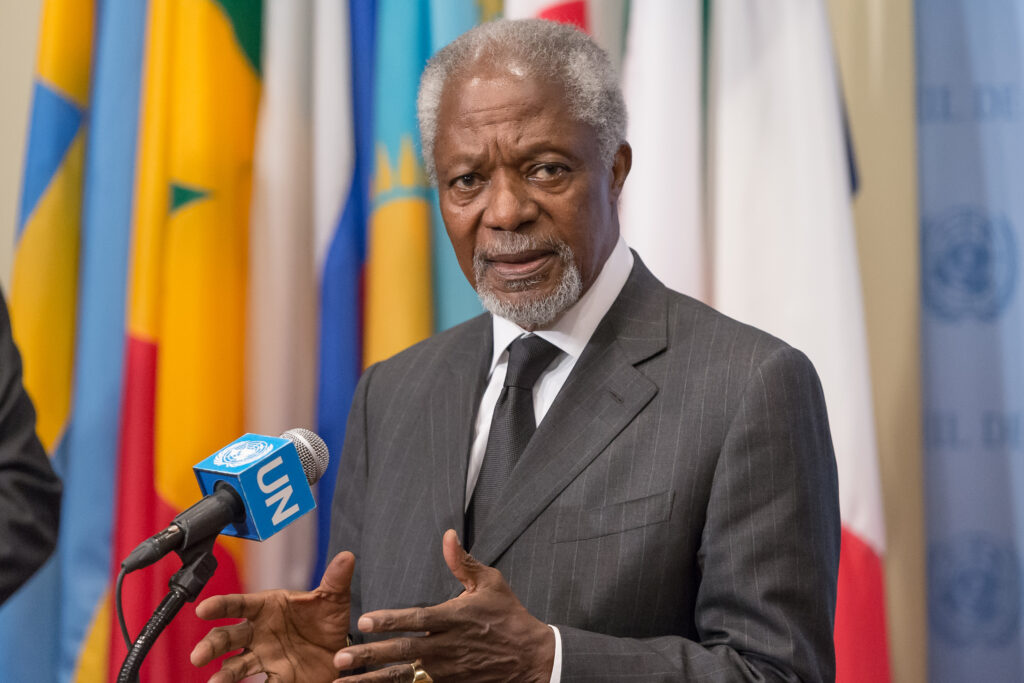
Kofi Annan var alltid synnerligen välklädd, tunt grått skägg, ”huskey” röst, ganska liten men rörde sig med en naturlig elegans. Han utstrålade en självklar auktoritet, som parad med hans klokhet och starka empati samt ett aldrig sviktande lugn gjorde honom till en central punkt var han än befann sig.

Hela hans apparition ingav ett stort förtroende till vilket man förhöll sig med respekt. Annan var synnerligen omtyckt – inte minst av Departementets personal som han påtagligt värnade om. En sekreterare i Annans stab yttrade vid något tillfälle – om jag blir avskedad önskar jag att det är Mr. Annan som meddelar mig detta.

DPKO var under departementschefen och hans stab organiserat i ett antal avdelningar vilka ansvarade för de aktuella geopolitiska områdena Afrika, Asien, Mellan Östern, Central Amerika och Europa. Inom varje avdelning fanns en chef med sina politiska rådgivare som alla var FN tjänstemän.

Efter behov knöts till avdelningarna sekonderade militära specialister d.v.s. officerare från medlemsstaterna. Dessutom fanns det en administrativ avdelning samt senare en avdelning som skulle svara för etablering av ett för truppbidragarländerna konformt utbildningssystem för de fredsbevarande styrkorna. Det var detta som blev min huvudsakliga uppgift.

Det var en ganska jobbig tid där policy och koncept skulle introduceras och koordineras med medlemsländerna. Allt detta krävde resurser i form av pengar och personal. Det hela blev därutöver en politisk fråga enär liknande idéer ej tidigare hade på allvar diskuterats – och definitivt inte inom FN:s huvudkvarter.

Frågan måste därför föreläggas Generalförsamlingen och dess Femte utskott för ett principbeslut om verksamheten som sådan och därefter ett beslut om medelstilldelning. Annan och hans stab hjälpte och guidade mig under denna process och med aktivt stöd från den amerikanska FN delegation gick det hela igenom.


FN hade nu för första gången fått ett samordnat och senare implementerat utbildningspaket för de fredsbevarande styrkorna och Sekretariatet hade begåvats med permanent militär utbildningsenhet.

Annan hade sett och förstått behovet av denna utbildning och ville se detta realiserat som del i FN:s reformprogram för de fredsbevarande styrkorna.

Vid denna tid fanns inom Sekretariatet ett ganska massivt motstånd gentemot etableringen av en permanent militär enhet i FN-högkvarteret. Det ansågs ej förenligt med FN:s allmänna policy att organisera en ständig militär närvaro i Sekretariatet, vilket var att betrakta som en ”non-military organisation”. Sådana enheter skulle tillhöra de av FN beslutade externa fältoperationerna. Motståndet var tufft.

När policyn hade formulerats, samordnats inom eget departement och aktuella dokument på väg ut till de andra departementen samt som förhandsinfo till Femte utskottet – då ringde Annans andre man och meddelade mig kort att inga dylika dokument skulle distribueras – det fanns inget behov för denna slags verksamhet inom Sekretariastet.

Arbetar man i FN ”far-man-inte-taket” – man reflekterar, bidar och undersöker. Det visade sig att dokumenten fanns hos departementets administrativa chef – min vän Franz Bauman. Han hade inte fått något meddelande, kände inte till något om ett återkallande om ”non-distribution” varför han på min fråga helt sonika sände iväg dokumenten till alla listade mottagare inklusive Femte utskottet. Detta var ju högst irriterande för vissa. Min personal och jag var lättade och Annan godkände hela konceptet.

Hela genomförandeprocessen var komplicerad och omfattade bl.a. fem stora regionala seminarier till vilka inbjöds endast berörd personal från de regionala ländernas utrikes- och försvarsdepartement. Inga andra tilläts deltaga för att ej försvåra det därvarande politiska klimatet.

I det sammanhanget blev jag så tillfrågad om Spaniens ambassadör i Argentina kunde beredas möjlighet att närvara vid seminariet i Buenos Aires. Svaret blev nekande varför spanjorerna vände sig till Annans andre man. Denne svarade ja och informerade mig efteråt om sitt beslut. Jag protesterade med hänvisning till tidigare beslutad policy i denna fråga men det var inte tal om att ändra fattat beslut.

Jag bad då om företräde för Annan, föredrog ärendet varvid han förklarade att han skulle lösa frågan. Det gjorde han – det kom ingen spansk ambassadör. Detta kan synas som sk-t saker och så är det i vår kultur och där vi gör andra prioriteringar. Inom FN systemet och främst inom Sekretariatet ser man helt annorlunda på detta. Det rör sig om prestige, positioneringar, inflytande och ”face-saving”.

Annan och det stora flertalet stod helt utanför dessa futiliteter – men var medveten om dem.

Om Annan har sagts och sägs mycket – om hans diplomatiska förmåga, ”Fingerspitzgefühl”, integritet, förmågan att rätt förhålla sig till den regionala/globala komplexiteten, hans hängivenhet till FN och ödmjukheten till sin uppgift.

Annan var högt respekterad av olika statsmän runt om i världen inte minst för sin mjuka men ändå principfasta framtoning i alla krävande förhandlingar.

Personligen ansåg jag Annan som en utomordentlig person med chefsegenskaper som går lång utöver det vanliga. En sådan stimulerande chef som Kofi Annan har jag aldrig haft.

Annan fångar nog sig själv bäst i ett av hans många odödliga ”quotables” – “We may have different religions, different languages, different colored skin, but we all belong to one human race”.

*Christian Hårleman är fd ordförande för TFF:s styrelse. Se övrigt om honom på länken ovan.

Related Posts

Below are TFF-related media mentions, comments, videos and social media posts published elsewhere but not on this homepage. We happen to catch and list only a fraction. Regarding video comments and debates, we recommend that you go to the TFF Video Channel on Substack where many of them are reproduced. Jan Oberg is a contributor to China Daily – 52 million daily clicks – and Global Times, CGTN and CCTV (the national television), China Investment, Xinhua News Agency and several others. Articles and videos on these media very often multiply into countless Chinese (and Western media) that re-post them from these main media. Thanks to The China Academy, his analyses, interviews and comments are frequently posted on YouTube channels such as Thinkers Forum and Wave Media. These videos are often re-posted on Bilibili (China’s YouTube), the China Content Center on TikTok, and on the Chinese edition of TikTok, Douyin.com. This means reaching hundreds of millions of viewers worldwide over a year. While there are too many to catch on all these...
Jan Oberg TFF director October 13, 2026 According to Alfred Nobel’s will, the Nobel Peace Prize shall be awarded: ”to the person who has done the most or best to advance fellowship among nations, the abolition or reduction of standing armies, and the establishment and promotion of peace congresses.” Further down, he also expresses how the prize for the “champions of peace” shall be decided: “that for champions of peace by a committee of five persons to be selected by the Norwegian Storting. Alfred Nobel’s will is remarkably short and clear. But few seem to have read it. Nobel did not say that the committee itself should consist of members of parliament. He entrusted the Storting with appointing five persons. In principle, it could have selected diplomats, mediators, peace researchers, conflict-resolution specialists, or other individuals with recognised expertise in matters of peace from around the world. Instead, the Storting gradually...
The Quest for Humane Survival Richard Falk Professor emeritus, Princeton UniversityTFF Associate since 1986October 12, 2026 After decades of teaching and writing about international law in academic frameworks that were not institutionally situated within law school environments—at Princeton and the University of California, Santa Barbara—I found myself most receptive to the TWAIL outlook. It has been especially illuminating in clarifying the extent to which international law evolved as a dialogical critique of Europe’s efforts to legitimize its colonial undertakings. In particular, TWAIL has exposed how international law has functioned to legalize the subjugation of Third World peoples, securing conditions for exploitative investment and trade relations, the coercive enforcement of public debts, and an ideology of cultural superiority. TWAIL’s exposure of these economic legacies of colonialism has influenced my understanding of the history and development of international law, broadly conceived, as an ideological project of the Western sub-system of the world...

Recent Articles

Below are TFF-related media mentions, comments, videos and social media posts published elsewhere but not on this homepage. We happen to catch and list only a fraction. Regarding video comments and debates, we recommend that you go to the TFF Video Channel on Substack where many of them are reproduced. Jan Oberg is a contributor to China Daily – 52 million daily clicks – and Global Times, CGTN and CCTV (the national television), China Investment, Xinhua News Agency and several others. Articles and videos on these media very often multiply into countless Chinese (and Western media) that re-post them from these main media. Thanks to The China Academy, his analyses, interviews and comments are frequently posted on YouTube channels such as Thinkers Forum and Wave Media. These videos are often re-posted on Bilibili (China’s YouTube), the China Content Center on TikTok, and on the Chinese edition of TikTok, Douyin.com. This means reaching hundreds of millions of viewers worldwide over a year. While there are too many to catch on all these...
Jan Oberg TFF director October 13, 2026 According to Alfred Nobel’s will, the Nobel Peace Prize shall be awarded: ”to the person who has done the most or best to advance fellowship among nations, the abolition or reduction of standing armies, and the establishment and promotion of peace congresses.” Further down, he also expresses how the prize for the “champions of peace” shall be decided: “that for champions of peace by a committee of five persons to be selected by the Norwegian Storting. Alfred Nobel’s will is remarkably short and clear. But few seem to have read it. Nobel did not say that the committee itself should consist of members of parliament. He entrusted the Storting with appointing five persons. In principle, it could have selected diplomats, mediators, peace researchers, conflict-resolution specialists, or other individuals with recognised expertise in matters of peace from around the world. Instead, the Storting gradually...
The Quest for Humane Survival Richard Falk Professor emeritus, Princeton UniversityTFF Associate since 1986October 12, 2026 After decades of teaching and writing about international law in academic frameworks that were not institutionally situated within law school environments—at Princeton and the University of California, Santa Barbara—I found myself most receptive to the TWAIL outlook. It has been especially illuminating in clarifying the extent to which international law evolved as a dialogical critique of Europe’s efforts to legitimize its colonial undertakings. In particular, TWAIL has exposed how international law has functioned to legalize the subjugation of Third World peoples, securing conditions for exploitative investment and trade relations, the coercive enforcement of public debts, and an ideology of cultural superiority. TWAIL’s exposure of these economic legacies of colonialism has influenced my understanding of the history and development of international law, broadly conceived, as an ideological project of the Western sub-system of the world...

TFF on Substack

Discover and subscribe to more peace materials on TFF Substack

Most Popular

Below are TFF-related media mentions, comments, videos and social media posts published elsewhere but not on this homepage. We happen to catch and list only a fraction. Regarding video comments and debates, we recommend that you go to the TFF Video Channel on Substack where many of them are reproduced. Jan Oberg is a contributor to China Daily – 52 million daily clicks – and Global Times, CGTN and CCTV (the national television), China Investment, Xinhua News Agency and several others. Articles and videos on these media very often multiply into countless Chinese (and Western media) that re-post them from these main media. Thanks to The China Academy, his analyses, interviews and comments are frequently posted on YouTube channels such as Thinkers Forum and Wave Media. These videos are often re-posted on Bilibili (China’s YouTube), the China Content Center on TikTok, and on the Chinese edition of TikTok, Douyin.com. This means reaching hundreds of millions of viewers worldwide over a year. While there are too many to catch on all these...
Jan Oberg TFF director October 13, 2026 According to Alfred Nobel’s will, the Nobel Peace Prize shall be awarded: ”to the person who has done the most or best to advance fellowship among nations, the abolition or reduction of standing armies, and the establishment and promotion of peace congresses.” Further down, he also expresses how the prize for the “champions of peace” shall be decided: “that for champions of peace by a committee of five persons to be selected by the Norwegian Storting. Alfred Nobel’s will is remarkably short and clear. But few seem to have read it. Nobel did not say that the committee itself should consist of members of parliament. He entrusted the Storting with appointing five persons. In principle, it could have selected diplomats, mediators, peace researchers, conflict-resolution specialists, or other individuals with recognised expertise in matters of peace from around the world. Instead, the Storting gradually...
The Quest for Humane Survival Richard Falk Professor emeritus, Princeton UniversityTFF Associate since 1986October 12, 2026 After decades of teaching and writing about international law in academic frameworks that were not institutionally situated within law school environments—at Princeton and the University of California, Santa Barbara—I found myself most receptive to the TWAIL outlook. It has been especially illuminating in clarifying the extent to which international law evolved as a dialogical critique of Europe’s efforts to legitimize its colonial undertakings. In particular, TWAIL has exposed how international law has functioned to legalize the subjugation of Third World peoples, securing conditions for exploitative investment and trade relations, the coercive enforcement of public debts, and an ideology of cultural superiority. TWAIL’s exposure of these economic legacies of colonialism has influenced my understanding of the history and development of international law, broadly conceived, as an ideological project of the Western sub-system of the world...
Read More
girl-5894831_1280
Below are TFF-related media mentions, comments, videos and social media posts published elsewhere but not on this homepage. We happen to catch and list only a fraction. Regarding video comments and debates, we recommend that you go to the TFF Video Channel on Substack where many of them are reproduced. Jan Oberg is a contributor to China Daily – 52 million daily clicks – and Global Times, CGTN and CCTV (the national television), China Investment, Xinhua News Agency and several others. Articles and videos on these media very often multiply into countless Chinese (and Western media) that re-post them from these main media. Thanks to The China Academy, his analyses, interviews and comments are frequently posted on YouTube channels such as Thinkers Forum and Wave Media. These videos are often re-posted on Bilibili (China’s YouTube), the China Content Center on TikTok, and on the Chinese edition of TikTok, Douyin.com. This means reaching hundreds of millions of viewers worldwide over a year. While there are too many to catch on all these...
Nobel-Prize-Plaque
Jan Oberg TFF director October 13, 2026 According to Alfred Nobel’s will, the Nobel Peace Prize shall be awarded: ”to the person who has done the most or best to advance fellowship among nations, the abolition or reduction of standing armies, and the establishment and promotion of peace congresses.” Further down, he also expresses how the prize for the “champions of peace” shall be decided: “that for champions of peace by a committee of five persons to be selected by the Norwegian Storting. Alfred Nobel’s will is remarkably short and clear. But few seem to have read it. Nobel did not say that the committee itself should consist of members of parliament. He entrusted the Storting with appointing five persons. In principle, it could have selected diplomats, mediators, peace researchers, conflict-resolution specialists, or other individuals with recognised expertise in matters of peace from around the world. Instead, the Storting gradually...
law-419057_1280
The Quest for Humane Survival Richard Falk Professor emeritus, Princeton UniversityTFF Associate since 1986October 12, 2026 After decades of teaching and writing about international law in academic frameworks that were not institutionally situated within law school environments—at Princeton and the University of California, Santa Barbara—I found myself most receptive to the TWAIL outlook. It has been especially illuminating in clarifying the extent to which international law evolved as a dialogical critique of Europe’s efforts to legitimize its colonial undertakings. In particular, TWAIL has exposed how international law has functioned to legalize the subjugation of Third World peoples, securing conditions for exploitative investment and trade relations, the coercive enforcement of public debts, and an ideology of cultural superiority. TWAIL’s exposure of these economic legacies of colonialism has influenced my understanding of the history and development of international law, broadly conceived, as an ideological project of the Western sub-system of the world...
images-2
Advocates of nuclear disarmament are regularly dismissed by the champions of nuclear deterrence as naïve and unrealistic, utopian or even irresponsible. Yet this ‘doctrine’ of deterrence, regarded by France as the ‘cornerstone’ of its national security, is based on quasi-religious beliefs, a theory that cannot be proven, risky gambles and fragile assumptions. So much so that one might legitimately ask which side the ‘Care Bears’ are on. Marc FinaudVice-President of Initiatives for Nuclear Disarmament (IDN) October 9, 2026 This article was originally published on Pressenza When it comes to these things being treated as religious concepts, look here. Idealists and realists It was Hubert Védrine, François Mitterrand’s former Foreign Minister, who repeatedly coined the phrase: ‘Europeans are a sort of Care Bears who don’t realise they’re living in Jurassic Park’. He applies this reference to the cartoon for well-behaved children not only to what he regards as weakness or idealism...
8824b09f-33a5-43f9-9fd0-550f28cda24d_1536x1024
What the West Borrowed from Asia and What It Left Behind Jan Krikke October 8, 2026 The article was originally published here In the late 1960s, the musical Hair announced that the Age of Aquarius was dawning. Its opening anthem promised a transformation of human consciousness: an era of peace, harmony and understanding. Half a century later, a familiar echo of that promise is a meditation app offered by your employer. You can find it in the same list of benefits as the pension plan and the gym discount. How did a spiritual revolution become an employee benefit? The answer lies in the history of the movement known as New Age: where it came from, what it borrowed from Asia, and why the meaning of what it borrowed changed in the process. Two definitions will help. New Age is a loose label for a wide range of spiritual practices and...
Screenshot 2026-10-04 210142
Small and different + among the 10% most active + 9,000 texts + 150 Associates + 60 000 a day — and a stubborn belief that peace is smarter and must be secured by peaceful means. In 2026, the Transnational Foundation for Peace and Future Research (TFF) turns 40. On Monday, October 5, 2026, a new TFF homepage will go live — a new gateway to more than 9,000 articles, analyses, research papers and other contributions produced over four decades of independent peace research. But this is not simply a new website. For four decades, TFF has worked from a simple conviction: peace is smarter than militarism and can be brought about by peaceful means. This is not merely an aspiration. It is the principle expressed in the UN Charter and the Gandhian tradition that has guided our work from the beginning. TFF is a research-based, independent and people-financed foundation....





