

At 70: A few problems with the human rights concept

Today the Universal Declaration of Human Rights turns 70. All reason to celebrate. Without the norms embedded in this extremely important document, humankind would be much worse off.

Because normativity is important even though it is only words. It enables us to make those who violate human rights accountable. And that is, in general terms, an extremely important aspect of the UN and its Charter.

So too the norm expressed in its Article 1 – that peace shall be established by peaceful means and only when all such means have been tried an found in vain, can the UN member states take to violent means. As a last resort.

That said, the only two problems I have with the human rights philosophy and concept are:

  1. The word “human” – the implicit idea that only humans have right, not all the other creatures on earth. That is, it is a very anthropocentric concept. We need something much more inclusive and holistic today.
  2. The word “rights” – people constantly claiming their rights is good but it’s not enough. Gandhi said it a very long time ago: “There are no rights without duties.”

One could also formulate it this way: Human beings have duties vis-a-vis those whose rights are not embedded in any declaration, i.e. other living creatures, be it trees, rivers or microorganisms, in short: Mother Earth. And these creatures cannot speak up and claim their rights – for which reason we shall have to show empathy and use our imagination to “hear” them.

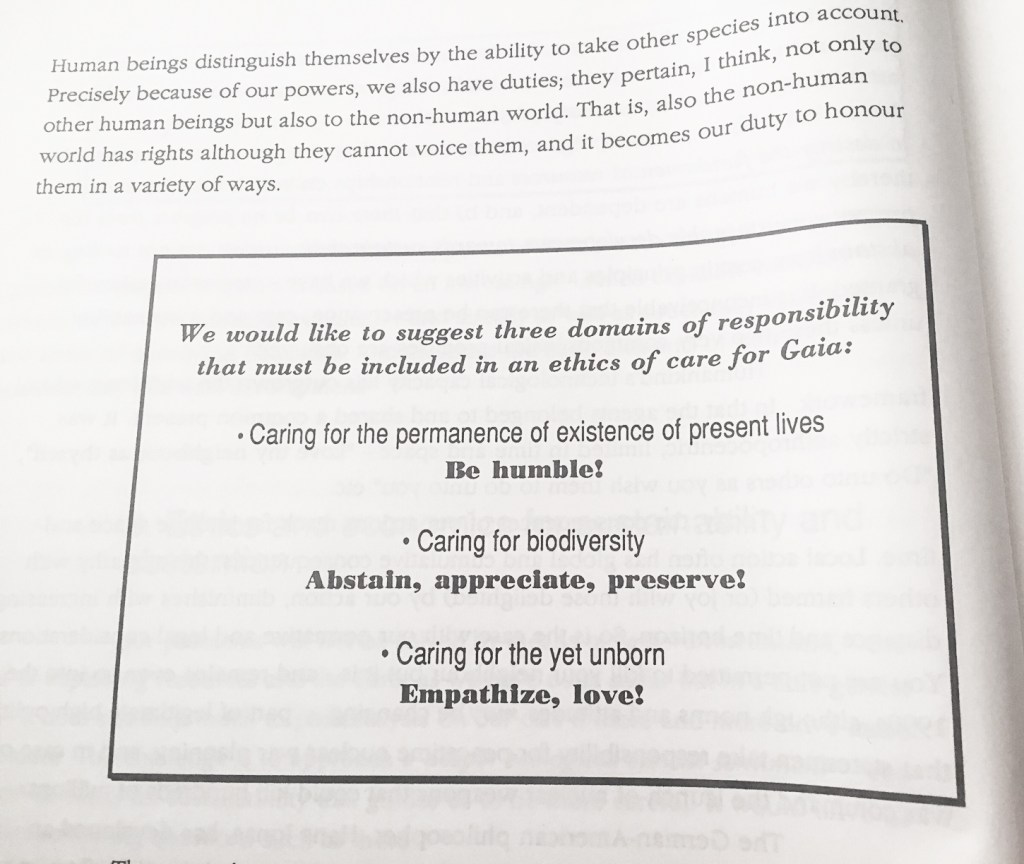
We need to see it as our duty to care – care both for the non-human beings and, most importantly, caring for the yet unborn, that is for future generations.

This means giving up the contractual thinking so fundamental in the Western worldview or social cosmology.

When it comes to the yet unborn, we have to do something to make their lives possible and even good even though they cannot claim these rights and even though we do not have a ‘contract’ – a quid pro quo – with them.

The question “what did future generations ever do for us/me” is of course meaningless. But we need anyhow to think beyond ourselves in time and space, all of us: Care for the rights of the non-human beings and for the not yet born human beings.

Other serious problems

It goes without saying that there are many more problems with the human rights concept and policies today. To mention a few:

  1. How universal can they be, given the world has so many and different cultures, ways of thinking and historical experiences? Is it at all realistic to argue that they can be universal?
  2. To which extent can one argue that the Declaration came out as basically Western product and with too much focus on the individual?
  3. How destructive has it been for the whole idea that, since about the intervention in Yugoslavia, human rights have been (mis)used as an argument, or justification, for the concept and policy of humanitarian intervention and the Responsibility To Protect (R2P) – advocating the legitimate use of military force in the name of human rights protection – even though these interventions have, more often than not, caused gross human rights violation and been conducted without a UN Security Council mandate?
  4. The whole intimacy between government and human rights NGO – where the N stands more for Near- than Non-Governmental, e.g. the rotation of government officials into human rights organisations and vice versa – in other words, the fundamental politicization of human rights to such an extent that the commitment to human rights become purely political and selective, a weapon in the (propaganda) for oneself and against designated enemies. 

So what about implementation?

That said – admittedly in the more philosophical realm – it is good to also discuss how we can, much more fully, implement the present human rights norms.

You just need to let your eyes run down over the Declaration’s 30 points in summary above to see how far the world still is from the ideals – and how the West that has been championing this Declaration has itself become increasingly authoritarian over time, excusing itself predominantly by referring to its global war on terror.

For the Western world, human rights have always been predominantly about freedoms to speak, assemble and travel etc. – whereas the rights in the economic sphere – such as the right to a job and the right to have enough to survive on, even the right to life –  have always been secondary. 

This of course has to do with global, Western-driven capitalism which is not exactly a human rights promoting system, just look at the ongoing marginalisation, suffering, poverty and misery of millions of people. And when China has championed these rights the last 40 years, the West points out that it systematically violates human right, the rights of course as the West sees them.

Or look at the wars and human- and system-caused environmental problems that cause the number of IDPs (Internally Displaces Persons), refugees, asylum seekers and migrants (different concepts!) increase, now so tragically approaching 70 million fellow human beings.

A new ethics of global care

We, therefore, need a new ethics of global care – norm systems like Christianity talking about what you as an individual should and should not do to your neighbour are way too narrow in time and space in our globalising world and in the future.

Fortunately, there are some good attempts at re-thinking rights and duties such as The Earth Charter Initiative and The People’s Charter to Create A Nonviolent World – but they have not been integrated enough in the general discourse and neither have they been institutionalised nor made legally binding by governments.

While humanity can see progress here and there in terms of civilisation – which means respecting the equal human rights of everybody – there is certainly a very long way to go to improve both the way we think and speak about these things and the way the right, all of them, are realised in daily lives on the ground around our troubled Earth.

Note
1. I have written about these matters some 25 years ago in “Alternatives To World Disorder In the 1990s. Sustainability, Nonviolence, Global Ethics And Democracy,” General Education Series, Institute of Asian Cultural Studies, International Christian University, ICU, Tokyo, 1991.

Here’s a photo of one of the summaries about global ethics:


PhD, Peace & future researcher + ‌Art Photographer, Professor Emeritus and media commentator

One Response

  1. This is a very important and timely warning. It is good to be reminded of the provisions of the Human Rights Charter, firstly to see how many of its provisions remain unenforced, and secondly to see how they need to be amended and broadened. Sadly, it seems that these principles have been often used by powerful countries as weapons against other countries but not against themselves. Just see how many Western leaders have been tried for their war crimes and human rights violations. As Churchill said: “History will be kind to me, because I write history”. To be fair, most Western countries have been forced to observe some of the human rights principles in their own countries as the result of public pressure, but they have got away with murder in other countries, as we have seen in the cases of illegal wars and war crimes in Afghanistan, Iraq, Syria, Libya, Yemen, etc. and in their support for saw-wielding dictators when it has suited their interests. We need some form of mechanism with some teeth to make sure that these principles are observed in relation to other countries too. Your other point about the need to go beyond human rights, and to make sure that we pay attention to the requirements of the world around us is also very important. In the desertification, deforestation, the loss of fish stocks, the slaughter of hundreds of millions of animals each year in a cruel way for human consumption, chicken farms, the loss of habitat for many species due to the use of herbicide and industrial farming, etc. we have seen a total disregard for nature and its impact ultimately on our own lives. More and more evidence is being produced that animals are sentient beings and, in fact, there is an organic link between us and the whole of nature. This is an area that needs urgent attention for the future of life, including human life, on earth.

Related Posts

Photo above: Carl Fredrik Reuterswärd’s Non-Violence outside UN Headquarters in New York. Kirill Levin, CC BY-NC-SA 2. Jan Oberg November 3, 2026 I am happy to be published in Horizons which is produced by the Center for International Relations and Sustainable Development, CIRSD, in Belgrade. My contribution brings out a radical re-thinking of what concepts such as defence, security, deterrence – and peace – may mean if we want to create a more peaceful world. It also summarises a few things I have been working with the last few decades. Please read it here Og her er den på dansk, takket være Johnny Baltzersens lynhurtige oversættelse
UNITE-tillid, DREAM-velstand og andre konstruktive komponenter Normally we publish articles in English here. But this is a translation of a very important TFF document that should reach as many as possible in Denmark since this country’s government has been one of the most hardline in Europe and, up till now at least, has refused to use diplomacy and, instead, spent tremendous sums on arming Ukraine with the express goal of defeating Russia. Thus this – unique – article is in Danish. Vi er Johnny Baltzersen og hans Fælles Sikkerhed – Fælles Fremtid på Substack overmåde taknemmelige for at have oversat og publiceret TFF’s 2025-portfølje for fredsidéer med henblik på Ukraines fremtid. Vi håber den nu kan nå mange flere danskere – som også vil sprede den og skabe debat – nu den danske regerings og folketingspartiernes politik på dette område siden 2022 står nu – forudsigeligt – ved vejs ende....
Jan Oberg TFF director October 28, 2026 Exactly one month has now passed since I published my criticism of the introduction to the special issue on Johan Galtung published by the Journal of Global Security Studies, JoGSS, and of Tor Egil Førland’s chapter about Galtung which serves as a preview to his forthcoming biography of Galtung to be published by PRIO. See the original on The Transnational here and the same article on TFF Substack with many general and critical comments and, in particular, the people who decided to withdraw from the biography project in protest. The special issue itself was extraordinary. It was devoted to the intellectual legacy of one of the founders of peace research and contained a number of strong assessments of his personality, scholarship, intellectual trajectory, and public role. Such assessments are, of course, entirely legitimate. No scholar is beyond criticism, and neither was Johan Galtung....

Recent Articles

Photo above: Carl Fredrik Reuterswärd’s Non-Violence outside UN Headquarters in New York. Kirill Levin, CC BY-NC-SA 2. Jan Oberg November 3, 2026 I am happy to be published in Horizons which is produced by the Center for International Relations and Sustainable Development, CIRSD, in Belgrade. My contribution brings out a radical re-thinking of what concepts such as defence, security, deterrence – and peace – may mean if we want to create a more peaceful world. It also summarises a few things I have been working with the last few decades. Please read it here Og her er den på dansk, takket være Johnny Baltzersens lynhurtige oversættelse
UNITE-tillid, DREAM-velstand og andre konstruktive komponenter Normally we publish articles in English here. But this is a translation of a very important TFF document that should reach as many as possible in Denmark since this country’s government has been one of the most hardline in Europe and, up till now at least, has refused to use diplomacy and, instead, spent tremendous sums on arming Ukraine with the express goal of defeating Russia. Thus this – unique – article is in Danish. Vi er Johnny Baltzersen og hans Fælles Sikkerhed – Fælles Fremtid på Substack overmåde taknemmelige for at have oversat og publiceret TFF’s 2025-portfølje for fredsidéer med henblik på Ukraines fremtid. Vi håber den nu kan nå mange flere danskere – som også vil sprede den og skabe debat – nu den danske regerings og folketingspartiernes politik på dette område siden 2022 står nu – forudsigeligt – ved vejs ende....
Jan Oberg TFF director October 28, 2026 Exactly one month has now passed since I published my criticism of the introduction to the special issue on Johan Galtung published by the Journal of Global Security Studies, JoGSS, and of Tor Egil Førland’s chapter about Galtung which serves as a preview to his forthcoming biography of Galtung to be published by PRIO. See the original on The Transnational here and the same article on TFF Substack with many general and critical comments and, in particular, the people who decided to withdraw from the biography project in protest. The special issue itself was extraordinary. It was devoted to the intellectual legacy of one of the founders of peace research and contained a number of strong assessments of his personality, scholarship, intellectual trajectory, and public role. Such assessments are, of course, entirely legitimate. No scholar is beyond criticism, and neither was Johan Galtung....

TFF on Substack

Discover and subscribe to more peace materials on TFF Substack

Most Popular

Photo above: Carl Fredrik Reuterswärd’s Non-Violence outside UN Headquarters in New York. Kirill Levin, CC BY-NC-SA 2. Jan Oberg November 3, 2026 I am happy to be published in Horizons which is produced by the Center for International Relations and Sustainable Development, CIRSD, in Belgrade. My contribution brings out a radical re-thinking of what concepts such as defence, security, deterrence – and peace – may mean if we want to create a more peaceful world. It also summarises a few things I have been working with the last few decades. Please read it here Og her er den på dansk, takket være Johnny Baltzersens lynhurtige oversættelse
UNITE-tillid, DREAM-velstand og andre konstruktive komponenter Normally we publish articles in English here. But this is a translation of a very important TFF document that should reach as many as possible in Denmark since this country’s government has been one of the most hardline in Europe and, up till now at least, has refused to use diplomacy and, instead, spent tremendous sums on arming Ukraine with the express goal of defeating Russia. Thus this – unique – article is in Danish. Vi er Johnny Baltzersen og hans Fælles Sikkerhed – Fælles Fremtid på Substack overmåde taknemmelige for at have oversat og publiceret TFF’s 2025-portfølje for fredsidéer med henblik på Ukraines fremtid. Vi håber den nu kan nå mange flere danskere – som også vil sprede den og skabe debat – nu den danske regerings og folketingspartiernes politik på dette område siden 2022 står nu – forudsigeligt – ved vejs ende....
Jan Oberg TFF director October 28, 2026 Exactly one month has now passed since I published my criticism of the introduction to the special issue on Johan Galtung published by the Journal of Global Security Studies, JoGSS, and of Tor Egil Førland’s chapter about Galtung which serves as a preview to his forthcoming biography of Galtung to be published by PRIO. See the original on The Transnational here and the same article on TFF Substack with many general and critical comments and, in particular, the people who decided to withdraw from the biography project in protest. The special issue itself was extraordinary. It was devoted to the intellectual legacy of one of the founders of peace research and contained a number of strong assessments of his personality, scholarship, intellectual trajectory, and public role. Such assessments are, of course, entirely legitimate. No scholar is beyond criticism, and neither was Johan Galtung....
Read More
knotted gun
Photo above: Carl Fredrik Reuterswärd’s Non-Violence outside UN Headquarters in New York. Kirill Levin, CC BY-NC-SA 2. Jan Oberg November 3, 2026 I am happy to be published in Horizons which is produced by the Center for International Relations and Sustainable Development, CIRSD, in Belgrade. My contribution brings out a radical re-thinking of what concepts such as defence, security, deterrence – and peace – may mean if we want to create a more peaceful world. It also summarises a few things I have been working with the last few decades. Please read it here Og her er den på dansk, takket være Johnny Baltzersens lynhurtige oversættelse
TFFPortfolioVign
UNITE-tillid, DREAM-velstand og andre konstruktive komponenter Normally we publish articles in English here. But this is a translation of a very important TFF document that should reach as many as possible in Denmark since this country’s government has been one of the most hardline in Europe and, up till now at least, has refused to use diplomacy and, instead, spent tremendous sums on arming Ukraine with the express goal of defeating Russia. Thus this – unique – article is in Danish. Vi er Johnny Baltzersen og hans Fælles Sikkerhed – Fælles Fremtid på Substack overmåde taknemmelige for at have oversat og publiceret TFF’s 2025-portfølje for fredsidéer med henblik på Ukraines fremtid. Vi håber den nu kan nå mange flere danskere – som også vil sprede den og skabe debat – nu den danske regerings og folketingspartiernes politik på dette område siden 2022 står nu – forudsigeligt – ved vejs ende....
JoGSS-Silent
Jan Oberg TFF director October 28, 2026 Exactly one month has now passed since I published my criticism of the introduction to the special issue on Johan Galtung published by the Journal of Global Security Studies, JoGSS, and of Tor Egil Førland’s chapter about Galtung which serves as a preview to his forthcoming biography of Galtung to be published by PRIO. See the original on The Transnational here and the same article on TFF Substack with many general and critical comments and, in particular, the people who decided to withdraw from the biography project in protest. The special issue itself was extraordinary. It was devoted to the intellectual legacy of one of the founders of peace research and contained a number of strong assessments of his personality, scholarship, intellectual trajectory, and public role. Such assessments are, of course, entirely legitimate. No scholar is beyond criticism, and neither was Johan Galtung....
Screenshot 2026-10-26 115647
An aspect of Iran’s culture and civilisation you’ve probably never heard about. Don’t be surprised if the US and Israel also try to bomb them. Jan ObergTFF director October 26, 2026 Today – under the “USraeli” threat of new “annihilating” bombings – opens the 7th International Conference on Peace and Conflict Resolution at Tehran’s University. As far as I can tell, this is the only permanent, advanced peace research institution in West Asia/the Middle East. Perhaps more countries in that region could be inspired? I mean, how many military “security” institutes and military academies do they have? Many peace research institutes and university departments have been established since the 1950s in the West. They are now all under attack; some have closed down, some have gone mainstream, yet others kept the name but do nothing to research peace and disseminate results or advice; instead, they cooperate with militarism’s platforms such...
Screenshot 2026-10-15 141837
Let’s discuss using AI to create peace – in contrast to boring geopolitics devoid of creative healing and visions. Jan Oberg TFF director October 15, 2026 I asked VEED to create a short video exemplifying how peace is preferable to war, then chose the lady as a template. Simple as that. In less than a minute, it produced this video, which any peace-loving person would appreciate. The only problem is that human intelligence (HI), at least the one that exists among Western decision-makers, isn’t half as moral or smart as AI. I have used AI to dialogue about peace and peace plans, creative conflict resolution and visions of a better future for humankind. It so happens that I am having more stimulating, intelligent, creative and moral discussions with AI than I could possibly have with any EU or NATO leader today. Yes, AI has very problematic and dangerous aspects; used...
girl-5894831_1280
Below are TFF-related media mentions, comments, videos and social media posts published elsewhere but not on this homepage. We happen to catch and list only a fraction. Regarding video comments and debates, we recommend that you go to the TFF Video Channel on Substack where many of them are reproduced. Jan Oberg is a contributor to China Daily – 52 million daily clicks – and Global Times, CGTN and CCTV (the national television), China Investment, Xinhua News Agency and several others. Articles and videos on these media very often multiply into countless Chinese (and Western media) that re-post them from these main media. Thanks to The China Academy, his analyses, interviews and comments are frequently posted on YouTube channels such as Thinkers Forum and Wave Media. These videos are often re-posted on Bilibili (China’s YouTube), the China Content Center on TikTok, and on the Chinese edition of TikTok, Douyin.com. This means reaching hundreds of millions of viewers worldwide over a year. While there are too many to catch on all these...






