TFF Associate since 2006 and former board member, Oxford, with this homepage.
March 9, 2026
In a recent statement, Israel’s Prime Minister Benjamin Netanyahu boasted that he felt very happy that after 40 years of trying to get the United States involved in a major war with Iran, he had finally succeeded in achieving his goal. This statement is very telling in that it reveals Israel’s real goal in Iran, namely to fight and bring down the Iranian government, and other claims, including all the US’s attempts at peace with Iran, have been a deceptive fraud.
As someone who has followed Iran’s relations with the West and Israel before and after the Islamic Revolution very closely, I have witnessed many ups and downs in those relations. Under the Shah, Israel had close and even privileged relations with Iran. After the 1953 CIA coup, which toppled Dr Mohammad Mosaddeq’s government and restored the Shah to power, the Americans called on Mossad to train the personnel in the newly established SAVAK (The National Bureau for Intelligence and Security), especially in the use of torture in interrogation techniques.
In fact, the Shah’s closeness to Israel and hostility towards the Palestinians were one of the main reasons for public dissatisfaction with the government, which led to the Islamic Revolution. Many clerical leaders in the new revolutionary government had been imprisoned and tortured by SAVAK and held a grudge against Israel.
Shortly after the victory of the revolution, some elements in the US administration encouraged the Iraqi dictator Saddam Hussein to attack Iran, although he was very reluctant to do so, fearing Iran’s superior power, but the Americans promised massive help to him, which they and other Western countries and even Russia delivered to him. The war lasted eight years and killed and wounded nearly a million Iranians, including by the use of gas whose precursors were supplied mainly by the United States and Germany.
During the course of the war, the Israelis who did not wish to see Saddam win outright provided small quantities of weapons to Iran to ensure that neither side won, but the amount and significance of those weapons have been greatly exaggerated. After the war, when the Americans turned against Saddam Hussein, and he was significantly weakened and eventually removed during the invasion of Iraq, the Israelis concentrated on combating the Iranian government.
In fact, the Israeli Prime Minister Ariel Sharon complained that the United States should have attacked Iran, instead of Iraq, and urged the Americans to make sure that Iran would be next. This is supported by Netanyahu’s statement that he had been working hard for 40 years to get the United States involved in a major war with Iran.
During the past few decades, Iran has been trying to improve relations with the West, but whenever there has been a reformist government in power in Iran, and there has been the prospect of improved relations with the West and incidentally with Israel, the Israeli government, backed by its Neoconservative supporters in the United States, have done their best to frustrate those efforts.
They fear that if Iran gets closer to the West, which is the best guarantee of democratic and human rights reforms at home and better relations with the West and Israel, it would undermine Israel’s unique place as America’s main client and receiver of billions of dollars in US aid in the region.
In 1995, President Hashemi-Rafsanjani offered a major oil contract, valued at over $1 billion, to the US company Conoco, in the hope of improving political and economic relations with the United States. This was the first oil contract offered to a US firm since the 1979 revolution. The pro-Israeli Neoconservatives in the American government forced Conoco to cancel the deal.
To add insult to injury, completely out of the blue, Martin S. Indyk, Assistant Secretary for Near Eastern Affairs, introduced the so-called “Dual Containment Policy”, imposing sanctions on both Iran and Iraq, even though Iran had recently emerged from a devastating eight-year war imposed on Iran by Saddam Hussein, which killed and wounded close to a million Iranians.
The excuse for imposing sanctions on Iran was an attack on Khobar Tower in Dhahran, Saudi Arabia, which killed 19 U.S. Air Force personnel and injured over 400 others. The neocons in the US administration wrongly attributed it to Iran, although the Saudis themselves said that it had been the work of Al Qaeda, something that has been confirmed by subsequent investigation. But, for pro-Israeli activists, facts should not be allowed to interfere with propaganda. The main issue was to isolate and demonise any country they perceived to pose a threat to Israel, which, according to them, included Iran.
After the 9/11 terrorist attacks in the United States, Iran’s reformist president, Mohammad Khatami, conveyed Iran’s sincere condolences to “the great American nation” and proposed the “Dialogue Among Civilisations”. Iran provided valuable support to the United States in the toppling of the Taliban and the formation of the new government in Afghanistan. Iran was instrumental in persuading the members of the anti-Taliban Northern Alliance to join the new government formed by the United States.
Again, panicked by the possibility of closer relations between Iran and the United States, President Bush’s speechwriter, David Frum, surreptitiously included the phrase “Axis of Evil” in the president’s State of the Union Address, lumping Iran with Iraq and North Korea, three unlikely partners, together as members of the so-called Axis of Evil, preventing any possibility of rapprochement between Iran and the United States.
When President Hasan Rouhani visited New York to speak at the UN General Assembly in 2013, he took with him a prominent Jewish leader and member of the Iranian parliament, and spoke warmly of Iranian relations with the Jews. His government signed the landmark nuclear deal (JCPOA or the Joint Comprehensive Plan of Action) with the United States in 2015, endorsed by five permanent members of the Security Council, plus Germany. Iran agreed to cut over 90% of its nuclear activities, to enrich uranium for medical purposes only, joined the Additional Protocol, and allowed intrusive, unannounced IAEA inspections. The agreement blocked all the paths to Iran’s acquisition of nuclear weapons. It was unanimously approved by the Security Council Resolution 2231 and by the EU Commission.
Once again, under pressure from Benjamin Netanyahu, President Donald Trump unilaterally withdrew the United States from the agreement in 2018 and imposed crippling sanctions on Iran. Iran continued to adhere to the terms of the deal for nearly two years, hoping that the next president might return to the deal, but when President Biden failed to return to the JCPOA and continued the sanctions, Iran began to increase enrichment up to 60% to encourage the West to honour the deal.
However, the IAEA continued its inspections of the Iranian nuclear programme and reported that Iran had not weaponised its nuclear programme. All of Iran’s nuclear activities were carried out under IAEA inspection, which allegedly involved more than 50 per cent of IAEA inspections worldwide. During his second term, Trump intensified his pressure on Iran and, at Netanyahu’s bidding, launched two unprovoked wars on Iran in the middle of negotiations which seemed to be progressing well. This has eroded any trust in the United States, not only among Iranians, but also among Russians, the Chinese and many people in the global south who see that they cannot rely on the US’s promises and agreements.
On all those occasions, Israeli leaders and pro-Israeli groups worked hard to frustrate any possibility of improved relations between Iran and the West. The Israelis continue to demonise Iran and hope to weaken and divide it because they think that it ensures Western backing for Israel. This policy has done a great deal of harm to Iran, to Israel, to the region and to the West and has resulted in unending wars, bloodshed, economic hardship and chaos.

Clearly, the aim of the Israelis is not to see a democratic, prosperous and friendly Iran, living in peace with them and the West. Their aim is to weaken, disarm, incapacitate, and, if possible, divide Iran, in the same way that they have done in Lebanon, Syria and most notably in Gaza and the West Bank. The remarks by Mike Huckabee, the Christian-Zionist US ambassador to Israel, in his interview with Tucker Carlson, saying that it would be a good thing if Israel could control the so-called Greater Israel, from the Nile to the Euphrates, have rung alarm bells in the region.
However, this gives an impression of where Christian Zionists and many right-wing Israelis would like to go. Huckabee solemnly declared that “there’s really no such thing as a Palestinian.” Not only is this totally false from a historical point of view, it also runs counter to the US’s official policy over many decades calling for a two-state solution. Incidentally, the term Christian Zionist is an oxymoron.
Christ’s mission was about compassion, loving one’s enemies, forgiveness and universality, while Zionism is an extreme, nationalist, ethno-supremacist political ideology. Christ declared, “My Kingdom is not of this world.” He also said: “For those who are led by the Spirit of God are the children of God.” This broad universal outlook does not distinguish between Jews and Gentiles but preaches spirituality and righteousness.
Huckabee refers to some Biblical verses promising the land to Abraham and his descendants, but the same book of the Old Testament speaks about the creation of the world by Yahweh over six days, some 6,000 years ago. It also speaks of God creating Adam and then taking one of his ribs to make Eve. Does Huckabee also believe in those verses? Given the degree of narrow-mindedness and dogmatism in people like him, it wouldn’t be surprising if he does believe in those verses as well. However, if he doesn’t, what an appalling hypocrisy to believe selectively in some verses and ignore others.
If Christian Zionists read Jesus’s Gospels, rather than the Old Testament, they would see that it conveys a completely different message. Christian Gospels interpret those verses about the Covenant with Abraham quite differently. According to the New Testament, the promise is interpreted not according to genealogy but along religious lines. For instance, in Galatians 3:16, St Paul draws attention to the formulation of the promise, avoiding the term “seeds” in the plural, choosing instead “seed”: “The promises were spoken to Abraham and to his seed. Scripture does not say ‘and to seeds,’ meaning many people, but ‘and to your seed,’ meaning one person, who is Christ.” In Galatians 3:28-29, Paul goes further and argues that the promise did not have a genetic/physical association, but a spiritual/religious one: “There is neither Jew nor Gentile, neither slave nor free, neither male nor female, for you are all one in Christ Jesus. If you belong to Christ, then you are Abraham’s seed, and heirs according to the promise.” In any case, confusing some allegorical texts in old scriptures and confusing them with politics is a very dangerous game.
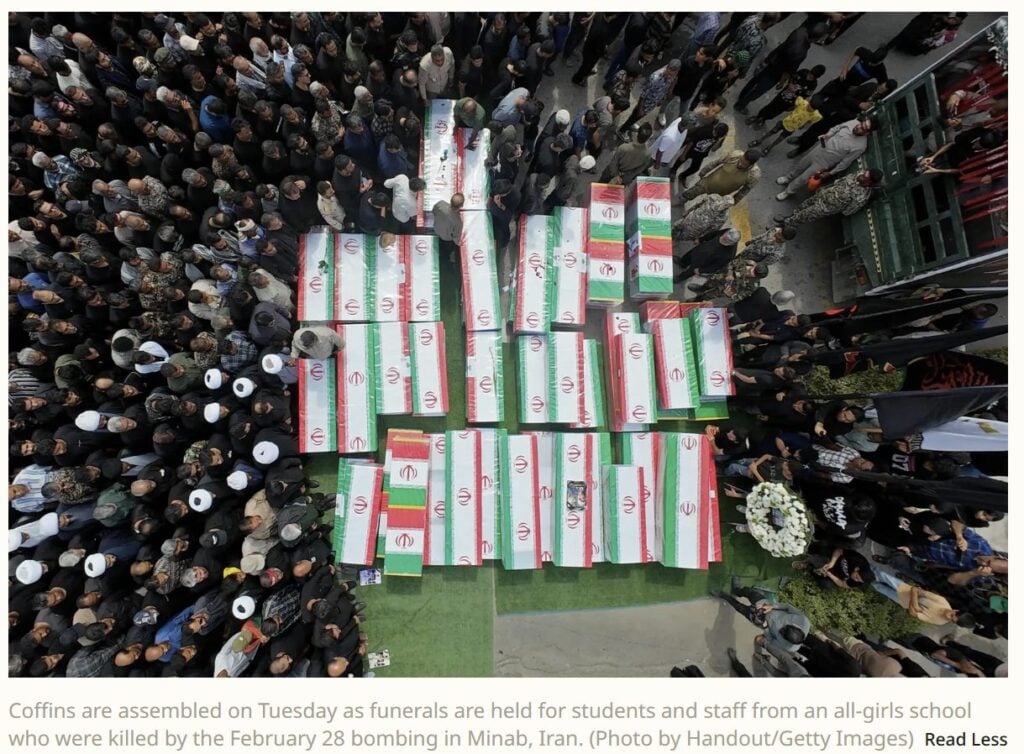
As a result of illegal and unprovoked Israeli-US attacks on Iran, the war has spread to nearly all Middle Eastern countries. It has killed thousands of Iranians, including at least 160 primary school girls, and wounded scores more. The deliberate targeting and assassination of Iran’s supreme leader is a war crime. No matter what one thinks of Iran and its late leader, that criminal act must be condemned by everybody who does not wish to see the world descend into total chaos and lawlessness.
At the very least, the war will result in a global recession, and at worst, it can lead to a devastating world war with unforeseen consequences, just to satisfy the bloodlust of an indicted war criminal, supported by a weak-willed US president.
Israel’s only chance of peace and continued existence in the Middle East is to end the occupation of the Palestinians and learn to live in peace with all its neighbours, including the Iranians. The current aggressive and expansionist policies have failed and will lead to greater disasters in the future. Historically, Iranians have had warm relations with the Jews, but Israel’s unremitting hostility towards Iran, leading to two unprovoked and illegal wars, runs the risk of reversing those historical relations.
In the eyes of the Israeli leaders, Iranian reformism, which would improve democracy and human rights, is seen as a threat because it prolongs the life of the Islamic regime. Development, women’s rights, closer ties with the West, eased sanctions, international cooperation, all work against the goal to demonise the Iranian regime, enabling the West to control Iran’s energy resources, and to restructure the Middle East in keeping with Israel’s expansionist goals. Hence, their preference for a pro-US Iranian proxy, who would serve American interests and who would be friendly and even subservient to Israel.
This policy has failed in the past and will fail in the future. There is no way that a nation of some eight million people, which is opposed by most nations in the Middle East due to its occupation of Palestinian lands and aggressive policies towards its neighbours, especially after the genocide in Gaza, can rule over and dominate an ancient nation of some 93 million people, with millennia-deep roots in the region, with a glorious civilisation and with vast natural resources. The Middle East’s over five hundred million Arabs, Iranians and Turks, all heirs to ancient civilisations, will not allow that to happen, even though the Israelis enjoy unconditional US support.
Israel must give up its unrealistic and ahistorical dream of ethno-religious supremacy. It must end its decades-long brutal occupation of the Palestinian people, either allow the formation of an independent Palestinian state, in keeping with numerous UN resolutions, to live side by side with Israel, or form a single state by dismantling the current apartheid laws and live in peace with the Palestinians as citizens of a democratic state with equal rights for all.
If Israel follows that path, the best that it can hope for is to be accepted as an equal member of the nations in the region, working to bring about a peaceful and prosperous Middle East. All the members of the Arab League, as well as all the 57 majority Muslim states, including Iran, have accepted and proposed that formula.
The alternative is to continue conflict and bloodshed, and eventually be forced to leave the region. That would be a sad and disastrous outcome, especially for Israel.