

It’s no coincidence that, after years of fighting abroad, the United States is beset with paranoia, loss of trust, and increasingly bitter divisions

Stephen M. Walt

March 16, 2021

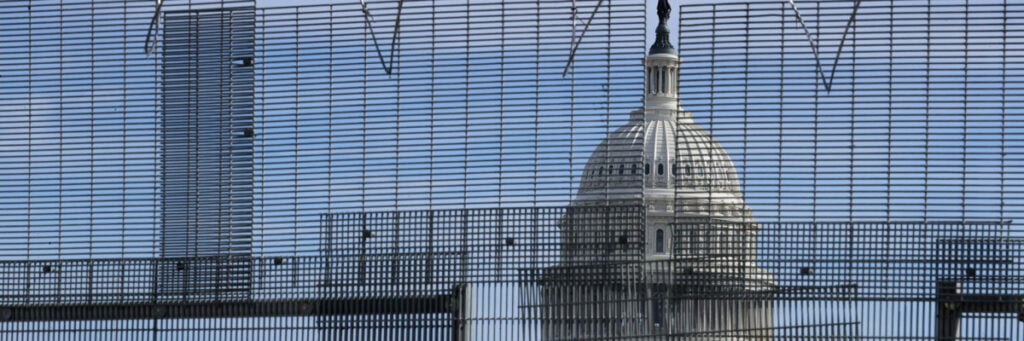
“Fortress America” is a derogatory term that usually refers to extreme forms of isolationism. Last week, however, CNN anchor Fareed Zakaria gave the idea a new and equally disturbing twist. In a thought-provoking column in the Washington Post, Zakaria described how excessive concerns for security are making the United States more “imperial” in appearance than the old colonial empires, with embassies, public buildings, and even the U.S. Capitol itself surrounded by barricades, moats, or fortifications. Instead of presenting a welcoming visage to the outside world and to the American people, one that conveys confidence, strength, and openness, America’s public face appears uncertain, vulnerable, fearful, and distant.

Originally published at Eurasia News Online

According to Zakaria, such concerns have also encouraged an excessive regard for secrecy, new layers of hierarchy and restriction, and a timid and sclerotic approach to public policy. In his words, “the U.S. government now resembles a dinosaur—a large, lumbering beast with much body and little brain, increasingly well-protected but distant from ordinary people and unresponsive to the real challenges that confront the nation.”

I couldn’t agree more, having noticed much the same tendency a few years ago. But the big question is: Why is this happening? Is it simply because the world has gotten more dangerous, or is there a connection between how the United States has been acting abroad and various threats to liberty at home?

I think there is. What follows is somewhat speculative, but there are several obvious ways in which America’s recent conduct abroad has led to greater insecurity, paranoia, loss of trust, and division within the United States, so much so that officials now have to erect barricades all over Washington (and in plenty of other cities as well).

Reason No. 1 is the familiar problem of “blowback.” During the “unipolar moment,” U.S. officials were convinced that a crusading foreign policy would be good for the United States and good for the rest of the world. As former President George W. Bush put it a few years before he took office, remaking the world in America’s image would usher in “generations of democratic peace.” 

Instead, we’ve seen a steady deterioration in democracy and eroding security at home and abroad. Whatever Americans’ intentions may have been, U.S. actions have sometimes caused enormous suffering in other countries—through sanctions, covert action, support for thuggish dictators, and a remarkable ability to turn a blind eye to the brutal conduct of close allies—not to mention America’s own far-flung military activities.

Given the countries the United States has invaded, the bombs it’s dropped, and the drone strikes it’s conducted, it is any wonder that some people in other places wish Americans ill?

Bush used to say that terrorists came after the United States because they “hate our freedoms,” but there is a mountain of evidence—including the official 9/11 Commission Report—showing that what drove anti-American extremism was opposition to U.S. policy.

Given what the United States had done—especially in the Middle East—it was entirely predictable that some groups would try to hit it back, and that a few of them would occasionally succeed. To say this is not to justify their actions or imply everything the United States has done was wrong; it is simply to remind us that U.S. actions are a key part of this story too.

Second, the vast sums Americans have spent trying to nation-build, spread democracy, or defeat all “terrorists of global reach” inevitably left fewer resources available to help Americans at home (including the veterans of the country’s protracted wars).

The United States still spends more on national security than the next six or seven countries combined, and there’s little doubt that all that money has produced an impressive amount of military power. But the United States doesn’t have the world’s best primary and secondary schools; the best health care; best WiFi; best railways, roads, or bridges; or best power grids, and it lacks well-funded public institutions that can serve U.S. citizens’ needs in a pandemic or enable the country to maintain the technological edge it will need to compete with other countries for the rest of this century.

Looking back, the over $6 trillion spent on what Bush dubbed the “war on terror”—including the money spent on unwinnable wars in Afghanistan and Iraq—could surely have been spent helping Americans live more comfortable and secure lives at home (or merely left in taxpayers’ pockets).

Add to the list the decisions to promote rapid globalization and financial deregulation, which did significant harm to some sectors of the economy and led to the 2008 financial crisis, and you begin to see why confidence in the elite has taken a hit.

Third, running an ambitious and highly interventionist foreign policy—and, in particular, one that tries to manipulate, manage, and ultimately shape the internal politics of foreign countries—requires a lot of deception.

To sustain public support for it, elites have to spend a lot of time inflating threats, exaggerating benefits, acting in secret, and manipulating what the public is told. But eventually at least some of the truth comes out, dealing another blow to public trust.

And when actions abroad prompt blowback at home, government officials feel compelled to impose even more restrictions and start monitoring what ordinary citizens are doing, fueling suspicion and distrust of government even more.

To make matters worse, the architects of failure are rarely, if ever, held accountable. Instead of acknowledging their mistakes openly, even discredited former officials can head off to corporate boards, safe sinecures, or lucrative consulting firms, hoping to return to power as soon as their party regains the White House.

Once back in office, they are free to repeat their previous mistakes, backed by a chorus of pundits whose recommendations never change no matter how often they’ve failed.

Why should ordinary Americans trust an elite that has misled them repeatedly, failed to deliver as promised, accrued an ever-larger share of the nation’s wealth, and suffered so few consequences for past errors?

At this point it becomes easy to persuade someone that “the system is rigged” and that mainstream media is filled with “fake news.” Donald Trump didn’t learn how to lie in 2016—on the contrary, his career was founded on lies from day one—but he got elected president in part because Americans no longer believed anyone could be relied upon to tell the truth.

Weave these strands together, and you have a fertile environment for conspiracy theories, especially after Americans have been told over and over that a vast array of shadowy and ruthless adversaries were plotting to snatch their freedom away from them.

In the 1950s, it was the fear of communist infiltration; after 9/11 it was the supposedly mortal peril of Islam, or immigrants, or a “refugee invasion.” Once you’ve been persuaded that the Islamic State posed an existential threat (as opposed to being a serious but manageable problem), it might not be hard to convince you that former Secretary of State Hillary Clinton was running a pedophile ring out of a pizza parlor.

Too bad we didn’t spend more time worrying about some real dangers, like a new and highly contagious virus.

What I am suggesting is that America’s actions abroad helped create the dangers Americans now face at home. The United States set out to remake the world in its image, and when some parts of that world pushed back, it reacted the way that most societies do when they are attacked.

Americans got scared, lashed out even more, stopped thinking clearly and strategically, and looked around for someone to blame. Instead of seeking out leaders who were genuinely interested in solving the real problems the United States faced, Americans ended up with the performative patriotism of a Ted Cruz or a Mike Pompeo—all swagger and no substance.

I’m not the first to point this out, of course, and the ideas sketched above are surely not the full story. Social media helped get us here, along with the emergence of the galaxy of media figures who figured out you could get rich being hateful, outrageous, and deceitful.

I think Julian Zelizer is right to pin some of the blame on former House Speaker Newt Gingrich, whose desire for power alone did more than anyone to destroy the norms of bipartisan cooperation and compromise. And the Republican Party’s decision to pin its political future on gerrymandering, voter suppression, and mobilizing a shrinking base and not on trying to appeal to the median voter is surely part of the problem, too, along with the twisted soul of Trump himself.

But the connection between imperial adventures abroad and domestic turmoil at home should not be overlooked. President James Madison once warned that “No nation could preserve its freedom in the midst of continual warfare,” and we would do well to reflect on his warning today.

Endless campaigns abroad unleash a host of political forces—militarism, secrecy, enhanced executive authority, xenophobia, faux patriotism, demagoguery, etc.—all of them contrary to the civic virtues on which a healthy democracy depends.

If President Joe Biden genuinely wants to heal America’s divisions on the home front, he needs to start doing less elsewhere.

Otherwise, the United States is going to need some bigger walls, and I don’t mean on its borders.

Originally published at Eurasia News Online

About the author

Stephen M. Walt is the Robert and Renée Belfer professor of international relations at Harvard University.

Please help TFF remain truly independent by contributing if you benefited from this article

2 Responses

  1. He points out many obvious self-created problems of the USA. But he misses the point. How can he ask whether the world has become a more dangerous place without mentioning MIMAC? He doesn’t seem to acknowledge what all the US-driven wars are about. “U.S. actions have sometimes caused enormous suffering in other countries…” Where hasn’t it you may ask? He admits though, that “Given the countries the United States has invaded, the bombs it’s dropped, and the drone strikes it’s conducted, it is any wonder that some people in other places wish Americans ill?” Referring to the official 9/11 commission report shows me that he has no idea of how ill the US democracy is. It’s non-existing legal system together with a corrupted neocon political system makes the USA a fascist regime. But of course a Harvard professor cannot freely speak out about the nation’s actual condition. He would be ridiculed and fired. One thing he did get right. “If President Joe Biden genuinely wants to heal America’s divisions on the home front, he needs to start doing less elsewhere.” This of course will not happen because he, like all other nod doll presidents, will do what MIMAC tells him to do.

  2. “Second, the vast sums Americans have spent trying to nation-build, spread democracy, or defeat all “terrorists of global reach” inevitably left fewer resources available to help Americans at home (including the veterans of the country’s protracted wars). ” The USA does NOT try to do any of these fine-sounding things at all. They interfere with what are supposed to be sovereign nations as if these nations have no rights, expect everyone to obey their demands regardless of international laws or even commonsense, pretend that others are enemies when it is the USA which is belligerent and cruel, and make no attempt to understand the Point of view of supposed enemies. To hear the nonsense now about “aggressive” China or “dangerous Russia trying to influence our election” (as if the US farce is a free and fair election!) and the excessive bowing to Israel regardless of its destruction of any chance of peace with its region makes us realize that the US empire needs to be treated with more unity of opposition to its dictates!!

Related Posts

Jan Oberg, TFF director April 9, 2026 I was recently invited to have a good, long talk about the world – and, of course, about peace too – with Boris Malagurski on his Weight of Chains Channel on YouTube. It was a real joy and seems to have been greatly appreciated by the viewers too. Mr Malagurski and I shall of course be grateful if you share this conversation in your circles – of course, only if you like what you see and hear 😉☮️ And remember that this one – like hundreds of others with TFF Associates – can be enjoyed at our TFF Video Collection.
A friendly quarrel while we agree that the US sanctions are a weapon of mass destruction and kill more people than wars do. And that we must talk much more about sanctions than we have so far. Jan Oberg, TFF director March 16, 2026 John Mearsheimer recently stated that U.S. sanctions murdered around 38 million people between 1971 and 2021 – see the video below. It is a dramatic figure, and it has spread quickly because it captures, in one sentence, the enormous human cost of modern sanctions. I share his concern about the destructive effects of economic coercion. But the specific number he cites — and the way he attributes it — deserves a friendly academic clarification. The figure comes from a 2023 Lancet Global Health article estimating the mortality effects of unilateral U.S. and EU sanctions over the past half‑century. This is the first point where Mearsheimer’s shorthand diverges from the text: the study...
By Jan ObergTFF co-founder and director February 11, 2026 PART 3 — ECONOMICS, TRADE & FINANCIAL SOVEREIGNTY A. Trade Measures & Market Signaling Economic pressure can be applied instantly and scaled without violence. Immediate Measures (within a week) Government boycott US goods and services  A very powerful signal which over time will be felt. Targeted tariffs on selected U.S. goods Symbolic but high-visibility sectors send a clear message. Suspend trade facilitation talks A peaceful pause that signals deep concern. Freeze U.S. participation in public procurement – military procurement in particular A nonviolent way to reduce influence. Competition law review of U.S. corporations A legal tool to scrutinise market dominance. Longer-Term Measures EU–Asia–Africa trade corridors Reducing reliance on U.S. markets. European supply chains for critical minerals Strategic autonomy in resource access. European Strategic Trade Authority Monitoring coercive practices globally. Euro-denominated commodity markets Weakening the dollar’s pricing monopoly. The EU must resume contacts and negotiations with Russia, focusing on energy cooperation To...

Recent Articles

Tony Robinson October 4, 2026 Violence is easy to recognise when someone is being beaten, shot or killed. It becomes more difficult when nobody is holding a weapon. Poverty, discrimination, exploitation and repression can restrict a human life just as effectively, although they do so in very different ways and with very different consequences. Simply adding more categories to an ever-growing list of forms of violence does not really solve the problem. The more interesting question is what all these different situations have in common and why it makes sense to describe them using the same word. Human beings do not simply react to what happens around them. They remember the past, imagine things that do not yet exist, make plans and undertake projects. Workers organise because they imagine different working conditions; people migrate because they imagine another life somewhere else; social movements emerge because people refuse to accept the...
It’s a matter of principles, courage, vision and pulling together – while the militarist world is falling apart… Peter Langille October 3, 2026 “Here, then, is the problem which we present to you, stark and dreadful and inescapable: Shall we put an end to the human race; or shall mankind renounce war?”The Bertrand Russell—Albert Einstein Manifesto, July 9, 1955 ⁕ The forecast for what’s ahead is worrisome. The sharp rise in armed conflicts over the past three years is adding to what was already the highest level in over seventy years. Genocides, which should be prevented are supported. A shared climate emergency that jeopardises survival is ignored. Diverse polls now suggest that people are war-weary, worried and interested in a more effective United Nations. And, there are viable policy options for a more secure world! Yet governments are doubling-down, betting on more war and investing heavily. If current trends persist,...
Johan Galtung 1930-2024October 2015 Published here on October 3, 2026 Let us focus on Civilization for conflict analysis and remedies. Major forms of disorder use violence; war is state organized violence. The most belligerent states are the United States of America and Israel, both with civilization roots. National Evangelism, the US Protestant Christian civilization– more national than evangelical–justifies US warfare as exceptionalism of a people chosen by God, with a manifest destiny to run the world. Orthodox Judaism justifies Israeli warfare to conquer and expand from Nile to Euphrates as a religious right and duty to the Eternal One. The third most belligerent country, the UK, no longer believes it is God-chosen but chosen by the USA; not quite the same but something. But the root cause of global disorder lies in the Occident–with Islam–seeing itself as the single, universal civilization valid for all at all times, all others being...

TFF on Substack

Discover and subscribe to more peace materials on TFF Substack

Most Popular

Tony Robinson October 4, 2026 Violence is easy to recognise when someone is being beaten, shot or killed. It becomes more difficult when nobody is holding a weapon. Poverty, discrimination, exploitation and repression can restrict a human life just as effectively, although they do so in very different ways and with very different consequences. Simply adding more categories to an ever-growing list of forms of violence does not really solve the problem. The more interesting question is what all these different situations have in common and why it makes sense to describe them using the same word. Human beings do not simply react to what happens around them. They remember the past, imagine things that do not yet exist, make plans and undertake projects. Workers organise because they imagine different working conditions; people migrate because they imagine another life somewhere else; social movements emerge because people refuse to accept the...
It’s a matter of principles, courage, vision and pulling together – while the militarist world is falling apart… Peter Langille October 3, 2026 “Here, then, is the problem which we present to you, stark and dreadful and inescapable: Shall we put an end to the human race; or shall mankind renounce war?”The Bertrand Russell—Albert Einstein Manifesto, July 9, 1955 ⁕ The forecast for what’s ahead is worrisome. The sharp rise in armed conflicts over the past three years is adding to what was already the highest level in over seventy years. Genocides, which should be prevented are supported. A shared climate emergency that jeopardises survival is ignored. Diverse polls now suggest that people are war-weary, worried and interested in a more effective United Nations. And, there are viable policy options for a more secure world! Yet governments are doubling-down, betting on more war and investing heavily. If current trends persist,...
Johan Galtung 1930-2024October 2015 Published here on October 3, 2026 Let us focus on Civilization for conflict analysis and remedies. Major forms of disorder use violence; war is state organized violence. The most belligerent states are the United States of America and Israel, both with civilization roots. National Evangelism, the US Protestant Christian civilization– more national than evangelical–justifies US warfare as exceptionalism of a people chosen by God, with a manifest destiny to run the world. Orthodox Judaism justifies Israeli warfare to conquer and expand from Nile to Euphrates as a religious right and duty to the Eternal One. The third most belligerent country, the UK, no longer believes it is God-chosen but chosen by the USA; not quite the same but something. But the root cause of global disorder lies in the Occident–with Islam–seeing itself as the single, universal civilization valid for all at all times, all others being...
Read More
Living-Peace-Sign-Budapest-copy
Tony Robinson October 4, 2026 Violence is easy to recognise when someone is being beaten, shot or killed. It becomes more difficult when nobody is holding a weapon. Poverty, discrimination, exploitation and repression can restrict a human life just as effectively, although they do so in very different ways and with very different consequences. Simply adding more categories to an ever-growing list of forms of violence does not really solve the problem. The more interesting question is what all these different situations have in common and why it makes sense to describe them using the same word. Human beings do not simply react to what happens around them. They remember the past, imagine things that do not yet exist, make plans and undertake projects. Workers organise because they imagine different working conditions; people migrate because they imagine another life somewhere else; social movements emerge because people refuse to accept the...
b54a1f10-8c65-4f0b-9dd5-4abc0a7d04cc_2659x2659
It’s a matter of principles, courage, vision and pulling together – while the militarist world is falling apart… Peter Langille October 3, 2026 “Here, then, is the problem which we present to you, stark and dreadful and inescapable: Shall we put an end to the human race; or shall mankind renounce war?”The Bertrand Russell—Albert Einstein Manifesto, July 9, 1955 ⁕ The forecast for what’s ahead is worrisome. The sharp rise in armed conflicts over the past three years is adding to what was already the highest level in over seventy years. Genocides, which should be prevented are supported. A shared climate emergency that jeopardises survival is ignored. Diverse polls now suggest that people are war-weary, worried and interested in a more effective United Nations. And, there are viable policy options for a more secure world! Yet governments are doubling-down, betting on more war and investing heavily. If current trends persist,...
010
Johan Galtung 1930-2024October 2015 Published here on October 3, 2026 Let us focus on Civilization for conflict analysis and remedies. Major forms of disorder use violence; war is state organized violence. The most belligerent states are the United States of America and Israel, both with civilization roots. National Evangelism, the US Protestant Christian civilization– more national than evangelical–justifies US warfare as exceptionalism of a people chosen by God, with a manifest destiny to run the world. Orthodox Judaism justifies Israeli warfare to conquer and expand from Nile to Euphrates as a religious right and duty to the Eternal One. The third most belligerent country, the UK, no longer believes it is God-chosen but chosen by the USA; not quite the same but something. But the root cause of global disorder lies in the Occident–with Islam–seeing itself as the single, universal civilization valid for all at all times, all others being...
Screenshot 2026-10-02 011738
Jan ObergPhD, director, The Transnational Foundation for Peace and Future Research, TFFLund, Sweden October 2, 2026 This is my full original manuscript. The Chinese Academy of Social Science, CASS, makes two publications out if it. 1. China’s Five-year plan emphasized the capabilities of basic research and original innovation. It is regarded as the goal of the future social development, which, as required, should be significantly enhanced. Can you comment on the importance of original innovation in research and academic study? I believe it is easier to define “original innovation” in the natural sciences than in social sciences. The breaking points of what constitutes something new, or innovative, are not quite as sharp in the latter. But in both fields it is about opening up something that was closed, unseen, unexplored before – making manifest what was earlier latent. Innovations come in many forms and shapes – naming something that was not...
arctic-circle-map
The agreement is catastrophic both because of what it says and what it doesn’t mention. It reduces further the major asset of security policies: Freedom of action. Jan Oberg TFF director September 25, 2026 A couple of hours before the agreement was signed on September 22, 2026, I published the following 13 hypotheses about what it would most likely contain on TFF Substack (in English). I was wrong on only the first point. Contrary to what Trump had written on his Truth Social platform, it does not appear to come into force immediately. In fact, it turned out to be worse than even I had anticipated. After these hypotheses now come a number of reflections in light of what the agreement actually contains, and does not contain, as well as the way in which it has generally been presented by major media outlets and by the public-service broadcaster DR. My...
girl-5894831_1280
Below are TFF-related media mentions, comments, videos and social media posts published elsewhere but not on this homepage. We happen to catch and list only a fraction. Regarding video comments and debates, we recommend that you go to the TFF Video Channel on Substack where many of them are reproduced. Jan Oberg is a contributor to China Daily – 52 million daily clicks – and Global Times, CGTN and CCTV (the national television), China Investment, Xinhua News Agency and several others. Articles and videos on these media very often multiply into countless Chinese (and Western media) that re-post them from these main media. Thanks to The China Academy, his analyses, interviews and comments are frequently posted on YouTube channels such as Thinkers Forum and Wave Media. These videos are often re-posted on Bilibili (China’s YouTube), the China Content Center on TikTok, and on the Chinese edition of TikTok, Douyin.com. This means reaching hundreds of millions of viewers worldwide over a year. While there are too many to catch on all these...




