American Diplomacy with North Korea and Vietnam

johangaltung

Foreword to Michael Haas’ Book

What is that American Diplomacy, after US bombing killed 3,5 million in Pyongyang in 1952 and the US Army killed 3 million in Vietnam from 1961 (Kennedy) to 30 Apr 1975 (Ford)?  Softer?

This very rich, well researched book by Michael Haas–a senior, major US political scientist–gives detailed “softer” empirical, factual answers in Part II.  Indeed, highly recommended.

In this foreword, however, I will explore US deep culture implications for US foreign policy, close to “American Diplomacy”.

The US self-image as successor to Israel as MFN – most favored nation – by God, with Chosen People-Promised Land, CPPL, status, is from 1620, on Mayflower. Since about Year 70 Israel clearly no longer enjoyed CPPL status; that was under King David and under King Solomon.

The position as CPPL was empty, may those with credentials apply. Puritan Pilgrims from East Anglia via Leiden in Holland, did, and according to themselves successfully so. London, with no chosen people but command of the Promised Land was beaten in a War of Independence 1775-1812 for Promised Land for Chosen People, ushering in 141 years of wars for “unconditional surrender”. The USA looks invincible.

Till 1953. The Korea war 1950-53 with a Uniting for Peace UN mandate ended not with victory but cease-fire, armistice, DMZ; strongly resisted by Northern Korea and China. The war in Vietnam 1961 till 30 April 1975 ended with the US Army withdrawing unconditionally.

Four stages can be recognized in this very recent history:

  1. French then Japanese colonization of Vietnam, Japanization of Korea;
  2. Defeat of Japan, Vietnam back to France, Korea divided USSR-USA;
  3. Nationalisms in both against France and USSR-USA, for independence;
  4. USA belligerence against that; keeping South Korea, losing Vietnam.

The role of “American Diplomacy”?  To justify US warfare, and, if it does not work, to justify “softer approaches”, like negotiation.

The role of “American Democracy”?  A real life story about that.

Dennis Kucinich, House Representative (D) from Ohio before he was gerrymandered away – another aspect of US democracy, FAFE [Free And Fair Elections] in practice – called a meeting in his office suite in the building across the street from the US Congress.

I was asked to tell some representatives about a meeting with leading Taliban in Afghanistan.  To them, the problem was the 1893 Durand Line between the British empire – now Pakistan – and Afghanistan, cutting in two the lands of the biggest nation without a state, the Pashtuns.  Making Pashtuns and Taliban almost synonymous.

Solution: eliminate that line; create a Central Asian Community, border-free, with Afghanistan-Pakistan inviting the other “stans”, Iran, Assad-Kashmir; all in Afghanistan and Afghanistan in them.

A Representative said: “Taliban may think like that. But I am an elected representative in US democracy. The people elected me for this – he made the V sign – then we will tell them what the solution is.

A decade later the USA is still fighting, with NATO allies, for a victory and solution in Afghanistan they will never obtain, because:

  • Afghanistan is 98% Muslim, USA is national evangelist.
  • Afghans can draw upon the solidarity of 1650 million Muslims; the USA has deep problems even with its NATO allies.
  • Their time horizon is unlimited, the US an administration or two.
  • There are strong Muslim groups in USA and allies, not vice versa.
  • Muslims know the West, the languages, cultures, not vice versa.
  • They are up against an “unleveled” US president.

This unequal fight may tempt some in USA to use nukes against a very invulnerable country, leading to revenge in vulnerable USA. The outcome will be more isolation, decline and fall of the US Republic.

That process has already started, as witnessed by the many major conferences to which the USA is no longer invited. The ball is in other courts: in Russia, India, China–in BRICS in general.

“American Diplomacy” seams to go through four stages:

  1. Telling other states what to do; if they comply, that is.
  2. If they do not comply, attack them as anti-American enemies.
  3. If winning, see to it that they comply and reward the compliers.
  4. If not winning, try “softer approaches”, negotiation, diplomacy.

What will happen if US thinking about North Korea and Vietnam is at the same level as for Afghanistan?  CIA?  “Central” no doubt, and “Agency”, but how about the “Intelligence”?

USA withdrew badly wounded from Vietnam and is now heading for the same in Afghanistan.

North Korea: there seems to be a stalemate, with 8 million or so in and around Seoul being as hostages to North Korean artillery should there be a US attack.  North Korea will not launch a first strike, but they want to show USA-Japan-the World that they are equal to USA in offensive capability with an invulnerability of force and value – people – unmatched in human history. Mantra:  “1952” NEVER AGAIN!

Peace is around the corner if American Diplomacy were able to think-speak-act peace. Take North Korea on their word. Ask them for the details of converting an armistice to a peace treaty; of normalizing diplomatic relations with Seoul-Tokyo-Washington; of an UN-inspected nuclear-free Korean Peninsula.  And then: Negotiate.

Much “American Diplomacy” is used to fight this; USA wants to control South Korea.

Vietnam: the US defeat was total as opposed to in Korea; there will be no war in the foreseeable future in spite of theories about how that unwinnable war could have been won.

But there was some basis for the imposed division between North and South Vietnam; how Vietnam overcame it may teach a USA divided North-South some lessons.

Vietnam improved its karma with USA; USA may learn to improve its karma with the world.  Peace is around the corner.

Conclusion: the general problem is a US deep culture as Chosen People with a Promised World.  Time has come, USA, to become normal.
Originally published on Transcend Media Service, TMS, here.

Related Posts

A Message from Jan Oberg November 6, 2026 Over the past fifty years, I have devoted roughly 175,000 hours to research and public education for a more peaceful world: thinking, researching, writing, organising, publishing, debating, maintaining websites, corresponding, reaching out, leading a foundation, work in conflict and war zones, professorships, teaching courses and giving public lectures and doing media work. In short, ten hours a day, seven days a week, for half a century. The focus was on international political peace – analysing and trying to stop wars, address underlying conflicts and making alternative peace plans – at the desk and on the ground. Important as that has been and remains, it is only one kind of peace and it is now in a tragic militarist state compared with what it could have been.  Lately, however, I have found myself thinking about a concept from economics as well as everyday...
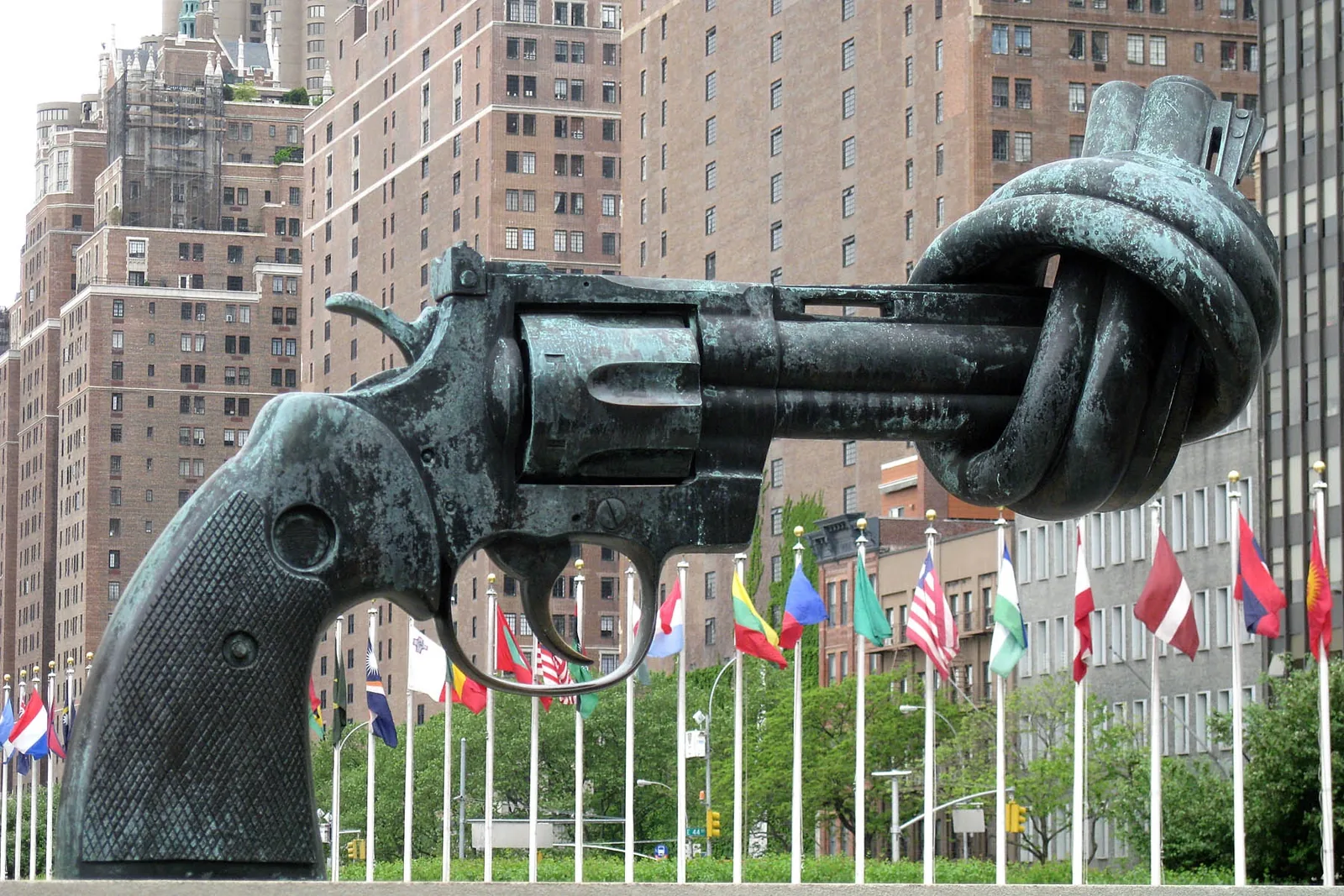
Photo above: Carl Fredrik Reuterswärd’s Non-Violence outside UN Headquarters in New York. Kirill Levin, CC BY-NC-SA 2. Jan Oberg November 3, 2026 I am happy to be published in Horizons which is produced by the Center for International Relations and Sustainable Development, CIRSD, in Belgrade. My contribution brings out a radical re-thinking of what concepts such as defence, security, deterrence – and peace – may mean if we want to create a more peaceful world. It also summarises a few things I have been working with the last few decades. Please read it here Og her er den på dansk, takket være Johnny Baltzersens lynhurtige oversættelse
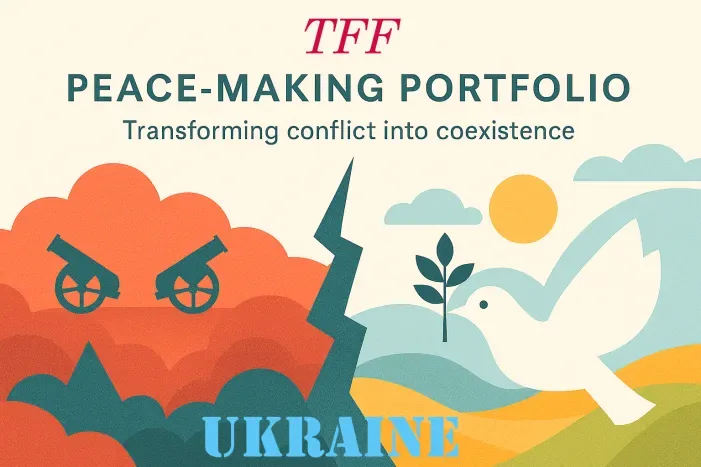
UNITE-tillid, DREAM-velstand og andre konstruktive komponenter Normally we publish articles in English here. But this is a translation of a very important TFF document that should reach as many as possible in Denmark since this country’s government has been one of the most hardline in Europe and, up till now at least, has refused to use diplomacy and, instead, spent tremendous sums on arming Ukraine with the express goal of defeating Russia. Thus this – unique – article is in Danish. Vi er Johnny Baltzersen og hans Fælles Sikkerhed – Fælles Fremtid på Substack overmåde taknemmelige for at have oversat og publiceret TFF’s 2025-portfølje for fredsidéer med henblik på Ukraines fremtid. Vi håber den nu kan nå mange flere danskere – som også vil sprede den og skabe debat – nu den danske regerings og folketingspartiernes politik på dette område siden 2022 står nu – forudsigeligt – ved vejs ende....

Recent Articles

Serious but also a lot of laughs and positive energy. Because peace is also about conviviality and enchantment… Jan Oberg, TFF director November 16, 2026 This is a long (129 minutes) conversation with me. We cover very many, also personal, issues that makes a somewhat unusual media event. I am very grateful to Flemming Blicher for giving me this opportunity. I can’t remember any channel or editor who spent as much time as he did preparing it – including also asking me to answer a series of pre-interview questions, which are now posted under the conversation. If you sympathise with its content, please share it. Watch it here
A Message from Jan Oberg November 6, 2026 Over the past fifty years, I have devoted roughly 175,000 hours to research and public education for a more peaceful world: thinking, researching, writing, organising, publishing, debating, maintaining websites, corresponding, reaching out, leading a foundation, work in conflict and war zones, professorships, teaching courses and giving public lectures and doing media work. In short, ten hours a day, seven days a week, for half a century. The focus was on international political peace – analysing and trying to stop wars, address underlying conflicts and making alternative peace plans – at the desk and on the ground. Important as that has been and remains, it is only one kind of peace and it is now in a tragic militarist state compared with what it could have been.  Lately, however, I have found myself thinking about a concept from economics as well as everyday...
Photo above: Carl Fredrik Reuterswärd’s Non-Violence outside UN Headquarters in New York. Kirill Levin, CC BY-NC-SA 2. Jan Oberg November 3, 2026 I am happy to be published in Horizons which is produced by the Center for International Relations and Sustainable Development, CIRSD, in Belgrade. My contribution brings out a radical re-thinking of what concepts such as defence, security, deterrence – and peace – may mean if we want to create a more peaceful world. It also summarises a few things I have been working with the last few decades. Please read it here Og her er den på dansk, takket være Johnny Baltzersens lynhurtige oversættelse

TFF on Substack

Discover and subscribe to more peace materials on TFF Substack

Most Popular

Serious but also a lot of laughs and positive energy. Because peace is also about conviviality and enchantment… Jan Oberg, TFF director November 16, 2026 This is a long (129 minutes) conversation with me. We cover very many, also personal, issues that makes a somewhat unusual media event. I am very grateful to Flemming Blicher for giving me this opportunity. I can’t remember any channel or editor who spent as much time as he did preparing it – including also asking me to answer a series of pre-interview questions, which are now posted under the conversation. If you sympathise with its content, please share it. Watch it here
A Message from Jan Oberg November 6, 2026 Over the past fifty years, I have devoted roughly 175,000 hours to research and public education for a more peaceful world: thinking, researching, writing, organising, publishing, debating, maintaining websites, corresponding, reaching out, leading a foundation, work in conflict and war zones, professorships, teaching courses and giving public lectures and doing media work. In short, ten hours a day, seven days a week, for half a century. The focus was on international political peace – analysing and trying to stop wars, address underlying conflicts and making alternative peace plans – at the desk and on the ground. Important as that has been and remains, it is only one kind of peace and it is now in a tragic militarist state compared with what it could have been.  Lately, however, I have found myself thinking about a concept from economics as well as everyday...
Photo above: Carl Fredrik Reuterswärd’s Non-Violence outside UN Headquarters in New York. Kirill Levin, CC BY-NC-SA 2. Jan Oberg November 3, 2026 I am happy to be published in Horizons which is produced by the Center for International Relations and Sustainable Development, CIRSD, in Belgrade. My contribution brings out a radical re-thinking of what concepts such as defence, security, deterrence – and peace – may mean if we want to create a more peaceful world. It also summarises a few things I have been working with the last few decades. Please read it here Og her er den på dansk, takket være Johnny Baltzersens lynhurtige oversættelse
Read More
Screenshot 2026-11-10 174455
Serious but also a lot of laughs and positive energy. Because peace is also about conviviality and enchantment… Jan Oberg, TFF director November 16, 2026 This is a long (129 minutes) conversation with me. We cover very many, also personal, issues that makes a somewhat unusual media event. I am very grateful to Flemming Blicher for giving me this opportunity. I can’t remember any channel or editor who spent as much time as he did preparing it – including also asking me to answer a series of pre-interview questions, which are now posted under the conversation. If you sympathise with its content, please share it. Watch it here
AbstractVision_2017_#1_800 (kopia)
A Message from Jan Oberg November 6, 2026 Over the past fifty years, I have devoted roughly 175,000 hours to research and public education for a more peaceful world: thinking, researching, writing, organising, publishing, debating, maintaining websites, corresponding, reaching out, leading a foundation, work in conflict and war zones, professorships, teaching courses and giving public lectures and doing media work. In short, ten hours a day, seven days a week, for half a century. The focus was on international political peace – analysing and trying to stop wars, address underlying conflicts and making alternative peace plans – at the desk and on the ground. Important as that has been and remains, it is only one kind of peace and it is now in a tragic militarist state compared with what it could have been.  Lately, however, I have found myself thinking about a concept from economics as well as everyday...
knotted gun
Photo above: Carl Fredrik Reuterswärd’s Non-Violence outside UN Headquarters in New York. Kirill Levin, CC BY-NC-SA 2. Jan Oberg November 3, 2026 I am happy to be published in Horizons which is produced by the Center for International Relations and Sustainable Development, CIRSD, in Belgrade. My contribution brings out a radical re-thinking of what concepts such as defence, security, deterrence – and peace – may mean if we want to create a more peaceful world. It also summarises a few things I have been working with the last few decades. Please read it here Og her er den på dansk, takket være Johnny Baltzersens lynhurtige oversættelse
TFFPortfolioVign
UNITE-tillid, DREAM-velstand og andre konstruktive komponenter Normally we publish articles in English here. But this is a translation of a very important TFF document that should reach as many as possible in Denmark since this country’s government has been one of the most hardline in Europe and, up till now at least, has refused to use diplomacy and, instead, spent tremendous sums on arming Ukraine with the express goal of defeating Russia. Thus this – unique – article is in Danish. Vi er Johnny Baltzersen og hans Fælles Sikkerhed – Fælles Fremtid på Substack overmåde taknemmelige for at have oversat og publiceret TFF’s 2025-portfølje for fredsidéer med henblik på Ukraines fremtid. Vi håber den nu kan nå mange flere danskere – som også vil sprede den og skabe debat – nu den danske regerings og folketingspartiernes politik på dette område siden 2022 står nu – forudsigeligt – ved vejs ende....
JoGSS-Silent
Jan Oberg TFF director October 28, 2026 Exactly one month has now passed since I published my criticism of the introduction to the special issue on Johan Galtung published by the Journal of Global Security Studies, JoGSS, and of Tor Egil Førland’s chapter about Galtung which serves as a preview to his forthcoming biography of Galtung to be published by PRIO. See the original on The Transnational here and the same article on TFF Substack with many general and critical comments and, in particular, the people who decided to withdraw from the biography project in protest. The special issue itself was extraordinary. It was devoted to the intellectual legacy of one of the founders of peace research and contained a number of strong assessments of his personality, scholarship, intellectual trajectory, and public role. Such assessments are, of course, entirely legitimate. No scholar is beyond criticism, and neither was Johan Galtung....
Screenshot 2026-10-26 115647
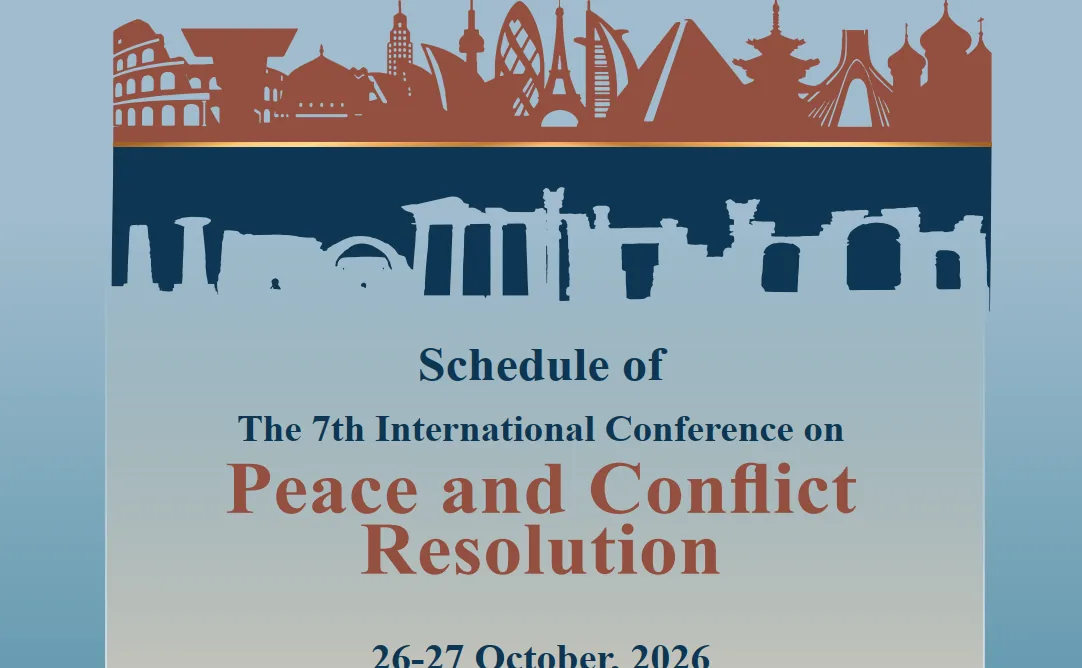
An aspect of Iran’s culture and civilisation you’ve probably never heard about. Don’t be surprised if the US and Israel also try to bomb them. Jan ObergTFF director October 26, 2026 Today – under the “USraeli” threat of new “annihilating” bombings – opens the 7th International Conference on Peace and Conflict Resolution at Tehran’s University. As far as I can tell, this is the only permanent, advanced peace research institution in West Asia/the Middle East. Perhaps more countries in that region could be inspired? I mean, how many military “security” institutes and military academies do they have? Many peace research institutes and university departments have been established since the 1950s in the West. They are now all under attack; some have closed down, some have gone mainstream, yet others kept the name but do nothing to research peace and disseminate results or advice; instead, they cooperate with militarism’s platforms such...