ACURA ViewPoint: Krishen Mehta: The Ukraine War viewed from the Global South

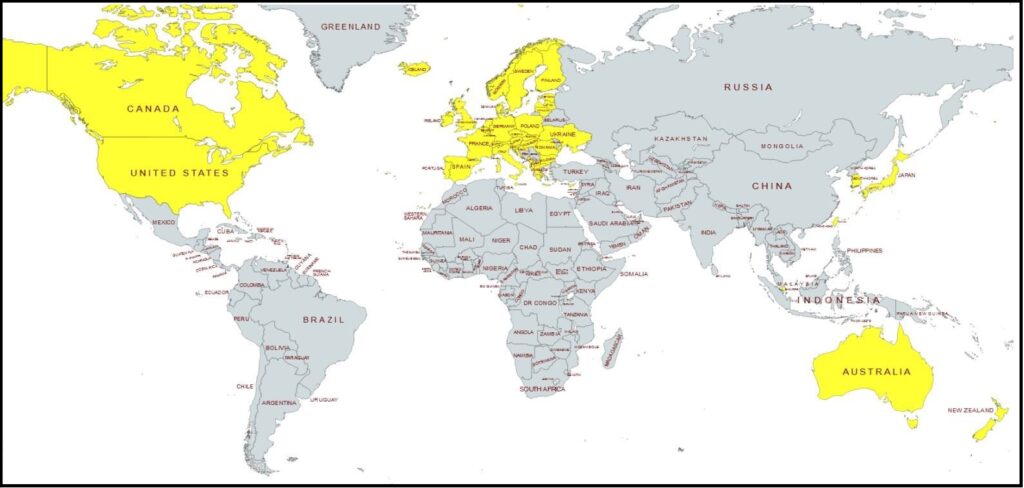
Map Shows Countries That Support Western Govt Sanctions Against Russia vs Those Who Do Not

By Krishen Mehta

February 22, 2023

In October 2022, about eight months after the beginning of the war in Ukraine, the University of Cambridge in the UK harmonized surveys that asked the inhabitants of 137 countries about their views of the West, Russia, and China. The findings in the combined study are robust enough to demand our serious attention.

  • Of the 6.3 billion people who live outside of the West, 66% feel positively towards Russia, and 70% feel positively towards China.
  • 75% of respondents in South Asia, 68% of respondents in Francophone Africa, and 62% of respondents in Southeast Asia report feeling positively toward Russia.
  • Public opinion of Russia remains positive in Saudi Arabia, Malaysia, India, Pakistan, and Vietnam.

These findings have caused some surprise and even anger in the West. It’s difficult for Western thought leaders to comprehend that two-thirds of the world’s population is just not lining up with the West in this conflict. However, I believe there are five reasons why the Global South is not taking the West’s side. I discuss these reasons in the short essay below. 

Originally published at US-Russia Accord on February 22, 2023

1. The Global South does not believe that the West understands or empathizes with its problems.

India’s foreign minister, S. Jaishankar, summed it up succinctly in a recent interview: “Europe has to grow out of the mindset that Europe’s problems are the world’s problems, but the world’s problems are not Europe’s problems.” Developing countries face many challenges, from the aftermath of the pandemic, the high cost of debt service, and the climate crisis that is ravaging their environments, to the pain of poverty, food shortages, droughts, and high energy prices. Yet the West has barely given lip service to the seriousness of many of these issues, even while insisting that the Global South join it in sanctioning Russia. 

The Covid pandemic is a perfect example. Despite the Global South’s repeated pleas to share intellectual property on the vaccines with the goal of saving lives, no Western nation has been willing to do so. Africa remains to this day the most unvaccinated continent in the world. African nations have the manufacturing capability to make the vaccines, but without the necessary intellectual property, they remain dependent on imports. 

But help did come from Russia, China, and India. Algeria launched a vaccination program in January 2021 after it received its first batch of Russia’s Sputnik V vaccines. Egypt started vaccinations after receiving China’s Sinopharm vaccine at about the same time, while South Africa procured a million doses of AstraZeneca from the Serum Institute of India.

In Argentina, Sputnik became the backbone of the national vaccine program. This all happened while the West was using its financial resources to buy millions of doses in advance, then often destroying them when they expired. The message to the Global South was clear — the pandemic in your countries is your problem, not ours. 

2. History matters: who stood where during colonialism and after independence? 

Many countries in Latin America, Africa, and Asia view the war in Ukraine through a different lens than the West. They see their former colonial powers regrouped as members of the Western alliance. This alliance — for the most part, members of the European Union and NATO or the closest allies of the US in the Asia-Pacific region — makes up the countries that have sanctioned Russia. By contrast, many countries in Asia, and almost all countries in the Middle East, Africa, and Latin America, have tried to remain on good terms with both Russia and the West, shunning sanctions against Russia. Could this be because they remember their history at the receiving end of the West’s colonial policies, a trauma that they still live with but which the West has mostly forgotten?

Nelson Mandela often said that it was the Soviet Union’s support, both moral and material, that helped inspire South Africans to overthrow the Apartheid regime. Because of this, Russia is still viewed in a favorable light by many African countries. And once independence came for these countries, it was the Soviet Union that supported them, despite its own limited resources. Egypt’s Aswan Dam, completed in 1971, was designed by the Moscow-based Hydro Project Institute and financed in large part by the Soviet Union. The Bhilai Steel Plant, one of the first large infrastructure projects in newly independent India, was set up by the USSR in 1959. 

Other countries also benefited from the political and economic support provided by the former Soviet Union, including Ghana, Mali, Sudan, Angola, Benin, Ethiopia, Uganda, and Mozambique. On February 18, 2023, at the African Union Summit in Addis Ababa, Ethiopia, the foreign minister of Uganda, Jeje Odongo, had this to say: “We were colonized and forgave those who colonized us. Now the colonizers are asking us to be enemies of Russia, who never colonized us. Is that fair? Not for us. Their enemies are their enemies. Our friends are our friends.”

Rightly or wrongly, present-day Russia is seen by many countries in the Global South as an ideological successor to the former Soviet Union. Fondly remembering the USSR’s help, they now view Russia in a unique and often favorable light. Given the painful history of colonization, can we blame them?

3. The war in Ukraine is seen by the Global South as mainly about the future of Europe rather than the future of the entire world.

The history of the Cold War has taught developing countries that getting embroiled in great power conflicts carries enormous risks but returns scant, if any, rewards. As a consequence, they view the Ukraine proxy war as one that is more about the future of European security than the future of the entire world. From the Global South’s perspective, the Ukraine war seems to be an expensive distraction from its own most pressing issues. These include higher fuel prices, rising food prices, higher debt service costs, and more inflation, all of which Western sanctions against Russia have greatly aggravated.

A recent survey published by Nature Energy states that up to 140 million people could be pushed into extreme poverty by the soaring energy prices seen over the past year. High energy prices not only directly impact energy bills — they also lead to upward price pressures along supply chains and ultimately on consumer items, including food and other necessities. This across-the-board inflation inevitably hurts developing countries much more than the West.  

The West can sustain the war “as long as it takes.” They have the financial resources and the capital markets to do so, and of course they remain deeply invested in the future of European security. But the Global South does not have the same luxury, and a war for the future of security in Europe has the potential to devastate the security of the entire world. The Global South is alarmed that the West is not pursuing negotiations that could bring this war to an early end, beginning with the missed opportunity in December 2021, when Russia proposed revised security treaties for Europe that could have prevented the war but which were rejected by the West.

The peace negotiations of April 2022 in Istanbul were also rejected by the West in part to “weaken” Russia. Now, the entire world — but especially the developing world — is paying the price for an invasion that the Western media like to call “unprovoked” but which likely could have been avoided, and which the Global South has always seen as a local rather than an international conflict.

4. The world economy is no longer dominated by America or led by the West. The Global South now has other options.

Several countries in the Global South increasingly see their futures as tied to countries that are no longer in the Western sphere of influence. Whether this view reflects an accurate perception of the shifting balance of power or wishful thinking is partially an empirical question, so let’s look at some metrics.

The US share of global output declined from 21 percent in 1991 to 15 percent in 2021, while China’s share rose from 4% to 19% during the same period. China is the largest trading partner for most of the world, and its GDP in purchasing power parity already exceeds that of the US. The BRICS (Brazil, Russia, China, India, and South Africa) had a combined GDP in 2021 of $42 trillion, compared with $41 trillion in the US-led G7. Their population of 3.2 billion is more than 4.5 times the combined population of the G7 countries, which stands at 700 million. 

The BRICS are not imposing sanctions on Russia nor supplying arms to the opposing side. Russia is one of the biggest suppliers of energy and foodgrains for the Global South, while China’s Belt and Road Initiative remains a major supplier of financing and infrastructure projects. When it comes to financing, food, energy, and infrastructure, the Global South must rely more on China and Russia more than on the West.

The Global South also sees the Shanghai Cooperation Organization expanding, more countries wanting to join the BRICS, and some countries now trading in currencies that move them away from the dollar, the Euro, or the West. Meanwhile, some countries in Europe are risking deindustrialization thanks to higher energy costs. This reveals an economic vulnerability in the West that was not so evident before the war. With developing countries having an obligation to put the interests of their own citizens first, is it any wonder that they see their future more and more tied to countries outside the West?

5. The “rules-based international order” is losing credibility and in decline.

The vaunted “rules-based international order” is the bulwark of post–World War II liberalism, but many countries in the Global South see it as having been conceived by the West and imposed unilaterally on other countries. Few if any non-Western countries ever signed on to this order. The South is not opposed to a rules-based order, but rather to the present content of these rules as conceived by the West.

But one must also ask, does the rules-based international order apply even to the West?

For decades now, many in the Global South have seen the West as having its way with the world without much concern for playing by the rules. Several countries were invaded at will, mostly without United Nations Security Council authorization. These include the former Yugoslavia, Iraq, Afghanistan, Libya, and Syria. Under what “rules” were those countries attacked or devastated, and were those wars provoked or unprovoked? Julian Assange is languishing in prison and Ed Snowden remains in exile, both for having the courage (or perhaps the audacity) to expose the truths behind these and similar actions.  

Even today, sanctions imposed on over 40 countries by the West impose considerable hardship and suffering. Under what international law or “rules-based order” did the West use its economic strength to impose these sanctions? Why are the assets of Afghanistan still frozen in Western banks while the country is facing starvation and famine? Why is Venezuelan gold still held hostage in the UK while the people of Venezuela are living at subsistence levels? And if Sy Hersh’s expose is true, under what ‘rules-based order’ did the West destroy the Nord Stream pipelines? 

A paradigm shift appears to be taking place. We’re moving from a Western-dominated to a more multipolar world. The war in Ukraine has made more evident the international divergences that are driving this shift. Partly because of its own history, and partly because of emerging economic realities, the Global South sees a multipolar world as a preferable outcome, one in which its voice is more likely to be heard. 

President Kennedy ended his American University speech in 1963 with the following words: “We must do our part to build a world of peace where the weak are safe and the strong are just. We are not helpless before that task or hopeless for its success. Confident and unafraid, we must labor on towards a strategy of peace.” That strategy of peace was the challenge before us in 1963, and it remains a challenge for us today. The voices for peace, including those of the Global South, need to be heard.

Originally published at US-Russia Accord on February 22, 2023

About the author

Krishen Mehta is a member of the Board of the American Committee for US Russia Accord, and a Senior Global Justice Fellow at Yale University. 

Please help TFF remain truly independent by contributing if you benefited from this article

One Response

Related Posts

The agreement is catastrophic both because of what it says and what it doesn’t mention. It reduces further the major asset of security policies: Freedom of action. Jan Oberg TFF director September 25, 2026 A couple of hours before the agreement was signed on September 22, 2026, I published the following 13 hypotheses about what it would most likely contain on TFF Substack (in English). I was wrong on only the first point. Contrary to what Trump had written on his Truth Social platform, it does not appear to come into force immediately. In fact, it turned out to be worse than even I had anticipated. After these hypotheses now come a number of reflections in light of what the agreement actually contains, and does not contain, as well as the way in which it has generally been presented by major media outlets and by the public-service broadcaster DR. My...
Jan Oberg May 15, 2026 Go to this Fox News page and scroll the whole way down: President Donald Trump tells the world that his meeting with President Xi Jinping yielded a lot of very concrete political and economic results – of course, only where the Chinese side, according to him, agreed with him. He does not mention the Taiwan issue, but Secretary of State, Marco Rubio, says that it did not feature prominently in their talks and that the US policy on Taiwan has not changed. Then go to China Daily – or Global Times – and you will see that for the Chinese it is framework, principles, structure of cooperation etc. that matters – all embedded in the overall idea of “constructive bilateral relationship of strategic stability.” Nowhere is any concrete agreement or deal – all that Trump refers to – mentioned. At the general level, this gives you insights into the very different social...
Jan Oberg, TFF director April 9, 2026 I was recently invited to have a good, long talk about the world – and, of course, about peace too – with Boris Malagurski on his Weight of Chains Channel on YouTube. It was a real joy and seems to have been greatly appreciated by the viewers too. Mr Malagurski and I shall of course be grateful if you share this conversation in your circles – of course, only if you like what you see and hear 😉☮️ And remember that this one – like hundreds of others with TFF Associates – can be enjoyed at our TFF Video Collection.

Recent Articles

Tony Robinson October 4, 2026 Violence is easy to recognise when someone is being beaten, shot or killed. It becomes more difficult when nobody is holding a weapon. Poverty, discrimination, exploitation and repression can restrict a human life just as effectively, although they do so in very different ways and with very different consequences. Simply adding more categories to an ever-growing list of forms of violence does not really solve the problem. The more interesting question is what all these different situations have in common and why it makes sense to describe them using the same word. Human beings do not simply react to what happens around them. They remember the past, imagine things that do not yet exist, make plans and undertake projects. Workers organise because they imagine different working conditions; people migrate because they imagine another life somewhere else; social movements emerge because people refuse to accept the...
It’s a matter of principles, courage, vision and pulling together – while the militarist world is falling apart… Peter Langille October 3, 2026 “Here, then, is the problem which we present to you, stark and dreadful and inescapable: Shall we put an end to the human race; or shall mankind renounce war?”The Bertrand Russell—Albert Einstein Manifesto, July 9, 1955 ⁕ The forecast for what’s ahead is worrisome. The sharp rise in armed conflicts over the past three years is adding to what was already the highest level in over seventy years. Genocides, which should be prevented are supported. A shared climate emergency that jeopardises survival is ignored. Diverse polls now suggest that people are war-weary, worried and interested in a more effective United Nations. And, there are viable policy options for a more secure world! Yet governments are doubling-down, betting on more war and investing heavily. If current trends persist,...
Johan Galtung 1930-2024October 2015 Published here on October 3, 2026 Let us focus on Civilization for conflict analysis and remedies. Major forms of disorder use violence; war is state organized violence. The most belligerent states are the United States of America and Israel, both with civilization roots. National Evangelism, the US Protestant Christian civilization– more national than evangelical–justifies US warfare as exceptionalism of a people chosen by God, with a manifest destiny to run the world. Orthodox Judaism justifies Israeli warfare to conquer and expand from Nile to Euphrates as a religious right and duty to the Eternal One. The third most belligerent country, the UK, no longer believes it is God-chosen but chosen by the USA; not quite the same but something. But the root cause of global disorder lies in the Occident–with Islam–seeing itself as the single, universal civilization valid for all at all times, all others being...

TFF on Substack

Discover and subscribe to more peace materials on TFF Substack

Most Popular

Tony Robinson October 4, 2026 Violence is easy to recognise when someone is being beaten, shot or killed. It becomes more difficult when nobody is holding a weapon. Poverty, discrimination, exploitation and repression can restrict a human life just as effectively, although they do so in very different ways and with very different consequences. Simply adding more categories to an ever-growing list of forms of violence does not really solve the problem. The more interesting question is what all these different situations have in common and why it makes sense to describe them using the same word. Human beings do not simply react to what happens around them. They remember the past, imagine things that do not yet exist, make plans and undertake projects. Workers organise because they imagine different working conditions; people migrate because they imagine another life somewhere else; social movements emerge because people refuse to accept the...
It’s a matter of principles, courage, vision and pulling together – while the militarist world is falling apart… Peter Langille October 3, 2026 “Here, then, is the problem which we present to you, stark and dreadful and inescapable: Shall we put an end to the human race; or shall mankind renounce war?”The Bertrand Russell—Albert Einstein Manifesto, July 9, 1955 ⁕ The forecast for what’s ahead is worrisome. The sharp rise in armed conflicts over the past three years is adding to what was already the highest level in over seventy years. Genocides, which should be prevented are supported. A shared climate emergency that jeopardises survival is ignored. Diverse polls now suggest that people are war-weary, worried and interested in a more effective United Nations. And, there are viable policy options for a more secure world! Yet governments are doubling-down, betting on more war and investing heavily. If current trends persist,...
Johan Galtung 1930-2024October 2015 Published here on October 3, 2026 Let us focus on Civilization for conflict analysis and remedies. Major forms of disorder use violence; war is state organized violence. The most belligerent states are the United States of America and Israel, both with civilization roots. National Evangelism, the US Protestant Christian civilization– more national than evangelical–justifies US warfare as exceptionalism of a people chosen by God, with a manifest destiny to run the world. Orthodox Judaism justifies Israeli warfare to conquer and expand from Nile to Euphrates as a religious right and duty to the Eternal One. The third most belligerent country, the UK, no longer believes it is God-chosen but chosen by the USA; not quite the same but something. But the root cause of global disorder lies in the Occident–with Islam–seeing itself as the single, universal civilization valid for all at all times, all others being...
Read More
Living-Peace-Sign-Budapest-copy
Tony Robinson October 4, 2026 Violence is easy to recognise when someone is being beaten, shot or killed. It becomes more difficult when nobody is holding a weapon. Poverty, discrimination, exploitation and repression can restrict a human life just as effectively, although they do so in very different ways and with very different consequences. Simply adding more categories to an ever-growing list of forms of violence does not really solve the problem. The more interesting question is what all these different situations have in common and why it makes sense to describe them using the same word. Human beings do not simply react to what happens around them. They remember the past, imagine things that do not yet exist, make plans and undertake projects. Workers organise because they imagine different working conditions; people migrate because they imagine another life somewhere else; social movements emerge because people refuse to accept the...
b54a1f10-8c65-4f0b-9dd5-4abc0a7d04cc_2659x2659
It’s a matter of principles, courage, vision and pulling together – while the militarist world is falling apart… Peter Langille October 3, 2026 “Here, then, is the problem which we present to you, stark and dreadful and inescapable: Shall we put an end to the human race; or shall mankind renounce war?”The Bertrand Russell—Albert Einstein Manifesto, July 9, 1955 ⁕ The forecast for what’s ahead is worrisome. The sharp rise in armed conflicts over the past three years is adding to what was already the highest level in over seventy years. Genocides, which should be prevented are supported. A shared climate emergency that jeopardises survival is ignored. Diverse polls now suggest that people are war-weary, worried and interested in a more effective United Nations. And, there are viable policy options for a more secure world! Yet governments are doubling-down, betting on more war and investing heavily. If current trends persist,...
010
Johan Galtung 1930-2024October 2015 Published here on October 3, 2026 Let us focus on Civilization for conflict analysis and remedies. Major forms of disorder use violence; war is state organized violence. The most belligerent states are the United States of America and Israel, both with civilization roots. National Evangelism, the US Protestant Christian civilization– more national than evangelical–justifies US warfare as exceptionalism of a people chosen by God, with a manifest destiny to run the world. Orthodox Judaism justifies Israeli warfare to conquer and expand from Nile to Euphrates as a religious right and duty to the Eternal One. The third most belligerent country, the UK, no longer believes it is God-chosen but chosen by the USA; not quite the same but something. But the root cause of global disorder lies in the Occident–with Islam–seeing itself as the single, universal civilization valid for all at all times, all others being...
Screenshot 2026-10-02 011738
Jan ObergPhD, director, The Transnational Foundation for Peace and Future Research, TFFLund, Sweden October 2, 2026 This is my full original manuscript. The Chinese Academy of Social Science, CASS, makes two publications out if it. 1. China’s Five-year plan emphasized the capabilities of basic research and original innovation. It is regarded as the goal of the future social development, which, as required, should be significantly enhanced. Can you comment on the importance of original innovation in research and academic study? I believe it is easier to define “original innovation” in the natural sciences than in social sciences. The breaking points of what constitutes something new, or innovative, are not quite as sharp in the latter. But in both fields it is about opening up something that was closed, unseen, unexplored before – making manifest what was earlier latent. Innovations come in many forms and shapes – naming something that was not...
arctic-circle-map
The agreement is catastrophic both because of what it says and what it doesn’t mention. It reduces further the major asset of security policies: Freedom of action. Jan Oberg TFF director September 25, 2026 A couple of hours before the agreement was signed on September 22, 2026, I published the following 13 hypotheses about what it would most likely contain on TFF Substack (in English). I was wrong on only the first point. Contrary to what Trump had written on his Truth Social platform, it does not appear to come into force immediately. In fact, it turned out to be worse than even I had anticipated. After these hypotheses now come a number of reflections in light of what the agreement actually contains, and does not contain, as well as the way in which it has generally been presented by major media outlets and by the public-service broadcaster DR. My...
girl-5894831_1280
Below are TFF-related media mentions, comments, videos and social media posts published elsewhere but not on this homepage. We happen to catch and list only a fraction. Regarding video comments and debates, we recommend that you go to the TFF Video Channel on Substack where many of them are reproduced. Jan Oberg is a contributor to China Daily – 52 million daily clicks – and Global Times, CGTN and CCTV (the national television), China Investment, Xinhua News Agency and several others. Articles and videos on these media very often multiply into countless Chinese (and Western media) that re-post them from these main media. Thanks to The China Academy, his analyses, interviews and comments are frequently posted on YouTube channels such as Thinkers Forum and Wave Media. These videos are often re-posted on Bilibili (China’s YouTube), the China Content Center on TikTok, and on the Chinese edition of TikTok, Douyin.com. This means reaching hundreds of millions of viewers worldwide over a year. While there are too many to catch on all these...