
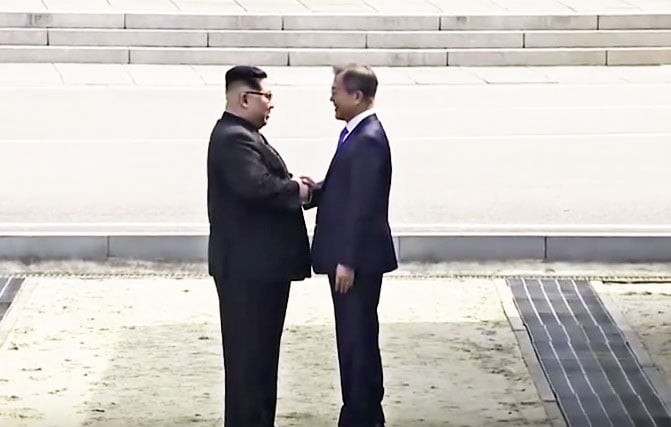
Please watch the video below carefully. You’ll see what could – could, and most likely will – become a piece of world peace history. Note the body language of the two leaders – warm smiles and long handshakes. In spite of being one and the same nation, they meet at the hardest border in the world.

Why is it so? Because everybody else around – the US, Japan, Russia, China – to varying degrees want them to be divided and feel threatened by their possible unification. And yes, a unified Korea would be a formidable economic power but a huge, dangerous conflict would be gone, the US could withdraw, Japan would get a chance to reconciliate in substantive terms.

What is most amazing in this clip is that Kim first steps over the border line into the South. Then – seemingly surprising Moon – invites Moon to step into the North, hand in hand. Hear the people nearby applauding.

This is historic peace-making in-the-making.

So much more convincing and promising than today’s Western/NATO norm: “peace” by violence, imposed from the outside. By us/US.

Here are two statesmen and the Western derogative image of Kim must now be a thing of the past.

I’m personally very tired of all the media and political commentators who, without a second thought, support NATO countries’ bombing in the name of peace, democracy and human rights – today must say that it could all be a ploy by “the Rocket Man”. Kim and the people around him are obviously very competent politicians with a longterm strategy.

In these otherwise dark times, let’s be hopeful that peace is what it will really unfold – a peace that takes place without the US or other foreign parties. It’s genuinely Korean thanks to both historical developments but also two personalities who both seem to have the right attitude and build on what all conflict-resolution must focus on: An identification of common or overlapping interests combined with a view of the future that is so much more benefit than continue enmity.

• •

I shall never forget when, about 20 years, ago I participated in an international peace conference in Seoul – and also visited this border and De-Militarized Zone (DMZ). On the last day there was a delightful dinner in a banquet hall and, as an end to the conference, the Korean participants rose and sang the South Korean national anthem “Aegukga” which, I was told, should be interpeted as expressive of the one-ness, the unity of the Korean people. Both sides!

I can’t say how many, but many in that hall had tears in their eyes, some crying and their voices trembling. I felt both surprised and very moved by the intense emotional charge there and then.

While there may be many in the two Koreas who are hesitant to unification, particularly among the younger generations, I believe the large majority want it, at least in a step-by-step process. The very least the rest of the world should do is to respect that one people has a right to be re-unified if they so want and that  nobody has a right to deny them that right.

• •

Body language and symbol politics has changed the entire world before. When Gandhi came to the Dandi coast at the end of his long Salt March, he picked up salt from the ground, held it up and said: “This is ours” – in defiance of the British colnial administration that maintained that this salt – too – belonged to Britain. Seventeen years later, India became independent.

When German chancellor, Willy Brandt, one of the greatest politicians in my generation – knelt down at the monument in Warsaw, spontaneously, to apologize for the crimes of Nazi Germany he changed European history. He did what very few politicians have the civil courage to do: he apologised for his country and his people’s wrongdoing to another people.

Brandt thereby also opened the way for his next brilliant move for Europe – the detente policy with the Soviet Union (something no Western politician would even think of today vis-a-vis Russia) and the “Ostpolitik” that lead eventually also to unification of the two Germanys.

• •

If what we saw this morning in Korea is allowed – allowed by all the others – to find its own path, it won’t take decades before we can see one of the world’s hardest conflicts de-escalate and trust and cooperation develop and eventually what most Korean people deeply want: to be the one country, the unified nation, they have a historical, collective human right to become.

Could every body else please leave the Koreans alone and in peace to do together what they want.

And could the West, the U.S. in particular, please be supportive of genuine, indigenous peace process and, as a goodwill step, withdraw just a few of its military vessels from the region – but many enough to make it a visible goodwill gesture.


There is also this video by Washington Post

PS It’s fun how feet obviously can play a role in peace-making – but guided by good will and expression of humanity. Gandhi walked about 300 kilometres on his and achieved independence. Brandt used his feet and knees to change Europe. And this morning the two Korean leaders took steps towards peace by inviting each other to set foot on the territory of the other.


Readings

The Joint Declaration issued at the summit, April 27, 2018



Peace & future researcher + ‌Art Photographer

6 Responses

  1. Don’t ignore the role of President Moon. He started breaking the ice on personal contact with the invitation to the winter games and has a much bigger role than ascribed to him in this piece.- That Kim steps over the line first is not the first big step.

  2. A beautiful and thoughtful article about a historic and heartwarming event. Gandhi once said that people’s natural inclination is towards love and peace, and this is why we need military academies and a great deal of propaganda and training to make people kill each other. Let’s hope that this is the beginning of the unification of Korea, as it was one country and was torn apart by violent means that killed millions and destroyed a great deal of the country. If the reason for the presence of US forces in the South was to prevent the threat from the north, now that the two leaders have met in friendship and coexistence foreign forces should leave and allow the two states to work out their differences among themselves. May these touching scenes provide an example for other adversaries such as Iran and Saudi Arabia and Israel and her neighbours to work towards peace and coexistence, rather than threats and war.

  3. Dear Jan – Thank for an insightful article and your hopeful thinking related to this historical event and promise towards a peceful unification of Korea. Warm regards Henrik

  4. Moon is watching what is going on in Syria. I think the west will never accept defeat there. Moon decided to give in. Iran will be next in line. They can do it like Moon or like in Syria, with the help of Russia. It could seem like conspiracy theorist were right after all. A one world government as stated by George Bush 11 september 1991. Can it be interpreted differently? I can’t at the moment. Peace comes with a prize.

Related Posts

Below are TFF-related media mentions, comments, videos and social media posts published elsewhere but not on this homepage. We happen to catch and list only a fraction. Regarding video comments and debates, we recommend that you go to the TFF Video Channel on Substack where many of them are reproduced. Jan Oberg is a contributor to China Daily – 52 million daily clicks – and Global Times, CGTN and CCTV (the national television), China Investment, Xinhua News Agency and several others. Articles and videos on these media very often multiply into countless Chinese (and Western media) that re-post them from these main media. Thanks to The China Academy, his analyses, interviews and comments are frequently posted on YouTube channels such as Thinkers Forum and Wave Media. These videos are often re-posted on Bilibili (China’s YouTube), the China Content Center on TikTok, and on the Chinese edition of TikTok, Douyin.com. This means reaching hundreds of millions of viewers worldwide over a year. While there are too many to catch on all these...
Jan Oberg TFF director October 13, 2026 According to Alfred Nobel’s will, the Nobel Peace Prize shall be awarded: ”to the person who has done the most or best to advance fellowship among nations, the abolition or reduction of standing armies, and the establishment and promotion of peace congresses.” Further down, he also expresses how the prize for the “champions of peace” shall be decided: “that for champions of peace by a committee of five persons to be selected by the Norwegian Storting. Alfred Nobel’s will is remarkably short and clear. But few seem to have read it. Nobel did not say that the committee itself should consist of members of parliament. He entrusted the Storting with appointing five persons. In principle, it could have selected diplomats, mediators, peace researchers, conflict-resolution specialists, or other individuals with recognised expertise in matters of peace from around the world. Instead, the Storting gradually...
The Quest for Humane Survival Richard Falk Professor emeritus, Princeton UniversityTFF Associate since 1986October 12, 2026 After decades of teaching and writing about international law in academic frameworks that were not institutionally situated within law school environments—at Princeton and the University of California, Santa Barbara—I found myself most receptive to the TWAIL outlook. It has been especially illuminating in clarifying the extent to which international law evolved as a dialogical critique of Europe’s efforts to legitimize its colonial undertakings. In particular, TWAIL has exposed how international law has functioned to legalize the subjugation of Third World peoples, securing conditions for exploitative investment and trade relations, the coercive enforcement of public debts, and an ideology of cultural superiority. TWAIL’s exposure of these economic legacies of colonialism has influenced my understanding of the history and development of international law, broadly conceived, as an ideological project of the Western sub-system of the world...

Recent Articles

Below are TFF-related media mentions, comments, videos and social media posts published elsewhere but not on this homepage. We happen to catch and list only a fraction. Regarding video comments and debates, we recommend that you go to the TFF Video Channel on Substack where many of them are reproduced. Jan Oberg is a contributor to China Daily – 52 million daily clicks – and Global Times, CGTN and CCTV (the national television), China Investment, Xinhua News Agency and several others. Articles and videos on these media very often multiply into countless Chinese (and Western media) that re-post them from these main media. Thanks to The China Academy, his analyses, interviews and comments are frequently posted on YouTube channels such as Thinkers Forum and Wave Media. These videos are often re-posted on Bilibili (China’s YouTube), the China Content Center on TikTok, and on the Chinese edition of TikTok, Douyin.com. This means reaching hundreds of millions of viewers worldwide over a year. While there are too many to catch on all these...
Jan Oberg TFF director October 13, 2026 According to Alfred Nobel’s will, the Nobel Peace Prize shall be awarded: ”to the person who has done the most or best to advance fellowship among nations, the abolition or reduction of standing armies, and the establishment and promotion of peace congresses.” Further down, he also expresses how the prize for the “champions of peace” shall be decided: “that for champions of peace by a committee of five persons to be selected by the Norwegian Storting. Alfred Nobel’s will is remarkably short and clear. But few seem to have read it. Nobel did not say that the committee itself should consist of members of parliament. He entrusted the Storting with appointing five persons. In principle, it could have selected diplomats, mediators, peace researchers, conflict-resolution specialists, or other individuals with recognised expertise in matters of peace from around the world. Instead, the Storting gradually...
The Quest for Humane Survival Richard Falk Professor emeritus, Princeton UniversityTFF Associate since 1986October 12, 2026 After decades of teaching and writing about international law in academic frameworks that were not institutionally situated within law school environments—at Princeton and the University of California, Santa Barbara—I found myself most receptive to the TWAIL outlook. It has been especially illuminating in clarifying the extent to which international law evolved as a dialogical critique of Europe’s efforts to legitimize its colonial undertakings. In particular, TWAIL has exposed how international law has functioned to legalize the subjugation of Third World peoples, securing conditions for exploitative investment and trade relations, the coercive enforcement of public debts, and an ideology of cultural superiority. TWAIL’s exposure of these economic legacies of colonialism has influenced my understanding of the history and development of international law, broadly conceived, as an ideological project of the Western sub-system of the world...

TFF on Substack

Discover and subscribe to more peace materials on TFF Substack

Most Popular

Below are TFF-related media mentions, comments, videos and social media posts published elsewhere but not on this homepage. We happen to catch and list only a fraction. Regarding video comments and debates, we recommend that you go to the TFF Video Channel on Substack where many of them are reproduced. Jan Oberg is a contributor to China Daily – 52 million daily clicks – and Global Times, CGTN and CCTV (the national television), China Investment, Xinhua News Agency and several others. Articles and videos on these media very often multiply into countless Chinese (and Western media) that re-post them from these main media. Thanks to The China Academy, his analyses, interviews and comments are frequently posted on YouTube channels such as Thinkers Forum and Wave Media. These videos are often re-posted on Bilibili (China’s YouTube), the China Content Center on TikTok, and on the Chinese edition of TikTok, Douyin.com. This means reaching hundreds of millions of viewers worldwide over a year. While there are too many to catch on all these...
Jan Oberg TFF director October 13, 2026 According to Alfred Nobel’s will, the Nobel Peace Prize shall be awarded: ”to the person who has done the most or best to advance fellowship among nations, the abolition or reduction of standing armies, and the establishment and promotion of peace congresses.” Further down, he also expresses how the prize for the “champions of peace” shall be decided: “that for champions of peace by a committee of five persons to be selected by the Norwegian Storting. Alfred Nobel’s will is remarkably short and clear. But few seem to have read it. Nobel did not say that the committee itself should consist of members of parliament. He entrusted the Storting with appointing five persons. In principle, it could have selected diplomats, mediators, peace researchers, conflict-resolution specialists, or other individuals with recognised expertise in matters of peace from around the world. Instead, the Storting gradually...
The Quest for Humane Survival Richard Falk Professor emeritus, Princeton UniversityTFF Associate since 1986October 12, 2026 After decades of teaching and writing about international law in academic frameworks that were not institutionally situated within law school environments—at Princeton and the University of California, Santa Barbara—I found myself most receptive to the TWAIL outlook. It has been especially illuminating in clarifying the extent to which international law evolved as a dialogical critique of Europe’s efforts to legitimize its colonial undertakings. In particular, TWAIL has exposed how international law has functioned to legalize the subjugation of Third World peoples, securing conditions for exploitative investment and trade relations, the coercive enforcement of public debts, and an ideology of cultural superiority. TWAIL’s exposure of these economic legacies of colonialism has influenced my understanding of the history and development of international law, broadly conceived, as an ideological project of the Western sub-system of the world...
Read More
girl-5894831_1280
Below are TFF-related media mentions, comments, videos and social media posts published elsewhere but not on this homepage. We happen to catch and list only a fraction. Regarding video comments and debates, we recommend that you go to the TFF Video Channel on Substack where many of them are reproduced. Jan Oberg is a contributor to China Daily – 52 million daily clicks – and Global Times, CGTN and CCTV (the national television), China Investment, Xinhua News Agency and several others. Articles and videos on these media very often multiply into countless Chinese (and Western media) that re-post them from these main media. Thanks to The China Academy, his analyses, interviews and comments are frequently posted on YouTube channels such as Thinkers Forum and Wave Media. These videos are often re-posted on Bilibili (China’s YouTube), the China Content Center on TikTok, and on the Chinese edition of TikTok, Douyin.com. This means reaching hundreds of millions of viewers worldwide over a year. While there are too many to catch on all these...
Nobel-Prize-Plaque
Jan Oberg TFF director October 13, 2026 According to Alfred Nobel’s will, the Nobel Peace Prize shall be awarded: ”to the person who has done the most or best to advance fellowship among nations, the abolition or reduction of standing armies, and the establishment and promotion of peace congresses.” Further down, he also expresses how the prize for the “champions of peace” shall be decided: “that for champions of peace by a committee of five persons to be selected by the Norwegian Storting. Alfred Nobel’s will is remarkably short and clear. But few seem to have read it. Nobel did not say that the committee itself should consist of members of parliament. He entrusted the Storting with appointing five persons. In principle, it could have selected diplomats, mediators, peace researchers, conflict-resolution specialists, or other individuals with recognised expertise in matters of peace from around the world. Instead, the Storting gradually...
law-419057_1280
The Quest for Humane Survival Richard Falk Professor emeritus, Princeton UniversityTFF Associate since 1986October 12, 2026 After decades of teaching and writing about international law in academic frameworks that were not institutionally situated within law school environments—at Princeton and the University of California, Santa Barbara—I found myself most receptive to the TWAIL outlook. It has been especially illuminating in clarifying the extent to which international law evolved as a dialogical critique of Europe’s efforts to legitimize its colonial undertakings. In particular, TWAIL has exposed how international law has functioned to legalize the subjugation of Third World peoples, securing conditions for exploitative investment and trade relations, the coercive enforcement of public debts, and an ideology of cultural superiority. TWAIL’s exposure of these economic legacies of colonialism has influenced my understanding of the history and development of international law, broadly conceived, as an ideological project of the Western sub-system of the world...
images-2
Advocates of nuclear disarmament are regularly dismissed by the champions of nuclear deterrence as naïve and unrealistic, utopian or even irresponsible. Yet this ‘doctrine’ of deterrence, regarded by France as the ‘cornerstone’ of its national security, is based on quasi-religious beliefs, a theory that cannot be proven, risky gambles and fragile assumptions. So much so that one might legitimately ask which side the ‘Care Bears’ are on. Marc FinaudVice-President of Initiatives for Nuclear Disarmament (IDN) October 9, 2026 This article was originally published on Pressenza When it comes to these things being treated as religious concepts, look here. Idealists and realists It was Hubert Védrine, François Mitterrand’s former Foreign Minister, who repeatedly coined the phrase: ‘Europeans are a sort of Care Bears who don’t realise they’re living in Jurassic Park’. He applies this reference to the cartoon for well-behaved children not only to what he regards as weakness or idealism...
8824b09f-33a5-43f9-9fd0-550f28cda24d_1536x1024
What the West Borrowed from Asia and What It Left Behind Jan Krikke October 8, 2026 The article was originally published here In the late 1960s, the musical Hair announced that the Age of Aquarius was dawning. Its opening anthem promised a transformation of human consciousness: an era of peace, harmony and understanding. Half a century later, a familiar echo of that promise is a meditation app offered by your employer. You can find it in the same list of benefits as the pension plan and the gym discount. How did a spiritual revolution become an employee benefit? The answer lies in the history of the movement known as New Age: where it came from, what it borrowed from Asia, and why the meaning of what it borrowed changed in the process. Two definitions will help. New Age is a loose label for a wide range of spiritual practices and...
Screenshot 2026-10-04 210142
Small and different + among the 10% most active + 9,000 texts + 150 Associates + 60 000 a day — and a stubborn belief that peace is smarter and must be secured by peaceful means. In 2026, the Transnational Foundation for Peace and Future Research (TFF) turns 40. On Monday, October 5, 2026, a new TFF homepage will go live — a new gateway to more than 9,000 articles, analyses, research papers and other contributions produced over four decades of independent peace research. But this is not simply a new website. For four decades, TFF has worked from a simple conviction: peace is smarter than militarism and can be brought about by peaceful means. This is not merely an aspiration. It is the principle expressed in the UN Charter and the Gandhian tradition that has guided our work from the beginning. TFF is a research-based, independent and people-financed foundation....





