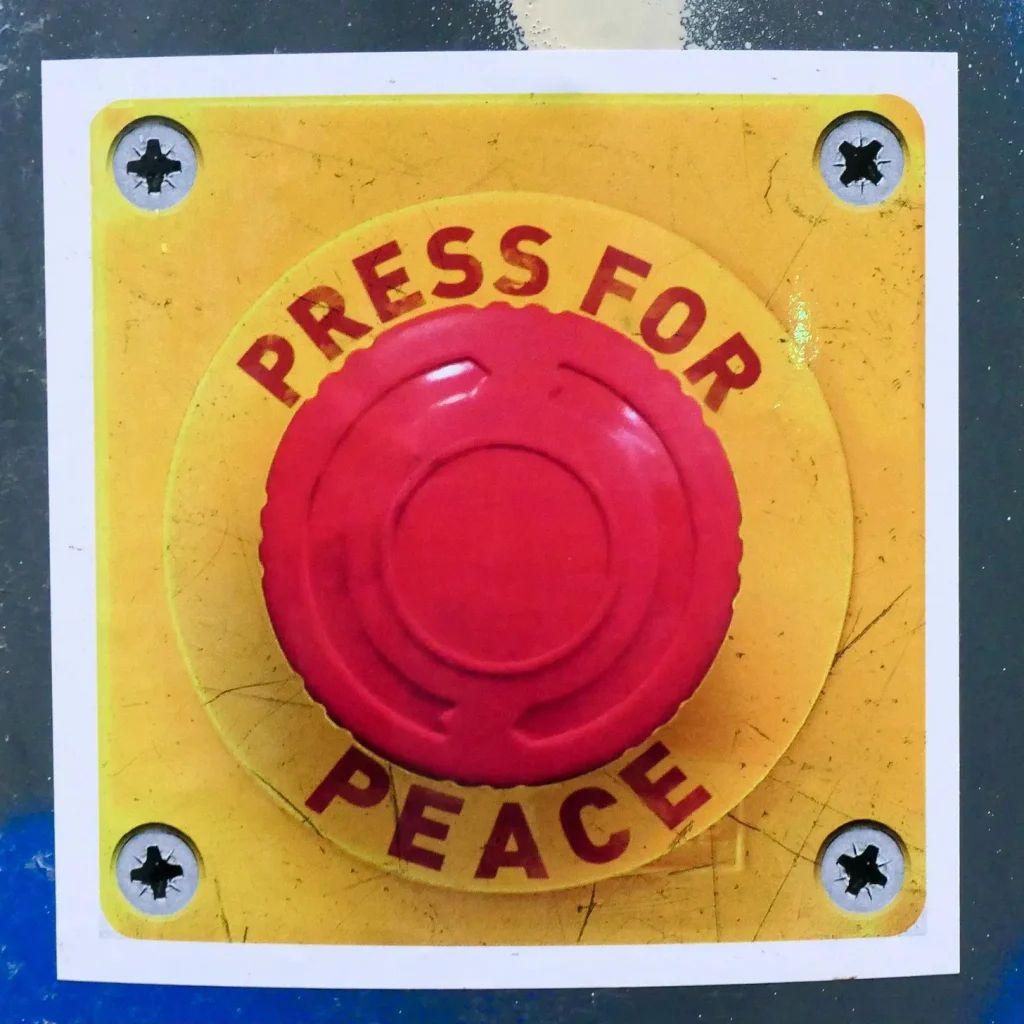
Of course, we can we abolish war before it destroys us!

Peter Langille

October 3, 2026

“Here, then, is the problem which we present to you, stark and dreadful and inescapable: Shall we put an end to the human race; or shall mankind renounce war?”
The Bertrand Russell—Albert Einstein Manifesto, July 9, 1955

⁕

The forecast for what’s ahead is worrisome. The sharp rise in armed conflicts over the past three years is adding to what was already the highest level in over seventy years. Genocides, which should be prevented are supported. A shared climate emergency that jeopardises survival is ignored.

Diverse polls now suggest that people are war-weary, worried and interested in a more effective United Nations. And, there are viable policy options for a more secure world!

Yet governments are doubling-down, betting on more war and investing heavily. If current trends persist, global military spending is projected to reach $6.6 trillion by 2035. Militarism will follow the money, deepening cultures of violence, poverty and extremes.

Overall, the costs are staggering. As reported in the Global Peace Index 2026, “the economic impact of violence on the global economy in 2025 was US$21.8 trillion in purchasing power parity (PPP) terms, equivalent to 10.5 per cent of global GDP, or US$2,657 per person… Military expenditure accounts for 43 per cent of the model at US$9.5 trillion…”

How did it come to this?

Selective interpretations of the past continue to play an unduly influential role. Even with deep interdependence, the 4th-century Roman dictum, “Si vis pacem, para bellum” — “If you want peace, prepare for war” – continues to have a peculiar hold over national security establishments. Conveniently, they overlook that the Roman Empire failed with its fixation on preparing for war, draining its economy and creating enemies until it was overextended and vulnerable. ‘Caveat emptor’ – as with individuals, nations tend to get what they invest in, plan and prepare for.

As early as 1961, President/General Dwight Eisenhower’s farewell address tried to warn of collusion arising from powerful sectors:

“In the councils of government, we must guard against the acquisition of unwarranted influence, whether sought or unsought, by the military-industrial complex. The potential for the disastrous rise of misplaced power exists and will persist.”

The allure of increasing profits and power proved too much to resist. With globalisation and assured funding, this complex expanded into finance, banking and insurance sectors, big oil and gas, telecommunications, logistics, media, academe, surveillance, big data, advanced tech, robotics and AI.

The unwarranted influence now goes unchallenged, diminishing political autonomy to the point where many leaders believe they cannot say “no.” And, this complex depends on violent conflict to ‘keep the old game alive’, to increase profits and control.

Most political leaders know that no amount of military spending can provide a reliable defence or ensure security in the nuclear era. Wars have seldom been winnable over the past 80 years, even for the most powerful.

The ever-higher costs are accompanied by ever-higher risks. Thirty-eight countries still rely on nuclear deterrence, with the constant threat of unacceptable death and destruction. There is no room for error in the current system of mutually assured destruction (MAD). Even a limited nuclear exchange is expected to trigger a ‘nuclear winter’; one that few, if any, will survive.

Today’s circumstances appear vaguely similar to those preceding World War I, which prompted the League of Nations, and those preceding World War II, which led to the United Nations. Rumours of new threats and geopolitical rivalry are prompting another arms race. Again, a declining great power plans to dominate. Prominent leaders now claim the “liberal world order is dead”. Few can begin to suggest what will replace it. Once more, people confront a dysfunctional, war-prone system – now also the primary impediment to addressing our shared climate emergency and sustainable development.

Both the liberal world order and the United Nations stemmed from a civilizational process to end empire and ‘to save succeeding generations from the scourge of war’. It was far from a just or equitable order as the process was far from complete.

The UN remains a work in progress — underfunded, unprepared, constrained by its 193 member states, and hamstrung by the Security Council veto.

Though no fault of its own, the UN cannot prevent violent conflict, stop genocide, enforce international law, or protect people and the planet effectively. These limits reflect the political priorities of its member states. Global military spending ($3 trillion) is roughly 780 times higher than the UN’s regular budget ($3.45 billion).

Until recently, few of the 193 UN member states were ready for a more effective UN. Officials have long insisted on pragmatic, incremental reforms only – the tippy-toe approach – foreclosing on big ideas, even the steps needed to adapt and modernize.

Many within the diverse peace communities also foreclose on big ideas, preferring to focus on protest and resistance to ‘this or that’, usually a war or a weapon system. With so many disturbing developments that approach is easy to understand and relatively easier to do, although it poses, little, if any challenge to the military-industrial complexes and a dysfunctional war-prone system.

For now, there is no unifying peace movement with higher objectives and a shared sense of purpose. And, there is no strategy for substantive change, let alone system change.

⁕

‘Mission Impossible’

Inevitably, the officials and their experts will insist that, ‘there are no alternatives’; that a more effective UN will never happen; that it’s ‘mission-impossible’. This helps the few to ‘maintain business as usual’ and to ‘keep the old game alive’.

The ‘Overton window’—of what’s politically acceptable at any given moment—has been closed to progressive ideas, especially those involving the UN and global governance.

But that is not a permanent closure.

In 2026, with the political pendulum swinging so far toward authoritarian militarism, the corrective shift back is beginning to open space for a safer, saner agenda. As Nathan Russel writes, “when the window of political possibilities is moved… the impossible becomes desirable and the simply desirable becomes imperative.”

People are waking up.

The fatalistic cynicism that characterised recent years appears to be giving way to a more ambitious internationalism. A recent IPSOS poll from Global Nation suggests that unlike last year, an encouraging shift in attitudes is now underway with more people identifying as global citizens, more support for taxes to address global challenges and considerably more support for providing international institutions with enforcement power.

The Rockefeller Foundation’s 2025 survey found that the global public views conflict prevention and peacekeeping as essential to international cooperation (92%), nearly matching the priority placed on food and water security and other basic survival needs (93%). Across multiple public opinion surveys, it is evident that people want stronger international institutions—especially a more effective UN.

The new predatory hegemon is also prompting worries worldwide. Many governments would prefer a more just and equitable rules-based order, with respect for international law over a return to ‘might is right’. Most also know of safety in numbers and that they need the UN as a multilateral counterweight.

So, what might be done differently? How might the UN project be completed, funded and provided with the capacity to fulfil its assigned tasks?

⁕

Build on the available UN foundation

The UN already has the advantage of an exemplary Charter, universal membership, 80 years of experience working on all the shared global challenges, with offices, programs and operations worldwide.

To imagine change is the first step toward achieving it. Just imagine if there were a shared vision, say, “peace on earth is possible’; if the focus shifted to a higher objective – ‘a UN-centred global peace system’; if a coherent sequence of steps already underway might combine to deliver the objective; if a unity of purpose and effort might arise with modest coordination and support, and; if social movements and governments started to aim higher and pull together.

A recent Guide to a UN-Centred Global Peace System outlines 20 steps to strengthen the UN’s capacity to prevent war, enforce international law, protect the environment, and promote disarmament.

Thankfully, work on most of these steps is already underway, supported by committed individuals and organizations. And, many engaged in this work are aware that our scattered, siloed and specialized approaches seldom add up to make a big difference. But they might.

Last year, forty civil society organizations mobilized as the ‘Article 109 Coalition’ to push for a much-needed conference review of the UN Charter. A campaign for a UN Parliamentary Assembly attracted nearly 2000 parliamentarians from 138 countries to call for democratic representation of the world’s citizens.

A proposed UN Emergency Peace Service – a rapid, reliable and gender-equitable ‘UN 911’ – is increasingly viewed as a far more cost-effective way to prevent armed conflict and genocide, to protect civilians at risk and to encourage disarmament. Many support the need for another UN decade devoted to developing a global Culture of Peace – a set of values, attitudes, modes of behaviour, and ways of life that reject violence and focus on preventing armed conflicts.

There is renewed interest in a financial transaction tax as a means to ensure those who benefit in the financial sector also contribute a fair share to the UN, to climate change and to sustainable development. In short, there is encouraging progress.

Further efforts to help refine and realise each step are encouraged, as these are steps to make the UN foundation more effective. And, if combined and implemented, they add up to a UN-centred global peace system.

Overall, such a system might cost $15-to-$20 billion – a small percentage of the money wasted annually on preparing for more war – with the potential to abolish war, civilise international relations and to save $trillions.

Imagine!

⁕

How Now?

In an earlier period, Milton Friedman, a pioneer of neoliberal shock therapy, stressed that, “ideas that seem ‘politically impossible’ today may one day become ‘politically inevitable’. As he explained, “only a crisis – actual or perceived – produces real change”. “When that crisis occurs, the actions that are taken depend on the ideas that are lying around”.

It is now crucial to think ahead, refine the better ideas, plan and be prepared for the moment. Scholar of international law and human rights, Richard Falk, also encouraged a ‘politics of impossibility’:

It is important to recognise that what seems impossible happens… The impossible happens when enough people insist through thought, action, and faith that it must happen.

Everyone can help to generate the wider understanding and support what is required to develop a UN-centred global peace system. On this occasion, ‘mission-impossible’ –‘peace on earth’ – has a chance to become widely desirable, possibly inevitable.

Here is one strategy for change: Aim higher and pull together!

In the earlier words of William R. Frye, “That which is radical one year, may be considered conservative the next.”

“Paradigm shifts happen when prevailing systems are deemed inadequate or failing and when another option is widely viewed as better”.

☮️
Leave a Reply

Your email address will not be published. Required fields are marked *

Related Posts

Tony Robinson October 4, 2026 Violence is easy to recognise when someone is being beaten, shot or killed. It becomes more difficult when nobody is holding a weapon. Poverty, discrimination, exploitation and repression can restrict a human life just as effectively, although they do so in very different ways and with very different consequences. Simply adding more categories to an ever-growing list of forms of violence does not really solve the problem. The more interesting question is what all these different situations have in common and why it makes sense to describe them using the same word. Human beings do not simply react to what happens around them. They remember the past, imagine things that do not yet exist, make plans and undertake projects. Workers organise because they imagine different working conditions; people migrate because they imagine another life somewhere else; social movements emerge because people refuse to accept the...
Johan Galtung 1930-2024October 2015 Published here on October 3, 2026 Let us focus on Civilization for conflict analysis and remedies. Major forms of disorder use violence; war is state organized violence. The most belligerent states are the United States of America and Israel, both with civilization roots. National Evangelism, the US Protestant Christian civilization– more national than evangelical–justifies US warfare as exceptionalism of a people chosen by God, with a manifest destiny to run the world. Orthodox Judaism justifies Israeli warfare to conquer and expand from Nile to Euphrates as a religious right and duty to the Eternal One. The third most belligerent country, the UK, no longer believes it is God-chosen but chosen by the USA; not quite the same but something. But the root cause of global disorder lies in the Occident–with Islam–seeing itself as the single, universal civilization valid for all at all times, all others being...
How Oxford University Press allowed a personality‑driven narrative to masquerade as scholarship. Jan Oberg, dr hc, TFF director This article has also been published on TFF Substack where more readers react and withdraw their interviews from the project. A Special Issue in a scholarly journal is not an ordinary publication. It is a collective, curated […]

Recent Articles

Tony Robinson October 4, 2026 Violence is easy to recognise when someone is being beaten, shot or killed. It becomes more difficult when nobody is holding a weapon. Poverty, discrimination, exploitation and repression can restrict a human life just as effectively, although they do so in very different ways and with very different consequences. Simply adding more categories to an ever-growing list of forms of violence does not really solve the problem. The more interesting question is what all these different situations have in common and why it makes sense to describe them using the same word. Human beings do not simply react to what happens around them. They remember the past, imagine things that do not yet exist, make plans and undertake projects. Workers organise because they imagine different working conditions; people migrate because they imagine another life somewhere else; social movements emerge because people refuse to accept the...
It’s a matter of principles, courage, vision and pulling together – while the militarist world is falling apart… Peter Langille October 3, 2026 “Here, then, is the problem which we present to you, stark and dreadful and inescapable: Shall we put an end to the human race; or shall mankind renounce war?”The Bertrand Russell—Albert Einstein Manifesto, July 9, 1955 ⁕ The forecast for what’s ahead is worrisome. The sharp rise in armed conflicts over the past three years is adding to what was already the highest level in over seventy years. Genocides, which should be prevented are supported. A shared climate emergency that jeopardises survival is ignored. Diverse polls now suggest that people are war-weary, worried and interested in a more effective United Nations. And, there are viable policy options for a more secure world! Yet governments are doubling-down, betting on more war and investing heavily. If current trends persist,...
Johan Galtung 1930-2024October 2015 Published here on October 3, 2026 Let us focus on Civilization for conflict analysis and remedies. Major forms of disorder use violence; war is state organized violence. The most belligerent states are the United States of America and Israel, both with civilization roots. National Evangelism, the US Protestant Christian civilization– more national than evangelical–justifies US warfare as exceptionalism of a people chosen by God, with a manifest destiny to run the world. Orthodox Judaism justifies Israeli warfare to conquer and expand from Nile to Euphrates as a religious right and duty to the Eternal One. The third most belligerent country, the UK, no longer believes it is God-chosen but chosen by the USA; not quite the same but something. But the root cause of global disorder lies in the Occident–with Islam–seeing itself as the single, universal civilization valid for all at all times, all others being...

TFF on Substack

Discover and subscribe to more peace materials on TFF Substack

Most Popular

Tony Robinson October 4, 2026 Violence is easy to recognise when someone is being beaten, shot or killed. It becomes more difficult when nobody is holding a weapon. Poverty, discrimination, exploitation and repression can restrict a human life just as effectively, although they do so in very different ways and with very different consequences. Simply adding more categories to an ever-growing list of forms of violence does not really solve the problem. The more interesting question is what all these different situations have in common and why it makes sense to describe them using the same word. Human beings do not simply react to what happens around them. They remember the past, imagine things that do not yet exist, make plans and undertake projects. Workers organise because they imagine different working conditions; people migrate because they imagine another life somewhere else; social movements emerge because people refuse to accept the...
It’s a matter of principles, courage, vision and pulling together – while the militarist world is falling apart… Peter Langille October 3, 2026 “Here, then, is the problem which we present to you, stark and dreadful and inescapable: Shall we put an end to the human race; or shall mankind renounce war?”The Bertrand Russell—Albert Einstein Manifesto, July 9, 1955 ⁕ The forecast for what’s ahead is worrisome. The sharp rise in armed conflicts over the past three years is adding to what was already the highest level in over seventy years. Genocides, which should be prevented are supported. A shared climate emergency that jeopardises survival is ignored. Diverse polls now suggest that people are war-weary, worried and interested in a more effective United Nations. And, there are viable policy options for a more secure world! Yet governments are doubling-down, betting on more war and investing heavily. If current trends persist,...
Johan Galtung 1930-2024October 2015 Published here on October 3, 2026 Let us focus on Civilization for conflict analysis and remedies. Major forms of disorder use violence; war is state organized violence. The most belligerent states are the United States of America and Israel, both with civilization roots. National Evangelism, the US Protestant Christian civilization– more national than evangelical–justifies US warfare as exceptionalism of a people chosen by God, with a manifest destiny to run the world. Orthodox Judaism justifies Israeli warfare to conquer and expand from Nile to Euphrates as a religious right and duty to the Eternal One. The third most belligerent country, the UK, no longer believes it is God-chosen but chosen by the USA; not quite the same but something. But the root cause of global disorder lies in the Occident–with Islam–seeing itself as the single, universal civilization valid for all at all times, all others being...
Read More
Living-Peace-Sign-Budapest-copy
Tony Robinson October 4, 2026 Violence is easy to recognise when someone is being beaten, shot or killed. It becomes more difficult when nobody is holding a weapon. Poverty, discrimination, exploitation and repression can restrict a human life just as effectively, although they do so in very different ways and with very different consequences. Simply adding more categories to an ever-growing list of forms of violence does not really solve the problem. The more interesting question is what all these different situations have in common and why it makes sense to describe them using the same word. Human beings do not simply react to what happens around them. They remember the past, imagine things that do not yet exist, make plans and undertake projects. Workers organise because they imagine different working conditions; people migrate because they imagine another life somewhere else; social movements emerge because people refuse to accept the...
010
Johan Galtung 1930-2024October 2015 Published here on October 3, 2026 Let us focus on Civilization for conflict analysis and remedies. Major forms of disorder use violence; war is state organized violence. The most belligerent states are the United States of America and Israel, both with civilization roots. National Evangelism, the US Protestant Christian civilization– more national than evangelical–justifies US warfare as exceptionalism of a people chosen by God, with a manifest destiny to run the world. Orthodox Judaism justifies Israeli warfare to conquer and expand from Nile to Euphrates as a religious right and duty to the Eternal One. The third most belligerent country, the UK, no longer believes it is God-chosen but chosen by the USA; not quite the same but something. But the root cause of global disorder lies in the Occident–with Islam–seeing itself as the single, universal civilization valid for all at all times, all others being...
Screenshot 2026-10-02 011738
Jan ObergPhD, director, The Transnational Foundation for Peace and Future Research, TFFLund, Sweden October 2, 2026 This is my full original manuscript. The Chinese Academy of Social Science, CASS, makes two publications out if it. 1. China’s Five-year plan emphasized the capabilities of basic research and original innovation. It is regarded as the goal of the future social development, which, as required, should be significantly enhanced. Can you comment on the importance of original innovation in research and academic study? I believe it is easier to define “original innovation” in the natural sciences than in social sciences. The breaking points of what constitutes something new, or innovative, are not quite as sharp in the latter. But in both fields it is about opening up something that was closed, unseen, unexplored before – making manifest what was earlier latent. Innovations come in many forms and shapes – naming something that was not...
arctic-circle-map
The agreement is catastrophic both because of what it says and what it doesn’t mention. It reduces further the major asset of security policies: Freedom of action. Jan Oberg TFF director September 25, 2026 A couple of hours before the agreement was signed on September 22, 2026, I published the following 13 hypotheses about what it would most likely contain on TFF Substack (in English). I was wrong on only the first point. Contrary to what Trump had written on his Truth Social platform, it does not appear to come into force immediately. In fact, it turned out to be worse than even I had anticipated. After these hypotheses now come a number of reflections in light of what the agreement actually contains, and does not contain, as well as the way in which it has generally been presented by major media outlets and by the public-service broadcaster DR. My...
girl-5894831_1280
Below are TFF-related media mentions, comments, videos and social media posts published elsewhere but not on this homepage. We happen to catch and list only a fraction. Regarding video comments and debates, we recommend that you go to the TFF Video Channel on Substack where many of them are reproduced. Jan Oberg is a contributor to China Daily – 52 million daily clicks – and Global Times, CGTN and CCTV (the national television), China Investment, Xinhua News Agency and several others. Articles and videos on these media very often multiply into countless Chinese (and Western media) that re-post them from these main media. Thanks to The China Academy, his analyses, interviews and comments are frequently posted on YouTube channels such as Thinkers Forum and Wave Media. These videos are often re-posted on Bilibili (China’s YouTube), the China Content Center on TikTok, and on the Chinese edition of TikTok, Douyin.com. This means reaching hundreds of millions of viewers worldwide over a year. While there are too many to catch on all these...
Screenshot-2026-09-28-145821
How Oxford University Press allowed a personality‑driven narrative to masquerade as scholarship. Jan Oberg, dr hc, TFF director This article has also been published on TFF Substack where more readers react and withdraw their interviews from the project. A Special Issue in a scholarly journal is not an ordinary publication. It is a collective, curated […]