
NATO Rutte’s Berlin Speech: Not About Russia, But About the End of Rational Politics

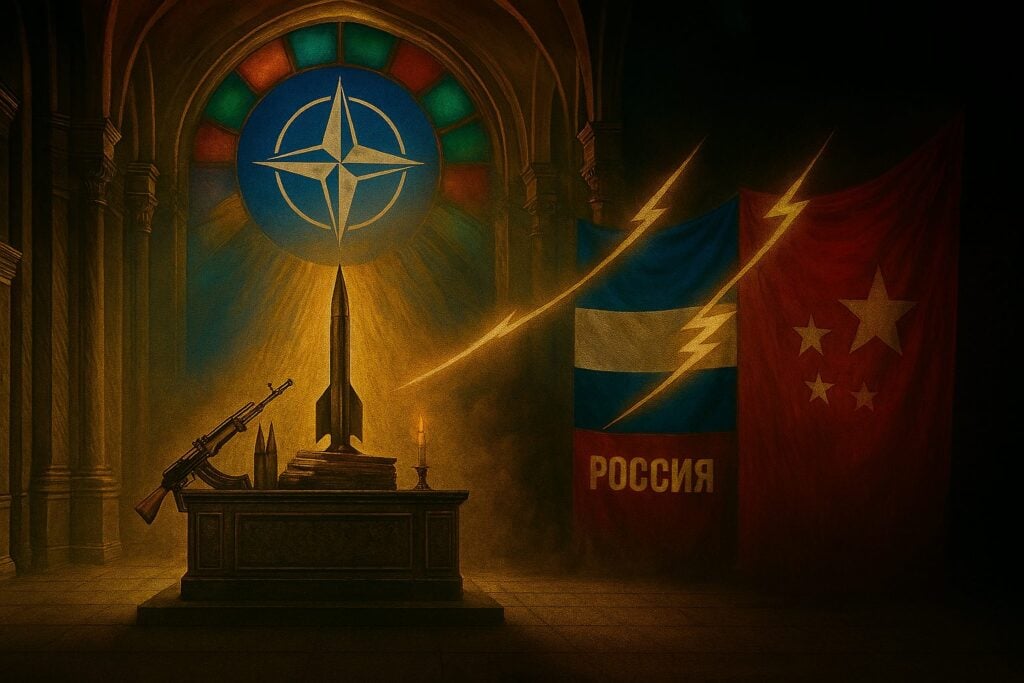
Inside NATO’s cathedral of fear, weapons become sacraments and projection becomes liturgy. From the stained-glass altar, thunderous light strikes Russia and China — not as analysis, but as ritual. This is not about Putin. It is about the West’s collapse into psycho-political theatre.

Jan Oberg

December 12, 2025

Mark Rutte’s Berlin speech in December 2025 has been hailed as a wake‑up call for NATO. But the deeper truth is this: Rutte’s speech is not about Russia and China at all. It is about NATO itself, and about the fundamental transformation of politics into psycho‑political theatre where rational policy has become impossible. The “red threat” he invoked is less an empirical reality than a stage device in a liturgical performance.

From Policy to Performance

Compared with a good month ago, Rutte’s purpose is alarm/urgency instead of agreement/consensus. His tone is existential/dramatic instead of pragmatic/institutional. His focus was on the survival of Europe instead of the credibility of NATO, and hinting that more than 5% of GNP may be needed. His threat perception is now that “Russia is already at our doorstep,” and that China is behind it, where it was a more general enemy image and Ukraine focus in November 2025. Significantly and amateurishly, he condescendingly calls Putin “this guy.” These are very significant escalatory changes.

Watch the full speech here, delivered about 13 minutes after that of the German foreign minister, Wadephul, which is an intellectual bottom feeder in poor English. And here is NATO’s transcript of Rutte’s speech, should you prefer to study it more closely.

Politics once meant rational calculation: weighing interests, negotiating compromises, balancing costs and probabilities. That paradigm has collapsed. In its place stands a new order: politics as performance. Leaders no longer persuade with evidence; they dramatise with sermons. Rutte’s Berlin speech exemplifies this shift. His words were not analytical but eschatological: “Russia is already at our door. NATO and Europe could be Putin’s next target.” This is not policy analysis; it is liturgy. (See postscript below, too).

NATO as Church

The speech revealed NATO’s metamorphosis into a church‑like institution.

  • Doctrine: NATO embodies goodness; Russia embodies evil.
  • Congregation: The Military‑Industrial‑Media‑Academic Complex, MIMC, causes and repeats the creed.
  • Rituals: Summits, communiqués, budget votes, press conferences, and speeches function as sacred ceremonies.
  • Eschatology: The apocalypse — Russia’s attack — is always imminent, never arriving, sustaining endless vigilance and ever larger military expenditures. Never peace. That is not the purpose.

In this church, Rutte plays the priest. His sermon is not about Russia’s actual capabilities or intentions; it is about reaffirming NATO’s faith in its own innocence and moral superiority. The congregation responds with offerings: pledges of 5% GDP for defence, tithes to the military‑industrial altar.

Psycho‑Pathological Rhetoric

Rutte’s rhetoric falls squarely into a tradition that includes Saddam Hussein, George W. Bush, and Adolf Hitler. Each claimed to be surrounded by enemies, each insisted on the necessity of defence, and each justified aggression by projecting evil onto the other side. The formula is always the same: we are threatened all the way around, and we must defend ourselves — no matter the reality.

Hitler invoked Versailles and “Jewish Bolshevism” to justify expansion. Saddam invoked imperialism and Zionism to justify repression and war. Bush invoked weapons of mass destruction to justify the invasion. Rutte invokes Putin to justify NATO’s expansion and militarisation. The psycho‑pathological script is identical: paranoia, projection, eschatology, and self‑sanctification.

And here lies the danger: there is an increasing risk that the Rutte‑type of performance, whether intended or not, will have the same consequence for Europe as Hitler’s did. Once politics becomes theatre of paranoia, escalation is not a possibility but a destiny.

The Absurd Stage

The absurdity of this transformation is striking. It resembles Ionesco’s The Chairs, where the stage fills with empty chairs until there is no room left for the characters themselves. In NATO’s theatre, the “chairs” are weapons, budgets, and warnings — multiplying endlessly until politics itself disappears. The room is filled with arsenals, slogans, and rituals, leaving no space for rational analysis or genuine diplomacy.

Groupthink thrives in this closed theatre. Leaders, media, and academics repeat the same refrains, trapped inside the box of paranoia. The more they echo each other, the less reality intrudes. The absurdity is not comic but tragic: a self‑reinforcing ritual that consumes substance and replaces it with performance.

The Red Threat as Stage Device

The “red threat” is not a description of Russia’s actual power. NATO remains technologically superior, vastly richer, and more expansive than Russia. Yet Rutte insists NATO is fragile, vulnerable, at risk of annihilation. This inversion of reality is the hallmark of absurd theatre: the stronger actor plays the victim, the weaker is cast as omnipotent aggressor. The red threat is a stage device, a prop that sustains the liturgy of fear.

Why Politics Has Changed

Readers will ask: Why has politics changed so dramatically? The answer lies in the decline of the West itself. The United States, NATO, and the European Union are facing the long arc of imperial exhaustion. Economic stagnation, social fragmentation, and geopolitical overreach have eroded confidence. As substance weakens, performance intensifies. The sermon replaces the policy because the empire no longer has coherent strategies to offer.

Rutte’s speech is therefore not only a symptom of NATO’s paranoia but of the West’s decline. The liturgical theatre of threat and innocence is the last refuge of a system that senses its own fragility. The louder the sermons, the weaker the empire beneath them.

The Existential Change

The tragic fact is that Rutte’s speech demonstrates the end of rational politics. There is no longer space for cohesive, analytical policy. What remains is performance: sermons of paranoia, rituals of spending, choruses of media repetition. Politics has mutated into psycho‑religious theatre, where leaders preach, congregations respond, and the apocalypse is always imminent.

Thus, the speech is not about Russia and China at all. It is about NATO’s transformation into a church of paranoia and projection in which the sermon itself is the policy. The red threat is not a geopolitical reality but a liturgical necessity. And in this theatre — absurd, pathological, and imperial in decline — substance has vanished; only performance remains.

Post‑script

The tragic transformation of politics described above makes it rather meaningless for an organisation like TFF to continue publishing rational analyses, as if today’s world were still guided by reason, concepts from peace research, international relations, or political science. With few exceptions, the omnipresent geo‑politico‑military day-to-day commentators do not seem to have noticed this change and speak now into a vacuum — into something that once existed but no longer does.

As TFF turns 40 on January 1, 2026, we therefore move in new directions – or do the same with new means and perspectives: toward idea‑producing visions and conceptual innovations that humanity will need in the multi‑nodal, networking world that will emerge after the fall of the US/Western empire and its institutions.

Our basic mission remains the same: Promoting the UN norm of making peace by peaceful means. But either you adapt the methods and perspectives to the ways of the world or you perish – or stop. TFF does not stop. We believe in the fundamental – superior – values of nonviolence, educated conflict-management and peacemaking over primitive and kakistocratic urges of militarism and pathological war-mongering in the name of fake peace.

◩
Peace & future researcher + ‌Art Photographer

One Response

  1. . Comparison with a cult is obvious. . There is a continuity from the Roman military campaign that began 2000 years ago, on the initiative of the Flavius family; formulated in the Bible’s “New Testament”, to what is unfolding in the West today. . It is originally based on divine emperors and tyrannical monetism. It is easy to recognize the power structures throughout the period, up to the present day. The pathological character of leaders emerge throughout the period, for example in Rutte (but also in the previous Na†o secretaries, Anders Fogh Rasmussen and Jens Stoltenberg, who both lead the war forward under new auspices). . Today, “the god” is called “mammon” and tyrannical monotheism, alias “the unipolar world order”, or the “security council” of the UN or “the international community” (consisting of the “collective west’s” share of the total world population, only 12%!) . This is expressed through the Christian tradition, with a passivated civilian population and outward aggression from central leadership. The idea of perfection – “the one true god”, the infallibility of the leaders and the 99% of the civilian population, “born in sin”. Based on the idea of perfection, there is a risk of looking at the outside world as “something less than perfect”; simply because it is different. From here, it is not far to the missionary, the creation of reality-distorted enemy images and foolish wars. . The Western project fulfills several of the criteria for a death cult, where the preferred solution is often to “eliminate the problem”, eliminate it – war – death – often called “the final solution”. . A grammatical amendment: na†o – then the context will be clearer. . It sounds exciting with the prospect of your new navigation principles. I’ve been thinking about the idea for a long time. I am convinced that it will bear new and nourishing fruit for your activities. . Respectfully O .

Related Posts

It’s a matter of principles, courage, vision and pulling together – while the militarist world is falling apart… Peter Langille October 3, 2026 “Here, then, is the problem which we present to you, stark and dreadful and inescapable: Shall we put an end to the human race; or shall mankind renounce war?”The Bertrand Russell—Albert Einstein Manifesto, July 9, 1955 ⁕ The forecast for what’s ahead is worrisome. The sharp rise in armed conflicts over the past three years is adding to what was already the highest level in over seventy years. Genocides, which should be prevented are supported. A shared climate emergency that jeopardises survival is ignored. Diverse polls now suggest that people are war-weary, worried and interested in a more effective United Nations. And, there are viable policy options for a more secure world! Yet governments are doubling-down, betting on more war and investing heavily. If current trends persist,...
Johan Galtung 1930-2024October 2015 Published here on October 3, 2026 Let us focus on Civilization for conflict analysis and remedies. Major forms of disorder use violence; war is state organized violence. The most belligerent states are the United States of America and Israel, both with civilization roots. National Evangelism, the US Protestant Christian civilization– more national than evangelical–justifies US warfare as exceptionalism of a people chosen by God, with a manifest destiny to run the world. Orthodox Judaism justifies Israeli warfare to conquer and expand from Nile to Euphrates as a religious right and duty to the Eternal One. The third most belligerent country, the UK, no longer believes it is God-chosen but chosen by the USA; not quite the same but something. But the root cause of global disorder lies in the Occident–with Islam–seeing itself as the single, universal civilization valid for all at all times, all others being...
How Oxford University Press allowed a personality‑driven narrative to masquerade as scholarship. Jan Oberg, dr hc, TFF director This article has also been published on TFF Substack where more readers react and withdraw their interviews from the project. A Special Issue in a scholarly journal is not an ordinary publication. It is a collective, curated […]

Recent Articles

Tony Robinson October 4, 2026 Violence is easy to recognise when someone is being beaten, shot or killed. It becomes more difficult when nobody is holding a weapon. Poverty, discrimination, exploitation and repression can restrict a human life just as effectively, although they do so in very different ways and with very different consequences. Simply adding more categories to an ever-growing list of forms of violence does not really solve the problem. The more interesting question is what all these different situations have in common and why it makes sense to describe them using the same word. Human beings do not simply react to what happens around them. They remember the past, imagine things that do not yet exist, make plans and undertake projects. Workers organise because they imagine different working conditions; people migrate because they imagine another life somewhere else; social movements emerge because people refuse to accept the...
It’s a matter of principles, courage, vision and pulling together – while the militarist world is falling apart… Peter Langille October 3, 2026 “Here, then, is the problem which we present to you, stark and dreadful and inescapable: Shall we put an end to the human race; or shall mankind renounce war?”The Bertrand Russell—Albert Einstein Manifesto, July 9, 1955 ⁕ The forecast for what’s ahead is worrisome. The sharp rise in armed conflicts over the past three years is adding to what was already the highest level in over seventy years. Genocides, which should be prevented are supported. A shared climate emergency that jeopardises survival is ignored. Diverse polls now suggest that people are war-weary, worried and interested in a more effective United Nations. And, there are viable policy options for a more secure world! Yet governments are doubling-down, betting on more war and investing heavily. If current trends persist,...
Johan Galtung 1930-2024October 2015 Published here on October 3, 2026 Let us focus on Civilization for conflict analysis and remedies. Major forms of disorder use violence; war is state organized violence. The most belligerent states are the United States of America and Israel, both with civilization roots. National Evangelism, the US Protestant Christian civilization– more national than evangelical–justifies US warfare as exceptionalism of a people chosen by God, with a manifest destiny to run the world. Orthodox Judaism justifies Israeli warfare to conquer and expand from Nile to Euphrates as a religious right and duty to the Eternal One. The third most belligerent country, the UK, no longer believes it is God-chosen but chosen by the USA; not quite the same but something. But the root cause of global disorder lies in the Occident–with Islam–seeing itself as the single, universal civilization valid for all at all times, all others being...

TFF on Substack

Discover and subscribe to more peace materials on TFF Substack

Most Popular

Tony Robinson October 4, 2026 Violence is easy to recognise when someone is being beaten, shot or killed. It becomes more difficult when nobody is holding a weapon. Poverty, discrimination, exploitation and repression can restrict a human life just as effectively, although they do so in very different ways and with very different consequences. Simply adding more categories to an ever-growing list of forms of violence does not really solve the problem. The more interesting question is what all these different situations have in common and why it makes sense to describe them using the same word. Human beings do not simply react to what happens around them. They remember the past, imagine things that do not yet exist, make plans and undertake projects. Workers organise because they imagine different working conditions; people migrate because they imagine another life somewhere else; social movements emerge because people refuse to accept the...
It’s a matter of principles, courage, vision and pulling together – while the militarist world is falling apart… Peter Langille October 3, 2026 “Here, then, is the problem which we present to you, stark and dreadful and inescapable: Shall we put an end to the human race; or shall mankind renounce war?”The Bertrand Russell—Albert Einstein Manifesto, July 9, 1955 ⁕ The forecast for what’s ahead is worrisome. The sharp rise in armed conflicts over the past three years is adding to what was already the highest level in over seventy years. Genocides, which should be prevented are supported. A shared climate emergency that jeopardises survival is ignored. Diverse polls now suggest that people are war-weary, worried and interested in a more effective United Nations. And, there are viable policy options for a more secure world! Yet governments are doubling-down, betting on more war and investing heavily. If current trends persist,...
Johan Galtung 1930-2024October 2015 Published here on October 3, 2026 Let us focus on Civilization for conflict analysis and remedies. Major forms of disorder use violence; war is state organized violence. The most belligerent states are the United States of America and Israel, both with civilization roots. National Evangelism, the US Protestant Christian civilization– more national than evangelical–justifies US warfare as exceptionalism of a people chosen by God, with a manifest destiny to run the world. Orthodox Judaism justifies Israeli warfare to conquer and expand from Nile to Euphrates as a religious right and duty to the Eternal One. The third most belligerent country, the UK, no longer believes it is God-chosen but chosen by the USA; not quite the same but something. But the root cause of global disorder lies in the Occident–with Islam–seeing itself as the single, universal civilization valid for all at all times, all others being...
Read More
Living-Peace-Sign-Budapest-copy
Tony Robinson October 4, 2026 Violence is easy to recognise when someone is being beaten, shot or killed. It becomes more difficult when nobody is holding a weapon. Poverty, discrimination, exploitation and repression can restrict a human life just as effectively, although they do so in very different ways and with very different consequences. Simply adding more categories to an ever-growing list of forms of violence does not really solve the problem. The more interesting question is what all these different situations have in common and why it makes sense to describe them using the same word. Human beings do not simply react to what happens around them. They remember the past, imagine things that do not yet exist, make plans and undertake projects. Workers organise because they imagine different working conditions; people migrate because they imagine another life somewhere else; social movements emerge because people refuse to accept the...
b54a1f10-8c65-4f0b-9dd5-4abc0a7d04cc_2659x2659
It’s a matter of principles, courage, vision and pulling together – while the militarist world is falling apart… Peter Langille October 3, 2026 “Here, then, is the problem which we present to you, stark and dreadful and inescapable: Shall we put an end to the human race; or shall mankind renounce war?”The Bertrand Russell—Albert Einstein Manifesto, July 9, 1955 ⁕ The forecast for what’s ahead is worrisome. The sharp rise in armed conflicts over the past three years is adding to what was already the highest level in over seventy years. Genocides, which should be prevented are supported. A shared climate emergency that jeopardises survival is ignored. Diverse polls now suggest that people are war-weary, worried and interested in a more effective United Nations. And, there are viable policy options for a more secure world! Yet governments are doubling-down, betting on more war and investing heavily. If current trends persist,...
010
Johan Galtung 1930-2024October 2015 Published here on October 3, 2026 Let us focus on Civilization for conflict analysis and remedies. Major forms of disorder use violence; war is state organized violence. The most belligerent states are the United States of America and Israel, both with civilization roots. National Evangelism, the US Protestant Christian civilization– more national than evangelical–justifies US warfare as exceptionalism of a people chosen by God, with a manifest destiny to run the world. Orthodox Judaism justifies Israeli warfare to conquer and expand from Nile to Euphrates as a religious right and duty to the Eternal One. The third most belligerent country, the UK, no longer believes it is God-chosen but chosen by the USA; not quite the same but something. But the root cause of global disorder lies in the Occident–with Islam–seeing itself as the single, universal civilization valid for all at all times, all others being...
Screenshot 2026-10-02 011738
Jan ObergPhD, director, The Transnational Foundation for Peace and Future Research, TFFLund, Sweden October 2, 2026 This is my full original manuscript. The Chinese Academy of Social Science, CASS, makes two publications out if it. 1. China’s Five-year plan emphasized the capabilities of basic research and original innovation. It is regarded as the goal of the future social development, which, as required, should be significantly enhanced. Can you comment on the importance of original innovation in research and academic study? I believe it is easier to define “original innovation” in the natural sciences than in social sciences. The breaking points of what constitutes something new, or innovative, are not quite as sharp in the latter. But in both fields it is about opening up something that was closed, unseen, unexplored before – making manifest what was earlier latent. Innovations come in many forms and shapes – naming something that was not...
arctic-circle-map
The agreement is catastrophic both because of what it says and what it doesn’t mention. It reduces further the major asset of security policies: Freedom of action. Jan Oberg TFF director September 25, 2026 A couple of hours before the agreement was signed on September 22, 2026, I published the following 13 hypotheses about what it would most likely contain on TFF Substack (in English). I was wrong on only the first point. Contrary to what Trump had written on his Truth Social platform, it does not appear to come into force immediately. In fact, it turned out to be worse than even I had anticipated. After these hypotheses now come a number of reflections in light of what the agreement actually contains, and does not contain, as well as the way in which it has generally been presented by major media outlets and by the public-service broadcaster DR. My...
girl-5894831_1280
Below are TFF-related media mentions, comments, videos and social media posts published elsewhere but not on this homepage. We happen to catch and list only a fraction. Regarding video comments and debates, we recommend that you go to the TFF Video Channel on Substack where many of them are reproduced. Jan Oberg is a contributor to China Daily – 52 million daily clicks – and Global Times, CGTN and CCTV (the national television), China Investment, Xinhua News Agency and several others. Articles and videos on these media very often multiply into countless Chinese (and Western media) that re-post them from these main media. Thanks to The China Academy, his analyses, interviews and comments are frequently posted on YouTube channels such as Thinkers Forum and Wave Media. These videos are often re-posted on Bilibili (China’s YouTube), the China Content Center on TikTok, and on the Chinese edition of TikTok, Douyin.com. This means reaching hundreds of millions of viewers worldwide over a year. While there are too many to catch on all these...





