The Munich ‘Security’ Conference (MSC) – the West’s premier – has become a €20‑Million militarist echo chamber

The MSC’s closed groupthink militarism offers only one prescription — more weapons — even as record military expenditures, squeezed from taxpayers in economic crisis, destroy diplomacy and drive escalation to the highest war risks in decades.

Jan Oberg

TFF director

February 13, 2026

From Dialogue Forum to Militarised Ritual

For decades, the Munich Security Conference (MSC) – which opened today and runs till Sunday – was one of the few places where adversaries could meet without theatrics. Founded in 1963 as the Wehrkundetagung, it served as a discreet Cold War dialogue forum between NATO and the Warsaw Pact. Even at moments of high tension, Soviet and later Russian representatives were present, and Munich allowed uncomfortable messages to be delivered directly rather than through press releases or military manoeuvres.

That era has vanished. The MSC has become something entirely different: a €13–20 million annual gathering of a closed Western security elite, a polished meeting of governments, defence industries, major media and aligned think tanks, all wrapped in the language of dialogue but operating as a self‑reinforcing militarist echo chamber. It is the Military-Industrial-Media Academic Complex, MIMAC, that meets here.

•

A €20‑Million Structure That Predetermines Its Outcome

The MSC’s financing reveals its orientation more clearly than any mission statement. Roughly €5–7 million comes from the German federal government; €6–10 million from corporate sponsors, including major defence and security companies; and €2–3 million from foundations and institutional partners.

When governments and arms‑industry actors are the primary funders, the gravitational pull inevitably shifts toward military‑centric definitions of security, technological solutions, alliance cohesion and deterrence doctrines, while peacebuilding, conflict transformation, diplomacy, mediation and non‑military approaches — which lack comparable financial backers — quietly disappear from the agenda.

In consequence, the MSC will be devoid of free thinking, alternative non-military security measures and every vision of a better world.

•

Speaking About the World, Not With It

The MSC’s agenda is curated by a tight circle of leadership, advisory‑council members, government partners, corporate sponsors and security‑aligned think tanks. Each layer reinforces the others, producing a remarkably coherent worldview in which the same actors define the problems, propose the solutions and moderate the discussions.

Panels are dominated by Western officials, military leaders and analysts funded by the same governments and industries that support the MSC; moderators from major Western media outlets reinforce prevailing assumptions rather than interrogating them.

The result is predictable: panels on Russia without Russians; panels on China with only one Chinese representative (its foreign minister whose different perspectives are hardly ever quoted by Western media); panels on peace without peace researchers; panels on the Global South without Global South voices.

Thanks to remarkable intellectual inbreeding, the MSC increasingly speaks about adversaries, about diplomacy, about peace — but not with the actors concerned, nor with those who work professionally on conflict resolution, least of all the UN.

This is an intentional architecture crafted by the congregation of the NATO Church, and so it is only logical that its former Secretary‑General, Jens Stoltenberg, now takes over as its presiding priest.

•

The Only Prescription: More Weapons

Across the MSC, the policy prescriptions are strikingly uniform: more weapons, stronger deterrence, longer‑range strike capabilities, higher military spending, deeper alliance integration.

The logic is circular: insecurity is met with more armament, which produces more insecurity, which justifies more armament. Offensive long‑range deterrence is a 100 percent predictable insecurity generator, because the opponent sees it as a threat, not reassurance – no matter your argument that you have no bad intentions.

Furthermore, the world has never spent more on weaponry than it does today, yet the objective risk of a major war is rising, not falling. Citizens facing economic crises are told to pay through their noses for “security” that demonstrably increases their risk.

In any rational forum, someone would stand up and say: Something must be wrong: let us stop and think. At Munich, no one does.

The Kabuki theatre must continue. Remember, anyone can start a fight in a bar – or a war – but it requires a few capacities to avoid war and create peaceful coexistence.

•

From Dialogue to Narrative Consolidation

Since the Obama-orchestrated Maidan regime-change in Kiev on 22 February 2014 and Russia’s Crimea annexation of 18 March 2014, the MSC has steadily closed the door on dialogue with Russia — a far cry from 2007 when Putin gave his now historic low-key speech in which he asked what had happened to the promises given to Gorbachev about not expanding NATO one inch.

The MSC has aligned itself fully with the strategic posture of NATO and the EU. Dialogue with adversaries has been replaced by discussions about adversaries; panels on Russia or China are framed entirely through Western threat lenses; and the conference has become a stage where governments, industries, media and aligned academics reinforce a single worldview that defines security almost exclusively in military terms and is unable to see the larger world and its opportunities.

The tragedy is not that the MSC has a perspective; the tragedy is that it has only one. And it is anything but trust, confidence, conflict-resolution and peace.

•

The Missing Counterpart: A Global Peace Conference

The MSC’s official prominence and media attention highlights a deeper structural absence: there is no equivalent high‑level forum for peace. No annual gathering where peace researchers, mediators, peace workers, conflict‑resolution practitioners, civil society, Global South voices, non‑aligned states and humanitarian actors and people of culture meet to explore non‑military approaches to security.

The most unrealistic and debunked assumption is that security is about arms and more arms lead to more stability, security and peace – the mantra of the NATO Church, no matter what the alliance does, including violating it own treaty 24/7 since bombing Yugoslavia in 1999.

There is no €20‑million (or cheaper) platform for diplomacy, prevention, reconciliation or structural peacebuilding; no global stage where peace is treated with the same seriousness, resources and media attention as deterrence, rearmament and unlimited militarist thinking.

The imbalance is not accidental; it reflects political priorities and the MIMAC‑shaped worldview that now dominates Western security thinking.

It is dead dangerous for you and me – in substance and because of its own self-affirming blindness.

•

Understanding Munich for What It Has Become

The Munich Security Conference no longer functions as a platform for dialogue between adversaries or as a space for exploring diverse approaches to security. Instead, it has become a high‑profile meeting point for a closed security groupthink — a place where elite interests converge, narratives are synchronised and the boundaries of acceptable discourse are tightly managed.

It is time understand it honestly. It is time for free media (if they still exist) to have a critical perspective. Will they, or have they been co-opted completely?

Until someone invests in a serious, well‑funded, global peace conference — something with the scale, visibility and ambition of Munich — the imbalance will remain. And so will the risks of warfare.

Perhaps it is time for BRICS, the Belt & Road Initiative, a coalition of peace-willing in cooperation with the United Nations and non-Western regions and actors – governments and citizens – to arrange a conference for true peace and human security where the military dimension has its proper – minimal – place.

We must never accept that violence becomes the first resort. It should always be the last resort after everything else has been tried and found in vain.

•

P.S. A conference that invites María Corina Machado to speak about Venezuela, Lindsey Graham to speak about Russia, Tony Blair to speak about peace, and uses only conservative Western media as moderators, documents not global security thinking but the intellectual and ethical disarmament of a declining West and – who knows? – a disintegrating EU and NATO.

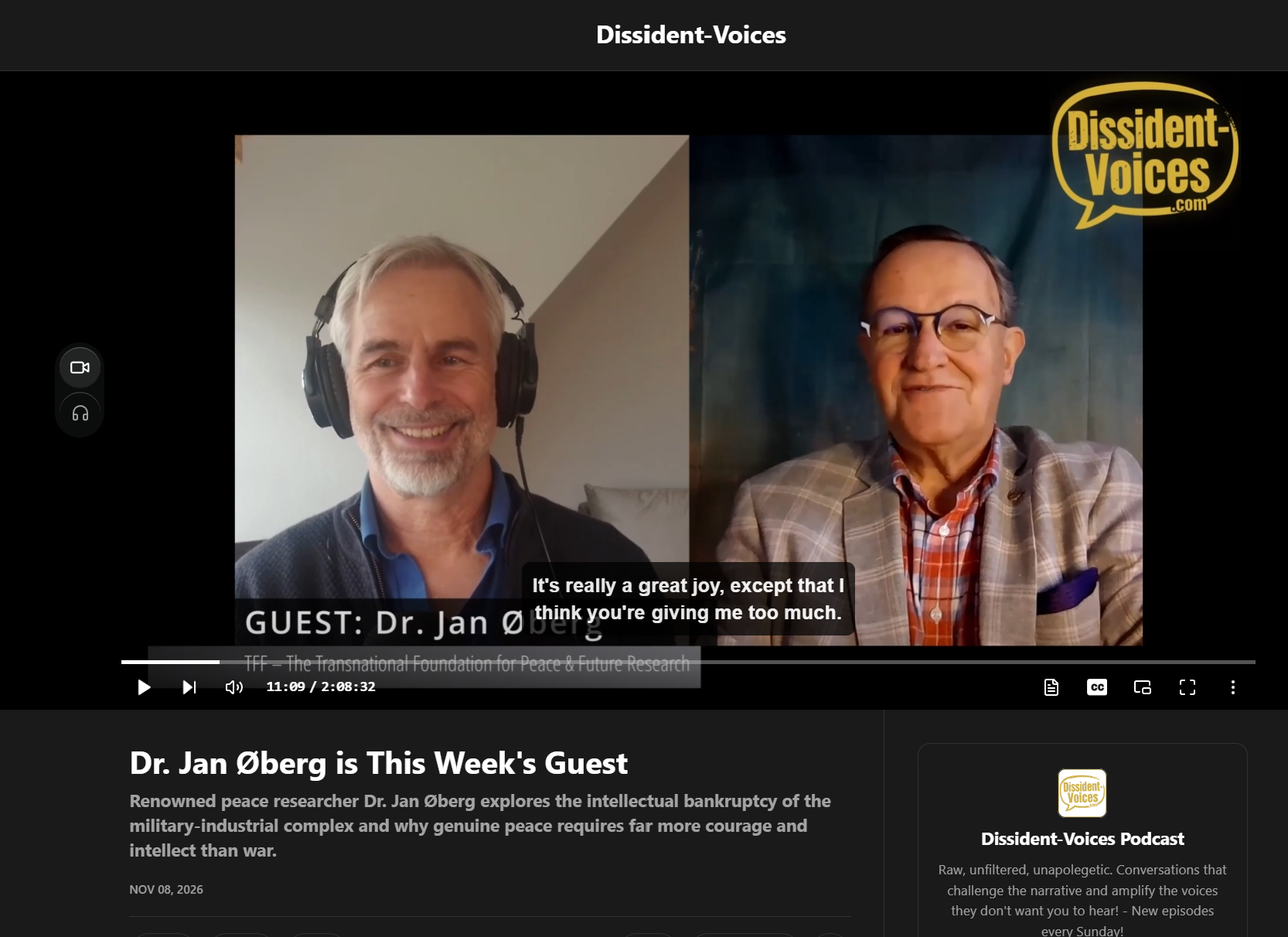
PhD, Peace & future researcher + ‌Art Photographer, Professor Emeritus and media commentator

Related Posts

A Message from Jan Oberg November 6, 2026 Over the past fifty years, I have devoted roughly 175,000 hours to research and public education for a more peaceful world: thinking, researching, writing, organising, publishing, debating, maintaining websites, corresponding, reaching out, leading a foundation, work in conflict and war zones, professorships, teaching courses and giving public lectures and doing media work. In short, ten hours a day, seven days a week, for half a century. The focus was on international political peace – analysing and trying to stop wars, address underlying conflicts and making alternative peace plans – at the desk and on the ground. Important as that has been and remains, it is only one kind of peace and it is now in a tragic militarist state compared with what it could have been.  Lately, however, I have found myself thinking about a concept from economics as well as everyday...
Photo above: Carl Fredrik Reuterswärd’s Non-Violence outside UN Headquarters in New York. Kirill Levin, CC BY-NC-SA 2. Jan Oberg November 3, 2026 I am happy to be published in Horizons which is produced by the Center for International Relations and Sustainable Development, CIRSD, in Belgrade. My contribution brings out a radical re-thinking of what concepts such as defence, security, deterrence – and peace – may mean if we want to create a more peaceful world. It also summarises a few things I have been working with the last few decades. Please read it here Og her er den på dansk, takket være Johnny Baltzersens lynhurtige oversættelse
UNITE-tillid, DREAM-velstand og andre konstruktive komponenter Normally we publish articles in English here. But this is a translation of a very important TFF document that should reach as many as possible in Denmark since this country’s government has been one of the most hardline in Europe and, up till now at least, has refused to use diplomacy and, instead, spent tremendous sums on arming Ukraine with the express goal of defeating Russia. Thus this – unique – article is in Danish. Vi er Johnny Baltzersen og hans Fælles Sikkerhed – Fælles Fremtid på Substack overmåde taknemmelige for at have oversat og publiceret TFF’s 2025-portfølje for fredsidéer med henblik på Ukraines fremtid. Vi håber den nu kan nå mange flere danskere – som også vil sprede den og skabe debat – nu den danske regerings og folketingspartiernes politik på dette område siden 2022 står nu – forudsigeligt – ved vejs ende....

Recent Articles

Serious but also a lot of laughs and positive energy. Because peace is also about conviviality and enchantment… Jan Oberg, TFF director November 16, 2026 This is a long (129 minutes) conversation with me. We cover very many, also personal, issues that makes a somewhat unusual media event. I am very grateful to Flemming Blicher for giving me this opportunity. I can’t remember any channel or editor who spent as much time as he did preparing it – including also asking me to answer a series of pre-interview questions, which are now posted under the conversation. If you sympathise with its content, please share it. Watch it here
A Message from Jan Oberg November 6, 2026 Over the past fifty years, I have devoted roughly 175,000 hours to research and public education for a more peaceful world: thinking, researching, writing, organising, publishing, debating, maintaining websites, corresponding, reaching out, leading a foundation, work in conflict and war zones, professorships, teaching courses and giving public lectures and doing media work. In short, ten hours a day, seven days a week, for half a century. The focus was on international political peace – analysing and trying to stop wars, address underlying conflicts and making alternative peace plans – at the desk and on the ground. Important as that has been and remains, it is only one kind of peace and it is now in a tragic militarist state compared with what it could have been.  Lately, however, I have found myself thinking about a concept from economics as well as everyday...
Photo above: Carl Fredrik Reuterswärd’s Non-Violence outside UN Headquarters in New York. Kirill Levin, CC BY-NC-SA 2. Jan Oberg November 3, 2026 I am happy to be published in Horizons which is produced by the Center for International Relations and Sustainable Development, CIRSD, in Belgrade. My contribution brings out a radical re-thinking of what concepts such as defence, security, deterrence – and peace – may mean if we want to create a more peaceful world. It also summarises a few things I have been working with the last few decades. Please read it here Og her er den på dansk, takket være Johnny Baltzersens lynhurtige oversættelse

TFF on Substack

Discover and subscribe to more peace materials on TFF Substack

Most Popular

Serious but also a lot of laughs and positive energy. Because peace is also about conviviality and enchantment… Jan Oberg, TFF director November 16, 2026 This is a long (129 minutes) conversation with me. We cover very many, also personal, issues that makes a somewhat unusual media event. I am very grateful to Flemming Blicher for giving me this opportunity. I can’t remember any channel or editor who spent as much time as he did preparing it – including also asking me to answer a series of pre-interview questions, which are now posted under the conversation. If you sympathise with its content, please share it. Watch it here
A Message from Jan Oberg November 6, 2026 Over the past fifty years, I have devoted roughly 175,000 hours to research and public education for a more peaceful world: thinking, researching, writing, organising, publishing, debating, maintaining websites, corresponding, reaching out, leading a foundation, work in conflict and war zones, professorships, teaching courses and giving public lectures and doing media work. In short, ten hours a day, seven days a week, for half a century. The focus was on international political peace – analysing and trying to stop wars, address underlying conflicts and making alternative peace plans – at the desk and on the ground. Important as that has been and remains, it is only one kind of peace and it is now in a tragic militarist state compared with what it could have been.  Lately, however, I have found myself thinking about a concept from economics as well as everyday...
Photo above: Carl Fredrik Reuterswärd’s Non-Violence outside UN Headquarters in New York. Kirill Levin, CC BY-NC-SA 2. Jan Oberg November 3, 2026 I am happy to be published in Horizons which is produced by the Center for International Relations and Sustainable Development, CIRSD, in Belgrade. My contribution brings out a radical re-thinking of what concepts such as defence, security, deterrence – and peace – may mean if we want to create a more peaceful world. It also summarises a few things I have been working with the last few decades. Please read it here Og her er den på dansk, takket være Johnny Baltzersens lynhurtige oversættelse
Read More
Screenshot 2026-11-10 174455
Serious but also a lot of laughs and positive energy. Because peace is also about conviviality and enchantment… Jan Oberg, TFF director November 16, 2026 This is a long (129 minutes) conversation with me. We cover very many, also personal, issues that makes a somewhat unusual media event. I am very grateful to Flemming Blicher for giving me this opportunity. I can’t remember any channel or editor who spent as much time as he did preparing it – including also asking me to answer a series of pre-interview questions, which are now posted under the conversation. If you sympathise with its content, please share it. Watch it here
AbstractVision_2017_#1_800 (kopia)
A Message from Jan Oberg November 6, 2026 Over the past fifty years, I have devoted roughly 175,000 hours to research and public education for a more peaceful world: thinking, researching, writing, organising, publishing, debating, maintaining websites, corresponding, reaching out, leading a foundation, work in conflict and war zones, professorships, teaching courses and giving public lectures and doing media work. In short, ten hours a day, seven days a week, for half a century. The focus was on international political peace – analysing and trying to stop wars, address underlying conflicts and making alternative peace plans – at the desk and on the ground. Important as that has been and remains, it is only one kind of peace and it is now in a tragic militarist state compared with what it could have been.  Lately, however, I have found myself thinking about a concept from economics as well as everyday...
knotted gun
Photo above: Carl Fredrik Reuterswärd’s Non-Violence outside UN Headquarters in New York. Kirill Levin, CC BY-NC-SA 2. Jan Oberg November 3, 2026 I am happy to be published in Horizons which is produced by the Center for International Relations and Sustainable Development, CIRSD, in Belgrade. My contribution brings out a radical re-thinking of what concepts such as defence, security, deterrence – and peace – may mean if we want to create a more peaceful world. It also summarises a few things I have been working with the last few decades. Please read it here Og her er den på dansk, takket være Johnny Baltzersens lynhurtige oversættelse
TFFPortfolioVign
UNITE-tillid, DREAM-velstand og andre konstruktive komponenter Normally we publish articles in English here. But this is a translation of a very important TFF document that should reach as many as possible in Denmark since this country’s government has been one of the most hardline in Europe and, up till now at least, has refused to use diplomacy and, instead, spent tremendous sums on arming Ukraine with the express goal of defeating Russia. Thus this – unique – article is in Danish. Vi er Johnny Baltzersen og hans Fælles Sikkerhed – Fælles Fremtid på Substack overmåde taknemmelige for at have oversat og publiceret TFF’s 2025-portfølje for fredsidéer med henblik på Ukraines fremtid. Vi håber den nu kan nå mange flere danskere – som også vil sprede den og skabe debat – nu den danske regerings og folketingspartiernes politik på dette område siden 2022 står nu – forudsigeligt – ved vejs ende....
JoGSS-Silent
Jan Oberg TFF director October 28, 2026 Exactly one month has now passed since I published my criticism of the introduction to the special issue on Johan Galtung published by the Journal of Global Security Studies, JoGSS, and of Tor Egil Førland’s chapter about Galtung which serves as a preview to his forthcoming biography of Galtung to be published by PRIO. See the original on The Transnational here and the same article on TFF Substack with many general and critical comments and, in particular, the people who decided to withdraw from the biography project in protest. The special issue itself was extraordinary. It was devoted to the intellectual legacy of one of the founders of peace research and contained a number of strong assessments of his personality, scholarship, intellectual trajectory, and public role. Such assessments are, of course, entirely legitimate. No scholar is beyond criticism, and neither was Johan Galtung....
Screenshot 2026-10-26 115647
An aspect of Iran’s culture and civilisation you’ve probably never heard about. Don’t be surprised if the US and Israel also try to bomb them. Jan ObergTFF director October 26, 2026 Today – under the “USraeli” threat of new “annihilating” bombings – opens the 7th International Conference on Peace and Conflict Resolution at Tehran’s University. As far as I can tell, this is the only permanent, advanced peace research institution in West Asia/the Middle East. Perhaps more countries in that region could be inspired? I mean, how many military “security” institutes and military academies do they have? Many peace research institutes and university departments have been established since the 1950s in the West. They are now all under attack; some have closed down, some have gone mainstream, yet others kept the name but do nothing to research peace and disseminate results or advice; instead, they cooperate with militarism’s platforms such...