Denna artikel finns också på svenska
The now suspended constitution for the European Union is bound to reappear more or less in the same form as before. There are some good ideas in it, such as those about gender equality and equal salary levels for men and women. Also, the Christian fundamentalists had to accept that the religious values are mentioned only along with the humanistic and other components in our culture, all on an equal level.
However, the important introductory text or preamble is rather deficient when it comes to the historical perspective on Europe’s relations with its former colonies and its ongoing dominance and power over them, albeit in new ways. It is evident from the military aspects of this constitution that Europe has no intention to create equal rights for its former colonies but rather continue its dominance by military means, if necessary.
A short criticism of the Articles on security and defence policies
Article I-40:1-3 outline a common (joint) European military defence, intensified armaments and common development of new weapon systems. It will all be adjusted to co-
operating with Nato.
Article I-40:7 states that defence against attack in Europe is a common obligation, and all available means are to be used. But what military threat could there be against the EU in
Europe? This article only seemingly offers a reason for intensified armaments. The real enemy may well be those third world and other non-European countries which have demanded equal rights since 30 years, i.e. through a New International Economic Order (1974 and onwards). Their demands may become more frequent and militant at some point in the near future.
The statement that all available means shall be used evidently also includes the French and the British nuclear arms, and considering the ever closer EU-Nato co-ordination process, it might also one day include the American nuclear arsenal.
Article III-194 delivers obscure and ambiguous statements about the strategic security interests of the union. European history gives us bad feelings. The contents here do not fit in with the preceding Article III-193:2 about … international co-operation in order to (c) keep the peace, prevent conflicts etc. It is definitely a cause for worry that “peace and prevention of conflicts” is mentioned in a few contexts and without even mentioning notions such as “peaceful conflict resolution” or supporting the UN Charter norm of making “peace by peaceful means.” Consequently, one must conclude that the Treaty does not provide for the opportunity that structures, measures and methods in support of peaceful conflict resolution will play a dominant role in the EU.
Similarly word like crisis management, conflict and violence prevention, disarmament, keeping the peace are occurring a few times but only in the most general sense of these words. (Words like non-violence, reconciliation or, say, nuclear disarmament and nuclear-free zones don’t appear at all). The European leaders do not seem to be interested in any practical and precise use of these concepts, goals and strategies.
Indeed, the difference between this fact on the one hand and the many pages filled with detailed rules regulating economic activity and competition is very striking. Practical details are numbered faithfully in Articles 50 to 58 although these rules are already well known throughout the world society and could easily have been given a generalised description in just a few lines.
Disarmament – for whom?
In the light of what is said about intensified armaments and arms production in Article 40-3 it seems strange and mysteriously unconnected to find the following in Article III-210: “The tasks mentioned in Article I-40:1 … shall include efforts for disarmament.” Whose disarmament is intended? It is abundantly clear from the text that disarmament within the European Union is not in question. The Treaty even binds member states to increase their (military) efforts and capacities!
Measures against terrorism
Military means shall be used for fighting terrorism. The European leaders seem to still believe that terrorism is an unprovoked outburst of evil against our peaceful democratic societies. It is quite shocking that the European leaders choose to suppress the evident and declared linking of terrorism to the ever ongoing European and American exploitation of the peoples of the Third World and the siding of some European countries with the Nato and the US attacks on countries like Serbia/Montenegro, Afghanistan and Iraq and its unreserved support to the Israeli occupation and colonization of Palestine.
The leaders of Europe seem to be of the opinion that they can make their citizens believe in any one-sided image of Europe, in any half truth or whole lie, they tell. There is not a word of self-criticism of how the Union has handled recent conflicts and no attempt to learn from mistakes such as the conflict (mis)management in the Balkans.
The overall assumption that military means could beat terrorism is as shocking as revealing of the intellectual level employed in writing this text. Hence the conspicuous absence of even the slightest hint that the EU will, de facto, struggle hard to become an actor that promotes real international economic and social justice – which would be the only way to bring terrorism to a halt.
No mention of nuclear arms
There is &endash; literally – not a single word stated about the nuclear weapons piled up within the EU. The more closely its military system is knit, the more involved the member states will be in handling weapons of mass destruction. The majority of states that have actually distanced themselves from such weapons may soon become unwilling hosts of such weapons and thereby also become targets of possible counter strikes. Why is this suggested constitution omitting this very important aspect of military defence or aggression?
And the patriarchy?
One may quite easily understand that a patriarchal socio-economic structure like the EU is not able to define its own deepest character. The work of the Treaty text was presided over by three men with the average age of 70. Would it not have been reasonable to include in the introductory paragraphs just a few words such as “that Europe reunited after bitter experiences of the patriarchal culture of violence will continue its way into civilization, equality, progress and well being.” And in the short passage of equality between women and men the following should be added: “The patriarchal social structure shall be analyzed and a far reaching transformation shall be carried out in order to create a new and richer culture of equality, which will substitute the obsolete patriarchal culture.”
What else should be included in a Constitution for the 21st Century?
Given the uniquely long text of the Constitution Treaty, it is difficult to keep it all in mind. It can be foreseen that further mentioning of the patriarchate could fit into several articles beyond those mentioned above.
The articles we have criticised should be changed, added to or replaced by fitting alternative writings.
In what follows we now limit our suggestions to the articles pertaining to security, defence and peace. We wish to add the essential concepts, values and principles that are so obviously missing in the existing constitution text, such as “peaceful conflict resolution”, “peace by peaceful means”, “negotiation strategies”, “peace conferences” etc. “Disarmament” is treated below under “The Goals of the Union”.
The great peace project
In Western mainstream media, politicians, editorial writers and others participating in the debates about the EU are always repeating the importance of the EU as a peace project. But it is equally justified from the facts presented in this constitution to describe the EU as a joint effort of the old colonial powers to keep and strengthen their dominant positions after the formal decolonization.
The evident need of EU countries for a strong military power in order to support their negotiating power is radiating through the veil of pronounced defensive strategies and their pronounced but blurred “interests”. Their great considerations for Nato co-operation make this real intention more probable, since Nato has extended its field of operations to the whole world and not just to the original North Atlantic area.
However, we would very much appreciate and wish to see Europe as a peace promoting power in the world, a power which by peaceful means creates economic and social justice via open discussions, truthful media information, consensus, analysis, compromise in pleasant contrast to the ultimatums, military operations, occupation and the dictated agreements of the World Trade Organization, the World Bank, IMF, etc.
It should be beyond every doubt that the EU could become a new kind of power in the world system &endash; had its leaders had the necessary vision. Indeed, with the animosity – even hatred – rising against U.S. foreign policy worldwide, the situation speaks for an alternative to Washington in the West. But it seems like the EU doesn’t see the potentials…
The goals of the Union
In Article I-3:1-4 about the goals of the union the following could be inserted:
“In every national and international conflict the member states shall exercise strict impartiality and carry out carefully analyzed, practically trained and prepared efforts for peaceful conflict resolution.” (Thereby one-sided military and power oriented policies are prevented or hampered.)
Instead of the existing point 5 in the same article, we suggest the following:
“The Union shall fulfil these goals with the non violent methods that are listed by peace research and that have been practiced in many countries and have successfully abolished tyranny and injustice. The experiences and lessons learnt from peaceful popular social change
and conflict resolution shall be systematically taken into consideration and applied to the maximum extent.”
And to this we add a 6th point (=Article I-3:6) as follows:
“The military power which has traditionally been retained by the EU member states shall gradually be reduced and the resources that are thereby released shall be made available for the development of wide-ranging civil activities.” (This is a clear message that the EU is not aiming at traditional competitive power status, which always creates tensions.)
The common security and defence policy
The exclusively military contents of Article I-40 should be replaced by the following:
“Historical experience shows that the exercise of military power never solves a conflict but instead creates new conflicts with still more sufferings. The background of many European countries as colonial masters implies a special obligation to make civil efforts in the fields of trade and commerce policies and promote peaceful conflict-resolution in order to compensate the social and economic damage done to the former colonies, a damage that constitutes the dominant single reason for their present problems.
In order to improve the competence of the EU in this regard, education in colonial history and in methods of conflict-resolution and reconciliation shall be imparted to all EU institutions. During this time-consuming process of reorientation the military forces of the union member states shall be given the same education in order to be able to intervene in favour of early listening and action and thereby prevent violence whenever such action is demanded by independent international humanitarian organizations.
Further, in order to abolish the frequent misuse of power inherent in the ongoing economic and political globalization process, the EU shall collectively apply boycotts and refuse purchasing any goods or services from those governments or enterprises that are held responsible for such misuse from time to time.
At the same time a solidarity-based and fair trade shall be developed in agreement with the criteria that have been adopted by the international Fair Trade organizations (ATO:s)”
The Constitution of a real peace project
Peaceful conflict resolution is the most important part of a constitution for any true peace project. In the existing constitution text there is not a single hint in this regard. So we have to create a special section for this important aspect. Let us call it Article I-40 A. The text will be as follows (I-40 A:1-2,a-i):
A 1. The actions of the member states in situations of conflict shall be characterised by an explicit distancing from violent conflict management of the type regularly shown by Atlantic power constellations like Nato and similar alliances: diplomatic pressure, followed by ultimatum, which implies threat of violence within a set time limit, thereafter gradual fulfilment of the threats up to a level of massive bombings of military as well as civil society, which weakens resistance by making the losses of lives and material values unbearable and thus resulting in a forced, comprehensive submission.
This pattern of action – know for several centuries – aims at annihilating the other party of the conflict, and in the long run has shown to create more problems than it solves. Systematic violence applied by a cynical, overwhelming power is also dehumanizing for the culture of the victorious power itself.
A 2. After five hundred years of excessive violence exercised by the great powers of Western Europe, the EU now proclaims a doctrine of conflict-resolution which excludes the use of violence, as follows:
a. The member states are obliged to abolish the ongoing praxis of trade by providing the small farmers of the third world their rightful opportunity to practise self sufficiency and trade freely their excess production. This shall be realized by abolishing price subsidies to the European farmers and middlemen who hitherto have sold their products at an unfair, low price under the false pretext of free competition while de facto destroying the competitive options for the said farmers.
This and other related measures will liberate both parties, since the oppressors too will learn thereby to stand on their own legs.
b. In order to facilitate progress in the areas of trade, the member states are advised to improve the competence and skills of the media in presenting a full picture of facts and figures, so that also controversial and disturbing facts about prevalent injustices, e.g. in the monopoly trade and price cartels, achieve the necessary publicity and attention in the direction of objective understanding of the root causes of various conflicts. This would provide possibilities for mutual understanding, for just day-to-day as well as long-term solutions.
c. The member states shall, at their earliest, individually and collectively abolish their arms trade to conflict areas and to countries at war, and they shall thereafter gradually abolish their remaining arms trade. Through these measures the creation of artificial tensions can be avoided, since even the existence of armaments is understood as threats by other parties.
d. The member states shall initiate every conflict management through early warning mechanisms and early action, open discussions and negotiations involving all parties involved in the particular conflict. Every and all parties must be made sure that they will be heard and paid attention to and get a fair hearing in a process aimed to lead to genuine solutions and consensus.
e. The member states shall extend economic and moral support as well as advice and consultations and thereby strengthen peaceful popular protests and demands directed against dictators and other abusers of power and shall also co-operate with popular boycott actions when demanded by genuinely popular movements.
f. The European Council shall organize and finance international conferences in order to penetrate conflicts and their causes together with all involved parties. The process shall be allowed to continue until a stage of maturity and consensus for peaceful and rightful solutions are reached.
g. Relying on the results of peace research and on the experiences of non-violent actions and methods the member states shall work for reducing conflicts and for their long term resolutions, e.g. by establishing massive civil presence in a conflict area, or by organizing permanent civil escort to persons who are threatened by violent attacks in public places.
h. To the above mentioned measures shall be generally added that in the past patriarchal values and approaches have to a great extent directed all efforts and processes in this field. The member states are therefore obliged to fulfil UN Resolution 1325, which demands 50% representation of women in all these contexts. Thereby the inherited self appreciation of the patriarchate will be questioned, which constitutes a precondition for the desired and necessary transformation.
i. The member states shall organize material and psychological support in each single case of oppression of women and violence against women. The member states shall also prescribe individual, intensive treatment to rehabilitate and make oppressors and aggressors behave in a way that is socially desirable and acceptable.
With these and other similar additions to the existing constitution it may become acceptable to the peoples of Europe as a real peace project.
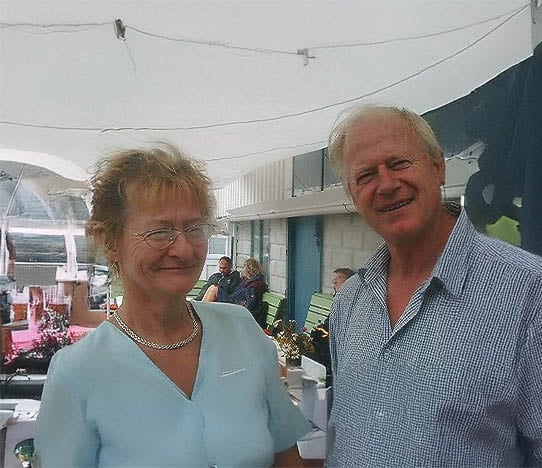
Erni Friholt & Ola Friholt
Stocken, Orust, Sweden
The original article was written in Swedish. In this translated version we have limited quotations from the Treaty text to a minimum and they are our translations from the Swedish edition of the Treaty text. You may find a copy of the EU Constitution in English here: