
Lidt om bogen Bogens indhold Bestil bogen her Anmeldelser

Siden den kolde krigs afslutning har dansk udenrigs- og sikkerhedspolitik bevæget sig langt ind i en politisk og moralsk blindgyde. Men det tjener hverken os eller verden at Danmark er blevet en krigs- og besættelsesmagt, viser den internationalt respekterede danske freds- og fremtidsforsker, Jan Øberg i denne bog. Tværtimod mindsker det vores og andres sikkerhed og bidrager til at øge, snarere end at mindske, terrortruslen.

Forudsigelig fiasko – der udkommer 4. juni 2004 – sætter fokus på det irakiske samfund og Vestens måde at betragte og behandle Irak på. Jan Øberg kombinerer konkret konfliktanalyse med et personligt engagement, og underbygger overbevisende og konsekvent det synspunkt, at Vestens mangelfulde konfliktforståelse og ukyndige konflikthåndtering måtte ende med den ulykkelige krig. Det er en krig, som efter forfatterens opfattelse hverken kan fremme ædle motiver – etablere et demokratisk Irak – eller økonomisk-kulturelle interesser, men tværtimod kan blive en boomerang mod os selv og forkorte Vestens lederskab.

Den danske freds- og fremtidsforsker Jan Øberg sætter i denne bog fokus på konflikten mellem Vesten og Irak, sådan som denne konflikt gennem en årrække har udviklet sig, og som i 2003 endte i krig og besættelse – bl.a. med Danmark som besættelsesmagt.

Forudsigelig fiasko afslører de officielle vestlige motiver som skalkeskjul for kolde interesser. Forfatteren kombinerer konkrete analyser med et personligt engagement. Bogen udforsker kritisk den underliggende, erklærede humanisme, de vestlige sanktioners effekter på den irakiske civilbefolkning, Bushregimets politik, EU’s forspildte muligheder for at spille en konstruktiv rolle, optakten til krigen samt det virkelige militære styrkeforhold mellem angriberne og Irak. En central del af bogen består af forfatterens krigsdagbog, skrevet under selve krigshandlingerne og kritisk i forhold til førende internationale mediers dækning.
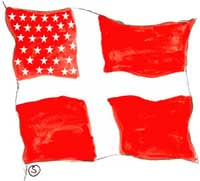
Dansk flagg

© Staffan Sommelius “US Dannebrog”

Øbergs kritiske analyse af før, under og efter krigen munder ud i 19 forslag til hvad der nu bør gøres i Irak: besættelsen bringes til ophør, en ny slags FN-mission sættes ind og en europæisk-mellemøstlig dialog og forsoning igangsættes. Og meget mere…

“Jeg tror Forudsigelig fiasko er den mest omfattende fremstilling i Norden af tiden før, under og efter invasionen. Bogen indeholder blandt andet tekster skrevet før krigen samt en række forudsigelser om at det ville gå – næsten – så galt som det er gået. Derfor titlen. Konflikten kunne være grebet an på en anden måde og skabt forudsigeligt bedre resultater,” siger Jan Øberg.

“Denne krig er udkæmpet i blinde i mere end én forstand. Beslutningstagere brød sig hverken om at erhverve en minimumsviden om Irak eller forstå irakernes situation og de brugte heller ikke de enkleste tommelfingerregler for konflikthåndtering. Vi var jo selv så gode og Saddam så ond at vi ikke havde bruge for hverken intellekt , indlevelse eller etik.

I Forudsigelig fiasko bruger jeg konfliktanalyse og andre værktøjer inden for moderne fredsforskning. Men bogen indeholder også mediekritik, dagbogtanker, fotografier og rejseoplevelser – det sidste fordi intet har overbevist mig mere om unødvendigheden af denne katastrofe end mine rejser i Irak før krigen. Derfor er min solidaritet heller ikke med hverken Fogh Rasmussen, Bush eller Saddam men med Iraks mennesker og FN-folkene dér, som gjorde en fantastisk indsats men blev tvunget ud af krigsmagerne.

For at stoppe krige og besættelser er det ikke nok at være imod og fordømme. Kritik er godt nok, men uden konstruktive alternativer kører krigsherrerne usvækket videre. De spiller på at mennesker skal føle sig modløse og tro at det er meget meget svært at gøre noget andet end det, de gør. Derfor viser jeg til slut i Forudsigelig fiasko hvordan besættelsen kan bringes til ophør og en langt bedre fremtid skabes. Og regimeskifte i Washington og måske også i København ville være nok så nyttigt som en del af processen,” slutter Jan Øberg.

Indhold

Forord

Til irakerne og FNs folk dér

Hvad bygger bogen på?

Hvad består bogen af?

Tak for støtten til fri forskning og debat

INDLEDNING

1. Om konfliktforståelse og holdningen til Saddam

Konfliktforståelsens ABC og DEF…

Afstandtagen fra Saddam og hans rædselsfulde regime

Kunne man arbejde med konfliktforståelse i Irak?

2. Krigs- og besættelsesmagten Danmark

Danmarks hårdtslående politik og nogle tænkelige årsager

Den aktuelle politik kan være terrorfremmende

Lær af de sidste 15 års konflikthåndtering

Vi må selv skabe debatten om konflikter, fred og udvikling

DEL 1 – OPTAKTEN

3. Den falske humanismes støvletramp

Dette burde bekymre humanister

Privat-terror versus stats-terror

Privat-terrorismen: et relativt ubetydeligt problem

Terrorister versus terrorisme

Terrorismen erstatter kommunismen som nødvendig fjende

Ny global agenda i stedet for støvletramp

4. Tre minutters stilhed for de døde i Afghanistan og Irak

Hvor mange er blevet dræbt i Afghanistan og Irak?

Vis alle uskyldigt dræbte samme respekt

International juridisk proces

Sandheds- og forsoningskommissioner

En ny type menneskelig og psyko-social hjælp

5. George W. Bush og USA

6 egenskaber

6 mulige tegn på psyko-politisk krise

Dette USA er farligt og selvdestruktivt

DEL 2 – IRAK: BAGGRUND OG INDTRYK

6. Det vil gå helt galt – nej til krig

7. Sanktionerne mod Irak og konsekvenserne af Olie-for-Mad-programmet

Lidt sanktionshistorie

Olie-for-Mad-programmet giver ikke Irak nogen indkomst

Listen over varer, som Irak ikke kan få er uendelig

Et velfærdssamfund under afvikling

Konsekvenserne for almindelige mennesker

Sanktionernes værste konsekvenser er “skjulte”

Som middelalderens sult- og krigspolitik

8. Besøg Irak!

Ind i landet og til Bagdad

Ude på landet

De underprivilegeredes håb

Ingen menneskelighed uden medfølelse

9. Medier og personkult

Mediebilledet

Den groteske personkult for udødelighed

Irakernes fascination og vores frygt

10. Måske behøver vi en intellektuel Intifada?

Standardbilledet, motiver versus interesser

Ordene – det er også en kommunikations-konflikt

11. Viden om Irak

Den lange historie helt kort

Andre ting, vi næppe hørte eller forstod – 8 eksempler

DEL 3 – EUs og FNs ROLLER

12. EU-landene må handle nu

Informations-blackout og diplomatisk mørke

Sanktionerne står i vejen

Olie – ja! Men USAs krig mod Irak handler ikke kun om Irak

Irak ser sig om efter partnere men EU er passiv

13. Et 14-punkts program for fred med Irak – EUs valg

14. Værn om FN. Nej til krigsmandat

Et FN-mandat gør ikke krig til fred

Den planlagte krig er i strid med FN-Pagtens ånd og bogstav

Siden den 11. september har FN lidt megen skade

Bush-regimet strategi for forebyggende atomkrig er en trussel

Kofi Annan kunne bruge Artikel 99 og 100 til at styrke FN

15. Krigsmaskinen tromler over FN, men ingen reagerer

USA og Kuwait underminerer FN ved at gå ind i den demilitariserede zone på grænsen mellen Irak og Kuwait

USAs og Iraks krænkelser af FNs resolutioner

Forsømte Kofi Annan en lejlighed til at standse eller udsætte krigen?

DEL 4 – KRIGEN KOMMER

16. Ligheder mellem Bush og Hussein, USA og Irak

Ligheder mellem Bush og Hussein

Ligheder mellem USA og Irak

Klare forskelle

17. Den ene var villig til dialog

Hvorfor er dette så afslørende?

Mediereflektioner

18. Irak var ikke en trussel mod verden

De militære udgifter

Atomvåben kunne være blevet brugt mod Irak

19. Inspektioner og sanktioner var absurd teater

Sanktionsfilosofien – helt igennem ugennemtænkt

Det ledte til et de facto folkemord

20. Tre krige og alle vil blive tabt

Medie- og propagandakrigen

Den militære krig

Besættelsens krig for at kontrollere og styre Irak

Alt for mange modsætninger

DEL 5 – KRIGSDAGBOG

21. Tænk frit om Operation Frihed og mediernes dækning

47 optegnelser og kommentarer mellem 27. marts og 15. maj 2003

DEL 6 – FRA BESÆTTELSE TIL ET FRIT IRAK

22. Amerikanerne der kom til Irak

En speciel type mennesker uden særlige kvalifikationer

Ingen undersøgende journalistik

Moderne kolonialisme – dødfødt projekt

23. Status et år efter invasionen 264

Vigtige begivenheder siden 9. april 2003

Hvad amerikanerne mener at have opnået

Elleve årsager til at besættelsen er en fiasko

En boomerang og andre fremtidige udfordringer

24. Bedre medier i konflikt, krig og fred

Krigsreportage men også fredsjournalistik

25. Erfaringer for fremtidens konflikthåndtering

Ingen tillid til regeringen i denne sag

Saddam – et produkt af international våbenhandel

Vi er selv en part i konflikten, ikke neutrale mæglere

Reducér afhængigheden af olie

Eksistensen, ikke spredningen, af masseødelæggelsesvåben er problemet

Lærdomme vedrørende konflikthåndtering

Nytænkning kan gøre EU til et alternativ til USA, der er på vej ned

Krigen mod terrorister og mod Irak har øget verdens usikkerhed

26. Lovende initiativ af Fogh Rasmussen til en
Mellemøsten-Europa fredsprocess

Statsministerens perspektiv

En videreudvikling i elleve punkter

27. En ny politik i Irak og Danmark

Besætterne ud, FN ind

Koalitionens medlemmer siger farvel

En bredere FN-mission og -koalition

Langsigtet forsoning

Ethvert menneske er en mulig fredsbevægelse

Anbefalelsesværdig litteratur og hjemmesider

•

Jan Øberg Forudsigelig fiasko

TIDERNE SKIFTER

ISBN 87-7973-089-2
Omslagsfoto og bogens 16 øvrige fotos fra Irak: Jan Øberg
Omslagsdesign: Michala C. Bendixen

304 sider, 268 kroner
For hvert solgt eksemplar går der 5 kroner til TFFs virke for fred.

Bestil bogen nu på

Telefon +45 33 18 63 90

Fax + 45 33 18 63 91

tiderneskifter@tiderneskifter.dk

Mere om bogen – og bestillings-side

– eller bestil eller køb den i din boghandel

Interviews & anmeldelser

Kristeligt Dagblad – interview ved Ulla Poulsen

Fyens Stiftstidende – anmeldelse ved Bjarke Vestesen

Ritzaus Bureau – interview og omtale ved Ole Hoff-Lund

Dagbladet Arbejderen – interview ved Mona Jensen

DR P1 Eftermiddag – samtale med Jan Falkentorp, 4. juni

Information – anmeldelse ved Mette Jørgensen 23. juni

Politiken – anmeldelse ved Anders Jerichow 23. juni

Politiken – Jan Øbergs svar på Jerichows anmeldelse

Dansk Biblioteks-Centrals – lektørsudtalelse ved Carsten Nørby Sørensen

Det Danske Fredsakademi – anmeldelse ved Holger Terp

Helsingborgs Dagblad, Kulturen – Mats Holms anmeldelse, 19. august

Solveig Czeskleba-Dupont anmelder bogen, 1. december 2004

Kommentarer

Weekendavisen – Jan Øberg om lærdommene af krigen

Censurnyt – Jan Øberg: Inkompetente Bush-folk og ingen suverænitet i Irak
Peace & future researcher + ‌Art Photographer

Related Posts

Peace will not result from any “peace” plan circulated to date. Neither will it emerge from warfare – as the elites of NATO, EU, Russia, and Ukraine seem to finally recognise after avoidable, unspeakable losses of people, trust and physical, socio-economic destruction. And horse-trading based on military ‘security’ guarantees reveals only peace and conflict illiteracy. TFF is critical of the widespread and severe misuse of the word peace – as if it did not require any knowledge. But we do not engage in geopolitical-military commentarism or dismissive criticism of present-day Realpolitik and its militarist mindset. Indeed, we do not believe that mainstream political and media elites are aware that they know woefully little about peace and peace-making or see it as a professional field. Thus, we do not expect they would acquaint themselves with a portfolio like this. TFF concentrates on constructive, visionary thinking grounded in the science and art of peace and in our 40 years...
Foreword The Board of The Transnational Foundation in Sweden has decided to publish an easy-to-read, scholarly anthology that addresses one of the most important – and potentially dangerous – issues of our time: Why are the political, economic, and medialised Western images of China so consistently negative – and what can you do to understand China better? These images may be expressions of a political will to present only various shades of grey and black with the aim of building a consciousness about China as an enemy and not a partner. They may also be seen as a sort of world-dominating ethos of ignorance based upon the assumption that “we’ve-got-nothing-to-learn-from-others,’ we are the teacher. Another possibility is that the West, deep down, feels that it is getting relatively weaker from a macro-historical perspective and comforts itself with denial and accusations against “the other” of being the reason for its manifest...
LONDON – So far so good, at least on the wider level. While internally Iraq seems on the edge of chaos, the much heralded clash of civilizations between the Muslim and Judaeo-Christian worlds has yet to become apparent. We have anger and despair aplenty in the Arab and Muslim worlds. But very little rushing to the standard and there was no great pilgrimage of warriors to join the fight, as happened when the Soviet Union invaded Afghanistan twenty years ago, and then, having driven the Red Army out, were left to ferment in that mountainous redoubt. With the armaments supplied by the CIA the mujahidin were transformed into Al Qaeda that became, for a relatively brief moment as these things go, ‘the greatest threat to the homeland that America has ever known.’ Nevertheless a ‘Cold War’ between much of the Muslim world and the West is certainly in full swing. Winston...

Recent Articles

Tony Robinson October 4, 2026 Violence is easy to recognise when someone is being beaten, shot or killed. It becomes more difficult when nobody is holding a weapon. Poverty, discrimination, exploitation and repression can restrict a human life just as effectively, although they do so in very different ways and with very different consequences. Simply adding more categories to an ever-growing list of forms of violence does not really solve the problem. The more interesting question is what all these different situations have in common and why it makes sense to describe them using the same word. Human beings do not simply react to what happens around them. They remember the past, imagine things that do not yet exist, make plans and undertake projects. Workers organise because they imagine different working conditions; people migrate because they imagine another life somewhere else; social movements emerge because people refuse to accept the...
It’s a matter of principles, courage, vision and pulling together – while the militarist world is falling apart… Peter Langille October 3, 2026 “Here, then, is the problem which we present to you, stark and dreadful and inescapable: Shall we put an end to the human race; or shall mankind renounce war?”The Bertrand Russell—Albert Einstein Manifesto, July 9, 1955 ⁕ The forecast for what’s ahead is worrisome. The sharp rise in armed conflicts over the past three years is adding to what was already the highest level in over seventy years. Genocides, which should be prevented are supported. A shared climate emergency that jeopardises survival is ignored. Diverse polls now suggest that people are war-weary, worried and interested in a more effective United Nations. And, there are viable policy options for a more secure world! Yet governments are doubling-down, betting on more war and investing heavily. If current trends persist,...
Johan Galtung 1930-2024October 2015 Published here on October 3, 2026 Let us focus on Civilization for conflict analysis and remedies. Major forms of disorder use violence; war is state organized violence. The most belligerent states are the United States of America and Israel, both with civilization roots. National Evangelism, the US Protestant Christian civilization– more national than evangelical–justifies US warfare as exceptionalism of a people chosen by God, with a manifest destiny to run the world. Orthodox Judaism justifies Israeli warfare to conquer and expand from Nile to Euphrates as a religious right and duty to the Eternal One. The third most belligerent country, the UK, no longer believes it is God-chosen but chosen by the USA; not quite the same but something. But the root cause of global disorder lies in the Occident–with Islam–seeing itself as the single, universal civilization valid for all at all times, all others being...

TFF on Substack

Discover and subscribe to more peace materials on TFF Substack

Most Popular

Tony Robinson October 4, 2026 Violence is easy to recognise when someone is being beaten, shot or killed. It becomes more difficult when nobody is holding a weapon. Poverty, discrimination, exploitation and repression can restrict a human life just as effectively, although they do so in very different ways and with very different consequences. Simply adding more categories to an ever-growing list of forms of violence does not really solve the problem. The more interesting question is what all these different situations have in common and why it makes sense to describe them using the same word. Human beings do not simply react to what happens around them. They remember the past, imagine things that do not yet exist, make plans and undertake projects. Workers organise because they imagine different working conditions; people migrate because they imagine another life somewhere else; social movements emerge because people refuse to accept the...
It’s a matter of principles, courage, vision and pulling together – while the militarist world is falling apart… Peter Langille October 3, 2026 “Here, then, is the problem which we present to you, stark and dreadful and inescapable: Shall we put an end to the human race; or shall mankind renounce war?”The Bertrand Russell—Albert Einstein Manifesto, July 9, 1955 ⁕ The forecast for what’s ahead is worrisome. The sharp rise in armed conflicts over the past three years is adding to what was already the highest level in over seventy years. Genocides, which should be prevented are supported. A shared climate emergency that jeopardises survival is ignored. Diverse polls now suggest that people are war-weary, worried and interested in a more effective United Nations. And, there are viable policy options for a more secure world! Yet governments are doubling-down, betting on more war and investing heavily. If current trends persist,...
Johan Galtung 1930-2024October 2015 Published here on October 3, 2026 Let us focus on Civilization for conflict analysis and remedies. Major forms of disorder use violence; war is state organized violence. The most belligerent states are the United States of America and Israel, both with civilization roots. National Evangelism, the US Protestant Christian civilization– more national than evangelical–justifies US warfare as exceptionalism of a people chosen by God, with a manifest destiny to run the world. Orthodox Judaism justifies Israeli warfare to conquer and expand from Nile to Euphrates as a religious right and duty to the Eternal One. The third most belligerent country, the UK, no longer believes it is God-chosen but chosen by the USA; not quite the same but something. But the root cause of global disorder lies in the Occident–with Islam–seeing itself as the single, universal civilization valid for all at all times, all others being...
Read More
Living-Peace-Sign-Budapest-copy
Tony Robinson October 4, 2026 Violence is easy to recognise when someone is being beaten, shot or killed. It becomes more difficult when nobody is holding a weapon. Poverty, discrimination, exploitation and repression can restrict a human life just as effectively, although they do so in very different ways and with very different consequences. Simply adding more categories to an ever-growing list of forms of violence does not really solve the problem. The more interesting question is what all these different situations have in common and why it makes sense to describe them using the same word. Human beings do not simply react to what happens around them. They remember the past, imagine things that do not yet exist, make plans and undertake projects. Workers organise because they imagine different working conditions; people migrate because they imagine another life somewhere else; social movements emerge because people refuse to accept the...
b54a1f10-8c65-4f0b-9dd5-4abc0a7d04cc_2659x2659
It’s a matter of principles, courage, vision and pulling together – while the militarist world is falling apart… Peter Langille October 3, 2026 “Here, then, is the problem which we present to you, stark and dreadful and inescapable: Shall we put an end to the human race; or shall mankind renounce war?”The Bertrand Russell—Albert Einstein Manifesto, July 9, 1955 ⁕ The forecast for what’s ahead is worrisome. The sharp rise in armed conflicts over the past three years is adding to what was already the highest level in over seventy years. Genocides, which should be prevented are supported. A shared climate emergency that jeopardises survival is ignored. Diverse polls now suggest that people are war-weary, worried and interested in a more effective United Nations. And, there are viable policy options for a more secure world! Yet governments are doubling-down, betting on more war and investing heavily. If current trends persist,...
010
Johan Galtung 1930-2024October 2015 Published here on October 3, 2026 Let us focus on Civilization for conflict analysis and remedies. Major forms of disorder use violence; war is state organized violence. The most belligerent states are the United States of America and Israel, both with civilization roots. National Evangelism, the US Protestant Christian civilization– more national than evangelical–justifies US warfare as exceptionalism of a people chosen by God, with a manifest destiny to run the world. Orthodox Judaism justifies Israeli warfare to conquer and expand from Nile to Euphrates as a religious right and duty to the Eternal One. The third most belligerent country, the UK, no longer believes it is God-chosen but chosen by the USA; not quite the same but something. But the root cause of global disorder lies in the Occident–with Islam–seeing itself as the single, universal civilization valid for all at all times, all others being...
Screenshot 2026-10-02 011738
Jan ObergPhD, director, The Transnational Foundation for Peace and Future Research, TFFLund, Sweden October 2, 2026 This is my full original manuscript. The Chinese Academy of Social Science, CASS, makes two publications out if it. 1. China’s Five-year plan emphasized the capabilities of basic research and original innovation. It is regarded as the goal of the future social development, which, as required, should be significantly enhanced. Can you comment on the importance of original innovation in research and academic study? I believe it is easier to define “original innovation” in the natural sciences than in social sciences. The breaking points of what constitutes something new, or innovative, are not quite as sharp in the latter. But in both fields it is about opening up something that was closed, unseen, unexplored before – making manifest what was earlier latent. Innovations come in many forms and shapes – naming something that was not...
arctic-circle-map
The agreement is catastrophic both because of what it says and what it doesn’t mention. It reduces further the major asset of security policies: Freedom of action. Jan Oberg TFF director September 25, 2026 A couple of hours before the agreement was signed on September 22, 2026, I published the following 13 hypotheses about what it would most likely contain on TFF Substack (in English). I was wrong on only the first point. Contrary to what Trump had written on his Truth Social platform, it does not appear to come into force immediately. In fact, it turned out to be worse than even I had anticipated. After these hypotheses now come a number of reflections in light of what the agreement actually contains, and does not contain, as well as the way in which it has generally been presented by major media outlets and by the public-service broadcaster DR. My...
girl-5894831_1280
Below are TFF-related media mentions, comments, videos and social media posts published elsewhere but not on this homepage. We happen to catch and list only a fraction. Regarding video comments and debates, we recommend that you go to the TFF Video Channel on Substack where many of them are reproduced. Jan Oberg is a contributor to China Daily – 52 million daily clicks – and Global Times, CGTN and CCTV (the national television), China Investment, Xinhua News Agency and several others. Articles and videos on these media very often multiply into countless Chinese (and Western media) that re-post them from these main media. Thanks to The China Academy, his analyses, interviews and comments are frequently posted on YouTube channels such as Thinkers Forum and Wave Media. These videos are often re-posted on Bilibili (China’s YouTube), the China Content Center on TikTok, and on the Chinese edition of TikTok, Douyin.com. This means reaching hundreds of millions of viewers worldwide over a year. While there are too many to catch on all these...





