By Jan Oberg
Three perspectives on the Syrian conflict formation
The Syrian conflict formation is hugely more complicated than we’ve been told by Western politicians (all mainstream in spite of democratic features) and mainstream/dependent media.
To some there are only internal aspects and it’s called a civil war only. That’s a necessary but not sufficient aspect.
The same goes for the only regional perspective focusing on e.g. the Israel-Palestine conflict, Iran’s, Saudi-Arabia’s, Turkey’s roles and policies.
To others, everything can be explained from the point of view of Western interventionism/imperialism. That’s also a necessary but not sufficient aspect.
To understand anything of the Syrian conflict formation – and there are very many layers, dimensions and participants over the last 100 years – we need all three basic approaches.
But given that Westerners are likely to have been informed by Western media and politicians they are likely to grossly underestimate the third, the Western-global dimension.
And that narrative is likely to be politically correct, to underestimate the nasty sides of the West the last good 100 years in the region and present the West as basically good guys interested in peace, democracy and freedom.
This bias has been reinforced by what is probably the most massive marketing/public relation effort in any modern war – in the style of the fake news story about Saddam’s soldiers throwing out babies from their incubators in Kuwait City. In order words, pure invention/lies/planted stories/rumours and PSYOPs – psychological operations selling unverifiable stories to influence our hearts and mind in a single policy-promoting direction.
The US/CIA involvement in Syria over the last 68 years is well-documented and easy to access – but never pointed out by the intellectually lazy who think it is enough to just point out that everything is the fault of the “dictator” and his “regime”.
The US worked on deliberately de-stabilising Syria years before 2011 (as documented by WikiLeaks and others) when the peaceful demonstrations took place. The Western military support to RIOTs (Rebels, Insurgents, Opposition and Terrorists – most of the latter) was stepped up and while many point out that the US under Obama didn’t “do anything”, it can be argued that NATO countries acted in a variety of ways, too many and wrong-headed ways – none of them serving a politically negotiated solution, peace or democracy in Syria.
The agenda was foreign interference, promoted military foreign presence (aggression) in international law terms and regime change. One more regimes change, that is, after the earlier completely failed ones in Iraq and Libya.
A series of Western NGOs – no longer Non but NEAR-Governmental Organisations – were part and parcel of the policy, increasingly involved and funded by the Western/NATO/Turkish-Saudi-Gulf-Israeli strategy of de-stabilization – such as US-based Avaaz and French foreign ministry manufactured media outfits such as the Syrian Media Incubator Aleppo Media Centre, the SMART News Agency, the media work of the White Helmets which did humanitarian work only among RIOT fighters and relatives (and stole the name of Syrian Civilian Defence from Syria’s own organisation with that name from 1953).
They came in on the civilian media narrative-creating side. And there are others. Since the days of Yugoslavia, think tanks, human rights and humanitarian organisations have been drawn in – and accepted – to serve specific political interventionist agendas in spite of calling themselves independent, not-for-profit etc. This co-optations spells, potentially, the end of civil society as well as of the open and critical debate about governments’ policies.
All of this continued and was stepped up also after it had become clear that the legitimate, peaceful, democratic, anti-govenment opposition in Syria had been completely sidelined and/or overtaken by Syrian militants and foreigners with guns in their hands.
The West did not get cold feet, it stepped up it regime-change policies in all kinds of ways, regrettably also by massive NGO-investments in proxi- and other pro-war campaigns.
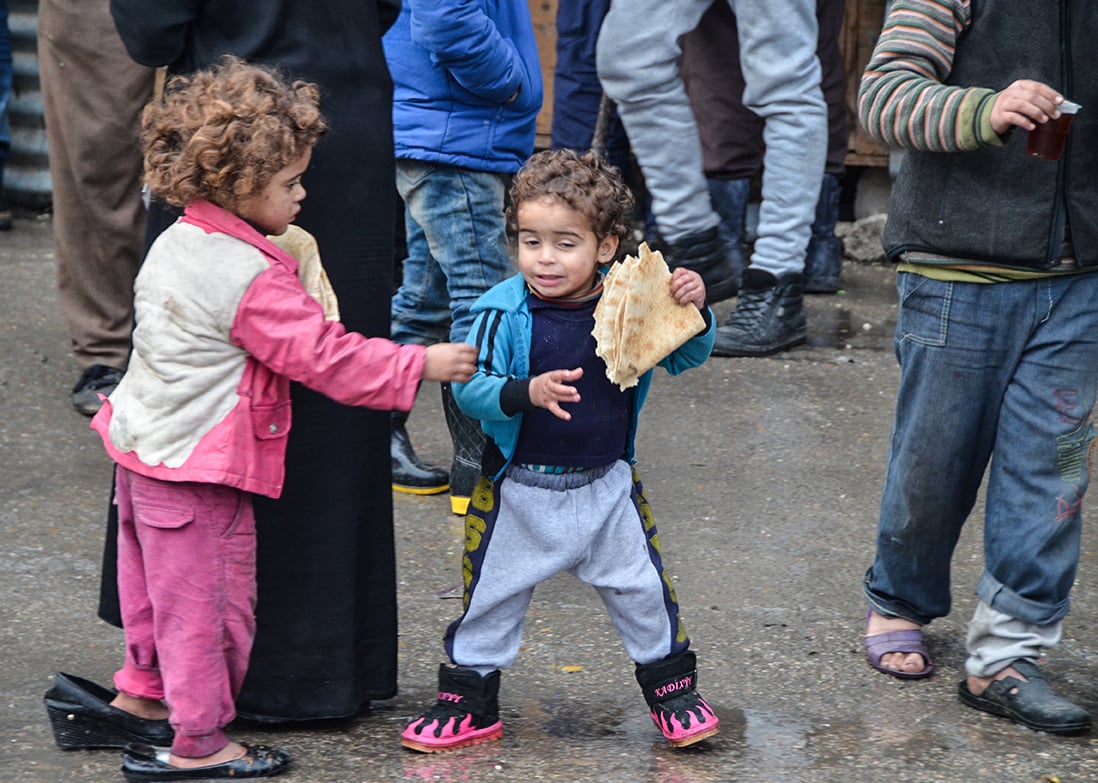
No one thought of the consequences for the huge majority of the innocent Syrian people who had never touched a gun, or thought of doing so.
And two more perspectives: Don’t focus on the violence and the evil guy only – it’s war-promoting
No one seems to even have asked the question whether this was the best way to deal with internal affairs in one of the world’s oldest, cultured societies – and secular too with a long practice of peaceful co-existence among various faiths and groups.
It fit the – classical but anyhow wrong – Western-constructed narrative of Good and Bad Guys which the West loves and has practised in all major conflicts – Noriega, Milosevic, Saddam, Putin, Gaddafi, Assad. And have gone wrong with everywhere, no exception. No lessons learnt.
It’s focus is on one bad guy and on the violence – “who is the worst” and “we apply good violence against evil violence” and fails to understand two things: the underlying conflicts which invariably are very complex and, secondly, that violence is only a symptom and black-and-white two-party conflicts don’t exist. It’s discourse can never lead to peace as I have argued here.
Of course this whole narrative is self-serving. “We” have no historical responsibility, everything can be explained by “them” and their Bad Guy and we can do whatever we want because we are the Good Guys. And there is a good violence that shall win over evil violence. Etc.
Even if all the media were truthful, this war on Syria lacks legitimacy and legality
It may well be true that Bashar al-Assad has made many mistakes, failed, dragged his feet, wanted to keep in power (most Presidents do, I believe, but it wasn’t his destiny as a eye specialist in London), that his leadership is based on the security service, the party and an old guard, that “the regime” should never have met the demonstrators the way it did, that there are far too many serious human rights violations and war crimes and that Syria has a long way to go to become a democracy. And more.
You’ll then have to ponder the question too: Why was he so relatively popular by the West before 2011? Why was he not called a dictator back then? Why was the dictator obviously not that hated by the citizens of Syria? And why did the US work with Syria about implementing, systematically, torture and renditions? (Yes, a bit of a polemical question, I know).
And – more importantly – and ethical consideration:
Even if all these things and more are true about al-Assad and the broader Syrian power structure that cannot under any circumstances explain or legitimize what has been done to the Syrian people by foreign factors with violent means. Although there are many, also non-state militants, a series of foreign governments have – directly or through proxies – occupied Syria in total violation of international law. And continuing that argument: Syria has a right to self-defence – and to call upon others to come to its help – according to the UN Charter’s Article 51.
This intervention in Syrian affairs started way before spring 2011 and was made manifest when the so-called Friends of Syria – established by French president Sarkozy, a non-convicted war criminal (Libya) – met in Marrakech in December 2012 and declared that the Syrian National Coalition was from now on the only legitimate representative of the people of Syria, not its legitimate president Bashar al-Assad.
The meeting repeated what had been done in Libya before (and its consequences) and forgot, like there, to ask the Syrian 23 million people.
That was December 12, 2012. Eastern Aleppo was liberated on December 12, 2016. There is a direct connection and these two dates and four years are defining characteristics of the Syrian catastrophe.
That’s what also makes Aleppo’s liberation so important as I wrote in TFF PressInfo # 404.
And that explains why Aleppo signifies so much more than the fall or liberation. It had to – quickly and deliberately – be “disappeared” and forgotten in the West press and politics.
And while there is silence, we work out another strategy: The U.S. and other West has lost the initiative and Turkey, Russia and Iran took it. Time for the West to go in in a new way: Troops on the ground. But this is not the theme of this analysis and we should have no illusions that Syria sufferings will soon over after Aleppo.
And the result?
The largest humanitarian crisis since 1945 anywhere in the world. A shattered country, culture and nation. 13 million people, more than half the people, in urgent need of humanitarian assistance. Millions of internally displaced people and refugees outside Syria, 300.000 or more dead – how many wounded in body and soul, we don’t know.
But how could that happen?
Well, we’ve been told again and again that it had nothing to do with the above-mentioned features. Or with the troubles of the Middle East, with Sykes-Picot, Balfour, economic crisis, militarisation, other wars, Iraq, Western colonialism (France and England) or American/CIA policies in the region, nothing to do with Israel.
Not at all! What can explain it all is – you better believe it – is that it is all one man’s work: After 11 years as President trying to make reforms, letting people out of prisons, handling up to 2 million refugees from the crisis “we” (deny that we) created in Iraq, running a system with free education, free health services and a secular state and being appreciated by the West … Bashar al-Assad woke up one morning in spring 2011, had gone clinically mad and started killing as many as he could of his own fellow citizens and destroying Syria’s economy, history, culture, architecture, livelihood. Everything!
If you hear a sligt satirical undertone here, you’re right. And it’s intentional.
This narrative doesn’t hold. It fell apart in Aleppo. And this, the world’s largest humanitarian crisis, cannot be blamed only on Syria’s leadership. And that strategy for tragedy cannot be seen as legitimate with reference to whatever bad features that can be ascribed to the Syrian government and its president. Killing so many and destroying so much cannot be justified by any policy goal however presumably noble and well-meaning .
As little as the use of nuclear weapons can by justified by any political aim.
What actually fell in Aleppo
On the day four years after Marrakech comes the fall of Aleppo, right?
Well, not really. What fell in Aleppo on December 12, 2016 was the entire Western policy of weaponisation, media management and deception, the proxy war and its assumed moral superiority. And the failure of the regime-change plan. Al-Assad had not gone away. He was, with help from his friends, turning the tide of that whole war project.
That – together with the liberation of about 100.000 from under occupation, people who were happy to again be under the Syrian government – is what Aleppo December 12, 2016 is about.
Embarrassing of course so, here’s the new strategy:
• Don’t talk about Aleppo anymore. Western media who were in Syria chose not to be in Aleppo during those historic day.
• Forget that our media filed reports about a coming Srebrenica, even genocide back then in December.
• Forget the humanitarian needs of those people.
• Focus on the Russians and Iran (Trump!), reduce the focus on Syria as such.
• But do give Amnesty International’s and similar report full blast without telling what it, fairly honestly, states itself in the chapter on methodology.
[The method – and the high-tech virtual construction of the Saydnaya prison – makes estimates about up to 13,000 murdered in one prison dubious. I’m a sociologist and know a bit about sampling and survey techniques, representativity, interview methodology and psychology and what can be concluded in terms of both reliability and validity on the basis of what respondents have told you under what circumstances. To conclude, on the basis of some 80 interviews, without a shred of empirical evidence that that many people have been killed there, simply does not qualify as acceptable research. For Western media disseminating it without caution is non-professional in terms of source checking and irresponsible in terms of public education. But unfortunately it serves the old narrative that fell apart in Aleppo].
What happened in Aleppo and how the largest group was disappeared in the media
Well, first of all people came free of occupation. Such a situation is something Europeans should be able to appreciate and empathize with. No one like to be occupied for years, see their family members being wounded or killed and their town reduced to ruins. Or have no livelihood.
The figures I have been able to obtain which are estimates is that 90,000-100,000 of the people in Eastern Aleppo stayed there or went to the Western government side and were assisted there by Syrian authorities, the Syrian Red Crescent and Russian medical teams. Some went to in preliminary camps, some to relatives or friends or in other ways, many looking forward to get back and re-build their places and start all over again.
Those – the majority – were disappeared by the leading media.
They instead focused on 25,000-35,000 who were evacuated – transported in Syrian buses – out of town, some (estimated to be around 7,000-10,000) to the town of Idlib, run by RIOT factions, and some to other places and some into Turkey. The Turkish foreign minister mentioned 37,500 all in all at CNN, December 20, 2016 – which must be assumed to include fighters, their families and sympathisers. The ICRC talks about 25,000 and a few thousand more.
Note in parenthesis that Eastern Aleppo was not 250,000 inhabitants as claimed by many; rather around half that number.
So, the media felt compelled to ignore the suffering of the first mentioned, largest group.
Those happen to be the ones I met some of, could freely choose to talk with and photograph (See the so far five photo stories here). I did that in Eastern Aleppo, particularly in the Hanano District, and in the Jibrin Reception Centre where some got the first humanitarian assistance by the Syrian Army, the Syrian Red Crescent, the Russians and by volunteers from Aleppo’s University.
On that side and although the fall/liberation was to be expected, I did not see Western humanitarian organisations there and none of the Eastern Allepians I asked about the White Helmets had seen them during these occupation years or these very days when the needs were enormous.
In summary, the large majority of people who came out of Eastern Aleppo at its liberation were ignored by the Western mainstream media. Those media had all left Western Aleppo days before – I stayed at the hotel where virtually all of them stayed and in none of the visits to the mentioned places in Aleppo did I see people from leading Western media, only independent Westerners like myself and, of course, people from local and regional media. No one from, say, BBC, CNN, no one from Scandinavia.
I still wonder about three things:
1) Why were they not there? Why did their people sit in Beirut, Ankara and Berlin – and here I talk about those who had been before in Syria, not those denied visa.
2) Why did they not cover the largest group of people in need of humanitarian aid, innocent people who had suffered too? Was it because they went to the government-controlled areas and it did not fit the narrative that they were happy and grateful to be liberated by the Syrian military and the Russians?
3) Why it’s been impossible for TFF and myself to get the story out from that side of the conflict out through a single large Western media although they’ve all received info about my presence there. I’ve written about it with concrete examples. A large German newspaper had an interview made with me and, at the moment of publication, dropped it.
The Nation – “the oldest continuously published weekly magazine in the United States (since 1865) and the most widely read weekly journal of progressive political and cultural news, opinion and analysis”, according to Wikipedia, asked me to write an article based on the three first photo stories I had published.
It was basically an editorial job and no new material was added. All was ready for publication, mutual agreement about details, no problems: And then a letter from editor Katrina vanden Heuvels that it would not be published due to changed editorial priorities.
Everyone is entitled to have his or her hypotheses.
And I to have mine.
The good news – the new media – and how you can help
Fortunately, the response and appreciation over my reports from Aleppo on the “new” media – social and otherwise – has been overwhelming in terms of quantity (tens of thousands) and quality – people’s appreciation, expressing how touched they were and their anger at understanding that they have not been given the larger picture in their newspapers and prime time television and other media they used to trust.
I’m proud to have been able to tell the story of these people in Syria. They deserve our attention and help. Our respect too. They’ve lost everything but are bent on moving on.
I’ll visit them again and therefore my hashtag on all I do is #keepfocusonaleppo. You can use that too.
If you want to help, I recommend you support the Syrian Red Crescent and the totally amazing Frenchman, Pierre le Corf and his We Are Super Heroes project in Aleppo who has devoted his personal fortune and his life to empower people and bring humanitarian aid, at the moment to Aleppo (see the Aleppo Project menu on this link).
Or support some local, truly humanitarian initiative for Syria’s people taken close to where you are. Just make sure it is humanitarian and not a cover-up for interventionist policies.