
Xinjiang deserves to be seen with eyes wide open!

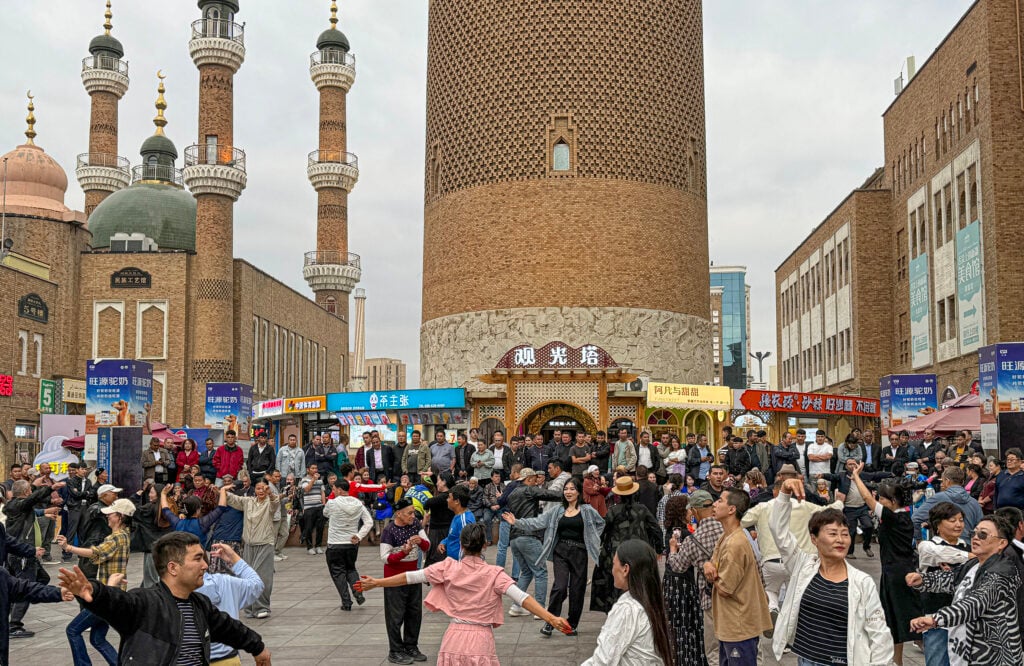
Citizens dancing on a Friday afternoon at the Grand Bazaar Square in Urumqi, Xinjiang, China – Photo Jan Oberg 2024

This is just a brief reflection on my second visit to China. Still tired from the long journey, I’m slowly adjusting to our time zone and trying to focus on the tasks waiting for me. But a flood of impressions keeps swirling in my mind, making it impossible to rest—especially after realizing how much Western propaganda had shaped my expectations. I thought I was heading to a brutal and backward corner of China, only to find myself utterly enchanted by what I encountered.

What intrigued me the most was the fact that I was about to visit what is often portrayed as China’s “most notorious” region. This is the province at the centre of ongoing accusations against China—claims of massive human rights abuses and even genocide, particularly targeting the Uyghur population. Sinophobia has various sources, triggers, and motives, and the narrative surrounding Xinjiang plays a major role in shaping perceptions.

What I find truly absurd is the eagerness to condemn the idea of genocide in Xinjiang while turning a blind eye to the very real and ongoing genocide in Palestine. Fact-checkers and so-called truth-verifiers operate with a clear agenda, often driven by Western grants that need justification.

Xinjiang is an incredible destination for anyone who prefers to experience a place firsthand, free from the interpretations of fact-checkers or NGOs who have never set foot here. This province has a remarkable tourism story to tell: in the first nine months of 2024, it welcomed an astounding 250 million visitors!

I hope I don’t come across as an arrogant representative of (so-called) developed Europe—or, to put it bluntly, the West. I’ll admit that I was initially caught up in the Western narrative myself. I expected to find a remote, desolate area—essentially “the middle of nowhere.” This assumption wasn’t rooted in ignorance, but rather in preconceived notions.

However, during my first visit to China last month, I was struck by its mysticism, diversity, and depth. I quickly realized that even a lifetime wouldn’t be enough to fully appreciate all its richness and nuances. Whenever I mentioned to my Chinese hosts that my next stop was Urumqi, they would light up and say, “Ah, that’s such a different place! Expect to see new things!” And they were absolutely right—it was unlike anything I had ever experienced!

Like a modern-day Marco Polo or Sinbad the Sailor—albeit travelling by plane in the 21st century—I was excited for a “different” experience in Urumqi. What I discovered, however, was more of a continuation of the familiar China, but with a surprising twist. The real surprise came from the scents, colours, and sounds that reminded me of my homeland, Macedonia. It was an unexpected and fascinating blend!

As I boarded the flight to Urumqi, I noticed just as many passengers as I had seen on the flight from Frankfurt to Beijing. “Ah,” I thought, “after all, this is China—a country with 1.5 billion people!” When we landed at Urumqi’s airport, I was amazed by how modern and bustling it was compared to Skopje’s modest terminal. Urumqi had spacious, functional facilities for both domestic and international flights.

The bus ride to the hotel took place at night, providing me with a glimpse of the illuminated city—massive boulevards with four to six lanes in each direction, towering skyscrapers, brightly lit intersections, and iconic landmarks. In comparison, Skopje felt like a small Ottoman town from two or three centuries ago.

Another striking impression was the seemingly endless construction—buildings going up everywhere, with no end in sight! The city is clearly booming. We later witnessed the fruits of this economic growth during our visit to the China Energy Group (a small segment of which could potentially solve Macedonia’s entire energy issues) and the leading electric car factory. I couldn’t help but laugh bitterly at the thought of the “camel cornerstone” fiasco in Tetovo while observing this progress.

During our free time, we ventured out to explore the city on our own. I’ll save the story of Urumqi’s phenomenal museum for another time—it was so rich and exciting that it even evoked memories of Balkan history, where civilizations, cultures, ethnicities, and languages intersect in a beautiful tapestry.

One thing I’ll emphasize is this: while the EU promotes the slogan “unity in diversity,” China embraces the philosophy of “harmony in diversity.” This approach has successfully created a soft, seamless mosaic—not through domination but by integrating everyone into the vibrant fabric of Chinese society.

At times, I genuinely felt at home—whether through the intricate embroidery patterns, the carpets and crafts, or the traditional music and food. Xinjiang’s natural beauty is hard to capture in words, with its breathtaking blend of mountain ranges, rivers, lakes, and deserts. Yet, every now and then, I would spot familiar elements that reminded me of home—like Radika, Lake Ohrid (which has its own “Heavenly Lake,” Tianchi), the peaks of Korab and Šar Mountain, or the horses of Mavrovo.

This region has been both fortunate and unfortunate throughout the centuries, serving as a crossroads for various peoples and cultures. It lies at a central point of the ancient Silk Road, whose beginnings I had glimpsed during my first visit to Jinan, on the other side of China. Today, the modern Belt and Road Initiative, BRI, follows these same routes but with cutting-edge infrastructure for connection.

It’s heartwarming to realize that many influences—musical instruments, traditional costumes, and more—have travelled from this place to reach us. This experience underscores the idea that the world is both vast and small, and that we, too, are a part of it.

During the wars in the former Yugoslavia, there was a Bosnian joke about superficial foreign “researchers.” A local man named Mujo encounters a foreigner in a pub, who is busily jotting down notes. After they exchange greetings, Mujo asks how long the foreigner will be in town and what he’s writing. The foreigner, who hails from the West, replies that he arrived yesterday and is leaving tomorrow, and that he’s working on a book titled “Bosnia and Herzegovina: Yesterday, Today, and Tomorrow.”

I’m not claiming to be an expert on China or its complexities, nor do I intend to write a book about it. But my experiences have turned me into a modest and curious explorer—someone eager to learn more, not just about China, but also about the connections between our civilizations and the potential for collaboration in creating a peaceful world. We often hear that we stand on “opposite sides,” even unfriendly ones, a narrative spread by those in this tranquil country of ours, now transformed into a military base and a NATO outpost.

However, I felt welcomed and safe among warm, hospitable friends. There was also a subtle sense of Eastern familiarity in many aspects of life. It’s essential for us to set aside stereotypes and explore every opportunity for closer cooperation across various fields. There’s so much to learn from these people—not only about them but also about ourselves as part of the global community.

I hope I shall return to China. I want to write about the Grand Bazaar in Urumqi, the fascinating stories in the museum, and how they helped me better understand the complexities of the Balkans—where diverse influences have intersected and continue to shape the lives of our ancestors, contemporaries, and future generations. I also wish to reflect on the Islamic Institute, a university that is more modern than many of our secular institutions.

It’s true that China faces internal challenges, but not all stem from ethnic or religious diversity. Many arise from far more complex historical and external influences—issues we know all too well from personal experience. Yet, China addresses these challenges through investments, compromises, diplomacy, gentleness, and relentless development.

In just a few days, I gathered countless stories, inspired by the rich cultural tapestry and intellectual challenges I encountered. It was worth the exhaustion and effort. As for the critics—they can keep complaining: If I have the chance again, especially now as I navigate life’s final stretch, I would gladly return and experience the “most notorious” places for myself. No one else will define who my friends are or are not.

For now, China feels like a warm and familiar place—it even smells like home, reminiscent of the bread from the Grand Bazaar in Urumqi.

Biljana Vankovska is a Professor of international relations and peace studies at the Institute for Security, Defense, and Peace, Faculty of Philosophy, Ss. Cyril and Methodius University in Skopje, Macedonia.

After having been a TFF Associate over 25 years, she joined TFF’s Board in October 2024.

Read about her here.

5 Responses

  1. Marvelously well written and intriguing. Blessings and contentment on the people of Xinjiang! Kudos to Ms. Vankovska. I read a similarly candid and valuable report about Xinjiang a few years ago written by Singaporean Ambassador and Journalist Kishore Mahbubani.

  2. What an excellent and informative work this is. I enjoyed the observations and nuanced interpretation of all the author encountered. A breath of fresh air if only for the fact that the western coverage and it’s sinophobic drivel are dredged from the bottom of the barrel when there is in fact so much we can learn about China.

  3. Thank you @mohandeer. Your site was one of the first I encountered on this topic. For a balanced view, the following article is key in my own considerable personal compilation: • Xinjiang and Uyghurs — What You’re Not Being Told (by The Corporate/Corrupt Western Media) – – World Affairs via Worldtruth blog https://mohandeer.wordpress.com/2019/07/06/xinjiang-and-uyghurs-what-youre-not-being-toldby-the-corporate-corrupt-western-media/ “Now, let’s break down the facts. There are four types of Uyghur Muslims: 1. Well-educated Uyghurs who are moderate/secular Muslims 2. Poor and lower middle-class Uyghurs 3. Nomads 4. Separatists and terrorists”

Related Posts

Johan Galtung 1930-2024October 2015 Published here on October 3, 2026 Let us focus on Civilization for conflict analysis and remedies. Major forms of disorder use violence; war is state organized violence. The most belligerent states are the United States of America and Israel, both with civilization roots. National Evangelism, the US Protestant Christian civilization– more national than evangelical–justifies US warfare as exceptionalism of a people chosen by God, with a manifest destiny to run the world. Orthodox Judaism justifies Israeli warfare to conquer and expand from Nile to Euphrates as a religious right and duty to the Eternal One. The third most belligerent country, the UK, no longer believes it is God-chosen but chosen by the USA; not quite the same but something. But the root cause of global disorder lies in the Occident–with Islam–seeing itself as the single, universal civilization valid for all at all times, all others being...
Jan ObergPhD, director, The Transnational Foundation for Peace and Future Research, TFFLund, Sweden October 2, 2026 This is my full original manuscript. The Chinese Academy of Social Science, CASS, makes two publications out if it. 1. China’s Five-year plan emphasized the capabilities of basic research and original innovation. It is regarded as the goal of the future social development, which, as required, should be significantly enhanced. Can you comment on the importance of original innovation in research and academic study? I believe it is easier to define “original innovation” in the natural sciences than in social sciences. The breaking points of what constitutes something new, or innovative, are not quite as sharp in the latter. But in both fields it is about opening up something that was closed, unseen, unexplored before – making manifest what was earlier latent. Innovations come in many forms and shapes – naming something that was not...
The agreement is catastrophic both because of what it says and what it doesn’t mention. It reduces further the major asset of security policies: Freedom of action. Jan Oberg TFF director September 25, 2026 A couple of hours before the agreement was signed on September 22, 2026, I published the following 13 hypotheses about what it would most likely contain on TFF Substack (in English). I was wrong on only the first point. Contrary to what Trump had written on his Truth Social platform, it does not appear to come into force immediately. In fact, it turned out to be worse than even I had anticipated. After these hypotheses now come a number of reflections in light of what the agreement actually contains, and does not contain, as well as the way in which it has generally been presented by major media outlets and by the public-service broadcaster DR. My...

Recent Articles

Tony Robinson October 4, 2026 Violence is easy to recognise when someone is being beaten, shot or killed. It becomes more difficult when nobody is holding a weapon. Poverty, discrimination, exploitation and repression can restrict a human life just as effectively, although they do so in very different ways and with very different consequences. Simply adding more categories to an ever-growing list of forms of violence does not really solve the problem. The more interesting question is what all these different situations have in common and why it makes sense to describe them using the same word. Human beings do not simply react to what happens around them. They remember the past, imagine things that do not yet exist, make plans and undertake projects. Workers organise because they imagine different working conditions; people migrate because they imagine another life somewhere else; social movements emerge because people refuse to accept the...
It’s a matter of principles, courage, vision and pulling together – while the militarist world is falling apart… Peter Langille October 3, 2026 “Here, then, is the problem which we present to you, stark and dreadful and inescapable: Shall we put an end to the human race; or shall mankind renounce war?”The Bertrand Russell—Albert Einstein Manifesto, July 9, 1955 ⁕ The forecast for what’s ahead is worrisome. The sharp rise in armed conflicts over the past three years is adding to what was already the highest level in over seventy years. Genocides, which should be prevented are supported. A shared climate emergency that jeopardises survival is ignored. Diverse polls now suggest that people are war-weary, worried and interested in a more effective United Nations. And, there are viable policy options for a more secure world! Yet governments are doubling-down, betting on more war and investing heavily. If current trends persist,...
Johan Galtung 1930-2024October 2015 Published here on October 3, 2026 Let us focus on Civilization for conflict analysis and remedies. Major forms of disorder use violence; war is state organized violence. The most belligerent states are the United States of America and Israel, both with civilization roots. National Evangelism, the US Protestant Christian civilization– more national than evangelical–justifies US warfare as exceptionalism of a people chosen by God, with a manifest destiny to run the world. Orthodox Judaism justifies Israeli warfare to conquer and expand from Nile to Euphrates as a religious right and duty to the Eternal One. The third most belligerent country, the UK, no longer believes it is God-chosen but chosen by the USA; not quite the same but something. But the root cause of global disorder lies in the Occident–with Islam–seeing itself as the single, universal civilization valid for all at all times, all others being...

TFF on Substack

Discover and subscribe to more peace materials on TFF Substack

Most Popular

Tony Robinson October 4, 2026 Violence is easy to recognise when someone is being beaten, shot or killed. It becomes more difficult when nobody is holding a weapon. Poverty, discrimination, exploitation and repression can restrict a human life just as effectively, although they do so in very different ways and with very different consequences. Simply adding more categories to an ever-growing list of forms of violence does not really solve the problem. The more interesting question is what all these different situations have in common and why it makes sense to describe them using the same word. Human beings do not simply react to what happens around them. They remember the past, imagine things that do not yet exist, make plans and undertake projects. Workers organise because they imagine different working conditions; people migrate because they imagine another life somewhere else; social movements emerge because people refuse to accept the...
It’s a matter of principles, courage, vision and pulling together – while the militarist world is falling apart… Peter Langille October 3, 2026 “Here, then, is the problem which we present to you, stark and dreadful and inescapable: Shall we put an end to the human race; or shall mankind renounce war?”The Bertrand Russell—Albert Einstein Manifesto, July 9, 1955 ⁕ The forecast for what’s ahead is worrisome. The sharp rise in armed conflicts over the past three years is adding to what was already the highest level in over seventy years. Genocides, which should be prevented are supported. A shared climate emergency that jeopardises survival is ignored. Diverse polls now suggest that people are war-weary, worried and interested in a more effective United Nations. And, there are viable policy options for a more secure world! Yet governments are doubling-down, betting on more war and investing heavily. If current trends persist,...
Johan Galtung 1930-2024October 2015 Published here on October 3, 2026 Let us focus on Civilization for conflict analysis and remedies. Major forms of disorder use violence; war is state organized violence. The most belligerent states are the United States of America and Israel, both with civilization roots. National Evangelism, the US Protestant Christian civilization– more national than evangelical–justifies US warfare as exceptionalism of a people chosen by God, with a manifest destiny to run the world. Orthodox Judaism justifies Israeli warfare to conquer and expand from Nile to Euphrates as a religious right and duty to the Eternal One. The third most belligerent country, the UK, no longer believes it is God-chosen but chosen by the USA; not quite the same but something. But the root cause of global disorder lies in the Occident–with Islam–seeing itself as the single, universal civilization valid for all at all times, all others being...
Read More
Living-Peace-Sign-Budapest-copy
Tony Robinson October 4, 2026 Violence is easy to recognise when someone is being beaten, shot or killed. It becomes more difficult when nobody is holding a weapon. Poverty, discrimination, exploitation and repression can restrict a human life just as effectively, although they do so in very different ways and with very different consequences. Simply adding more categories to an ever-growing list of forms of violence does not really solve the problem. The more interesting question is what all these different situations have in common and why it makes sense to describe them using the same word. Human beings do not simply react to what happens around them. They remember the past, imagine things that do not yet exist, make plans and undertake projects. Workers organise because they imagine different working conditions; people migrate because they imagine another life somewhere else; social movements emerge because people refuse to accept the...
b54a1f10-8c65-4f0b-9dd5-4abc0a7d04cc_2659x2659
It’s a matter of principles, courage, vision and pulling together – while the militarist world is falling apart… Peter Langille October 3, 2026 “Here, then, is the problem which we present to you, stark and dreadful and inescapable: Shall we put an end to the human race; or shall mankind renounce war?”The Bertrand Russell—Albert Einstein Manifesto, July 9, 1955 ⁕ The forecast for what’s ahead is worrisome. The sharp rise in armed conflicts over the past three years is adding to what was already the highest level in over seventy years. Genocides, which should be prevented are supported. A shared climate emergency that jeopardises survival is ignored. Diverse polls now suggest that people are war-weary, worried and interested in a more effective United Nations. And, there are viable policy options for a more secure world! Yet governments are doubling-down, betting on more war and investing heavily. If current trends persist,...
010
Johan Galtung 1930-2024October 2015 Published here on October 3, 2026 Let us focus on Civilization for conflict analysis and remedies. Major forms of disorder use violence; war is state organized violence. The most belligerent states are the United States of America and Israel, both with civilization roots. National Evangelism, the US Protestant Christian civilization– more national than evangelical–justifies US warfare as exceptionalism of a people chosen by God, with a manifest destiny to run the world. Orthodox Judaism justifies Israeli warfare to conquer and expand from Nile to Euphrates as a religious right and duty to the Eternal One. The third most belligerent country, the UK, no longer believes it is God-chosen but chosen by the USA; not quite the same but something. But the root cause of global disorder lies in the Occident–with Islam–seeing itself as the single, universal civilization valid for all at all times, all others being...
Screenshot 2026-10-02 011738
Jan ObergPhD, director, The Transnational Foundation for Peace and Future Research, TFFLund, Sweden October 2, 2026 This is my full original manuscript. The Chinese Academy of Social Science, CASS, makes two publications out if it. 1. China’s Five-year plan emphasized the capabilities of basic research and original innovation. It is regarded as the goal of the future social development, which, as required, should be significantly enhanced. Can you comment on the importance of original innovation in research and academic study? I believe it is easier to define “original innovation” in the natural sciences than in social sciences. The breaking points of what constitutes something new, or innovative, are not quite as sharp in the latter. But in both fields it is about opening up something that was closed, unseen, unexplored before – making manifest what was earlier latent. Innovations come in many forms and shapes – naming something that was not...
arctic-circle-map
The agreement is catastrophic both because of what it says and what it doesn’t mention. It reduces further the major asset of security policies: Freedom of action. Jan Oberg TFF director September 25, 2026 A couple of hours before the agreement was signed on September 22, 2026, I published the following 13 hypotheses about what it would most likely contain on TFF Substack (in English). I was wrong on only the first point. Contrary to what Trump had written on his Truth Social platform, it does not appear to come into force immediately. In fact, it turned out to be worse than even I had anticipated. After these hypotheses now come a number of reflections in light of what the agreement actually contains, and does not contain, as well as the way in which it has generally been presented by major media outlets and by the public-service broadcaster DR. My...
girl-5894831_1280
Below are TFF-related media mentions, comments, videos and social media posts published elsewhere but not on this homepage. We happen to catch and list only a fraction. Regarding video comments and debates, we recommend that you go to the TFF Video Channel on Substack where many of them are reproduced. Jan Oberg is a contributor to China Daily – 52 million daily clicks – and Global Times, CGTN and CCTV (the national television), China Investment, Xinhua News Agency and several others. Articles and videos on these media very often multiply into countless Chinese (and Western media) that re-post them from these main media. Thanks to The China Academy, his analyses, interviews and comments are frequently posted on YouTube channels such as Thinkers Forum and Wave Media. These videos are often re-posted on Bilibili (China’s YouTube), the China Content Center on TikTok, and on the Chinese edition of TikTok, Douyin.com. This means reaching hundreds of millions of viewers worldwide over a year. While there are too many to catch on all these...





