
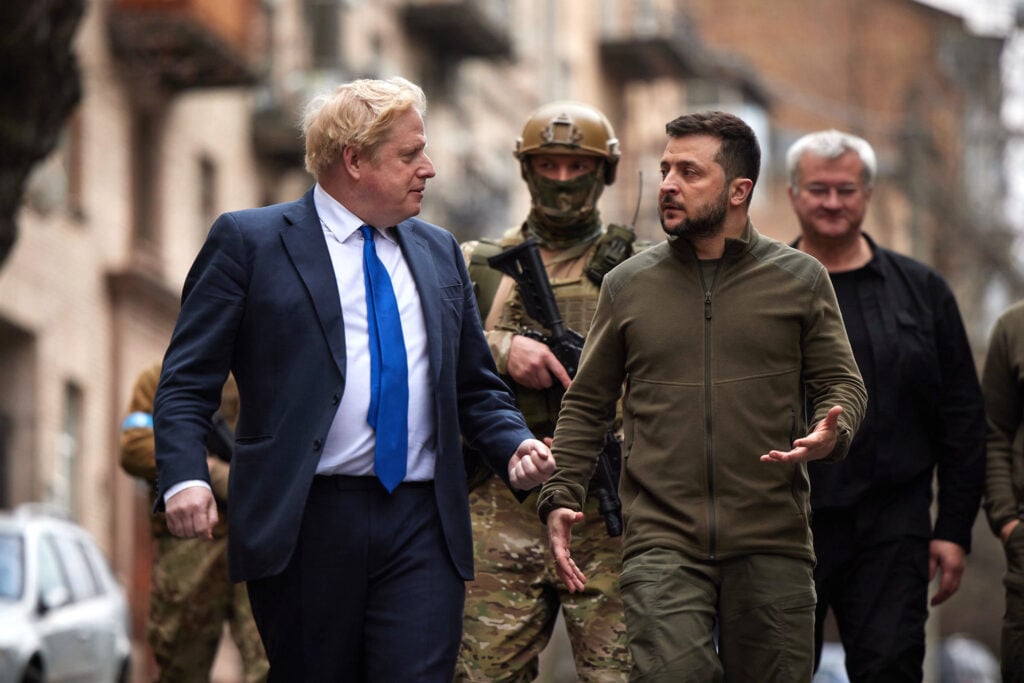
Given their lack of information about the Ukraine-Russia deal scuttled by Boris Johnson early in the war, many Americans will be inclined to believe Biden’s evidence-free claims in last week’s CNN debate.

Ray McGovern
Special to Consortium News, July 2, 2024

July 5, 2024

At Thursday’s debate with Donald Trump, President Joe Biden, calling Russian President Vladimir Putin a “war criminal,” claimed that he “wants all of Ukraine. … Do you think he’ll stop? … What do you think happens to Poland and other places?”

Spoiler Alert: Official Ukrainian sources confirm that Putin did stop in March 2022, after Ukrainian President Volodomyr Zelensky agreed to forswear membership in NATO. This was the key provision in the Ukraine-Russia deal initialed by Davyd Arakhamia, who at the time was Zelensky’s chief negotiator (and his party’s faction leader in the Rada) at the talks in Istanbul at the end of March, hardly a month into the war.

The Russians lifted their objection to Ukraine joining the EU, as the Ukrainians agreed to neutrality. Security guarantees sought by Kyiv (short of NATO membership) would be worked out. The fighting would stop. Agreement on the status of Crimea would be put off to the future.

Putin and Zelensky reportedly were micromanaging the March 2022 negotiations, and at that early stage the Russians expressed readiness for the two to meet. 

At the same time that Biden and other Western leaders raise the alarm that Putin will attack other parts of Europe when he’s through with Ukraine, they claim Russia can’t even take the Ukrainian province of Kharkiv, has lost more than 500,000 men to just 30,000 Ukrainians and its economy is faltering (none of which is true.)  But Cold War Western power was based on an exaggerated Soviet threat and the same is true today. 

In a November 2023 Kyiv Post report titled “Russia Offered to End War in 2022 If Ukraine Scrapped NATO Ambitions – Zelensky Party Chief,”  Arakhamia confirmed that in the March 2022 negotiations Russia proposed ending the war on the condition that Ukraine abandon its NATO aspirations and adopt a neutral stance.

Arakhamia continued:

“Neutrality was the biggest thing for them, they were ready to end the war if we took — as Finland once did — neutrality and made commitments that we would not join NATO. This was the key point. 

While negotiations continued in Istanbul, former U.K. Prime Minister Boris Johnson unexpectedly arrived in Kyiv on April 9 and said that Ukraine shouldn’t sign anything with them at all – and ‘let’s just fight.’ ”

Arakhamia’s candor was refreshing. But it came as no surprise to those of us following Ukraine in early 2022. On May 5, 2022 — a year and a half before Arakhamia spilled the beans to the Kyiv Post — Ukrainska Pravda ran a report under the title “Possibility of talks between Zelensky and Putin came to a halt after Johnson’s visit”:

“According to sources close to Zelenskyy, the Prime Minister of the United Kingdom, Boris Johnson, who appeared in the capital almost without warning, brought two simple messages.

The first is that Putin is a war criminal, he should be pressured, not negotiated with. And the second is that even if Ukraine is ready to sign some agreements on guarantees with Putin, they [the West] are not. The collective West felt that Putin was not really as powerful as they had previously imagined, and that here was a chance to press him.”

Three days after Johnson left Kyiv, Putin publicly stated that talks with Ukraine had “turned into a dead end.” Putin expressed confidence that Russia would ultimately prevail and added that it would “rhythmically and calmly” continue conducting the operation in Ukraine.

In his major speech to the Russian Foreign Ministry on June 14, Putin said the Russian troops approaching Kyiv in February-March 2022 were there “to push the Ukrainian side to negotiations.” 

From Feb. 24 on, the Russians had expressed readiness for diplomacy. Interestingly, Zelensky appointed Arakhamia chief negotiator on Feb. 28.

Putin continued:

“Surprisingly, as a result, agreements that satisfied both Moscow and Kyiv were indeed reached and initialed in Istanbul. … The document was titled ‘Agreement on Permanent Neutrality and Security Guarantees for Ukraine’. It was a compromise but  resolved the problems that were stated as major ones even at the start of the special military operation.

But the path to peace was rejected again. … The former UK prime minister said directly during his visit to Kyiv – no agreements. Russia must be defeated on the battlefield. … Thus they began to intensively pump Ukraine up with weapons and started talking about the need to inflict a strategic defeat on Russia.”

Who has been telling Biden that Putin “will not stop at Ukraine?” Exhibit A would be Fiona Hill, disciple of arch-Russophobe historian Richard Pipes, and national intelligence officer for Russia (2006-09). 

Her insights appeared in The New York Times exactly a month before Russia invaded Ukraine.

On Jan. 24, 2022, the Times featured a guest essay by Hill titled “Putin has the U.S. Right Where He Wants It”:

“This time, Mr. Putin’s aim is bigger than closing NATO’s ‘open door’ to Ukraine and taking more territory — he wants to evict the United States from Europe. As he might put it: ‘Goodbye, America. Don’t let the door hit you on the way out.’”  [Emphasis added.]

Fiona Hill’s NYT essay about Putin driving the U.S. out of Europe had a short (two-month) shelf life, as Putin’s negotiators in Istanbul extracted a Ukrainian commitment not to seek NATO membership and a stop in hostilities. Hill admitted as much in a September/October 2022 Foreign Affairs article which included, briefly, the substance of the Istanbul agreement.

This may be damning with faint praise but, in this respect, Fiona Hill showed far more integrity than the Times, which continues to deny its readers the facts about the Istanbul accord and how it showed that in March-April 2022 Putin did stop once Ukrainian negotiators agreed to forswear membership in NATO.

With Putin having provided, in his June 14 speech, chapter and verse on the (aborted by Boris Johnson) “Agreement on Permanent Neutrality and Security Guarantees for Ukraine,” the Times wasted no time distorting the terms of the Istanbul accord, mostly by omission and turgid obfuscation, in publishing two highly deceptive articles on June 15. 

Neither article mentions  Johnson’s wrecking-ball role in scuttling the Istanbul accord. And even the subsequent admissions of Ukrainian negotiators are mangled.

Thus, New York Times readers, and the thousands of media outlets that take their lead from the Times, are once again misled on a crucial issue — one for which there is ample official Ukrainian testimony that the Times chooses to omit or fudge. And many Americans will be inclined to believe Biden’s evidence-free claims about Putin’s ultimate objectives, and to acquiesce in the dangerously growing tension with Russia — malnourished as they are on accurate information.

For many it will come down to: Between Biden and Putin, Americans “know” whom to believe!


Speaking to Western journalists on June 5, Putin cautioned: 

“You should not make Russia out to be the enemy. You’re only hurting yourself with this … They thought that Russia wanted to attack NATO. Have you gone completely crazy? … Who came up with this? It is just complete nonsense, you know? Total rubbish.”

Sadly, it is the kind of nonsense that could mislead Americans, conditioned to believe the worst of Russia, into supporting some kind of risky escalatory move by an administration determined to show how tough it is, as the November election inches closer and closer. Strap on your seatbelts.


Ray McGovern works with Tell the Word, a publishing arm of the ecumenical Church of the Saviour in inner-city Washington. His 27 years as a C.I.A. analyst included leading the Soviet Foreign Policy Branch and conducting the morning briefings of the President’s Daily Brief. In retirement he co-founded Veteran Intelligence Professionals for Sanity (VIPS).

Views expressed in this article and may or may not reflect those of Consortium News.

One Response

  1. Another fine article confirming that the lackeys of the West are projecting their own criminal thoughts onto the designated enemy. Of course to scare and fool us all and keep the war machine running and killing ordinary people. Our Western leaders are themselves what they claim about Putin. Biden, Johnson and Putin are all war criminals in close collaboration with the mainstream media. But one can amply argue that in connection with the Ukraine war, it is indisputably the Western leaders who lead as war criminals. Once again confirmed. But the populations of the West are unfortunately still misled by the massive Western propaganda. The decline of the West is inevitable. Sad…

Related Posts

Jan Oberg, TFF director April 9, 2026 I was recently invited to have a good, long talk about the world – and, of course, about peace too – with Boris Malagurski on his Weight of Chains Channel on YouTube. It was a real joy and seems to have been greatly appreciated by the viewers too. Mr Malagurski and I shall of course be grateful if you share this conversation in your circles – of course, only if you like what you see and hear 😉☮️ And remember that this one – like hundreds of others with TFF Associates – can be enjoyed at our TFF Video Collection.
By Jan ObergTFF co-founder and director February 11, 2026 PART 3 — ECONOMICS, TRADE & FINANCIAL SOVEREIGNTY A. Trade Measures & Market Signaling Economic pressure can be applied instantly and scaled without violence. Immediate Measures (within a week) Government boycott US goods and services  A very powerful signal which over time will be felt. Targeted tariffs on selected U.S. goods Symbolic but high-visibility sectors send a clear message. Suspend trade facilitation talks A peaceful pause that signals deep concern. Freeze U.S. participation in public procurement – military procurement in particular A nonviolent way to reduce influence. Competition law review of U.S. corporations A legal tool to scrutinise market dominance. Longer-Term Measures EU–Asia–Africa trade corridors Reducing reliance on U.S. markets. European supply chains for critical minerals Strategic autonomy in resource access. European Strategic Trade Authority Monitoring coercive practices globally. Euro-denominated commodity markets Weakening the dollar’s pricing monopoly. The EU must resume contacts and negotiations with Russia, focusing on energy cooperation To...
PART 2 — Diplomacy, Law and Nonviolent Power By Jan ObergTFF co-founder and director January 26, 2026 This is the second of four TFF-created idea portfolios designed to curb the global reach of the United States and, in both the short and long term, help catalyse a worldwide nonviolent resistance to what many observers describe as the Trump administration’s uniquely confrontational, destructive and world-threatening policies. These portfolios outline what governments and citizens across the world can do through dynamic diplomacy, creative initiatives, and strictly nonviolent means. They are typical TFF works in that we do not only tell what the problem is and how bad it will go – as 90+% of all commentators, experts and scholars do – we tell what we think can be done, inviting you to think of what you think you can do. It seems painfully clear to me that the current political dynamics in Washington increasingly resemble the most dangerous...

Recent Articles

Tony Robinson October 4, 2026 Violence is easy to recognise when someone is being beaten, shot or killed. It becomes more difficult when nobody is holding a weapon. Poverty, discrimination, exploitation and repression can restrict a human life just as effectively, although they do so in very different ways and with very different consequences. Simply adding more categories to an ever-growing list of forms of violence does not really solve the problem. The more interesting question is what all these different situations have in common and why it makes sense to describe them using the same word. Human beings do not simply react to what happens around them. They remember the past, imagine things that do not yet exist, make plans and undertake projects. Workers organise because they imagine different working conditions; people migrate because they imagine another life somewhere else; social movements emerge because people refuse to accept the...
It’s a matter of principles, courage, vision and pulling together – while the militarist world is falling apart… Peter Langille October 3, 2026 “Here, then, is the problem which we present to you, stark and dreadful and inescapable: Shall we put an end to the human race; or shall mankind renounce war?”The Bertrand Russell—Albert Einstein Manifesto, July 9, 1955 ⁕ The forecast for what’s ahead is worrisome. The sharp rise in armed conflicts over the past three years is adding to what was already the highest level in over seventy years. Genocides, which should be prevented are supported. A shared climate emergency that jeopardises survival is ignored. Diverse polls now suggest that people are war-weary, worried and interested in a more effective United Nations. And, there are viable policy options for a more secure world! Yet governments are doubling-down, betting on more war and investing heavily. If current trends persist,...
Johan Galtung 1930-2024October 2015 Published here on October 3, 2026 Let us focus on Civilization for conflict analysis and remedies. Major forms of disorder use violence; war is state organized violence. The most belligerent states are the United States of America and Israel, both with civilization roots. National Evangelism, the US Protestant Christian civilization– more national than evangelical–justifies US warfare as exceptionalism of a people chosen by God, with a manifest destiny to run the world. Orthodox Judaism justifies Israeli warfare to conquer and expand from Nile to Euphrates as a religious right and duty to the Eternal One. The third most belligerent country, the UK, no longer believes it is God-chosen but chosen by the USA; not quite the same but something. But the root cause of global disorder lies in the Occident–with Islam–seeing itself as the single, universal civilization valid for all at all times, all others being...

TFF on Substack

Discover and subscribe to more peace materials on TFF Substack

Most Popular

Tony Robinson October 4, 2026 Violence is easy to recognise when someone is being beaten, shot or killed. It becomes more difficult when nobody is holding a weapon. Poverty, discrimination, exploitation and repression can restrict a human life just as effectively, although they do so in very different ways and with very different consequences. Simply adding more categories to an ever-growing list of forms of violence does not really solve the problem. The more interesting question is what all these different situations have in common and why it makes sense to describe them using the same word. Human beings do not simply react to what happens around them. They remember the past, imagine things that do not yet exist, make plans and undertake projects. Workers organise because they imagine different working conditions; people migrate because they imagine another life somewhere else; social movements emerge because people refuse to accept the...
It’s a matter of principles, courage, vision and pulling together – while the militarist world is falling apart… Peter Langille October 3, 2026 “Here, then, is the problem which we present to you, stark and dreadful and inescapable: Shall we put an end to the human race; or shall mankind renounce war?”The Bertrand Russell—Albert Einstein Manifesto, July 9, 1955 ⁕ The forecast for what’s ahead is worrisome. The sharp rise in armed conflicts over the past three years is adding to what was already the highest level in over seventy years. Genocides, which should be prevented are supported. A shared climate emergency that jeopardises survival is ignored. Diverse polls now suggest that people are war-weary, worried and interested in a more effective United Nations. And, there are viable policy options for a more secure world! Yet governments are doubling-down, betting on more war and investing heavily. If current trends persist,...
Johan Galtung 1930-2024October 2015 Published here on October 3, 2026 Let us focus on Civilization for conflict analysis and remedies. Major forms of disorder use violence; war is state organized violence. The most belligerent states are the United States of America and Israel, both with civilization roots. National Evangelism, the US Protestant Christian civilization– more national than evangelical–justifies US warfare as exceptionalism of a people chosen by God, with a manifest destiny to run the world. Orthodox Judaism justifies Israeli warfare to conquer and expand from Nile to Euphrates as a religious right and duty to the Eternal One. The third most belligerent country, the UK, no longer believes it is God-chosen but chosen by the USA; not quite the same but something. But the root cause of global disorder lies in the Occident–with Islam–seeing itself as the single, universal civilization valid for all at all times, all others being...
Read More
Living-Peace-Sign-Budapest-copy
Tony Robinson October 4, 2026 Violence is easy to recognise when someone is being beaten, shot or killed. It becomes more difficult when nobody is holding a weapon. Poverty, discrimination, exploitation and repression can restrict a human life just as effectively, although they do so in very different ways and with very different consequences. Simply adding more categories to an ever-growing list of forms of violence does not really solve the problem. The more interesting question is what all these different situations have in common and why it makes sense to describe them using the same word. Human beings do not simply react to what happens around them. They remember the past, imagine things that do not yet exist, make plans and undertake projects. Workers organise because they imagine different working conditions; people migrate because they imagine another life somewhere else; social movements emerge because people refuse to accept the...
b54a1f10-8c65-4f0b-9dd5-4abc0a7d04cc_2659x2659
It’s a matter of principles, courage, vision and pulling together – while the militarist world is falling apart… Peter Langille October 3, 2026 “Here, then, is the problem which we present to you, stark and dreadful and inescapable: Shall we put an end to the human race; or shall mankind renounce war?”The Bertrand Russell—Albert Einstein Manifesto, July 9, 1955 ⁕ The forecast for what’s ahead is worrisome. The sharp rise in armed conflicts over the past three years is adding to what was already the highest level in over seventy years. Genocides, which should be prevented are supported. A shared climate emergency that jeopardises survival is ignored. Diverse polls now suggest that people are war-weary, worried and interested in a more effective United Nations. And, there are viable policy options for a more secure world! Yet governments are doubling-down, betting on more war and investing heavily. If current trends persist,...
010
Johan Galtung 1930-2024October 2015 Published here on October 3, 2026 Let us focus on Civilization for conflict analysis and remedies. Major forms of disorder use violence; war is state organized violence. The most belligerent states are the United States of America and Israel, both with civilization roots. National Evangelism, the US Protestant Christian civilization– more national than evangelical–justifies US warfare as exceptionalism of a people chosen by God, with a manifest destiny to run the world. Orthodox Judaism justifies Israeli warfare to conquer and expand from Nile to Euphrates as a religious right and duty to the Eternal One. The third most belligerent country, the UK, no longer believes it is God-chosen but chosen by the USA; not quite the same but something. But the root cause of global disorder lies in the Occident–with Islam–seeing itself as the single, universal civilization valid for all at all times, all others being...
Screenshot 2026-10-02 011738
Jan ObergPhD, director, The Transnational Foundation for Peace and Future Research, TFFLund, Sweden October 2, 2026 This is my full original manuscript. The Chinese Academy of Social Science, CASS, makes two publications out if it. 1. China’s Five-year plan emphasized the capabilities of basic research and original innovation. It is regarded as the goal of the future social development, which, as required, should be significantly enhanced. Can you comment on the importance of original innovation in research and academic study? I believe it is easier to define “original innovation” in the natural sciences than in social sciences. The breaking points of what constitutes something new, or innovative, are not quite as sharp in the latter. But in both fields it is about opening up something that was closed, unseen, unexplored before – making manifest what was earlier latent. Innovations come in many forms and shapes – naming something that was not...
arctic-circle-map
The agreement is catastrophic both because of what it says and what it doesn’t mention. It reduces further the major asset of security policies: Freedom of action. Jan Oberg TFF director September 25, 2026 A couple of hours before the agreement was signed on September 22, 2026, I published the following 13 hypotheses about what it would most likely contain on TFF Substack (in English). I was wrong on only the first point. Contrary to what Trump had written on his Truth Social platform, it does not appear to come into force immediately. In fact, it turned out to be worse than even I had anticipated. After these hypotheses now come a number of reflections in light of what the agreement actually contains, and does not contain, as well as the way in which it has generally been presented by major media outlets and by the public-service broadcaster DR. My...
girl-5894831_1280
Below are TFF-related media mentions, comments, videos and social media posts published elsewhere but not on this homepage. We happen to catch and list only a fraction. Regarding video comments and debates, we recommend that you go to the TFF Video Channel on Substack where many of them are reproduced. Jan Oberg is a contributor to China Daily – 52 million daily clicks – and Global Times, CGTN and CCTV (the national television), China Investment, Xinhua News Agency and several others. Articles and videos on these media very often multiply into countless Chinese (and Western media) that re-post them from these main media. Thanks to The China Academy, his analyses, interviews and comments are frequently posted on YouTube channels such as Thinkers Forum and Wave Media. These videos are often re-posted on Bilibili (China’s YouTube), the China Content Center on TikTok, and on the Chinese edition of TikTok, Douyin.com. This means reaching hundreds of millions of viewers worldwide over a year. While there are too many to catch on all these...




