
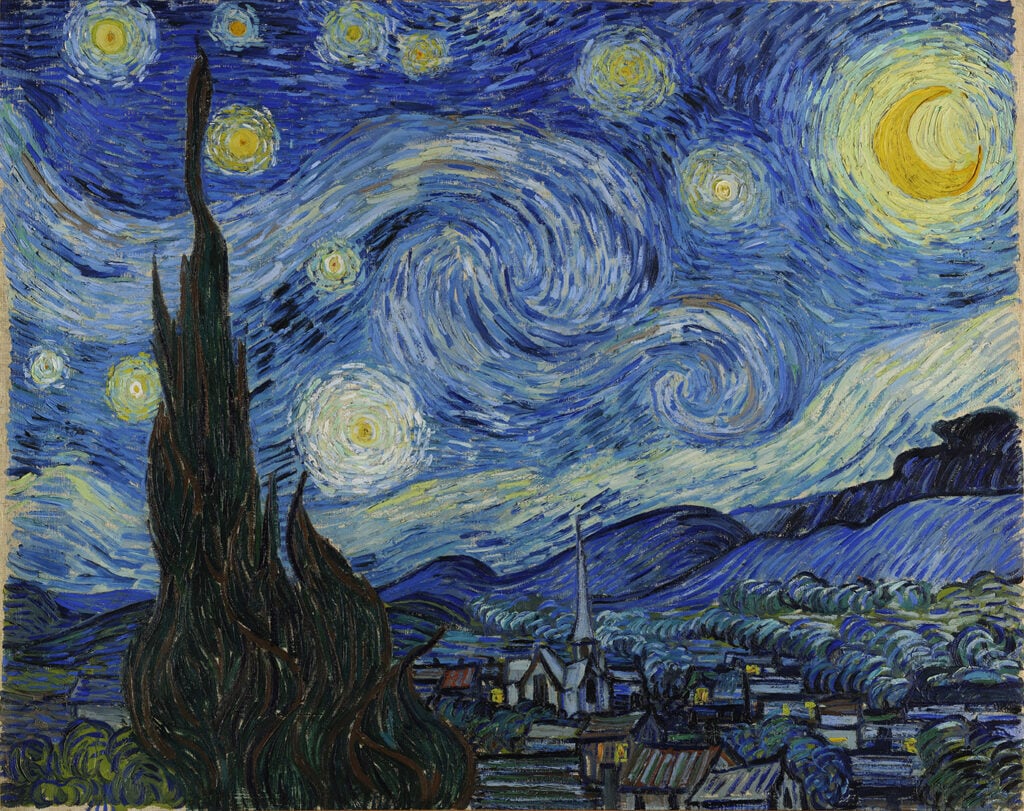
The Starry Night by Vincent van Gogh, 1889
August 29, 2023
Originally published on Curtin’s homepage on August 11, 2023
Because there is so much personal anguish, unhappiness, and human mental and physical suffering in the world, many people often wonder how they might personally change to find happiness, contentment, or some elusive something. Or even how to change other people, as if that arrogant illusion could ever work.
This question of significant personal change is usually couched within the context of narrow psychological analyses. This is very common and is a habit of mind that grows stronger over the years. People are reduced to their family upbringings and their personal relationships, while the social history they have lived through is dismissed as irrelevant.
The United States is very much a psychological society. Sociological and historical analyses are considered insignificant to people’s identities. It’s as if economics, politics, culture, and propaganda are beside the point.
Yes, it is often admitted that circumstances, such as illness, death, divorce, unemployment, etc. affect people, but such circumstances are not considered central to who people are and whom they become. These matters are rarely seen contextually, nor are connections made. They are considered inessentials despite the fact that they are always connected to larger social issues – that biography and history are intertwined.
In writing about what he termed the sociological imagination, C. Wright Mills put it clearly when he described it as “the idea that the individual can understand his own experience and gauge his own fate only by locating himself within his period, that he can know his own chances in life only by becoming aware of those of all individuals in his circumstances. In many ways it is a terrible lesson; in many ways a magnificent one.”
Without learning it, one cannot know who one is or whom one might become if one chose to change and were not just blown by the winds of fate.
We now live in a digital world where the uncanny nature of information pick up sticks is the big game. Uncanny because most people cannot grasp its mysterious power over their minds.
What was true in 1953 when Ray Bradbury penned the following words in Fahrenheit 451, is exponentially truer today:
Cram them full of non-combustible data, chock them so damn full of ‘facts’ that they feel stuffed, but absolutely ‘brilliant’ with information. Then they’ll feel they’re thinking, they’ll get a sense of motion without moving. . . . Don’t give them any slippery stuff like philosophy or sociology to tie things up with. That way lies melancholy.
That it is all noise, all signal – no silence.
That it prevents deep reflection but creates the habit of mental befuddlement that is consonant with the mental derangement of the mainstream media’s 24/7 news reports.
When almost everything you hear is a lie of one sort or another, it becomes barely possible to keep your wits about you.
These bits of bait are scattered all over the mind’s floor, tossed by an unknown player, the unnameable one who comes in the night to play with us. Their colors flood the mind, dazzle and razzle the eye.
It is screen time in fantasy-land.
•
This summer’s two hit movies – “Oppenheimer” and “Barbie” – while seemingly opposites, are two sides of this same counterfeit coin. Spectacles in The Society of the Spectacle as Guy Debord put it:
The spectacle is a social relation between people that is mediated by an accumulation of images that serve to alienate us from a genuinely lived life. The image is thus an historical mutation of the form of commodity fetishism.
“Oppenheimer,” while concentrating on the man J. Robert Oppenheimer who is called “the father of the atomic bomb,” omits the diabolic bombings of Hiroshima and Nagasaki as if there were no innocent victims, while “Barbie” plays the coy game of satirizing the doll that celebrates women as sex objects while advertising its same sex doll status. It’s just great “fun.” Colorful salt water taffy for a summer hoot. “Little Boy” meets sexy sister in the land of dreams where existential crises lead to expanded consciousness. Yes, Hollywood is the Dream Factory.
There is so much to attend to, multi-colored tidbits begging to be touched carefully, to grab our full consideration as we delicately lift them into the air of our minds. So many flavors. Call it mass attention disorder order or paranoia (beside the mind) or digital dementia. The names don’t matter, for it is a real condition and it is widespread and spreading madly. Everyone knows it but represses the truth that the country has become a comic book travesty sliding into quicksand while bringing the world down with it.
“Oppenheimer” plays while a mumbling and bumbling U.S. President Biden pushes the world toward nuclear annihilation with Russia over Ukraine.
“Barbie” struts on her stilettos while men receive guidance from the CDC on “chest feeding” and millions of young people are not sure what sex they are.
What’s up?
It’s all noise, all signal – no silence.
The instinct of self-defense has disappeared. “Not to see many things, not to hear many things, not to permit many things to come close,” this, Nietzsche told us, is the instinct of self-defense. But we have let all our defenses down because of the Internet, cell phones, and the digital revolution. We have turned on, tuned in, and dropped into computerized cells whose flickering bars note signal strength but not mental bondage. Not the long loneliness of distant signals barely heard, but “Cause” what Rodriquez sings for us:
Cause my heart’s become a crooked hotel full of rumours
But it’s I who pays the rent for these fingered-face out-of-tuners
and I make 16 solid half-hour friendships every evening.
It’s all noise, all signal – no silence.
•
I recently had the arduous task of reviewing nearly fifty years of a writer’s personal journals. The thing that stood out to me was the repetitive nature of his comments and analyses of people he knew and the relationships he had. His political, literary, and historical comments were insightful, and his keen observations into the decades long diminution of the belief in existential freedom captured well the growing domination of today’s deterministic ethos with its biological emphasis and its underlying hopeless nihilism.
But it was also very clear that the people he wrote about were little different after forty to fifty years. Their situations changed but they did not – fundamentally. They were encased in long-standing carapaces that protected them from change and choices that would force them to metamorphosize or undergo profound metanoias. Most of them saw no connection between their personal lives and world events, nor did they seem to grasp what William James, in writing about habits, said, “if we suffer the wandering of our attention, presently it will wander all the time. Attention and effort are … but two names for the same psychic fact.”
The notebooks, of course, were one man’s observations. But they seemed to me to capture something about people generally. In the notes I took, I summarized this by the words “social addiction,” a habit of living and thinking that has resulted in vast numbers of people locked in their cells, confused, totally bamboozled, and in despair. This condition is now widely recognized, even by the most unreflective people, for it is felt in the gut as a dazed death-in-life, a treading of water waiting for the next disaster, the next bad joke passing for serious attention. It is impossible to fail to recognize, if not admit, that the United States has become a crazy country, mad and deluded in the worst ways and leading the world to perdition on a fool’s dream of dominance and delusions.
The psychoanalyst Allen Wheelis, an intriguing writer who questioned his own profession, put it well in his 1973 book How People Change:
Often we do not choose, but drift into those modes which eventually define us. Circumstances push and we yield. We did not choose to be what we have become, but gradually, imperceptibly, became what we are by drifting into the doing of those things we now characteristically do. Freedom is not an objective attribute of life; alternatives without awareness yield no leeway… Nothing guarantees freedom. It may never be achieved, or having been achieved, may be lost. Alternatives go unnoticed; foreseeable consequences are not foreseen; we may not know what we have been, what we are, or what we are becoming. We are the bearers of consciousness but of not very much, may proceed through a whole life without awareness of that which would have meant the most, the freedom which has to be noticed to be real. Freedom is the awareness of alternatives and of the ability to choose. It is contingent upon consciousness, and so may be gained or lost, extended or diminished.
He correctly warned that insight does not necessarily lead to change. It may help initiate it, but in the end the belief in freedom and the power of the will is necessary.
This has become harder in a society that has embraced biological determinism as a result of decades of propaganda.
Freedom has become a slogan only. We have generally become determined to be determined.
To realize that one has choices is necessary, and that not to decide is to decide. Decisions (from Latin de = off and caedere = to cut) are hard, for they involve deaths, the elimination of alternatives, the facing of one own’s death(s) with courage and hope. The loss of illusions.
This too has become more difficult in a country that has jettisoned so much of the deep human spirituality that still animates many people around the world whom the U.S. government considers enemies.
Such decisions also involve the intellectual honesty to seek out alternative voices to one’s fixed opinions on a host of public issues that affect everyone’s lives.
To recognize that who we are and who we become intersect with world events, war, politics, the foreign policies of one’s country, economics, culture, etc.; that they cannot be divorced from the people we say we are. That none of us are islands but part of the main, but when that main becomes corporate dominated mainstream news pumped into our eyes and ears day and night from little machines, we are in big trouble.
To not turn away from what the former CIA analyst Ray McGovern calls this propaganda machine – the Military-Industrial-Congressional-Intelligence-Media-Academic-Think Tank Complex (MICIMATT) – is a choice by default and one of bad faith in which one hides the truth from oneself while knowing one is doing so.
To not seek truth outside this complex is to deny one’s freedom and to determine not to change even when it is apodictic that things are falling apart and all innocence is being drowned in a sea of lies.
It’s all noise, all signal – no silence.
Change begins with desire, at the personal and public level. It takes courage to face the ways we have all been wrong, missed opportunities, shrunk back, lied, refused to consider alternatives. Everyone senses that the U.S. is proceeding down a perilous road now. Everything is out of joint, the country heading for hell.
•
I recently read an article by Timothy Denevi about the late writer Joan Didion who, together with her husband John Gregory Dunne, was at the Royal Hawaiian Hotel in Honolulu in June 1968 when Senator Robert F. Kennedy, who was assassinated in Los Angeles a few days previously, had died. The thing that struck me in the article was what Didion described as the sickening indifference of so many vacationers to the news about RFK’s death and funeral. Because television reception was sketchy in Hawaii, Didion and Dunne, not Kennedy supporters, were only able to watch a three-hour ABC taped special on June 8 that covered the assassination, funeral, and train ride of the body to Arlington Cemetery as millions of regular people kept vigil along the tracks.
A television had been set up on a large veranda where guests could watch this taped show. But few vacationers were interested; the opposite, actually. It angered them that this terrible national tragedy was intruding into their vacations. They walked away. It seemed to Didion and Dunne that something deep and dark was symbolized by their selfish indifference. As a result, Didion suffered an attack of vertigo and nausea and was prescribed antidepressants after psychiatric evaluation. She felt the 1960s “snapping” as she too snapped.
I think those feelings of vertigo and nausea are felt by many people today. Rightly so. The U.S.A. is snapping. It is no longer possible to remain a normal person in dark times like these, no matter how powerfully that urge tempts us.
Things have gone too far on so many fronts, from the Covid scam with all its attendant deaths and injuries to the U.S. war against Russia with its increasing nuclear risks, to name only two of scores of disasters. One could say Didion was a bit late, that the snapping began in Dallas, Texas on November 22, 1963 when President Kennedy was assassinated by the CIA.
As Billie Joel sings, “J.F.K. blown away, what more do I have to say?” And why was he assassinated? Because he changed dramatically in the last year of his life to embrace the role of peacemaker despite knowing that by doing so, he was accepting the real risk that he would be killed. He was courage and will personified, an exceptional example of radical change for the sake of the world.
So I come back to my ostensible subject: Do people change?
The short answer is: Rarely. Many play at it while playing dumb.
Yet it does happen, but only by some mixture of miracle and freedom, in an instant or with the passing of time where meaning and mystery can only exist. Where we exist. “If there is a plurality of times, or if time is cyclic,” the English writer John Berger muses, “then prophecy and destiny can coexist with freedom of choice.” Time always tells.
The last entry in the writer’s notebooks that I reviewed was this:
I read that Kris Kristofferson, whose music I love, has said that he would like the first three lines of Leonard Cohen’s “Bird on a Wire” on his tombstone:
Like a bird on the wire
Like a drunk in a midnight choir
I have tried in my way to be free
It seemed apposite.
About the author
This is what Edward Curtin says about himself on his – very interesting – homepage:
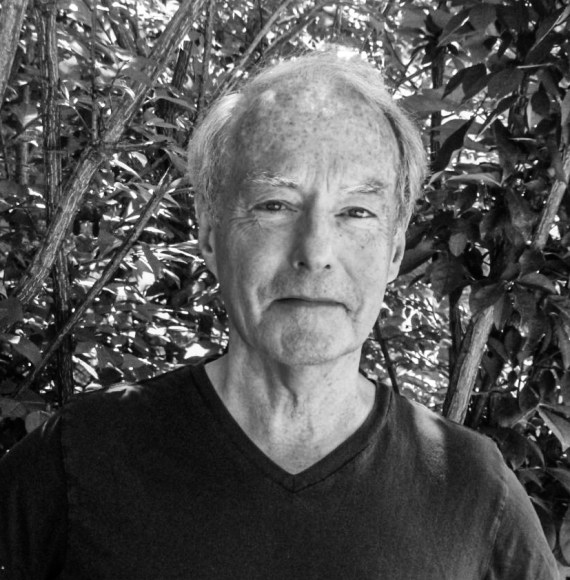
Educated in the classics, philosophy, literature, theology, and sociology, I teach sociology at Massachusetts College of Liberal Arts. My writing on varied topics has appeared widely over many years. I write as a public intellectual for the general public, not as a specialist for a narrow readership. I believe a non-committal sociology is an impossibility and therefore see all my work as an effort to enhance human freedom through understanding.
Edward Curtin





